



CCSD code G5100: Bypass of duodenum billing guide
CCSD code G5100 bills a bypass that leaves the duodenum in place CCSD code G5100...

Last Updated: Oct 16, 2026

CPT code 69436 covers tympanostomy with ventilating tube insertion under general anesthesia, per the official AMA descriptor.
Anesthesia type is the only difference between 69433 and 69436, so the anesthesia record decides the code.
Medicare wants bilateral tubes on one line as 69436-50 with 1 unit, paid at 150% of the unilateral rate.
Missing laterality modifiers and thin medical necessity documentation cause most denials on this code.
Pabau’s claims software pre-fills the claim from the patient record, carries CPT and ICD-10 lookup libraries, and checks required fields before submission.
CPT code 69436 covers tympanostomy with insertion of a ventilating tube, performed under general anesthesia. It’s the code ENT practices bill for pediatric ear tubes. The anesthesia record is what separates it from 69433.
Bilateral cases are where the money moves. Medicare wants both ears on one line, 69436 with modifier -50, paid at 150% of the unilateral rate. Two lines with -LT and -RT is a commercial-payer variant, not the Medicare default.
Payment slips away in small, repeatable ways. A laterality modifier left off, a diagnosis code the plan won’t accept, an authorization nobody requested. What follows walks the claim from the operative note to the remittance.
The American Medical Association descriptor reads: Tympanostomy (requiring insertion of ventilating tube), general anesthesia.
The code sits in the Surgery section, Ear subsection, under incision procedures on the middle ear. Its range is 69000 to 69979, and it pays the operating surgeon for the procedure itself.
Anesthesia is not bundled into it. The anesthesiologist bills separately using anesthesia codes and time units, and the facility bills its own fee.
One 20-minute case in an ambulatory surgical center can produce three claims from three parties.
Both codes describe the same operation. A myringotomy is made in the eardrum, and a ventilating tube goes through it.
Coders see that tube called a PE tube, a pressure equalization tube, or a grommet. The anesthesia record decides which code lands on the claim.
Take a 3-year-old with four documented episodes of acute otitis media in six months. Tubes go in on both sides at the ASC under general anesthesia. That claim is 69436-50, even though the surgical steps match the office version exactly.
Payers want the clinical reason for general anesthesia, not just a record that it was used. Young children can’t hold still while the eardrum is incised, and small movements risk injury. Put that reasoning in the operative note.
Age alone doesn’t satisfy many commercial reviewers. Add the anesthesiologist’s assessment, the ASA physical status classification, and one line on why local anesthesia wasn’t workable.
The academy’s tympanostomy coding guidance is worth reading before you set a note template.
Document the specific clinical reason general anesthesia was medically necessary, not just the patient’s age. For children under 4, a brief note on cooperation and movement risk covers most payer requirements. For older children and adults, add a sentence on why local or topical anesthesia was not feasible.
Medical necessity for this code lives in the ICD-10-CM diagnosis. Payers publish coverage policies, including Medicare local coverage determinations (LCDs), naming the diagnoses that support tube placement.
Check that list before submission, because a code that pays under one plan can fail under the next.
Code laterality as specifically as the chart allows. For disease in both ears, use a bilateral code where one exists, such as H66.93, or report the right and left codes together. That specificity protects the claim if the record is ever pulled for review.
Medicare pays this procedure in two pieces. The surgeon bills the professional fee under the Physician Fee Schedule.
The facility bills its own fee, and the system depends on the site. An ASC bills under the ASC payment system, while a hospital outpatient department bills under OPPS.
Those two facility systems are related, not identical. The ASC system borrows OPPS relative weights, then applies a lower conversion factor of its own.
ASC rates therefore land well under hospital outpatient rates for the same procedure, commonly in the range of 50% to 60%.
The professional side has a wrinkle in 2026. There are now two conversion factors. The CY 2026 final rule sets $33.57 for qualifying alternative payment model participants, and $33.40 for everyone else.
Your locality’s geographic practice cost indices adjust the code’s relative value units first. Multiply the adjusted total by whichever factor applies to your group.
Two payment facts are worth pinning up next to the fee schedule. First, 69436 carries a 10-day global period, so the routine tube check inside that window isn’t separately billable. Second, rates move with locality, so pull your own figures from the CMS fee schedule lookup before quoting a patient.
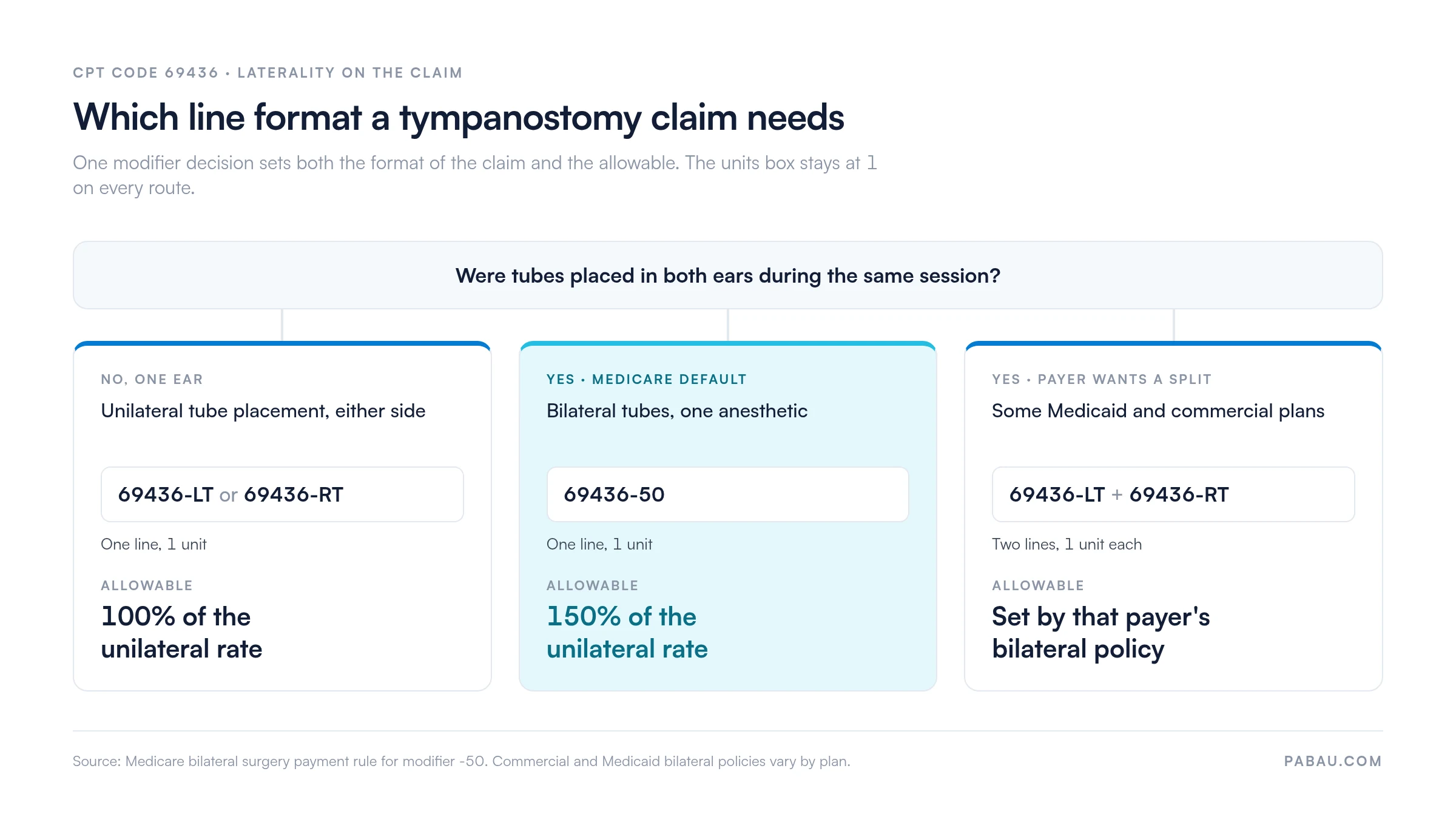
Medicare’s standard is a single line. Report 69436 with modifier -50 and put 1 in the units box, and the allowable comes back at 150% of the unilateral rate. Two units on one line, or the same code twice on one date, reads as a duplicate.
Splitting the case into -LT and -RT lines is a commercial-payer variant. Some Medicaid programs and commercial plans do require it, so check the plan’s bilateral policy before the claim is built. Sending the wrong format to a payer is a preventable denial.
Three routes cover almost every tympanostomy claim your practice will send.
Prior authorization is the norm on the commercial side for tympanostomy. Traditional Medicare generally doesn’t require it under standard coverage rules. Medicare Advantage plans set their own policies, so treat them like commercial plans for this step.
Check the plan’s own authorization lookup tool before surgery is scheduled. Retroactive approval isn’t guaranteed once the case is done, and a missing authorization number is one of the fastest ways to lose the claim.
Three documents have to agree with each other: the operative note, the anesthesia record, and the pre-operative clinical notes.
When one contradicts another, the claim is exposed on review, and the appeal usually costs more than the claim is worth.
Then run a short check before the claim leaves the practice.
Denials on this code repeat. Sort a month of them by reason code and the same five appear. That makes them fixable at the workflow level, rather than one claim at a time.
Our guide to medical billing denial codes maps the CARC codes you’ll see most.
Run a monthly denial analysis for 69436 claims, segmented by CARC reason code. If more than 15% of them share one code, fix the workflow rather than the individual claim. CO-4 usually points at a missing modifier, and CO-50 at medical necessity.
69436 sits in a family of middle ear codes that look alike on paper. Three of them get reported in its place by mistake, and one is commonly performed alongside it.
Tubes and an adenoidectomy done under one anesthetic are both reportable. Check the NCCI edits and the plan’s multiple procedure rules before submission, because the lower-valued code is usually reduced.
Eardrum repair falls under the middle ear repair codes rather than this group. Tympanoplasty without ossicular chain reconstruction takes CPT 69631, which carries a 90-day global period instead of 10 days.
Most ENT billing teams work across two screens. The clinical record holds the operative note and the codes, the clearinghouse portal takes the claim, and someone re-keys the details in between. Every re-key is another chance to drop a modifier or an authorization number.
Practice management software like Pabau builds the claim from the record instead. The CPT code already attached to the service lands on the charge line, and the ICD-10 slots are seeded from the patient’s recorded problem list.
Lookup libraries for CPT and ICD-10 sit beside the fields, so a coder can search a code without leaving the claim.
Pabau’s claims management software then checks that the claim’s required fields are complete before submission unlocks. From there it sends through the Claim.MD clearinghouse to thousands of US payers.
Eligibility runs in real time, remittances post back as electronic remittance advice, and claim status stays visible in one place.
Coding judgment stays with your coder. The software won’t choose -50 over -LT and -RT for you, and it won’t rule on whether a diagnosis satisfies a payer’s coverage policy.
What it takes away is the re-keying, the half-filled field, and the wait for a rejection to tell you.
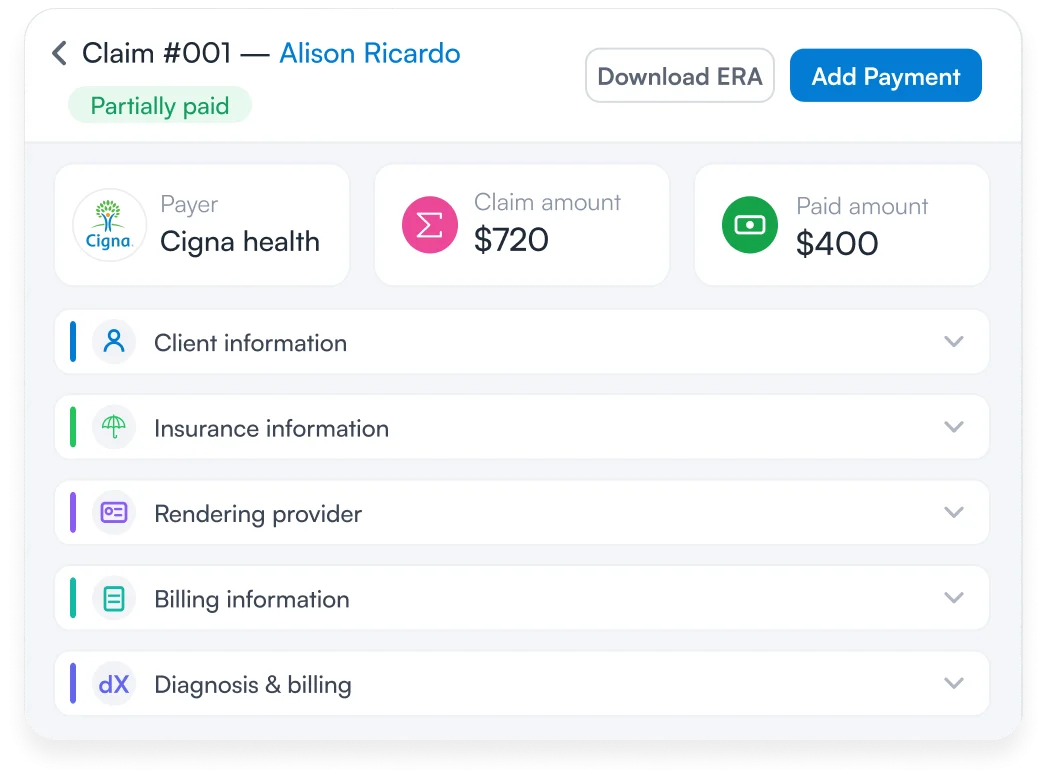

Pabau pre-fills the claim from the patient record, carries CPT and ICD-10 lookup libraries, and checks that required fields are complete before submission. See how it fits an ENT billing team.

Tympanostomy is a small operation with a fussy claim. The surgical work barely changes from patient to patient. The paperwork around it does, and that’s where the money goes missing.
Pick one fix this quarter. Standardize the operative note so anesthesia type and laterality are never left to inference. Two of the top denial reasons then stop reaching your work queue. The rest is repetition: check the diagnosis against the plan’s policy, confirm the authorization, match the line format to the payer.
Do that consistently and 69436 stops being a code your team argues about. Book a demo to see how Pabau builds a tympanostomy claim straight from the patient record.

Not sure what happens after you hit send? How a medical claims clearinghouse works follows the submission, validation, and remittance cycle for surgical codes.
Struggling to match payments to tympanostomy claims? Electronic remittance advice explained covers reading an 835 file against the 837P claim you sent.
Want fewer claims coming back at all? What makes a claim a clean claim sets out the fields payers check before a claim reaches adjudication.
Denials piling up faster than your team can work them? Denial management in healthcare shows how to route each denial to the person who can fix it.
Building a superbill for a surgical visit? Superbill best practices lists the elements that have to appear before a payer will accept it.
Ten days. Medicare assigns 69436 a 010 global period, so the routine post-operative tube check inside that window is already paid for. An unrelated visit in those 10 days takes modifier -24, and an unplanned return to the operating room takes -78.
POS 24 for an ambulatory surgical center, and POS 22 for an on-campus hospital outpatient department. Off-campus outpatient sites use POS 19. The surgeon’s fee drops to the facility rate at all three, so the place of service has to match where the surgery happened.
One. Medicare wants 69436 on a single line with modifier -50 and 1 in the units box. Two units on one line, or the code reported twice on the same date, reads as a duplicate. Plans that require -LT and -RT still take one unit per line.
Yes, where the record shows persistent effusion, hearing loss, or repeated infections that conservative treatment did not resolve. Adult tube placement is uncommon, so most 69436 volume sits with Medicaid and commercial plans, and their coverage rules usually decide the claim.
The surgeon’s professional fee goes on a CMS-1500, sent electronically as an 837P. An ASC bills its facility fee on its own CMS-1500 with POS 24, while a hospital outpatient department bills on a UB-04. Anesthesia bills separately again.



