CPT Code 62284: Injection procedure for myelography
CPT Code 62284: official descriptor and procedure overview The American Medical ...

Last Updated: Oct 19, 2026

CPT code 67840 covers excision of an eyelid lesion (excluding chalazion) without closure or with simple direct closure, and does not involve the lid margin.
Report 67840 once per eye, however many lesions you remove from that eyelid.
67840 sits under Surgery/Eye and Ocular Adnexa, so it is ophthalmology-specific. Choose 11440 instead when you excise a benign lesion by size from a broader facial site.
Modifiers E1-E4, RT/LT, and 50 all apply to 67840. Using the wrong one or omitting laterality is a top denial trigger.
Practice management software like Pabau pre-maps ICD-10 codes to CPT codes and scrubs claims before submission, which cuts 67840 denials.
CPT code 67840 covers excision of a lesion of the eyelid without closure or with simple direct closure. That descriptor comes from the American Medical Association (AMA). Two exclusions define its boundaries. The procedure must not involve the lid margin, and chalazion removals belong to their own code family, 67800-67808.
This code sits under the CPT classification Surgery/Eye and Ocular Adnexa/Eyelid/Excision, Destruction. Unlike the 11440 series, 67840 is anatomically specific to the eyelid as an ocular adnexa structure, not a general facial skin site. Practices billing UK private insurers use a separate schedule, where eyelid lesion excision is CCSD code C1210.
The procedure itself is usually a sharp excision of a benign or suspicious eyelid skin lesion. That is followed by either no formal closure or simple layered closure. If reconstruction beyond simple closure is required, a separate reconstructive code applies. Document the closure type explicitly in the operative note, because missing that detail is a common audit trigger.
Both codes can apply to lesion removal from the eyelid, but they operate under different logic. CPT 67840 is procedure-specific and location-specific, keyed to the eyelid as an ocular structure.
CPT 11440 (and the 11441-11446 series) applies to benign lesion excision on the face, ears, eyelids, nose, lips, or mucous membranes. It is size-based rather than location-specific.
Three factors decide which code you report:
The American Academy of Ophthalmology (AAO) reinforces this distinction. If an ophthalmologist excises an eyelid lesion as part of ocular adnexa surgery, 67840 is the correct code regardless of lesion size.
If a dermatologist removes the same lesion during a skin procedure visit and bills by size, 11440 applies. When both specialties are involved in the same surgical episode, only one physician bills one code for that excision.
Modifier selection for 67840 is more complex than for most minor procedure codes. The eyelid has four distinct anatomical positions, and a procedure can involve one or both eyes. According to AAPC’s CPT code guidance, the following modifiers all apply to 67840 in specific circumstances.
Medicare generally requires the E-code modifiers (E1-E4) for eyelid-specific procedures. Some commercial payers prefer RT/LT instead, so verify the payer’s claims processing rules before you submit.
Payers also split on how they want a bilateral claim formatted. Billing modifier 50 without checking whether the payer wants one line or two separate line items is a frequent bilateral denial trigger. The map below pairs each eyelid position with its modifier and its matching ICD-10 code.
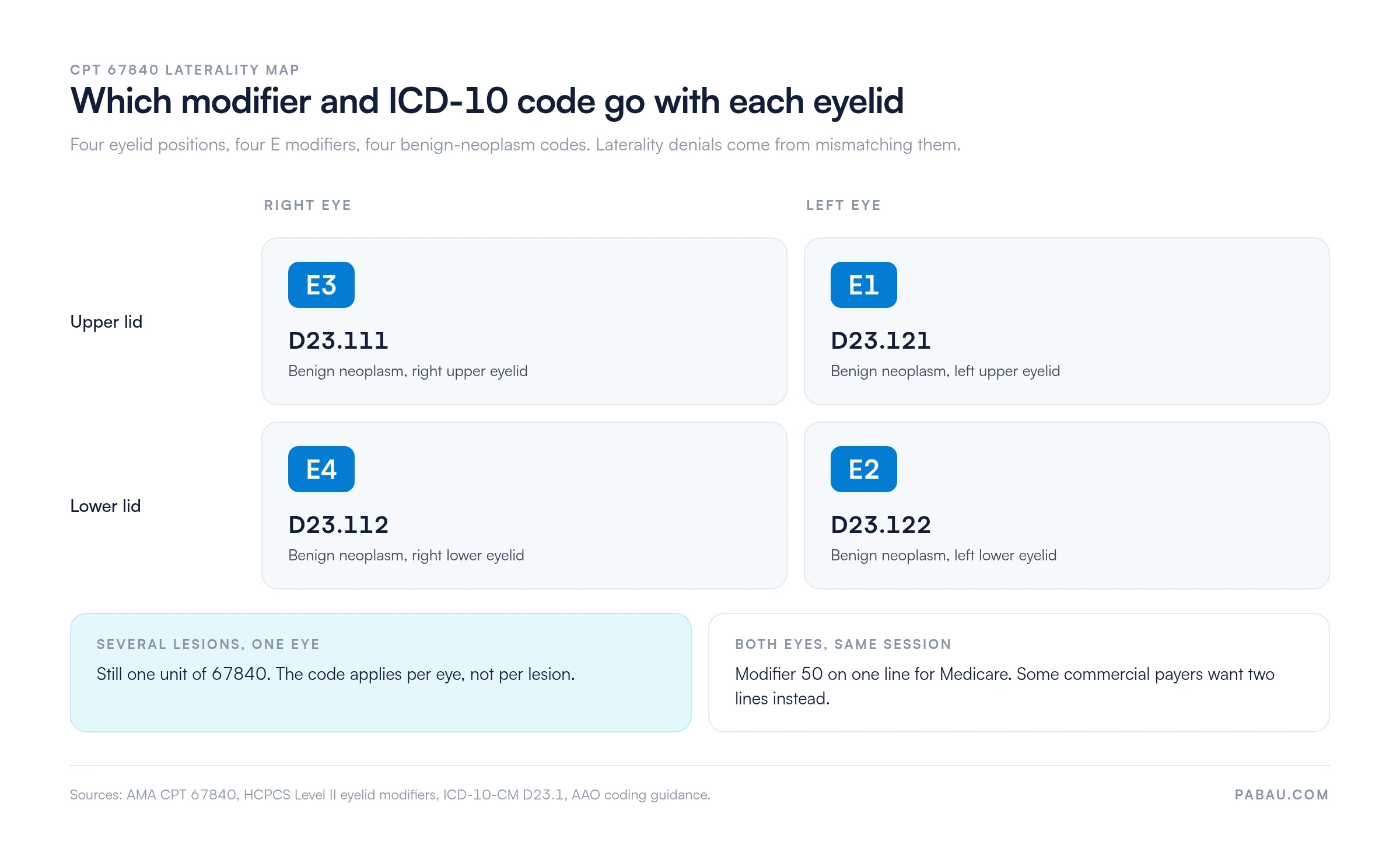
Check your MAC’s Local Coverage Determination before billing bilateral eyelid excisions. Some require two separate claim lines with E1/E2 or E3/E4 rather than a single line with modifier 50. Confirming the payer rule upfront avoids the most common 67840 bilateral denial.
Pairing CPT code 67840 with the correct ICD-10-CM diagnosis code is what establishes medical necessity for payer review. Payers read the ICD-10 code to confirm the excision was clinically warranted rather than cosmetic. The link between diagnosis and procedure has to be explicit on the claim.
According to the CMS Physician Fee Schedule, cosmetic eyelid procedures are excluded from Medicare coverage. That makes the ICD-10 pairing a make-or-break element of every 67840 claim. You can also check pairings against CrossCoder’s CPT-to-ICD-10 crosswalk tool before submission.
The ICD-10 code you select must align with the clinical documentation. List D23.10 on a claim while the operative note describes a lesion at the lid margin, and the claim gets a medical necessity denial. 67840 explicitly excludes lid margin involvement.
An accurate diagnosis pairing anchors the entire claim. Always code to the highest level of specificity available, which means the laterality sub-codes (D23.111, D23.112, D23.121, D23.122) rather than the unspecified D23.10. Our ICD-10-CM code library lists the eyelid subcategories in full.
Medicare reimbursement for CPT code 67840 varies by geographic location and place of service. FastRVU’s 2026 figures put the national non-facility rate at $277.90 and the facility rate at $134.27.
Verify the figure for your locality through the CMS MPFS lookup tool, because geographic adjustment factors move the final payment. Rates change annually with each Medicare Physician Fee Schedule update.
Use the FastRVU 2026 RVU lookup tool to calculate the Work RVU, Practice Expense RVU, and Malpractice RVU values for 67840 in your area. These figures are specific to Medicare, and commercial payer contracts may set rates independently.
A complete operative note carries every 67840 claim. Missing one required element can trigger a medical necessity denial or a post-payment audit. The elements below must appear explicitly in the record for each claim.
Local Coverage Determinations (LCDs) add payer-specific requirements on top of these baseline elements. They are issued by Medicare Administrative Contractors (MACs) such as Novitas, Palmetto GBA, and CGS. Always verify the applicable LCD for your region, since medical necessity criteria for eyelid procedures vary between MACs.
When excised eyelid tissue is sent for pathological examination, CPT 88305 may be reported separately. That code covers surgical pathology with gross and microscopic examination. It arises most commonly when the lesion looks atypical, when malignancy is suspected, or when the clinical history warrants tissue confirmation.
Under standard CMS billing rules, 88305 is separately reportable rather than bundled into 67840’s global surgical package. Payer bundling policies still vary, and some commercial plans bundle 88305 into minor eyelid procedure payments. Before billing 88305 alongside 67840, check the payer’s medical policy or submit a pre-claim inquiry.
The documentation must also support the pathology decision. The operative note should say why the specimen was sent rather than discarded, particularly when the clinical appearance suggested a benign process.
Bilateral eyelid lesion removal in a single surgical session adds modifier complexity. Payer rules differ on how to report two separate excisions, and the wrong format generates an automatic denial. The two common approaches are one line item with modifier 50, or two line items with eyelid-specific modifiers.
Bilateral eyelid lesion billing is among the highest-frequency denial scenarios in ophthalmology. Reviewing the denial management strategies that suit your payer mix before you file prevents most of these rejections.
Report 67840 once per eye, however many lesions you remove. The AAO’s coding guidance is explicit on this point, so a second unit for a second lesion on the same lid is not billable.
Multiple chalazia are the exception, and they are not 67840 territory at all. Excision of multiple chalazia on the same lid is 67801, from the chalazion family the descriptor already excludes.
When billing bilateral 67840 to Medicare, confirm the procedure was documented as bilateral in the operative note before appending modifier 50. Billing bilateral without explicit bilateral documentation is an audit risk even when the claim pays. The operative note should name both eyelids treated.
Most 67840 denials trace back to a small set of recurring errors. Billing staff who know the patterns can structure documentation and claim submission to head them off before adjudication.
The documentation and code-pairing requirements for 67840 create manual checkpoints on every claim. Billing staff verify the modifier, confirm the diagnosis pairing, and check the payer’s bilateral rule by hand, one claim at a time.
Pabau’s ophthalmology claims management software moves those checks into the workflow. It pre-maps ICD-10 diagnosis codes to procedure codes, flags a missing laterality modifier, and validates the claim electronically before it leaves the practice.
For a practice filing eyelid excision claims in volume, automated scrubbing catches the errors listed above before a payer sees them. Electronic remittance advice and denial reason codes return to the same record, so rework and appeals start where the claim was built.

Pabau connects clinical documentation to your billing workflow, pre-populating CPT and ICD-10 codes and running automated claim checks before every submission. See how it works for eye care practices.

67840 is a narrow code, and the narrowness is the whole difficulty. Get the pairings right and the claim usually pays first time. Miss one and it comes back for rework.
The trade-off worth remembering is between specificity and speed. Coding to D23.111 instead of D23.10 takes a few extra seconds at the desk. Those seconds separate a paid claim from a medical necessity review. The same goes for the one sentence confirming the lid margin was clear.
Pabau’s claim scrubbing and ICD-10-to-CPT linking take the manual checks off your billing staff for every 67840 claim. Book a demo to see how it works for ophthalmology and surgical eye care practices.

Need guidance on clean claim submission standards? Clean claim best practices covers the elements every claim needs to pass payer adjudication without a rejection.
Want to understand the full billing compliance picture? Medical billing compliance requirements outlines the regulatory standards that govern surgical procedure billing.
Looking to reduce denial rates across your practice? Denial management strategies walks through how to systematically identify, appeal, and prevent common claim denials.
Exploring clearinghouse options for your ophthalmology practice? Medical claims clearinghouse guide explains how clearinghouses process electronic claims and what to look for when choosing one.
CPT code 67840 reports excision of an eyelid lesion, excluding chalazion, without closure or with simple direct closure. The procedure must not involve the lid margin. It sits in the Surgery/Eye and Ocular Adnexa section of the CPT code set. Ophthalmologists and oculoplastic surgeons bill it most often, for benign or suspicious eyelid skin lesions.
CPT 67840 is ophthalmology-specific, classified under Eye and Ocular Adnexa, and keyed to the eyelid as an ocular structure. CPT 11440 is an integumentary system code for benign lesion excision from broader facial sites, and it is size-based. Use 67840 when an ophthalmologist performs the excision as part of ocular adnexa surgery. Use 11440 when a dermatologist or surgeon bills by lesion diameter for a facial skin site.
CPT 67840 takes the four eyelid modifiers E1 through E4, plus RT, LT, and modifier 50 for a bilateral procedure. E1 is the upper left eyelid, E2 the lower left, E3 the upper right, and E4 the lower right. Medicare generally requires the E codes for laterality, while some commercial payers prefer RT/LT. For a bilateral procedure, check whether your payer wants modifier 50 on one line or two separate lines.
FastRVU’s 2026 figures for CPT 67840 are $277.90 in the non-facility setting and $134.27 in the facility setting. Geographic Practice Cost Index (GPCI) locality adjustments move the final payment, so high-cost areas pay more. Verify your own rate through the CMS Physician Fee Schedule lookup tool before you set fee schedules or quote patients.
Yes, CPT 67840 can be billed bilaterally when lesions are removed from both eyes in the same session. Medicare accepts modifier 50 on a single claim line and pays 150% of the standard rate. Some commercial payers require two separate line items using individual eyelid modifiers (E1-E4). Each excision must be documented separately in the operative note, including distinct location, lesion description, and closure details for each side.
Once. CPT 67840 applies per eye, however many lesions come out of that eyelid in the session. The AAO’s coding guidance states this directly, so a second unit for a second lesion is not billable. Multiple chalazia on the same lid are different, and they take 67801 from the chalazion family instead.
No. Chalazion excision is explicitly excluded from CPT 67840. Chalazion procedures are billed under the 67800-67808 code family, depending on the number of lesions and whether the procedure is performed under general anesthesia. Billing a chalazion removal under 67840 is an auditable coding error and will result in denial upon review.
No, CPT 67840 does not include pathology charges. When excised eyelid tissue is sent for pathological examination, CPT 88305 (surgical pathology, gross and microscopic examination) may be billed separately. Payer bundling policies vary, though. Some commercial plans bundle 88305 into the global fee for minor eyelid procedures. Verify your payer’s policy before reporting 88305 alongside 67840.