CCSD code H4180: Full or partial thickness rectal biopsy
CCSD code H4180: definition and procedure scope CCSD code H4180 is listed in the...

Last Updated: Oct 22, 2026

CPT code 65820 covers goniotomy, an ab interno incision of the trabecular meshwork that lowers intraocular pressure.
Medicare pays roughly $723.46 for 65820 in 2026, built on 8.69 work RVUs and 21.66 total RVUs.
The 090-day global period bundles routine post-op care, so a standard IOP check inside that window is not billable.
CMS Billing and Coding Article A56866 expects at least 3 clock hours of trabecular meshwork treated before 65820 applies.
Practice management software like Pabau connects operative documentation to claims submission, so the codes already on file reach the claim form.
CPT code 65820 is the billing code for goniotomy. The surgeon incises the trabecular meshwork from inside the eye to improve aqueous outflow and lower intraocular pressure. Medicare pays roughly $723.46 for it in 2026, on 21.66 total RVUs, and the code carries a 90-day global period.
Those two numbers shape almost every billing decision that follows. Goniotomy also sits inside the MIGS bundling rules, so laterality, diagnosis stage, and the operative note all have to agree.
Below you get the current RVUs, the 2026 fee schedule, the ICD-10 pairings, the modifiers that apply, and a pre-submission check.
CPT 65820 covers a goniotomy, and the short descriptor is simply Goniotomy. The code sits in the Incision Procedures on the Anterior Chamber of the Eye section of the CPT code set.
The surgeon works ab interno, from inside the eye, using a gonioscopy lens and a goniotome or a similar blade.
The descriptor hides a threshold that matters at claim time. CMS Billing and Coding Article A56866 defines goniotomy as incising or excising at least 3 clock hours of trabecular meshwork.
The point is to open the meshwork into Schlemm’s canal. Treat less than that and the note will not support 65820.
Gonioscopy-Assisted Transluminal Trabeculotomy (GATT) and other ab interno trabeculotomy techniques are reported under 65820. Watch the wording here. GATT is a trabeculotomy, not a trabeculoplasty, and laser trabeculoplasty is a separate procedure with its own code, 65855.
According to the American Medical Association (AMA), CPT is the standard code set mandated under HIPAA for reporting physician procedures.
CPT 65820 carries a work RVU of 8.69 and a total RVU of 21.66. The total is the same whether the service is billed in a facility or a non-facility setting.
You can confirm both figures in the FastRVU RVU lookup tool or the CMS Physician Fee Schedule lookup.
Plenty of reference pages still show a work RVU of 7.31 for this code. That figure is stale, and any fee estimate built on it lands well below what Medicare now allows.
CMS republishes RVUs each year in the Physician Fee Schedule Final Rule, normally effective January 1. Pull the current file before you use these values in a payer negotiation.
The 2026 national average Medicare payment for CPT 65820 is about $723.46. That number holds in both facility and non-facility settings, because the total RVU does not change between them.
Treat $723.46 as an average rather than a promise. Run your ZIP code through the CMS Physician Fee Schedule lookup for the allowable your MAC will pay. It applies the geographic practice cost index to each RVU component, then multiplies by the current conversion factor.
Medicare covers goniotomy when the record shows open-angle glaucoma with intraocular pressure that medical therapy has not controlled.
Each Medicare Administrative Contractor (MAC) publishes its own coverage rules, so the operative and pre-operative notes have to carry the clinical story together.
Prior authorization is worth settling early too. Traditional Medicare does not require it for 65820, but plenty of Medicare Advantage and commercial plans do.
Every 65820 claim needs at least one ICD-10-CM diagnosis code, and the H40 series does most of the work. The trouble is in the last two characters.
In the H40.11 subcategory the 6th character carries laterality and the 7th carries glaucoma stage, and coders regularly collapse the two into one.
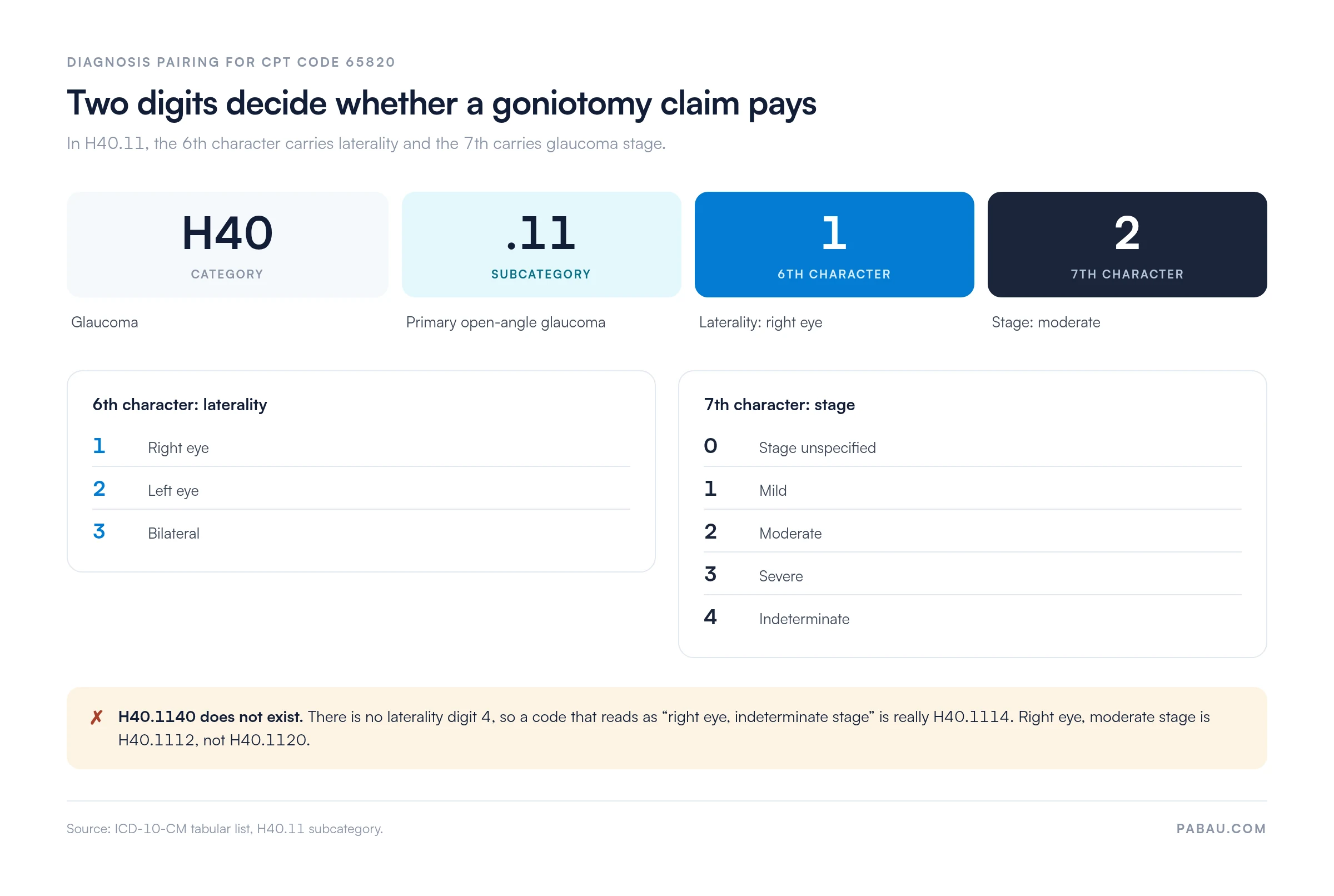
Laterality has to match the operative eye on both lines of the claim. H40.1120 with a right-eye goniotomy is a denial before a human ever reads the note.
Stage matters as well, so code the stage the chart supports and reach for a stage-unspecified code only when the record genuinely does not say.
Three modifiers carry almost every goniotomy claim: -RT, -LT, and -50. Add -22 or -53 when the operative course justifies it, and stop there.
Skip the eyelid modifiers. -E1 through -E4 identify eyelid positions, so they belong on chalazion excision, epilation, and punctal plug claims.
Goniotomy happens inside the anterior chamber, which makes an eyelid modifier on 65820 a coding error rather than a precaution.
Medicare and most commercial payers reject an ophthalmology surgical line with no laterality modifier. Add it at the claim line, not only in the chart note. The AAPC CPT code reference and your MAC’s billing bulletin are the two places to confirm current modifier policy.
CPT 65820 carries a 090-day global period. One payment covers the pre-operative visit the day before surgery, the surgery itself, and 90 days of routine post-operative care.
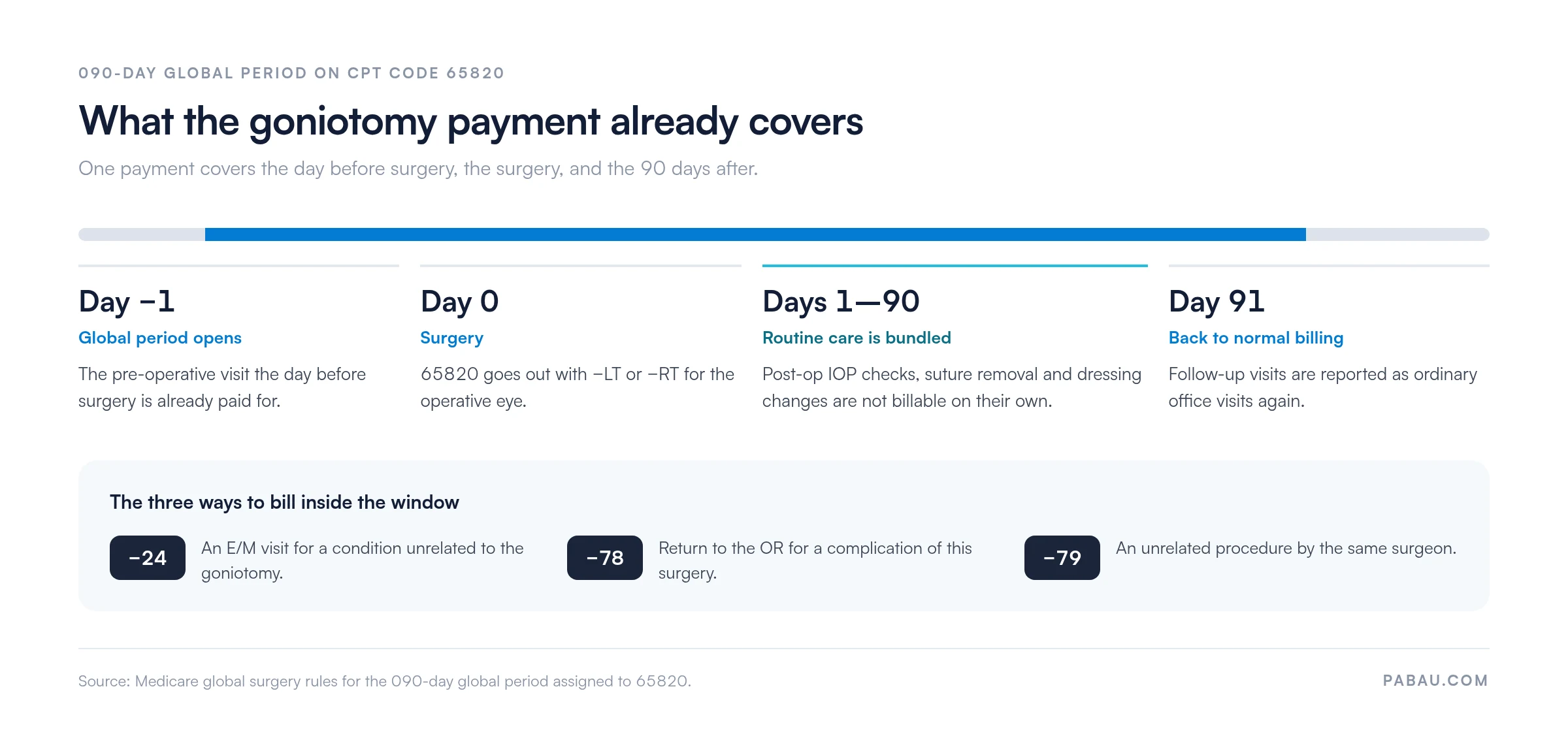
Post-op IOP monitoring causes more global-period errors than any other visit type. If the check exists to see whether the goniotomy worked, it is bundled. If the same patient turns up with new retinal pathology, the visit stands on its own with modifier -24 and a note that explains why.
Flag post-op visits at intake. Ask the front desk to note on the encounter whether the visit relates to a recent surgical episode. That one step stops a bundled visit going out as a standalone E&M claim inside the 90-day window.
Goniotomy shares an operating session with cataract surgery or a stent more often than it stands alone, and that is where the bundling rules bite.
CMS Billing and Coding Article A56866 is the document to read. The National Correct Coding Initiative (NCCI) edits are the mechanics that enforce it.
One deleted-code trap is worth naming. Codes 0191T and 0376T disappeared on January 1, 2022, so an internal cheat sheet that still pairs 65820 with either one is out of date.
NCCI edits also change quarterly, so pull the current NCCI edit tables before each billing cycle. When -59 or XS bypasses an edit, the operative note has to prove the two procedures were genuinely distinct.
Here is the path a goniotomy charge takes, and the point at which each step tends to fail.
Steps two and four are where the money leaks. A note that says only “anterior segment surgery” gives the coder nothing to work from. A laterality mismatch fails an automated edit before any human sees the claim. Both problems start in the note, which is why the check below beats the appeal.
The surgical approach decides which code applies, and these neighbors are not interchangeable. Read the operative note before you read the code list.
Five items catch most goniotomy denials, and all five live in the operative note. Work through them once and the claim usually pays first time.
Keeping a written clean claim submission checklist for ophthalmology surgical codes turns that into a habit rather than a memory test.
Each of those comes back with its own remark code, and the remark code tells you whether to correct and resubmit or open an appeal. Our reference on denial codes maps the ones ophthalmology teams see most.
Most practices run this workflow across two screens. The surgeon’s note lives in one system and the claim form in another, so someone retypes the code, the eye, and the diagnosis in between. Every retype is a chance to send a right-eye modifier with a left-eye diagnosis.
Practice management software like Pabau connects operative documentation to claims submission. The CPT code attached to the service lands on the charge line by itself.
The ICD-10 slots are seeded from the client’s recorded problem list. Built-in ICD-10-CM and CPT lookup libraries sit behind a search icon, so a coder can confirm H40.1112 without leaving the claim.
Pabau’s claims software for billers also checks that the claim’s required fields are complete before the send button unlocks. It then submits through the clearinghouse your region uses.
On US claims that adds real-time eligibility checks, claim status tracking, and remittance advice posted back against the original charge.

Pabau connects operative documentation to claims submission, so the CPT and ICD-10 codes already on the record reach the claim form. Ophthalmology billing teams submit through their clearinghouse and track the remittance in one place.

Goniotomy billing rewards precision in two places: the digits and the note. Get the laterality modifier and the H40 stage right, and 65820 is a clean claim worth roughly $723 in 2026. Miss either one and you are appealing a denial that an automated edit caught in seconds.
The bundling rules are the part worth re-reading each quarter. Article A56866 and the NCCI table decide whether a same-session stent or canaloplasty leaves 65820 payable. Those answers change while your internal cheat sheet quietly does not.
Retyping codes between the operative note and the claim form costs your billing team time. Book a demo to see how Pabau carries goniotomy documentation straight through to submission.

Want the wider picture on how surgical claims get paid? Revenue cycle management follows the money from documentation through to posted payment.
Losing too many ophthalmology claims to denials? Denial management in healthcare sets out how to track, categorize, and work denials by code.
Checking coverage before a surgical case? Insurance eligibility verification explains how real-time checks stop post-surgical rejections.
Trying to read what the payer sent back? Electronic remittance advice breaks down the ERA line by line, including the adjustment codes.
New to the surgical billing cycle? What is medical billing covers the fundamentals that every code-level decision rests on.
Traditional Medicare does not require prior authorization for 65820. Many Medicare Advantage and commercial plans do, and most of them want the failed medication trial documented first. Check the plan’s surgical policy before the case is scheduled, because a retroactive request is a slow way to get paid.
Look up the NCCI edit for that code pair before you appeal. A modifier indicator of 1 means a distinct-service modifier such as -59 or XS can unbundle the pair when the note supports two separate procedures. An indicator of 0 means the pair can never be unbundled, so correct the claim instead.
The surgeon who performs the goniotomy reports 65820. Co-surgery and assistant-at-surgery arrangements need modifier -62 or -80, and each one has to be permitted for this code on the Medicare Physician Fee Schedule. Check that indicator for 65820 before either modifier goes on the claim.
The code and its 090-day global period stay the same. What changes is the diagnosis and the payer, since pediatric cases pair with Q15.0 and usually bill to Medicaid or a commercial plan. Confirm that plan’s coverage rules, because they will not match your MAC’s.