CPT Code 88271: DNA probe cytogenetic FISH billing guide
CPT Code 88271: Official descriptor and what the code covers CPT Code 88271 is t...

Last Updated: Oct 21, 2026
CPT code 64650 is the procedure code for chemodenervation of the eccrine (sweat) glands of both axillae. In practice, that means botulinum toxin injected into the underarms to treat primary axillary hyperhidrosis. The code is bilateral by definition, so you bill it once per session for both underarms, never twice.
Getting that right matters, because 64650 claims tend to fail on setup rather than on clinical grounds. A missing prior authorization, a diagnosis without the site, or a missing J0585 drug line can each stall payment. Each one is fixable before the claim goes out, starting with the diagnosis pairing.
Let Pabau's smart automation suggest the right codes, reduce claim denials, and keep your practice compliant—effortlessly.
Automate repetitive tasks and focus on what matters most—your patients.
Reduce coding errors and ensure compliance with the latest regulations.
Clean claims, fewer denials, and faster reimbursements.
Powerful insights and reporting to help your practice thrive.
HIPAA compliant SOC 2 certified GDPR-compliant Trusted by 4,000+ clinics worldwide

CPT code 64650 covers botulinum toxin injections into the sweat glands of both underarms, and it’s reported once per session.
Never bill 64650 twice or add modifier 50, because the code is already bilateral.
Pair it with a site-specific diagnosis such as L74.510, since the parent code L74.51 isn’t billable.
Bill the toxin separately with HCPCS J0585, counting the units given rather than the vial size.
Get prior authorization approved before treatment, because payers rarely grant it retroactively.
CPT code 64650 is the procedure code for chemodenervation of eccrine glands of both axillae, as defined in the American Medical Association CPT code set. Put simply, it’s the code for injecting botulinum toxin into the underarm sweat glands to stop excess sweating.
The most important billing fact sits in the descriptor itself. Because “both axillae” is part of the code, one unit covers both underarms. That sets 64650 apart from codes like 64612 and 64616, which are reported per side.
The code pays for the injection work and the care around it on the day. You bill the drug, and any separate visit, on their own claim lines.
Included in 64650:
Billed separately, or with a different code:
National Correct Coding Initiative (NCCI) edits change every quarter. So check the current bundling pairs before you submit, especially when an E/M visit shares the claim.
The physician injects botulinum toxin type A into the skin of each underarm, which blocks the nerve signal that triggers sweating.
Most practices do it in the office (place of service 11), though some use an ambulatory surgery center. Knowing each step also tells the biller what the note should record.
The FDA has approved OnabotulinumtoxinA for severe primary axillary hyperhidrosis, which is exactly what 64650 describes. Palm and sole injections are off-label, so they fall outside 64650 and 64653. Where a payer covers them at all, they go to unlisted code 64999.
A 64650 claim needs primary focal hyperhidrosis of the axilla as the first-listed diagnosis. Payers won’t accept it as a secondary finding.
The code you choose also has to name the site, as the table shows.
Check CMS article A57185, “Billing and Coding: Botulinum Toxin Injections,” for the current list of accepted diagnosis codes. L74.51 itself is a non-billable parent code, so always report a child code such as L74.510. And if you code secondary hyperhidrosis (L74.52), document and code the condition behind it too.
Check your MAC’s coverage policy for botulinum toxins before assuming L74.510 alone proves medical necessity. Some MACs want proof that first-line treatments such as prescription-strength antiperspirants failed. Build that question into intake, so the history is on file before the treatment visit.
Bill HCPCS J0585 (OnabotulinumtoxinA, per unit) on the same claim as 64650 whenever your practice supplies the drug. The procedure code only pays for the injection work. So if the J0585 line is missing, you absorb the cost of the toxin.
Say the physician injects 50 units into each underarm from a 200-unit vial. The claim carries 64650 x 1 and J0585 x 100, because you bill the units given rather than the vial size. That leaves 100 units of waste.
Some payers let you bill unavoidable waste from a single-dose vial, so confirm their policy before adding those units. Either way, record the unit count in the treatment note at the point of care. Then the biller never has to guess.
The eccrine gland family has two codes, and both are standalone primary codes. CPT 64650 covers both axillae, while CPT 64653 covers other areas such as the scalp, face or neck, reported per day.
Neither one is an add-on to the other, and the grid below shows where each site lands.
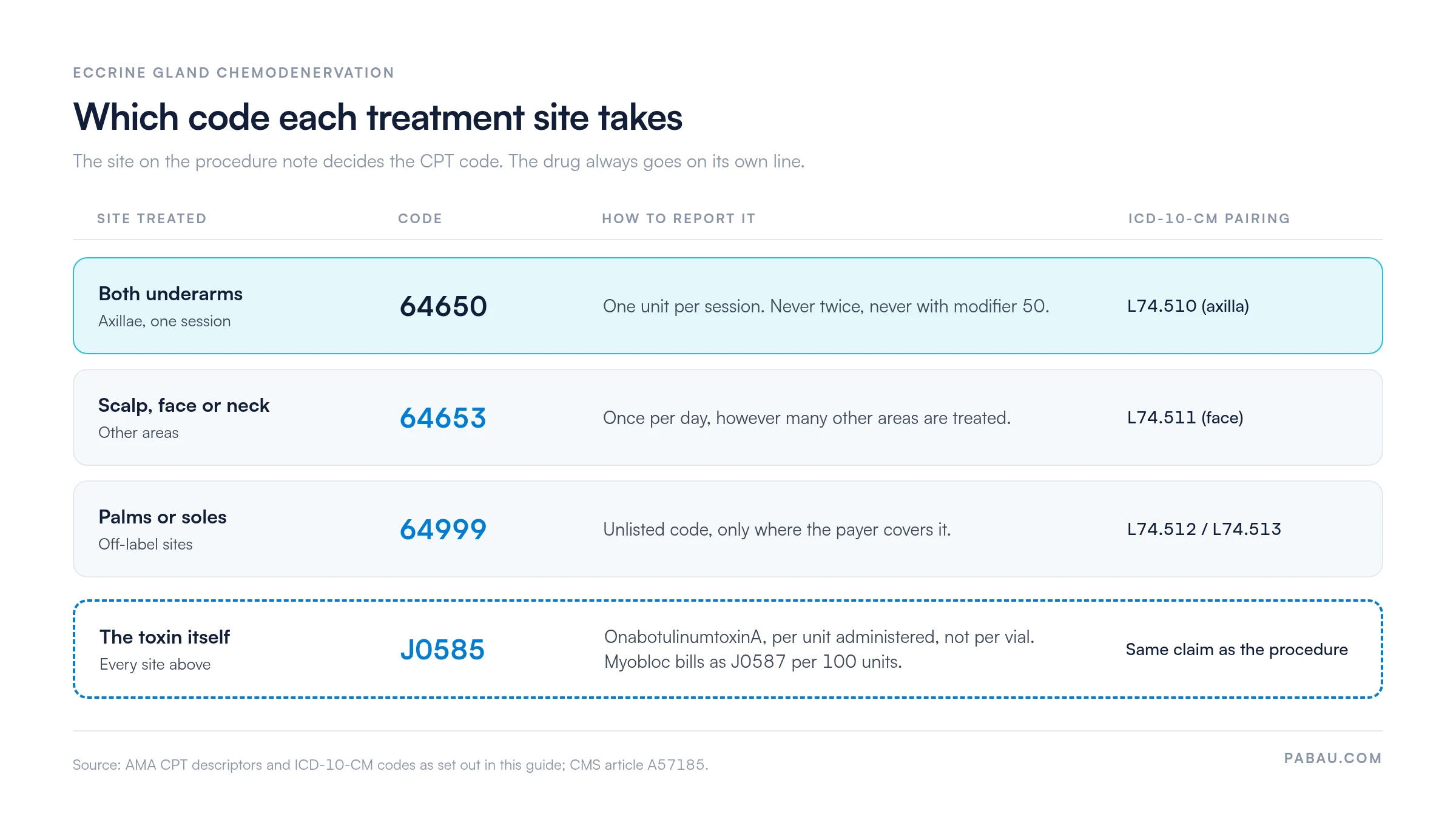
Quick check: a patient has both underarms and the forehead treated on the same day. What goes on the claim? You report 64650 once for the axillae and 64653 once for the face, each with its own site-specific diagnosis. Then confirm NCCI edits and payer policy before you submit.
Eccrine gland codes are never counted per limb. That count belongs to muscle chemodenervation, where CPT code 64642 covers one extremity with one to four muscles injected.
The wider chemodenervation family targets muscles rather than sweat glands. Picking one of these for a sweat treatment misstates the procedure, so match the code to the anatomy in the note.
Yes, Medicare covers 64650 for primary focal hyperhidrosis, provided the claim meets your MAC’s coverage policy for botulinum toxins. CMS article A57185 sets out the billing rules for this code family, including which diagnosis codes and clinical criteria qualify.
Covered under Medicare (subject to coverage criteria):
Not covered by Medicare:
Medicare Advantage plans follow the same coverage framework, but many add their own prior authorization step. So verify each plan before the first treatment.
Most commercial payers and many Medicare Advantage plans want prior authorization (PA) for 64650 before any toxin goes in. If you treat first, the denial usually can’t be won on medical necessity alone.
A typical PA request includes:
Track each open request against the patient’s booking, so nobody schedules treatment before approval lands. Many approvals also cover a set date range or number of sessions. Recheck the approval before each repeat treatment.
An audit-ready 64650 note proves the medical need, the procedure and the drug. A note that only says “Botox injected to axillae” often triggers post-payment review. Before the provider signs, make sure the note covers these points.
Medicare pays 64650 at two rates, depending on place of service. The non-facility rate (office, POS 11) runs higher because your practice covers the overhead. In a hospital outpatient department or an ambulatory surgery center, the lower facility rate applies.
These figures are approximate national averages, and your local rate shifts with the geographic adjustment. Pull the exact number for your MAC from the CMS Physician Fee Schedule lookup tool or FastRVU’s 2026 RVU lookup.
Commercial payers pay whatever your contract sets, often 110-150% of Medicare for in-network providers. Under Part B, Medicare pays J0585 at the Average Sales Price (ASP) plus 6%. Check each electronic remittance advice (ERA) to confirm the payer applied the right fee schedule and drug rate.
Audit your paid 64650 and J0585 claims side by side every quarter. If J0585 payments keep landing below ASP+6%, the claims may be going out with the wrong unit count. Cross-check the units billed against the procedure note before each submission cycle.
Most 64650 problems start well before the payer sees the claim. Here’s the path a clean claim takes, and where each step can go wrong.
Denials on 64650 follow the same few patterns across payers. So start by sorting your own denials by their claim adjustment reason codes. Our guide to medical billing denial codes explains what each one means.
Route each 64650 denial to a coder who knows chemodenervation claims. An appeal that pastes in the coverage policy without answering the stated reason rarely succeeds. That’s why catching the problem before submission beats appealing it afterward.
Many practices keep the treatment note in one system and build the claim in another. Units, sites and PA numbers get retyped along the way, and each retype is a chance for a denial.
Practice management software like Pabau keeps the note and the claim in one place. Its claims software for practices pre-fills the claim from the patient record, so 64650 and the diagnosis land on the charge line. Pabau also checks that required fields, such as the authorization number, are complete before the claim can be sent.
For US practices, Pabau’s Claim.MD integration handles electronic claim submission and real-time eligibility checks before the visit. It also tracks claim status and posts ERAs, so your team can see which 64650 claims have paid without chasing the payer.

Pabau pre-fills claims from the treatment record and checks required fields such as authorization numbers before sending, so fewer 64650 claims come back denied.

Most lost 64650 revenue slips away before the claim leaves the building. So the fix belongs at intake and in the treatment room, where the PA, the treatment history and the unit count get captured.
Start with your last few months of 64650 claims. If duplicate lines, missing PA numbers or vial-size units keep showing up, fix that step first. Once the note is complete, the rest of the workflow tends to hold.
The trade-off is a few extra minutes of documentation per patient, repaid in claims that clear on the first pass. Book a demo to see how Pabau carries a hyperhidrosis treatment from signed note to submitted claim.

Want to track denial trends by code? Denial management in healthcare covers how to build a steady appeals and prevention workflow.
Aiming for first-pass payment? What makes a clean claim walks through the fields payers check before they pay.
Capturing charges at the point of care? How to build a superbill shows what a complete charge record carries.
Researching ERA reconciliation? Electronic remittance advice guide explains how to read 835 files and match payments to claims.
Comparing clearinghouse options? Medical claims clearinghouse overview explains how clearinghouses check and route claims to payers.
Usually, yes, when it’s medically necessary. Most payers cover it for severe primary axillary hyperhidrosis after prescription antiperspirants have failed, billed as 64650 plus J0585. Cosmetic treatment isn’t covered, and most plans want prior authorization first.
Yes, on Medicare Part B claims. Botox comes in single-dose vials, so add JZ when no drug was discarded. When some was thrown away, bill the discarded units on a separate J0585 line with JW. Other payers set their own rules.
The FDA-labeled dose is 50 units per axilla, so a standard session uses 100 units. You’d bill J0585 x 100 alongside one unit of 64650. If the dose differs, bill the units recorded in the note.
Most commercial payers and many Medicare Advantage plans require prior authorization for CPT 64650. Requirements vary by payer and plan, so verify them before scheduling treatment. Treating without prior authorization approval is the most common reason retroactive appeals fail.
Only if the visit is significant and separately identifiable, such as a new problem assessed that day. Add modifier 25 to the E/M code and document it apart from the procedure. A routine pre-injection check is already part of 64650.