

CPT Code 30801: Superficial turbinate ablation billing guide
CPT Code 30801: Official descriptor and procedure overview The American Medical ...

Last Updated: Nov 27, 2026
64448 is the CPT code for a continuous femoral nerve block. It covers injection of anesthetic and/or steroid by continuous infusion through a catheter, including catheter placement and any imaging guidance. Anesthesiologists usually report it for pain control after total knee arthroplasty, hip surgery or femur fracture repair.
The catheter is the deciding fact. A note that shows one placed and an infusion running supports 64448 on its own line, with no 64447 or 76942 beside it. A note that doesn't is downcoded or denied, and missing catheter wording is among the common errors. What follows takes the claim from note to payment: the coding rule, documentation, modifiers, 2026 Medicare rates and denials.
Let Pabau's smart automation suggest the right codes, reduce claim denials, and keep your practice compliant—effortlessly.
Automate repetitive tasks and focus on what matters most—your patients.
Reduce coding errors and ensure compliance with the latest regulations.
Clean claims, fewer denials, and faster reimbursements.
Powerful insights and reporting to help your practice thrive.
HIPAA compliant SOC 2 certified GDPR-compliant Trusted by 4,000+ clinics worldwide

CPT code 64448 reports a continuous femoral nerve block, with catheter placement, the initial bolus and any imaging guidance included.
The note has to show a catheter left in place and an infusion set up, or the claim reads as a single-injection 64447.
Every 64448 line takes LT or RT, and it is never paired with 64447, 76942 or 77002 for the same nerve and side.
Medicare’s 2026 national payment is about $67.80, from 2.03 total RVUs in both facility and non-facility settings.
Common avoidable denials come from a missing catheter statement, a missing side modifier or a diagnosis that isn’t linked to the block.
CPT code 64448 reports a continuous femoral nerve block, where a catheter stays at the femoral nerve to infuse anesthetic after surgery. AAPC’s 64448 code summary describes the same service: the provider places a catheter and gives anesthetic and/or steroid by continuous infusion around the femoral nerve.
The American Medical Association descriptor reads: Injection(s), anesthetic agent(s) and/or steroid; femoral nerve, continuous infusion by catheter (including catheter placement), including imaging guidance, when performed.
Two parts of that wording drive billing. Catheter placement is inside the code, so it never goes on a line of its own. Imaging guidance is inside it too.
Code 64447 when the femoral nerve gets a single injection and no catheter stays behind. Code 64448 when a catheter is threaded and an infusion is set up. The bolus given before the infusion starts is part of 64448, so 64447 is not added for it.
In practice, two questions settle the code, and the procedure note answers both of them.
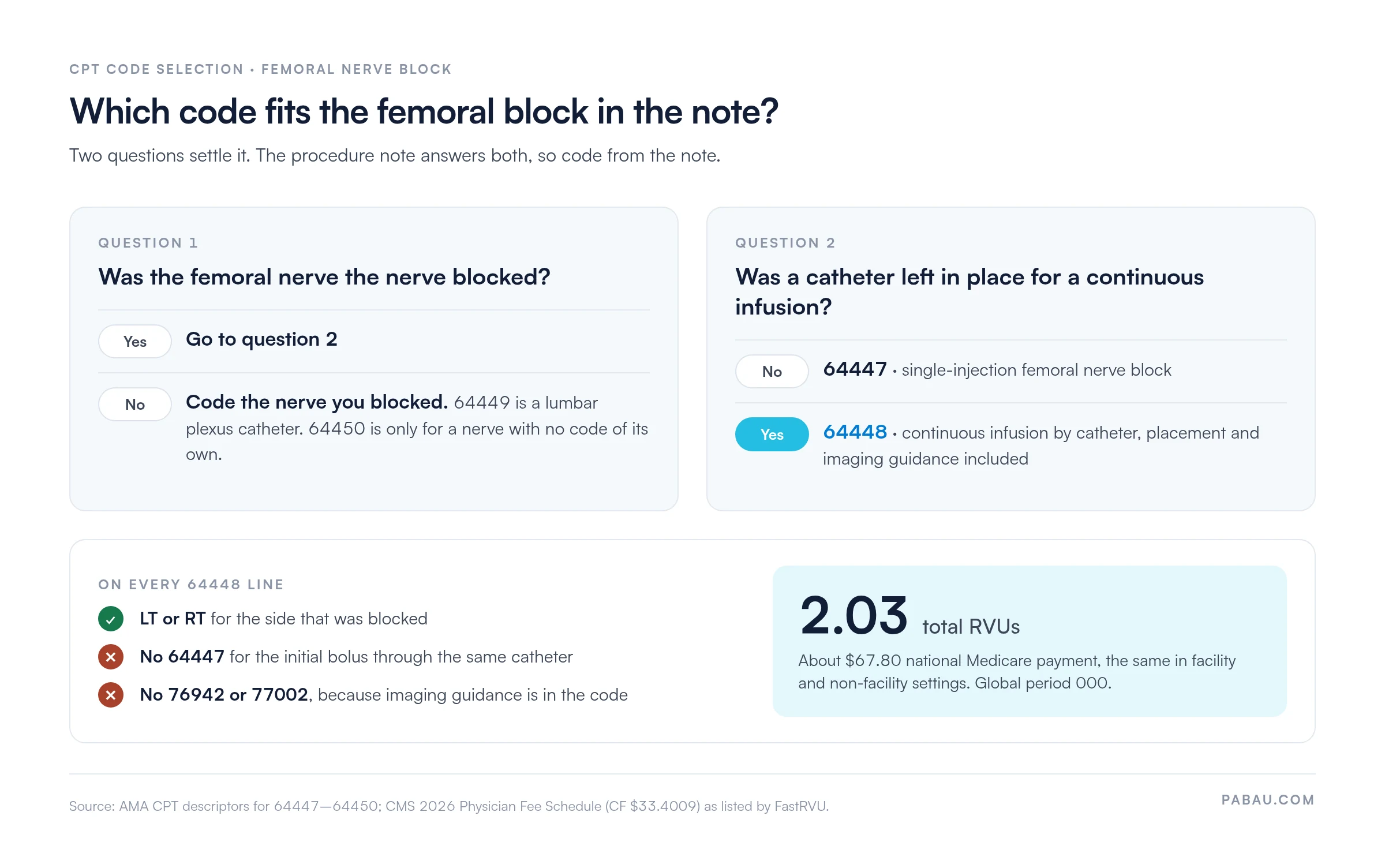
The 64400-64530 range covers anesthetic injections at named nerve sites. Femoral, lumbar plexus and “other peripheral” codes sit side by side, so a quick look at the neighbors prevents a wrong pick.
Code 64450 is the catch-all for a peripheral nerve or branch with no code of its own. The femoral nerve has two, so a femoral block billed as 64450 is simply the wrong code. Expect the payer to reject the line or recode it on review.
The procedure note must show that a continuous catheter was placed, not just that anesthetic went in near the femoral nerve. An auditor reads for each element below, and a missing one can mean a downcode to 64447 or a denial.
For the diagnosis side, many payers expect G89.18 for acute postprocedural pain alongside the surgical diagnosis. Check the payer’s policy before you rely on it alone.
Run the documentation check at the time of service, not after a denial. Ask anesthesia staff to confirm the catheter statement is in the note before it is signed. A signed note without that one phrase can cost the full 64448 payment and send the claim into an appeal.
Every 64448 claim raises two modifier questions: which side was blocked, and whether a same-day bundling edit applies. The AAPC’s CPT code reference and the CMS NCCI edits set what can go on the same date as 64448.
There is a femoral nerve on each side, so payers expect a laterality modifier on every 64448 line. Bill LT for the left nerve and RT for the right. A line without either one usually comes back as CO-4, meaning a required modifier is missing.
Sometimes 64448 and a same-day anesthesia code form an NCCI edit pair. Then modifier 59, or the more specific XU, shows the block is a separate service. Chapter II of the NCCI Policy Manual covers anesthesia, including blocks for postoperative pain.
Check the current quarterly edits before you append either modifier, because the edit pairs change. Getting it right first time is far cheaper than an appeal, and it is the core of a clean claim.
Ultrasound guidance (76942) and fluoroscopic guidance (77002) are not separately reportable with 64448. The descriptor includes imaging guidance when performed, so a separate imaging line would pay for it twice. Keep documenting the guidance method anyway, because it shows how the catheter position was confirmed.
Bilateral femoral catheters are uncommon, but they do happen. When both nerves are blocked, bill 64448-LT and 64448-RT as two lines on the same claim. Some payers reduce the second line by 50%, so check the payer’s bilateral rule before you submit.
Here’s an illustrative case. A patient is booked for a right total knee arthroplasty under general anesthesia. Before induction, the anesthesiologist places an ultrasound-guided catheter at the right femoral nerve. A ropivacaine bolus goes in, and an infusion pump is connected for postoperative pain.
Medicare pays for 64448 under the Physician Fee Schedule when medical necessity is documented and a qualified clinician performs it. The figures below are national values before geographic adjustment. Use the CMS Physician Fee Schedule lookup tool to see the rate for your locality.
RVUs and the conversion factor change every year, so confirm the figures in the current MPFS database or the FastRVU 2026 lookup tool. The global period is 000, so catheter checks on later days are not part of 64448.
Most avoidable problems on 64448 trace back to five causes, and each one can be caught before the claim goes out. The denial codes on the remittance tell you which one you hit. A steady denial management routine then turns each one into a fix upstream.
Medicare generally covers 64448 without prior authorization when medical necessity is documented and the clinician is enrolled. Commercial payers diverge, and the differences catch practices off guard.
When a commercial payer does want prior authorization for a continuous peripheral nerve block, send three items with the request:
Check MAC LCDs for femoral nerve blocks once a year, because they update separately from the fee schedule. A team that last read its MAC’s LCD in 2023 may be using old covered-diagnosis criteria. Set a reminder to recheck in Q1.
On many teams, a coder reads the procedure note and retypes its details into a claim form. That handoff is where a missing side modifier or an unlinked diagnosis slips through.
Pabau, a practice management platform with built-in claims management software, pre-fills the claim from the patient record instead. Coders pick CPT and ICD-10 codes from lookup libraries inside the claim. Required fields are checked before the claim can be sent.
US claims go out through Claim.MD as 837P files, to thousands of US payers. Eligibility checks run before the procedure date, and ERA remittances post back into Pabau, so a denial reason shows up as soon as it arrives. Prior authorization codes, dates and sessions sit on the patient’s case, with a warning when one is missing.

Pabau pre-fills claims from the patient record, checks required fields before sending, and submits through Claim.MD with eligibility checks and ERA remittances. Your team spends less time reworking returned claims.

CPT code 64448 leaves little room for interpretation. If a catheter stayed at the femoral nerve and an infusion ran, the code is 64448, on its own line with LT or RT. Neither the bolus nor the ultrasound earns a second line.
The money is lost earlier, in the note. Make the catheter statement and the side part of the template, and most of the denials above never reach your work queue.
Book a demo to see how Pabau carries the details from your procedure note into a complete claim.

Billing the single-shot version instead? CPT code 64447 covers the single-injection femoral nerve block and when to choose it over 64448.
Pairing the femoral catheter with a sciatic block? CPT code 64445 explains how the sciatic nerve block is coded and documented.
Seeing recurring denial patterns across your code set? Denial management in healthcare covers tracking, sorting and appealing denied claims before they pass the timely filing limit.
Want to know what a clean claim looks like before it leaves your system? Clean claim submission breaks down the elements that clear scrubbing and the errors that stop claims before they reach the payer.
Generally not under Medicare. NCCI policy treats postoperative pain management by the operating surgeon as part of the global surgical package. When an anesthesia practitioner places the catheter at the surgeon’s request, that practitioner reports 64448 separately.
The global period for 64448 is 000, so visits on later days are not part of it. A medically necessary follow-up visit is usually reported with a subsequent hospital care E/M code. Code 01996 doesn’t fit, because it covers epidural or intrathecal catheters.
No, not when 64448 is reported separately. The minutes spent placing the catheter come out of the anesthesia time for the surgery, so the same work isn’t paid twice.
Not on the professional claim. The pump, catheter kit and tubing are supplies, so they’re covered by the facility’s payment rather than a separate line next to 64448.




