HCPCS code Q4154: Biovance billing, Medicare rate and denial guide
HCPCS code Q4154: definition and code details HCPCS code Q4154 is a Level II cod...

Last Updated: Oct 6, 2026
64445 is the CPT code for injection(s), anesthetic agent(s) and/or steroid; sciatic nerve, including imaging guidance, when performed. It covers a single-injection sciatic nerve block, given for pain control after surgery or injury, or for sciatica. Ultrasound or fluoroscopic guidance is included in the code and is not billed separately.
Most denials on this code trace back to one of three errors. The block is coded as 64450, the laterality modifier is missing, or a guidance code such as 76942 or 77002 rides along on the claim.
Let Pabau's smart automation suggest the right codes, reduce claim denials, and keep your practice compliant—effortlessly.
Automate repetitive tasks and focus on what matters most—your patients.
Reduce coding errors and ensure compliance with the latest regulations.
Clean claims, fewer denials, and faster reimbursements.
Powerful insights and reporting to help your practice thrive.
HIPAA compliant SOC 2 certified GDPR-compliant Trusted by 4,000+ clinics worldwide

CPT 64445 covers a single-injection sciatic nerve block. A continuous catheter infusion uses its companion code, 64446.
Imaging guidance is included in 64445, so ultrasound (76942) and fluoroscopy (77002) are not billed separately for the same block.
Append RT or LT to a unilateral block. For a bilateral block, use modifier 50 or two RT and LT lines, per payer preference.
G89.18 (other acute postprocedural pain) is the most common ICD-10-CM pairing for a post-operative sciatic block.
Pabau’s claims management software supports CPT and ICD-10 coding, electronic claim submission, and real-time eligibility verification.
CPT Code 64445 is defined by the American Medical Association as: “Injection(s), anesthetic agent(s) and/or steroid; sciatic nerve, including imaging guidance, when performed.”
It reports one single-injection sciatic nerve block, with any ultrasound or fluoroscopic guidance included in the code. It sits in the Nervous System Surgery section, in the somatic nerve block range (codes 64400-64489).
Codes 64445 and 64446 are a deliberate pair for the same nerve. 64445 reports the single injection, and 64446 reports the continuous catheter. Billing both for the same sciatic nerve on the same date of service is improper under AMA and CMS guidelines.
CPT 64445 covers one procedure: a single injection of anesthetic and/or steroid around the sciatic nerve, on one side. The approach does not change the code. A proximal block near the hip and a distal block in the popliteal fossa both report 64445, because both target the sciatic nerve.
Most sciatic blocks are done for surgery or injury below the knee, such as foot, ankle and lower leg procedures. The popliteal approach targets the nerve just above its split into the tibial and common peroneal nerves. Proximal approaches block it higher, near the gluteal fold.
When a second nerve is blocked in the same session, it takes its own code. A femoral block adds 64447, for example, and each line carries its own laterality modifier.
Who gives the block, and why, decides whether it is billable. Under NCCI policy, a block that serves as the anesthetic for the surgery is included in the anesthesia service. It is not reported with 64445.
An anesthesia practitioner can report 64445 when the block is given for post-operative pain management, usually at the surgeon’s request. The note should say so, and the main anesthetic must be a separate service, such as general anesthesia.
Reporting 64445 for a service outside its descriptor is a common denial trigger. The following take a different code, or no separate code at all.
The most common miscoding error is reporting 64450 when the documentation clearly identifies the sciatic nerve. Payers that audit nerve block claims flag this substitution routinely. When the procedure note names the sciatic nerve, the specific code 64445 always takes precedence over the unspecified 64450.
A lower extremity case that blocks both the sciatic and femoral nerves on the same date bills 64445 and 64447 separately. Each line takes its own laterality modifier. Use 64450 only when the nerve targeted cannot be matched to a named code in the 64400-64489 range.
Imaging guidance is not billed separately with CPT Code 64445, because the descriptor already includes it: “including imaging guidance, when performed.” For the same sciatic block, ultrasound guidance under 76942 and fluoroscopic guidance under 77002 are part of the code. This is consistent with NCCI policy, and most commercial payers apply the same rule.
The rule dates from CPT 2020, when the AMA revised 64415-64417 and 64445-64448 to include guidance. Before then, 76942 was often reported as an add-on to a sciatic block. Billing guides, charge masters and coder habits from that era still carry the old pairing.
A guidance line billed with 64445 fails in one of two ways. The payer denies it as a bundling violation, or it pays in error and becomes an overpayment that can be recouped on audit. Adding modifier 59 or XU to push 76942 past the edit makes the problem worse, because no distinct service exists to support it.
Fluoroscopy brings a second coding error. It is sometimes reported as 77003, which covers fluoroscopic guidance for spinal or paraspinous injections. The peripheral nerve code is 77002, and it is bundled into 64445 as well.
Guidance stays out of the claim, but it belongs in the procedure note. Name the modality, state that needle position was confirmed on imaging, and keep an image where your payer or facility policy asks for one. That record supports the block’s accuracy and medical necessity if the claim is reviewed.
Check your charge capture rules. If your system adds a guidance code to every nerve block automatically, set an exception for 64445 and 64446. That way 76942 or 77002 never reaches the claim.
Three modifier scenarios apply to CPT Code 64445, and each one changes how the line is paid or whether it pays at all.
Leaving RT or LT off a unilateral sciatic block is a common mistake. Many payers auto-deny a nerve block line with no laterality modifier, even when the surgical note names the side. Make laterality a mandatory field in your billing workflow before the claim is submitted.
Run a laterality audit on your last 90 days of 64445 claims. Filter for any line without an RT, LT, or modifier 50 appended. Those claims are denial-ready. Flag them for documentation review before resubmission to avoid timely filing issues.
Claim approval depends as much on the paired ICD-10-CM diagnosis code as on the procedure code itself. The diagnosis must reflect the documented clinical indication. A diagnosis the provider’s note does not support is improper coding, even when the procedure itself is coded correctly.
For post-operative cases, G89.18 is typically sequenced as a secondary diagnosis, with the surgical procedure’s primary post-op code listed first. Confirm current ICD-10-CM annual guidance from the CDC ICD-10-CM web tool for any code updates affecting the G89 and M54 subcategories.
CMS published coverage guidance for peripheral nerve blocks, including sciatic nerve injections, through Coverage Article A57452 (Billing and Coding: Peripheral Nerve Blocks). Practices billing CPT Code 64445 to Medicare should read it alongside the Local Coverage Determinations issued by their Medicare Administrative Contractor (MAC).
MAC policies can add frequency limits or documentation requirements on top of the national baseline. Check your own MAC’s policy before you set a sciatic block schedule for a patient.
Blue Cross Blue Shield plans with published Medical Coverage Guidelines, such as BCBS Florida, typically want evidence that conservative treatment failed. They ask for it before approving an elective sciatic nerve block. Commercial payer criteria vary widely. Check the specific plan’s policy before assuming Medicare criteria apply.
Practices that submit 64445 claims electronically can check eligibility against the patient’s plan in real time before the procedure. That catches coverage-related denials at the point of care rather than after submission.
Incomplete documentation causes the CPT Code 64445 denials that are hardest to overturn on appeal. Under AMA guidance and standard payer audit criteria, the operative or procedure note must contain all of the following. Submitting a clean claim starts with getting documentation right before the claim leaves the practice.
A procedure note that identifies the nerve and substance but omits laterality will generate a modifier-related denial. One that adds 76942 or 77002 to the claim invites a bundling denial, or a recoupment if the guidance line was paid.
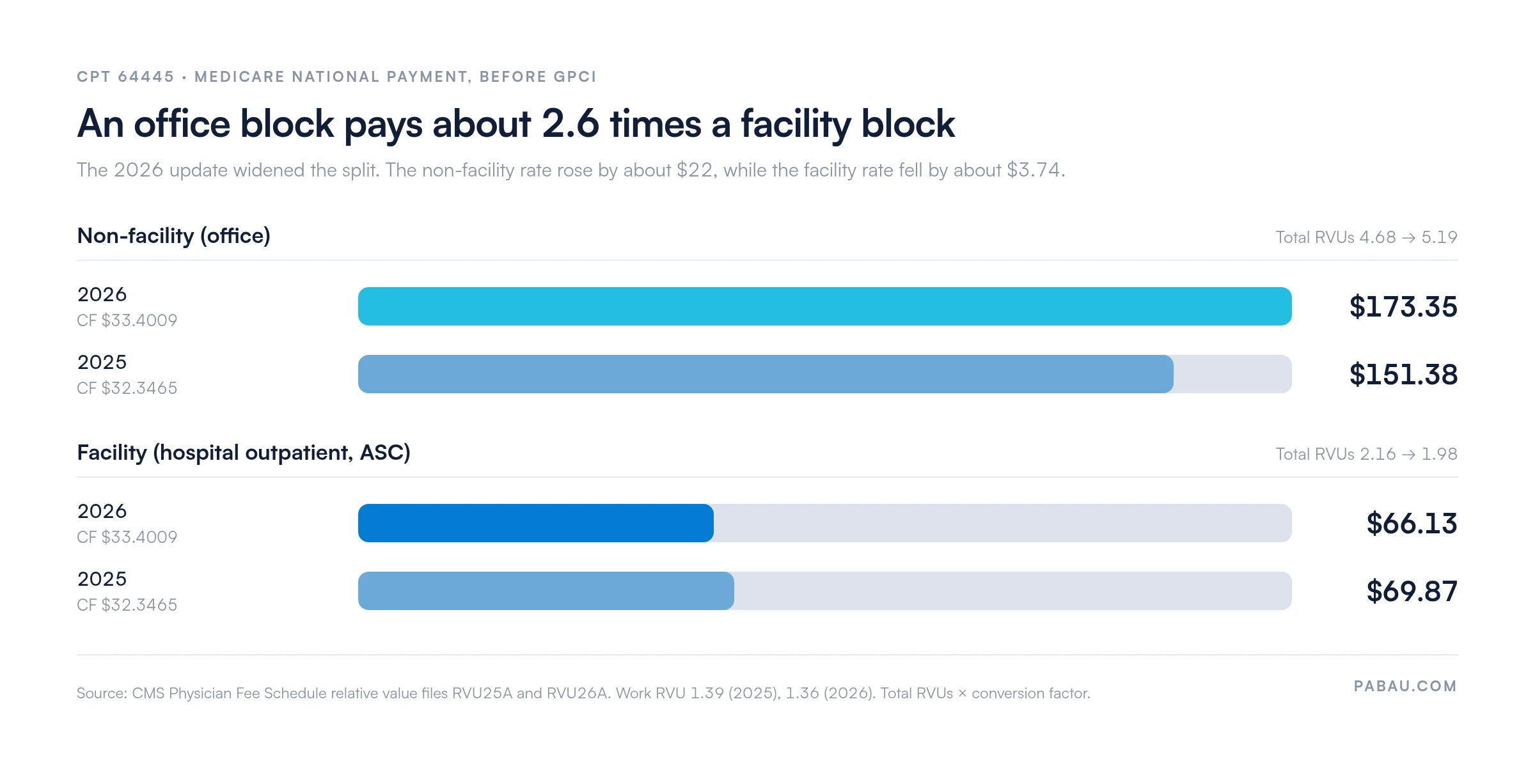
Medicare pays CPT Code 64445 from the annual Physician Fee Schedule. The code’s total relative value units (RVUs) are multiplied by a conversion factor to give the payment.
The total differs by setting. A facility claim, from a hospital outpatient department or ambulatory surgery center, carries fewer practice expense RVUs than a non-facility claim from an office. The figures below are national amounts from the CMS RVU25A and RVU26A files, before your geographic practice cost index (GPCI) adjustment.
The 2025 rates use a conversion factor of $32.3465. For 2026, CMS set two factors: $33.4009 for most clinicians and $33.5675 for qualifying APM participants. The higher factor lifts their rates to about $174.22 non-facility and $66.46 facility.
The place of service moves the payment far more than the yearly update does. An office-based block pays about 2.6 times a facility block, and the 2026 update widened that split.
The same CMS file sets three payment indicators for 64445. The global period is 000, so no post-procedure days are bundled into the payment. The bilateral indicator is 1, which pays a modifier 50 line at 150% of the single rate. The multiple-procedure indicator is 2, so standard reductions apply when other procedures are billed that day.
RVUs and the conversion factor change every January with the CMS final rule. Check the CMS Physician Fee Schedule lookup tool each year, and apply your locality’s GPCI to get your local rate.
The denial patterns below are drawn from AAPC coding guidance, CMS coverage article A57452, and the modifier and documentation issues common to this code. Each one comes back with a reason code on the remittance, and our guide to denial codes explains what each code means. Effective denial management workflows address these root causes before claims leave the practice.
A sciatic block done well can still go unpaid when the note or the claim build misses a detail. Anesthesia and pain practices that bill through claims software for practices with built-in coding edits catch most of the denial triggers above before submission. That cuts the manual review burden on billing staff and shortens the revenue cycle for nerve block procedures.
Pabau, the practice management and billing platform we build, keeps the procedure note and the claim in one record. For 64445, that helps in three places:

Pabau’s claims management tools support CPT and ICD-10 coding, real-time eligibility checks, and electronic claim submission through our Claim.MD integration. That helps your 64445 claims go out clean the first time.

A 64445 claim usually goes wrong after the block, when the claim is built. The usual causes are a 64450 where the note says sciatic, a missing RT or LT, or a guidance line the code already pays for.
If your charge capture still adds 76942 or 77002 to sciatic blocks, change that rule first. It is the quickest fix on this code, and it removes an overpayment risk as well as a denial.
Book a demo to see how Pabau builds each 64445 claim from the procedure note and checks it before it reaches the payer.

Need to understand how clearinghouse submissions work end-to-end? Medical claims clearinghouse overview explains how electronic claims move from practice to payer and where the process breaks down.
Want to reduce claim rejections before they hit the payer? 837 file format guide covers how electronic claim files are structured and what validation errors trigger rejections.
Looking for guidance on insurance credentialing for pain management providers? How to get credentialed with insurance companies walks through the enrollment process for new practices and individual providers.
Blocking an upper extremity nerve instead? CPT Code 64415 covers the single-injection brachial plexus block, with its own modifier and guidance rules.
Treating sciatica at the spine rather than the nerve? CPT Code 64483 explains how lumbar and sacral transforaminal epidural injections are coded and billed.
CPT Code 64445 is the procedure code for a single injection of anesthetic agent(s) and/or steroid into the sciatic nerve, including imaging guidance, when performed. It is used mainly for post-operative pain, post-traumatic lower extremity pain, and sciatica. The American Medical Association maintains it within the nerve block injection codes of the Nervous System Surgery section.
CPT 64445 is specific to the sciatic nerve. CPT 64450 covers injection into “other peripheral nerve or branch” and applies only when the targeted nerve has no dedicated code. When the operative note names the sciatic nerve, 64445 is required. Using 64450 instead is a miscoding error that payers audit and deny.
G89.18 (other acute postprocedural pain) is the most common ICD-10-CM diagnosis code paired with CPT 64445 for post-operative sciatic nerve blocks. For sciatica-related indications, M54.3- (with the appropriate laterality character) is used. Confirm that the diagnosis code reflects what is documented in the provider’s clinical record.
Yes, when the sciatic nerve is blocked bilaterally on the same date, modifier 50 applies and Medicare reimburses at 150% of the single-procedure rate. Some commercial payers prefer two separate line items with RT and LT modifiers instead of modifier 50. Verify the individual payer’s bilateral billing preference before submission and document bilateral technique in the procedure note.
Traditional Medicare does not universally require prior authorization for CPT 64445, but Medicare Advantage plans often do. Commercial payers, particularly BCBS plans with published Medical Coverage Guidelines, may require documentation of conservative treatment failure before approving elective sciatic nerve blocks. Check the patient’s specific plan before scheduling non-urgent procedures.
No. Since CPT 2020, the 64445 descriptor includes imaging guidance, when performed, so ultrasound guidance (76942) is not reported separately for the same sciatic block. The same applies to fluoroscopic guidance, which is 77002 for a peripheral nerve, not 77003. Billing either code with 64445 leads to a bundling denial or an overpayment that can be recouped. Modifier 59 does not change this. Document the guidance in the procedure note, but leave it off the claim.