HCPCS Code G0163: Skilled nursing observation and assessment
What is HCPCS Code G0163? HCPCS Code G0163 is a deleted Level II code for skille...

Last Updated: Oct 15, 2026

CPT Code 64447 covers a single injection of anesthetic agent and/or steroid into the femoral nerve, with imaging guidance bundled when performed.
Billing 76942 or 77002 alongside 64447 triggers an NCCI bundling edit, and no modifier overrides it.
Use 64448 only when a continuous infusion catheter stays at the femoral nerve. CPT 64447 covers single-injection technique.
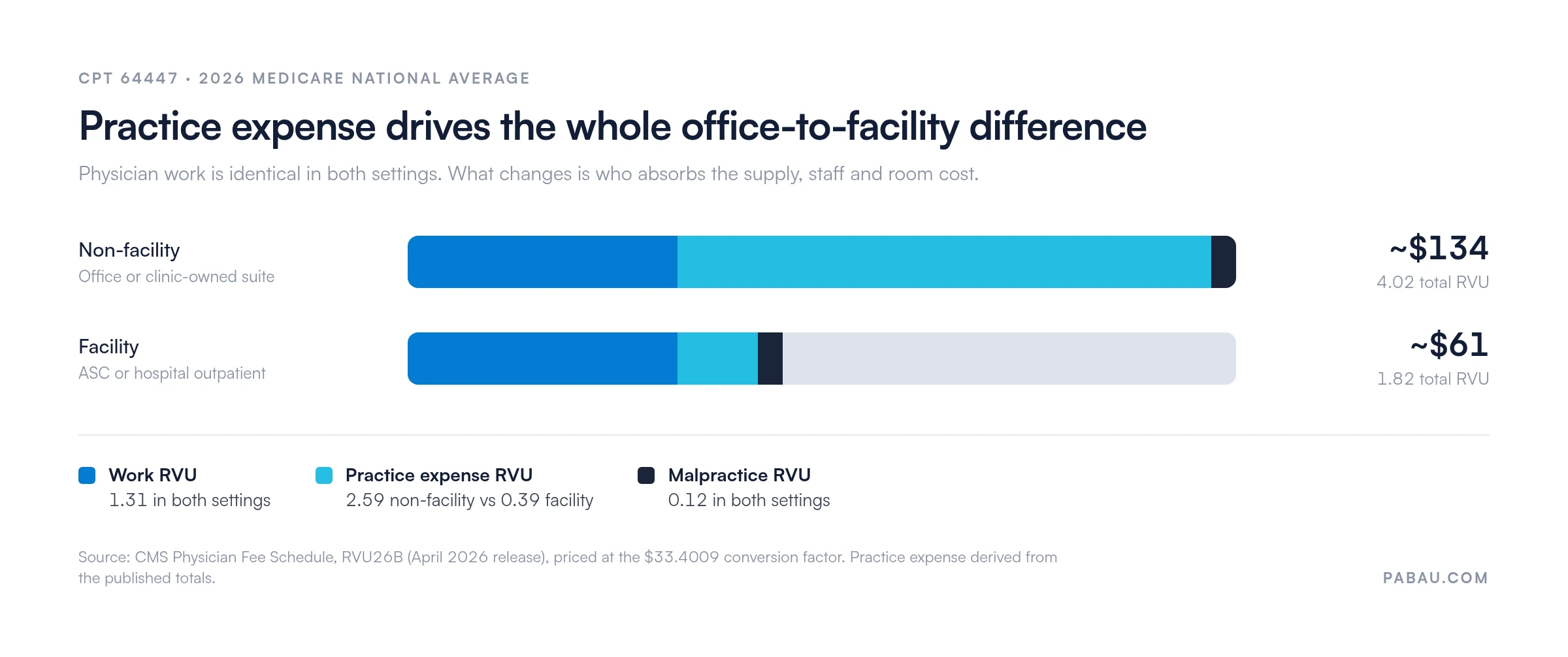
Medicare pays about $134 in the office and about $61 in a facility for 2026, on the same work RVU of 1.31.
Practice management software like Pabau flags bundling conflicts before submission, so fewer nerve block claims come back denied.
CPT Code 64447 is the billing code for a single injection of anesthetic, steroid, or both into the femoral nerve.
Imaging guidance is part of the code, so ultrasound and fluoroscopy are never billed alongside it. The code covers single-shot technique only. If a catheter stays in place for continuous infusion, 64448 applies instead.
For 2026, Medicare pays roughly $134 in the office and roughly $61 in a facility. Both settings carry the same work RVU of 1.31, so practice expense accounts for the whole difference. Local rates move with your MAC’s geographic adjustment.
The rest of this guide covers the fee schedule, the bundling rule, and code selection against 64448 and 64450. It then works through supporting ICD-10 codes and documentation.
The American Medical Association’s CPT code set carries the official descriptor for every procedure code. For 64447 it reads:
Official descriptor: “Injection(s), anesthetic agent(s) and/or steroid; femoral nerve, including imaging guidance, when performed.”
Three elements define scope. First, this is a single-injection procedure, not a catheter placement. Second, the agent may be a local anesthetic, a steroid, or both. Third, imaging guidance is included in the code itself when used, so it cannot be reported separately.
CPT 64447 falls within the peripheral nerve block family (CPT range 64400-64530). It is anatomically specific to the femoral nerve. That makes it distinct from the catch-all code 64450, which covers “other peripheral nerve or branch” blocks with no code of their own.
The sciatic nerve has its own named code in that family, and a single injection there reports 64445. Further down the limb, an injection into the plantar common digital nerves reports CPT 64455.
The femoral nerve originates from the lumbar plexus (L2-L4) and supplies the anterior thigh and medial leg. Blocking it reduces pain signals from the knee, hip, and proximal thigh. That makes the technique especially useful in orthopedic and trauma settings.
Common clinical indications for a femoral nerve block billed under CPT Code 64447 include:
Ultrasound guidance is now the dominant technique, because it shows the nerve, the nearby vessels, and the needle as the block is placed. That guidance is bundled into 64447, so the code applies whether imaging is used or not. “Including imaging guidance, when performed” means the same code is billed either way.
Medicare payment for CPT Code 64447 varies by setting and by MAC locality. The figures below are 2026 national averages from the CMS Physician Fee Schedule lookup tool, priced at the $33.4009 conversion factor. Check them against your own MAC’s published schedule before you bill.
Both settings share the same work and malpractice RVUs. The entire payment difference sits in practice expense. An office absorbs the supplies, staff time, and room cost that a facility bills on its own claim. The chart below breaks the two totals into their components.
Geographic adjustment factors then move each component by locality, and they hit practice expense hardest. Commercial payer rates often differ from Medicare too, so check your contracted rates before you treat the Medicare figure as a proxy.
Run a locality check before submitting. A non-facility rate in Manhattan is materially different from the national average. The CMS Physician Fee Schedule lookup tool filters by locality and status indicator. You see your exact allowable before the claim goes out.
Yes, without exception. This is the single most billing-relevant fact about CPT Code 64447, and it is the source of the code’s most common denial.
The official descriptor contains the phrase “including imaging guidance, when performed.” That language makes imaging part of the procedure’s value, whether you use ultrasound (76942) or fluoroscopy (77002). Submitting either code alongside 64447 for the same nerve on the same claim triggers an NCCI bundling edit.
No modifier overrides this bundling rule. The payer will deny or reduce the imaging line whatever you attach to it. Document that imaging was used in the procedure note, then leave the imaging code off the claim.
The distinction between 64447 and 64448 is technique-based rather than anatomical. Both target the femoral nerve. What separates them is whether a single bolus was injected or a catheter was placed for continuous infusion.
A common error is billing 64448 for a single-injection case. The provider threaded a catheter to deliver the drug, then removed it. If the catheter came out at the time of the block, 64447 is the correct code.
Femoral nerve blocks sit inside a broader family of peripheral nerve block codes, and choosing the wrong sibling is a common audit trigger. The table below covers the codes most often confused with CPT Code 64447.
The AAPC Codify CPT lookup tool lists the full sibling hierarchy for the peripheral nerve injection family. It is useful when you audit code selection across several nerve targets at once.
Chronic knee pain adds one more choice to that list. When the documented target is the genicular nerve branches rather than the femoral nerve, the block is reported with CPT 64454. Ablation of the same branches with a neurolytic agent is a separate procedure, reported with 64624.
Medical necessity requires a supporting ICD-10-CM diagnosis code on the claim. Medicare and most commercial payers cross-reference the submitted diagnosis against an approved list for peripheral nerve blocks. The diagnoses below are commonly paired with CPT Code 64447, though payer LCDs and clinical criteria ultimately govern coverage.
Always check the diagnosis code against the current payer LCD before submitting. CMS article A57452 governs Medicare coverage for peripheral nerve blocks and lists the covered diagnoses for this code family.
Medicare coverage for CPT Code 64447 sits under the CMS coding and billing framework. Billing and Coding Article A57452 covers peripheral nerve blocks specifically. Your MAC’s Local Coverage Determination carries the jurisdiction-specific criteria on top of that.
Key coverage requirements under Medicare:
Commercial payers follow their own clinical policy bulletins. Aetna sets separate criteria in its nerve block bulletin (CPB 0863), and United Healthcare and Blue Cross plans may require prior authorization for non-acute indications. Review each payer’s policy before you schedule an elective femoral nerve block.
An injectable given during the same visit raises its own coverage question, because who administers the dose decides the benefit. Medicare pays HCPCS code J1410 under Part B because a clinician gives it, while a dose the patient takes home sits under Part D.
Incomplete documentation is the second most common cause of 64447 denials, after the imaging unbundling error. Every element below belongs in the procedure note before the claim goes out. Miss one and the payer has grounds to downcode or deny.
Structured note templates cut the risk of an omission. The required fields are captured at the point of care, not reconstructed a week later. That is what turns a nerve block into a clean claim on first submission.
Femoral nerve block claims fail for a short list of predictable reasons, which makes them avoidable. Knowing which errors generate the highest denial volume for this code is where a denial workflow starts.
Each of those maps to a specific remittance code on the way back. Our reference on denial codes covers what each one means and the appeal route that fits it.
Build a denial tracker specific to 64447. Log every denial reason code against the claim. Mark whether it was imaging unbundling, wrong code selection, or documentation, then audit your top three causes monthly. Two or three systematic fixes usually clear most of the denial volume on this code.
The errors in this guide share one cause. Bundling edits, wrong sibling codes, and thin notes all depend on an individual coder catching every rule on every claim. Practice management software like Pabau moves that check into the workflow instead.
Pabau connects the clinical note to claim preparation in one platform. Document a femoral nerve block with its procedure and diagnosis, and our tools for accurate claims management flag known bundling conflicts. That check runs before the claim leaves the practice. So you fix the imaging line once, rather than appealing it a month later.
Claims then route through the Claim.MD clearinghouse, which validates them against thousands of US payers before adjudication. Eligibility checks run at the point of scheduling, so coverage for the patient’s diagnosis is confirmed before the block is performed rather than after.

Pabau’s claims workflow flags bundling conflicts, checks code and diagnosis pairings, and routes clean claims to the clearinghouse before submission. See how anesthesia and pain management practices use Pabau to protect reimbursement.

CPT Code 64447 is a well-defined code that still gets miscoded often. Two errors drive most of the denials, and both are settled before the claim is built. Did imaging go on a separate line, and did the catheter stay in?
Fix those at the note, not at the appeal. A note that names the nerve, the technique, and the agent leaves your coder no room to guess. It also survives the audit that follows a high-volume block program.
The setting matters just as much for the money. Same work, very different payment, so place of service deserves the same care as the code itself. Book a demo to see how Pabau validates nerve block claims before they reach the payer.

Need to understand how clearinghouse validation works? Medical claims clearinghouse guide explains how electronic claim routing reduces denials at the payer gateway.
Want to improve your first-pass claim acceptance rate? Electronic remittance advice (ERA) guide covers how to read remittance data to diagnose denial patterns systematically.
Credentialing with insurers for nerve block procedures? Insurance credentialing guide walks through the enrollment process for Medicare and commercial payers.
CPT Code 64447 is the billing code for a single injection of anesthetic agent and/or steroid into the femoral nerve, including imaging guidance when performed. It sits in the peripheral nerve block family (CPT range 64400-64530). It is used for postoperative analgesia, acute fracture pain management, and diagnostic femoral nerve blocks.
Yes. The official descriptor includes the phrase “including imaging guidance, when performed,” so ultrasound (76942) and fluoroscopic (77002) guidance are bundled into the code value. Submitting either imaging code alongside 64447 on the same claim triggers an NCCI bundling edit and denies the imaging line.
About $134 in the office (non-facility) and about $61 in a facility, based on total RVUs of 4.02 and 1.82 at the $33.4009 conversion factor. Work RVU is 1.31 in both settings, so practice expense accounts for the difference. Geographic adjustment moves the figure by locality.
CPT 64447 describes a single injection (bolus) at the femoral nerve. CPT 64448 describes continuous infusion through a perineural catheter placed at the same nerve. Both target the same structure, so technique decides which code applies. If no catheter was left in place for ongoing infusion, 64447 is correct.
CPT 64447 is anatomically specific to the femoral nerve. CPT 64450 is the catch-all code for “other peripheral nerve or branch” blocks that have no dedicated code. When the femoral nerve is the documented target, 64450 is incorrect and should not be used as a default.
Commonly paired diagnoses include M25.361 and M25.362 (knee pain), S72.001A (femur neck fracture), G57.20 (femoral nerve lesion), G89.18 (acute postprocedural pain), and M16.11 (hip osteoarthritis). Check them against your MAC’s Local Coverage Determination and CMS article A57452 for the full approved list.
The adductor canal block (saphenous nerve block) is most often reported under CPT 64450, because no dedicated code exists for the adductor canal approach. Some payers accept 64447 where the femoral nerve is targeted distally, but the note must specify the nerve and the technique. Verify with your MAC before billing.