CCSD code H4430: Examination of rectum under anaesthetic
CCSD code H4430 pays for the examination alone CCSD code H4430 is the UK private...

Last Updated: Oct 20, 2026
61781 is the CPT code for stereotactic computer-assisted (navigational) procedure; cranial, intradural (List separately in addition to code for primary procedure). In plain terms, it pays the surgeon for using image-guided navigation inside the dura during brain surgery.
It's an add-on code, so it never stands alone on a claim. Instead, it rides beneath a primary cranial procedure, such as a craniotomy for tumor. The dura decides the code. If it stays intact, you need 61782. Get that call right and document it clearly, and the add-on usually pays on the first pass. The sections below cover pairings, NCCI edits, the operative note and common denials.
Let Pabau's smart automation suggest the right codes, reduce claim denials, and keep your practice compliant—effortlessly.
Automate repetitive tasks and focus on what matters most—your patients.
Reduce coding errors and ensure compliance with the latest regulations.
Clean claims, fewer denials, and faster reimbursements.
Powerful insights and reporting to help your practice thrive.
HIPAA compliant SOC 2 certified GDPR-compliant Trusted by 4,000+ clinics worldwide

CPT 61781 is an add-on for stereotactic navigation during cranial intradural surgery, always billed beneath a primary procedure.
The dura decides the code: 61781 when it’s opened, 61782 when it stays intact, and 61783 for spinal cases.
The operative note must name the navigation system, image set and registration method, and confirm active use during the case.
Modifier 51 never goes on 61781, and a 69990 bundling edit needs modifier 59 or XU with separate documentation.
Medicare pays the add-on only when an eligible primary code on the same claim is paid too.
CPT code 61781 covers stereotactic computer-assisted navigation during a cranial procedure that opens the dura. The system overlays preoperative MRI or CT images onto the surgical field in real time. That lets the surgeon track instruments against structures they can’t see directly.
Because it’s an add-on, 61781 only pays when an eligible primary code sits on the same claim. Here’s the quick reference billers reach for first.
Three conditions have to line up before 61781 belongs on the claim.
Mixing up these three codes is the most common error in neurosurgery navigation billing. Their descriptors match word for word until the anatomic qualifier. As a result, a wrong pick is easy to miss on review.
Here’s the rule in one line. The dural status at the surgical site picks the code, whatever the approach. A subfrontal approach that enters the intradural space takes 61781. If the same approach stays extradural, say for a sphenoid wing lesion, you report 61782 instead.
The diagram below turns that rule into two questions you can ask of any operative note.
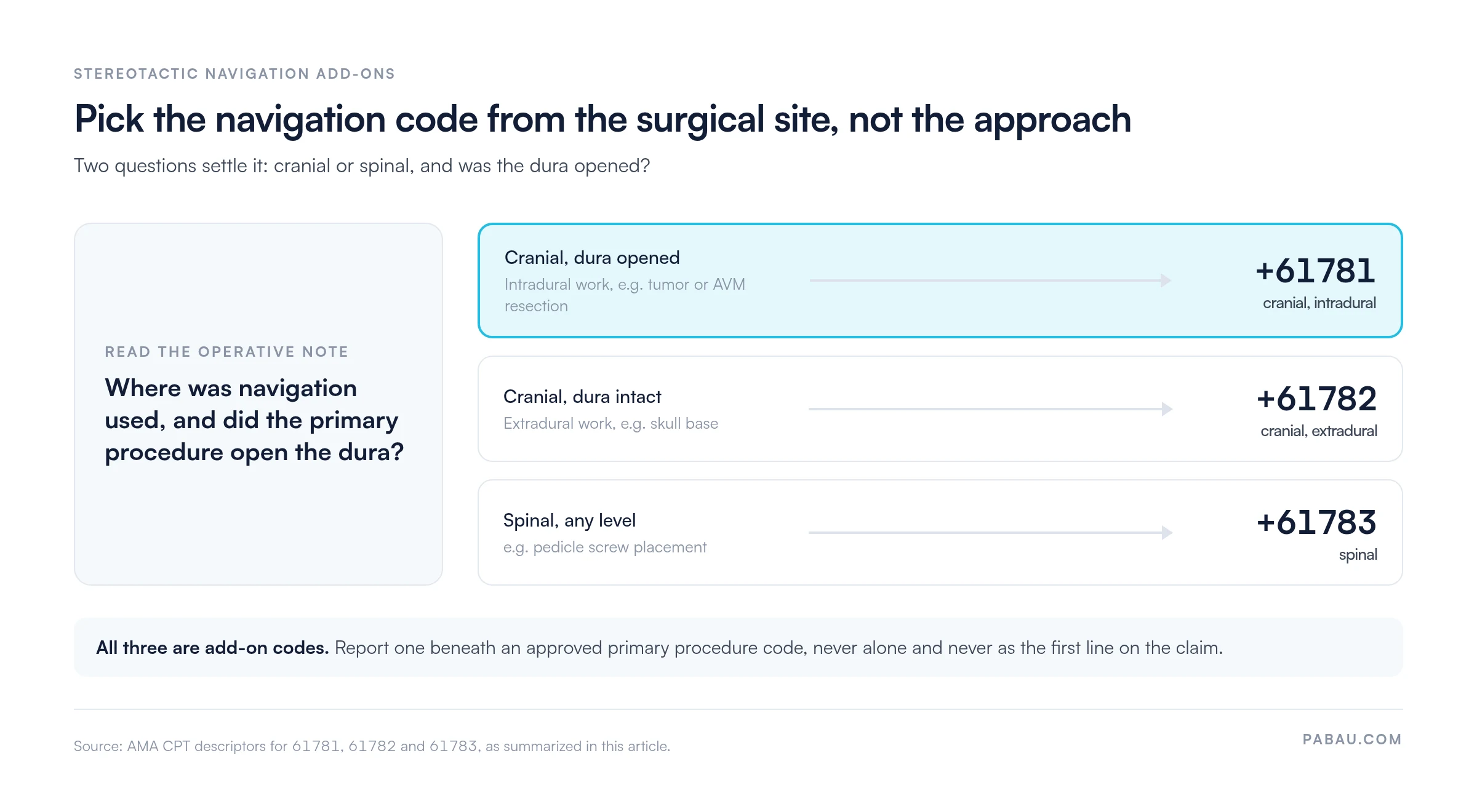
CPT code 61781 can only be reported with primary codes that the CPT parenthetical notes allow for the 61781–61783 series. Billing it against an unlisted primary is a leading cause of denials. That holds even when the pairing seems logical.
In practice, the approved list covers craniotomy and craniectomy codes in the 61304–61576 range. It also includes select skull base codes and certain other intracranial procedures. Typical examples are craniotomy for tumor resection, AVM excision and brain abscess drainage. Each one opens the dura.
Craniotomy for a supratentorial brain tumor other than a meningioma is reported as 61510. That code falls inside the 61304–61576 craniectomy and craniotomy range, so it is an approved primary for 61781.
Possibly, but check two sources before you do. First, confirm that the current CPT manual lists 62223 as an approved primary. Public sources don’t settle this one.
Second, check whether your MAC’s local coverage determination (LCD) restricts navigation add-ons on shunt procedures. Treat forum answers as a lead, then verify them against the NCCI table and your LCD.
Bundling checks belong at the coding stage, well before the claim goes out. Chapter 8 of the CMS NCCI Policy Manual covers the nervous system codes. Under it, the 61781–61783 codes go through standard bundling analysis when billed with other surgical add-ons.
Yes, as long as each service is documented and medically necessary. An NCCI edit still applies to the pair, though. Modifier 59, or the more specific XU, can bypass it. For that to hold, the operative report has to show two distinct services in the same case.
Payers don’t all accept modifier 59 here, and some MACs read it more strictly. CMS also updates the bundling pairs every quarter. So check the current NCCI table before you count on a bypass.
Because it’s an add-on, 61781 has limited modifier options. These are the ones worth knowing.
Solid documentation is the most reliable way to prevent a 61781 denial. Auditors look for specific elements rather than a passing line saying navigation was used. Above all, the note has to show that the surgeon navigated during the case. Setting the system up doesn’t count.
Build these six elements into your neurosurgery operative report template. When surgeons complete them in the standard note, the documentation is there at first submission. Nobody has to rebuild it during an appeal.
Medicare reimburses CPT code 61781 under the Physician Fee Schedule as an add-on to approved primary procedures. It carries a ZZZ global period, so it follows the primary code’s global period. There’s no separate global period to track.
For 2026 payment amounts, use the CMS Physician Fee Schedule lookup tool. Search for 61781 and pick your locality to see the RVUs and the payment rate.
Payment also hinges on the primary line. Medicare generally pays an add-on code only when an eligible primary on the same claim is paid as well.
Coverage for navigation add-ons varies by MAC jurisdiction. Some MACs limit 61781 to certain primary procedure types. Others set medical necessity criteria, such as tumor size or closeness to eloquent cortex.
Keep in mind that national Medicare coverage won’t override a stricter local rule. Commercial payers often follow similar criteria, and some require prior authorization on elective cases.
Here’s the usual path for a craniotomy claim with navigation, from the coder’s desk to the remittance.
Trouble tends to show up at step two or step four. A wrong family code fails at coding. Meanwhile, a denied primary takes the add-on down with it at adjudication.
Denials on this code fall into five groups, and each has a clear corrective step. Many start with a pairing error rather than a coverage exclusion. The ERA will carry a claim adjustment reason code (CARC), and our guide to common denial codes explains each one.
Once a month, pull every claim with 61781 and sort the paid lines from the denied ones. Then group the denials by CARC. The patterns show which pairing or documentation fixes belong in the operative report template.
Run these seven checks on every neurosurgery case that used stereotactic navigation.
Most of that checklist happens by hand, in the minutes between coding and submission. That’s also where a mistyped code or an empty field slips through.
Practice management software like Pabau offers quicker claims management by pre-filling each claim from the patient record. The CPT and ICD-10 codes attached to the visit land on the charge lines.
Built-in lookup libraries let you confirm a code without leaving the claim. Required fields also have to be complete before the claim can be sent.
In the US, claims go out through the Claim.MD clearinghouse, with eligibility checks, status tracking and ERA posting included. Your coder still owns the pairing and modifier decisions. Pabau simply removes the retyping and keeps each claim’s status in view.

Pabau pre-fills claims from the patient record and checks required fields before submission. US claims then go out through Claim.MD with status tracking.

CPT code 61781 is easy to qualify for and easy to lose. The code itself rarely causes the trouble. The trouble comes from a thin note, an unlisted primary or an unresolved 69990 edit.
If you change one habit, make it the operative report template. A coder can’t add a registration method after the fact. However, a template makes sure the surgeon records it every time, and the coding decision then follows from the note.
To see how Pabau pre-fills and tracks neurosurgery claims so your team spends less time retyping, book a demo.

Billing a case where the dura stayed intact? CPT code 61782 covers extradural cranial navigation, its pairings and the denials to expect.
Coding navigation on a spine case? CPT code 61783 explains the spinal navigation add-on and how it pairs with fusion codes.
Want fewer claims coming back? What makes a clean claim breaks down the fields and checks that get a claim paid on the first pass.
Not sure how to read the remittance? Electronic remittance advice explained shows how to read an ERA line by line, including CARC codes.
Want to understand how claims move through the clearinghouse? Medical claims clearinghouse overview explains how electronic claims are validated, routed and adjudicated before they reach a payer.
61781 takes its medical necessity from the primary procedure, so it points to the same diagnosis. Common examples include C71.- for malignant brain neoplasms, D33.- for benign brain neoplasms and Q28.2 for cerebral AVMs. Your MAC’s LCD may also list the diagnoses it accepts for navigation.
The add-on usually denies with it. Medicare pays an add-on code only when an eligible primary on the same claim is payable. Correct and resubmit the primary first, and the 61781 line can then process.
Only if the surgeon used navigation for guidance during the intradural work. If registration failed and the case finished freehand, leave 61781 off. Ask the surgeon to document the failure, so the coding decision holds up on audit.
Put the primary procedure on the first service line and 61781 on a line below it. Point both lines to the same supporting diagnosis. Leave modifier 51 off the add-on line.