CPT code 21011: Excision of soft tissue tumor of the face
CPT code 21011: Official descriptor and procedure overview CPT code 21011, as pu...

Last Updated: Oct 8, 2026

CPT Code 61782 is an add-on code for stereotactic computer-assisted navigation on cranial, extradural procedures. It cannot be billed without a primary procedure code.
The code family splits by anatomy. Use 61781 for intradural cranial navigation, 61782 for extradural cranial navigation, and 61783 for spinal navigation.
61782 is not a neurosurgery-only code. It is also the correct navigation add-on for functional endoscopic sinus surgery and skull-base procedures.
Documentation must confirm that navigation was used, specify the extradural location, and tie navigation to medical necessity. Missing any element is the most common denial trigger.
Practice management software like Pabau pairs add-on codes with their primary codes before submission, so fewer 61782 claims come back denied.
CPT Code 61782 is the add-on code for stereotactic computer-assisted volumetric navigation on cranial, extradural procedures. It is reported in addition to an approved primary procedure code, never on its own. Use 61781 when the navigated portion crosses the dura, and 61783 when it is spinal.
Two specialties report it. Neurosurgeons use 61782 alongside craniotomy and skull-base codes, and ENT surgeons use it alongside functional endoscopic sinus surgery codes.
This guide covers the code descriptor, RVU components, and valid primary pairings for both specialties. It also covers documentation requirements and the denial patterns that hit 61782 claims hardest.
CPT Code 61782 is an add-on code in the American Medical Association’s set of CPT codes. The AMA’s CPT code set maintains the official descriptor.
The clinical distinction is location. Extradural means the navigation system assisted with a cranial procedure performed outside the dura mater, the tough membrane surrounding the brain.
Procedures that enter through the dura use 61781 instead. Coders who conflate the two create a denial pattern that is hard to appeal without a corrected operative note.
The 61781-61782-61783 family shares one clinical technology, stereotactic computer-assisted volumetric navigation. It then splits into three codes based on anatomy. Payers and NCCI edits treat them as non-interchangeable.
The most frequent miscoding error is reporting 61781 when the procedure was extradural. Coders have to read the operative note for documentation of dural entry, not just for navigation use. The diagram below runs the same decision from the operative note down to the primary code family.
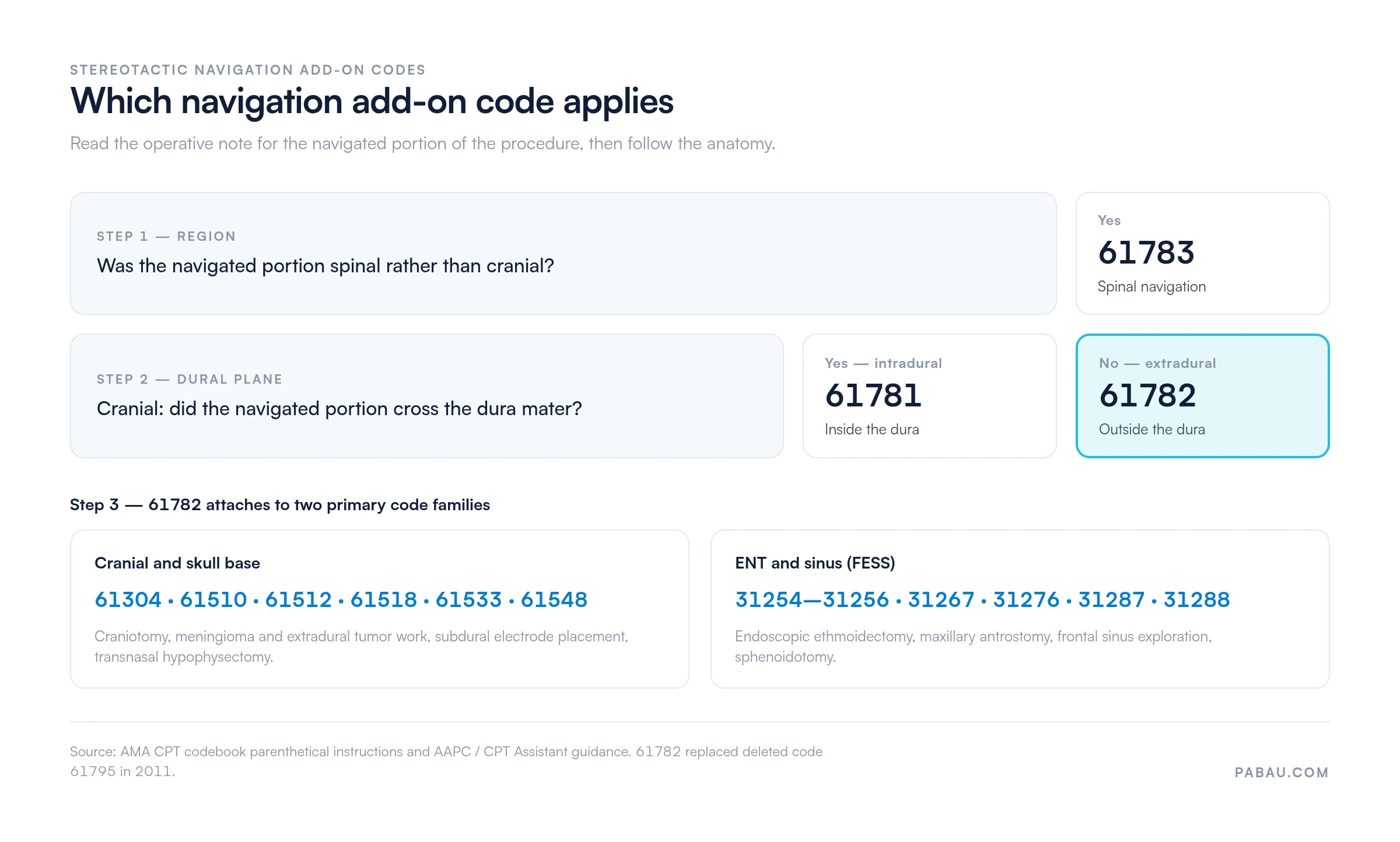
CPT Code 61782 cannot be submitted without a primary procedure code. The AMA CPT codebook parenthetical instructions list the base codes it may accompany. Pairing it with a code outside that list triggers an NCCI edit rejection. The approved list spans two specialties, so work from the family that matches your operative note.
61782 is also the navigation add-on for functional endoscopic sinus surgery, known as FESS. It replaced the deleted code 61795 in 2011, which is why older coding references still send ENT teams to the wrong code family.
Important note: These pairings follow AMA guidance and AAPC’s reference for 61782. Always check the current CPT codebook parenthetical list and run an NCCI edit check before billing. Approved pairings can change with annual CPT revisions.
Medicare reimburses CPT 61782 as an add-on under the 2026 Medicare Physician Fee Schedule (MPFS). Because the code is an add-on, payment is additive to the primary procedure. The CMS Physician Fee Schedule lookup tool gives current national amounts by locality.
Relative Value Units (RVUs) drive the Medicare payment calculation for CPT 61782. The table below breaks down the three components and what each one reflects for this code. Use FastRVU’s 2026 RVU lookup to retrieve current values by locality.
The place of service directly affects reimbursement for CPT Code 61782. Navigated cranial procedures are almost always performed in a hospital operating room.
In that facility setting the Practice Expense RVU is lower, because the facility bills separately for equipment and overhead. Billing 61782 in a non-facility setting produces a different payment amount.
Rates change annually with the MPFS final rule, so prior-year figures are not safe to reuse. Confirm every amount in the CMS Physician Fee Schedule search tool, using the current calendar year and your locality code.
Incomplete documentation is the leading cause of denials for CPT 61782 and its sibling codes. Payers and Medicare Administrative Contractors (MACs) read the operative note to confirm that navigation was used, not merely available. They also look for a clear statement of extradural anatomy.
The operative note has to address all of the following elements to support a clean claim:
MAC review patterns are consistent on this point. Missing any one of these elements is grounds for denial, even when the clinical use of navigation is not in dispute.
Run a pre-bill documentation checklist on every 61782 claim before submission. Confirm the operative note states navigation was used, specifies extradural anatomy, and documents medical necessity. A 60-second checklist step prevents the two-to-six-week turnaround of a wrongly denied claim.
Denials on CPT 61782 cluster around a small number of predictable errors. Recognizing them reduces rework and protects reimbursement on high-value surgical encounters. A structured approach to denial management in healthcare catches most of them before the claim leaves the practice.
Coverage for CPT 61782 is not universal. Some commercial payers and MACs classify stereotactic navigation add-on codes as investigational for certain diagnoses or procedure types. Verify payer-specific Local Coverage Determinations (LCDs) before you bill.
The ICD-10 diagnosis code reported alongside CPT 61782 has to establish medical necessity for cranial extradural navigation. Payers read the diagnosis to judge whether navigation assistance was clinically justified for the underlying condition.
Caveat: These are commonly associated diagnoses, not a guaranteed coverage list. Individual payers may apply medical necessity criteria that differ from Medicare’s. Confirm payer-specific LCD requirements when submitting CPT 61782 with any diagnosis code.
Build a four-step check for every 61782 claim. Confirm the primary code pairing, verify extradural documentation in the operative note, check payer LCD status, and confirm the place of service. Standardizing that check is what moves first-pass denial rates on navigated procedures.
Encounters that carry add-on codes compound the billing work. Each claim holds several codes, strict pairing rules, and a documentation trail that payers read line by line. One wrong pairing sends the whole encounter back.
Pabau is practice management software with claims management software built in. It organizes multi-code encounters, keeps every add-on code attached to its primary procedure, and routes claims through a clearinghouse for validation before they go out.
For US practices submitting 837P claims electronically, the Claim.MD integration adds real-time eligibility checks and electronic remittance advice handling. It also tracks denials by CARC reason code, so your team sees why a 61782 claim failed instead of guessing.
A well-configured clearinghouse edit set flags a missing primary code at submission. That beats finding out two weeks after the date of service, when the operative note is already filed and the surgeon has moved on.

Pabau’s claims management tools pair add-on codes with their primary procedures, flag missing documentation before submission, and track reimbursement across multi-code surgical encounters.

Three things decide a 61782 claim: anatomy, pairing, and documentation. Get the dural plane right, then attach the code to a primary procedure on the approved list. The note then has to say why navigation was needed for this patient.
The pairing question is the one worth re-checking, because 61782 belongs to ENT teams as much as to neurosurgery. A navigated sinus surgery claim that leaves it off is unbilled work, and nobody comes back to collect it.
Catching this at the claim level beats appealing it later, since a denied add-on takes weeks to unwind. Book a demo to see how Pabau checks add-on pairings before a neurosurgery or ENT claim is submitted.

Need to understand how denials are classified across medical billing? Denial codes in medical billing explains CARC and RARC codes used when payers reject add-on code claims.
Looking for a reference on RCM strategy for your specialty practice? What is revenue cycle management covers the end-to-end billing lifecycle that add-on codes like 61782 sit within.
Want to see how claims clearinghouse pricing compares? Claim.MD pricing overview breaks down the cost model for US electronic claims submission.
CPT Code 61782 is the add-on code for stereotactic computer-assisted volumetric navigation on cranial, extradural procedures. It carries a + symbol in the CPT codebook, so it is always reported alongside an approved primary procedure code. Neurosurgery and ENT both report it.
Yes. CPT 61782 carries a + symbol in the AMA CPT codebook and must be listed separately in addition to the primary procedure code. Submitting it alone results in an NCCI edit rejection.
CPT 61782 pairs with two families of primary codes. On the cranial side these include 61304, 61510, 61512, 61518, 61533 and 61548. On the ENT side it is approved with FESS codes 31254-31256, 31267, 31276, 31287 and 31288. Check the current CPT codebook parenthetical list and run an NCCI edit check before submission, since approved pairings change with annual CPT updates.
Yes. 61782 is the correct navigation add-on for functional endoscopic sinus surgery, and it replaced the deleted code 61795 in 2011. The operative note still has to document navigation use, the extradural location, and medical necessity.
CPT 61781 applies to intradural cranial navigation, inside the dura mater. CPT 61782 applies to extradural cranial navigation, outside the dura mater. CPT 61783 applies to spinal navigation. The three are not interchangeable, and using the wrong one for the documented procedure results in denial.
The most common denial reasons are billing 61782 without a primary procedure code and selecting it when the procedure was intradural. Omitting medical necessity from the operative note is the third. Pairing it with an unapproved primary code and skipping the payer’s Local Coverage Determination check account for most of the rest.
The operative note must state that stereotactic computer-assisted navigation was actively used, not merely available. It must confirm the extradural location, identify the navigation system and imaging modality, and document medical necessity for this case. Generic notes that omit any of these are the leading cause of 61782 denials on audit.