



CCSD code G5100: Bypass of duodenum billing guide
CCSD code G5100 bills a bypass that leaves the duodenum in place CCSD code G5100...

Last Updated: Oct 16, 2026
CPT Code 61783 reports stereotactic computer-assisted navigation performed on the spine or spinal cord. It is an add-on code, so it is always reported alongside the primary spinal procedure carried out in the same session. On its own, it does not belong on a claim.
The code sits in the stereotaxis subsection of the American Medical Association’s CPT code set, under procedures on the skull, meninges, and brain. Its descriptor still points at spinal anatomy. It covers an image-guided system that maps the surgical field in three dimensions while the operation is underway.
The short descriptor reads stereotactic computer-assisted (navigational) procedure; spinal. A ‘+’ symbol in the AMA CPT codebook marks it as an add-on. Below are the pairing rules, the 2026 fee schedule basis, and the RVU components. Documentation requirements, NCCI edits, and the most common denial triggers follow.

CPT Code 61783 describes stereotactic computer-assisted navigation of the spine or spinal cord, reported as an add-on to a primary procedure code.
61783 carries a ‘+’ designation and cannot be billed on its own. It must accompany a qualifying primary CPT code such as 63047, 22551, or 22633.
The operative report must explicitly confirm use of the navigation system. Missing that line is the most common denial trigger for this code.
Practice management software like Pabau helps capture add-on codes during procedure documentation, which lowers the risk of omitting 61783 from a spinal surgery claim.
CPT Code 61783 cannot stand alone on a claim. The AMA’s add-on code rules prohibit independent billing. The code must accompany a separately reportable primary procedure performed during the same operative session. Billing 61783 without a qualifying primary code is the most common denial reason for this service, and no modifier rescues it. The claim has to be resubmitted with the correct primary code.
The list below covers the primary CPT codes most frequently reported alongside 61783 in spinal surgery. Each one names the procedure the navigation supported, which is what makes the add-on reportable in the first place.
On the Medicare Physician Fee Schedule, 61783 carries a ZZZ global period indicator. ZZZ means the code has no global period of its own. It inherits the global period of the primary procedure it was billed with. Modifier 51 is never appended to an add-on code either.
The checklist below gathers the pairing rule, the documentation requirement, and the modifier restrictions into one view.
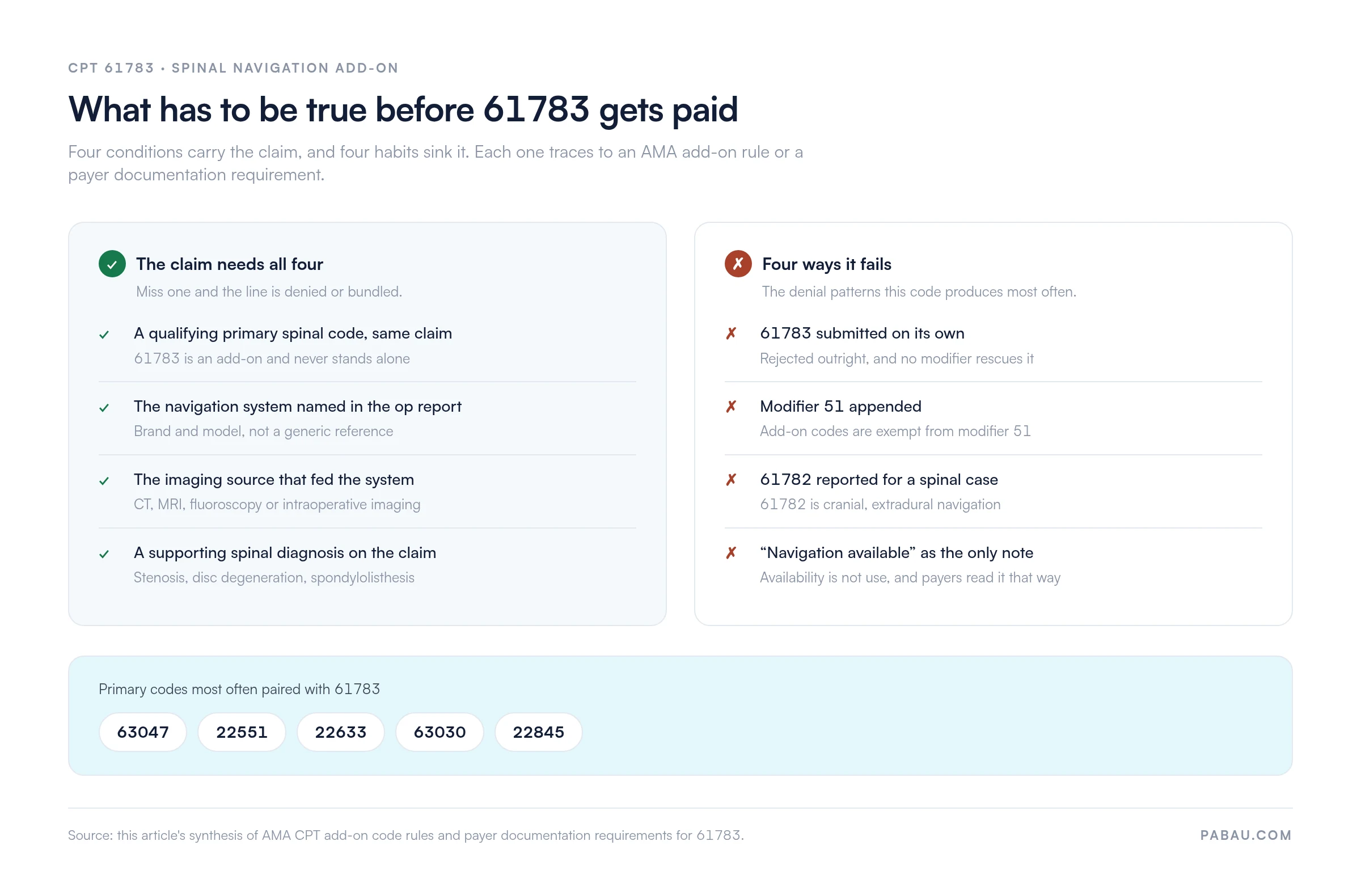
The 61781 to 61783 family all report stereotactic computer-assisted navigation, and the anatomy determines which code applies. Two of the three cover cranial work, separated by whether the navigation is intradural or extradural. Coders most often confuse 61782, which is cranial and extradural, with 61783. The table below sets out the distinctions.
All three codes share the add-on designation and the same documentation framework, but they are not interchangeable. Cranial navigation performed inside the dura is reported with 61781. Cranial navigation that stays outside the dura is reported with 61782. For any spinal procedure, 61783 is the correct code.
The CMS Physician Fee Schedule lookup tool is the authoritative source for current payment rates. Rates below reflect 2026 Medicare Physician Fee Schedule values and vary by geographic locality. Always verify against the CMS tool using the current year’s data before quoting rates to payers or patients.
Locality-adjusted rates differ. Practices in high-cost areas such as Manhattan or San Francisco see higher Medicare rates than practices in rural fee localities. Private payers usually set their allowable as a percentage of the Medicare rate. That percentage sits in your contract, so read the fee schedule attached to it before assuming parity.
Relative Value Units determine physician payment under the Medicare Resource-Based Relative Value Scale (RBRVS). Pull the current wRVU, peRVU, and mpRVU values for 61783 from the CMS relative value files rather than a third-party aggregator. The RVU structure reflects the work of operating and interpreting navigation guidance during a spinal procedure.
CMS finalized two conversion factors for CY2026. Qualifying APM participants are paid at $33.5675, and every other clinician at $33.4009. Multiply the total RVU from the CMS file by the factor that applies, and the result should reconcile with the allowable your payer quotes.
As an add-on code, 61783 carries a modest wRVU next to primary surgical codes. Billed on every encounter where navigation is used, the totals mount quickly in a high-volume neurosurgery practice. Twenty spinal cases a quarter with 61783 left off is work the surgeon did and never billed for.
Run a quarterly audit: pull all claims for your most common spinal primary codes (63047, 22551, 22633) and check what percentage include CPT 61783. If your navigation usage rate in the OR doesn’t match your billing rate, you have a documentation capture problem, not a coding problem.
The operative report is the make-or-break document for CPT Code 61783 billing. Payer auditors look for explicit confirmation that a navigation system was used – not just that it was available in the room. A clean claim submission for this code depends on the operative report addressing each of the following elements before the claim goes out the door.
A generic statement such as “navigation was used” is insufficient for many commercial payers. The record should describe how the navigation system contributed to the procedure. An auditor reading the note should be able to tell what the surgeon did with the system.
Add-on codes have a restricted modifier profile. Because 61783 is a ‘+’ code, modifier 51 (multiple procedures) does not apply. The modifiers below are the ones most relevant to 61783 billing, though applicability is payer-dependent. Always verify against current CMS guidance and individual payer policies before appending a modifier.
The National Correct Coding Initiative (NCCI) edits apply to CPT 61783. NCCI edit pairs identify procedure combinations that should not typically be billed together on the same claim. CMS updates the edit tables quarterly, so a code pair that was separately billable last quarter may be bundled today. Verify the current edit status for each pair before the claim goes out.
The ICD-10 diagnosis codes reported with CPT 61783 reflect the conditions that drive spinal surgery and make navigation clinically necessary. Confirm each one against the current ICD-10-CM diagnosis codes before submission. The table below lists the most common crosswalked diagnoses.
The AAPC Codify CPT lookup tool provides crosswalk data linking CPT codes to appropriate ICD-10 diagnoses, which supports medical necessity documentation review before submission.
CPT 61783 denials cluster around a predictable set of errors. Each one below has a direct fix that a billing team can apply without a compliance overhaul. Every one of them is cheaper to catch in a pre-submission audit than to appeal after the denial arrives.
Flag 61783 for a pre-submission edit check on every spinal surgery claim. Confirm three things. A qualifying primary code is present, the operative note names the navigation system, and the ICD-10 diagnosis supports medical necessity. Three checks, one code, significantly fewer denials.
Add-on codes depend on someone remembering to add them. When the code lookup lives in one tool and the claim is built in another, that hand-off is where 61783 falls off. Keeping both on a single record is what claims software for practices is for.
Practice management software like Pabau holds procedure documentation and claim creation in the same patient record. Capturing an add-on code while the procedure is being written up is what stops it being dropped later. Claims then go out electronically through Claim.MD, Pabau’s US clearinghouse partner, so submission and tracking stay in one system.
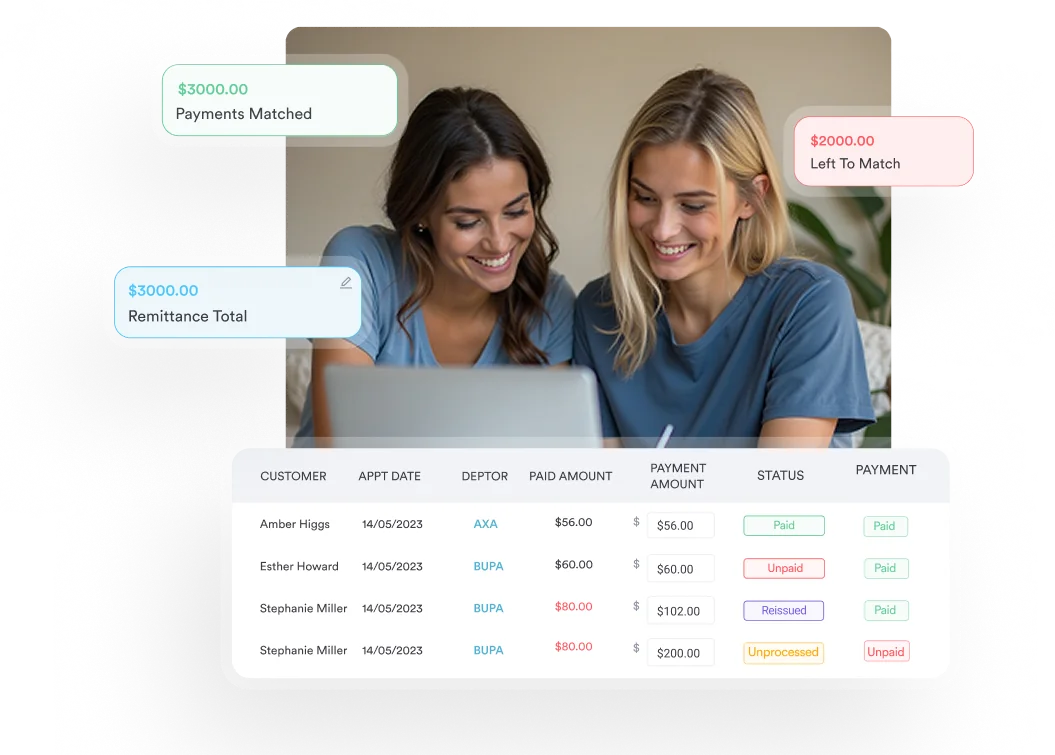
Reporting by CPT code then shows how 61783 is actually performing. If the code is denied more often than expected, a practice can see whether documentation, pairing errors, or NCCI conflicts sit behind the pattern. A static code reference cannot answer that question.

Pabau keeps spinal procedure documentation and claim creation on one record. Add-on codes like CPT 61783 get captured while the operative detail is still fresh.

CPT Code 61783 is simple in theory and easy to lose in practice. The add-on designation, the documentation burden, and the quarterly NCCI updates each create a point where the line drops off the claim.
The remedy is the same at every one of those points. Decide whether 61783 applies while the procedure is being documented, rather than when the claim is built. A surgeon who names the navigation system in the operative report has already done the hardest part of the claim.
Book a demo to see how Pabau captures add-on codes like 61783 while the spinal procedure is still being documented.

Need to understand how clearinghouse validation works? Medical claims clearinghouse overview explains how payer-side edits catch code-pair errors before payment processing.
Working through insurance eligibility for spinal surgery cases? Insurance eligibility verification covers the pre-authorization and eligibility steps that reduce denial risk for complex surgical procedures.
Want to improve billing accuracy across the practice? Medical billing compliance covers the audit and documentation standards that support clean claims for neurosurgery and spinal codes.
CPT Code 61783 is used to report stereotactic computer-assisted navigation performed on the spine or spinal cord. It is an add-on code, reported in addition to the primary spinal procedure code. It captures the separate physician service of operating and interpreting the navigation system during surgery.
No. CPT 61783 carries a ‘+’ designation in the AMA CPT codebook and cannot be billed independently. It must be reported alongside a qualifying primary procedure code performed during the same operative session. Claims submitted with 61783 as the only procedure code will be rejected.
Modifier 51 does not apply, because add-on codes are exempt from it. Modifier 59 may unbundle 61783 from a bundled code pair, but only when the NCCI modifier indicator permits it (indicator 1, not 0). Medicare prefers the more specific XE, XS, XP, and XU modifiers over 59 wherever one of them fits.
The operative report must explicitly name the stereotactic navigation system used. It also needs surgeon attestation that navigation guided the spinal procedure. Identify the imaging source, whether CT, MRI, or fluoroscopy, and describe the clinical indication for navigation use. A generic reference to “navigation available” typically does not satisfy commercial payer documentation standards.
Yes. CMS NCCI edits apply to CPT 61783 and are updated quarterly. The code pairs that trigger edits change with each quarterly update. Verify current edit status through the CMS NCCI tables or a compliant code lookup tool before billing. A modifier can override a bundle only when the modifier indicator for that edit pair allows it.



