CCSD code G5100: Bypass of duodenum billing guide
CCSD code G5100 bills a bypass that leaves the duodenum in place CCSD code G5100...

Last Updated: Oct 16, 2026
CPT code 58120 is the billing code for dilation and curettage (D&C), diagnostic and/or therapeutic, performed for nonobstetrical indications. It covers mechanical dilation of the cervical os followed by curettage to sample or remove endometrial tissue in a patient who is not pregnant.
Two facts in the operative note decide whether 58120 is the right code. The first is pregnancy status, which separates 58120 from the obstetric codes 59820 and 59821. The second is cervical dilation, which separates it from 58100, the endometrial biopsy code performed without dilators. A note that documents neither gets downcoded on review.

CPT code 58120 covers nonobstetrical D&C only, so obstetric cases are billed as 59820 or 59821.
58120 includes cervical dilation, which is what separates it from 58100, the endometrial biopsy code.
The operative note has to name the dilators and the size they reached, or the claim is downcoded to 58100.
Medicare pays 58120 at two rates, and the non-facility office rate is the higher of the two.
Pabau links the operative note to claim submission, so the dilation detail reaches the payer without manual re-entry.
The American Medical Association’s CPT code set defines CPT code 58120 as dilation and curettage (D&C), diagnostic and/or therapeutic, nonobstetrical. The procedure involves mechanically dilating the cervical os and using a curette to sample or debride the uterine endometrium. It sits within the Female Genital System surgery section of the CPT manual.
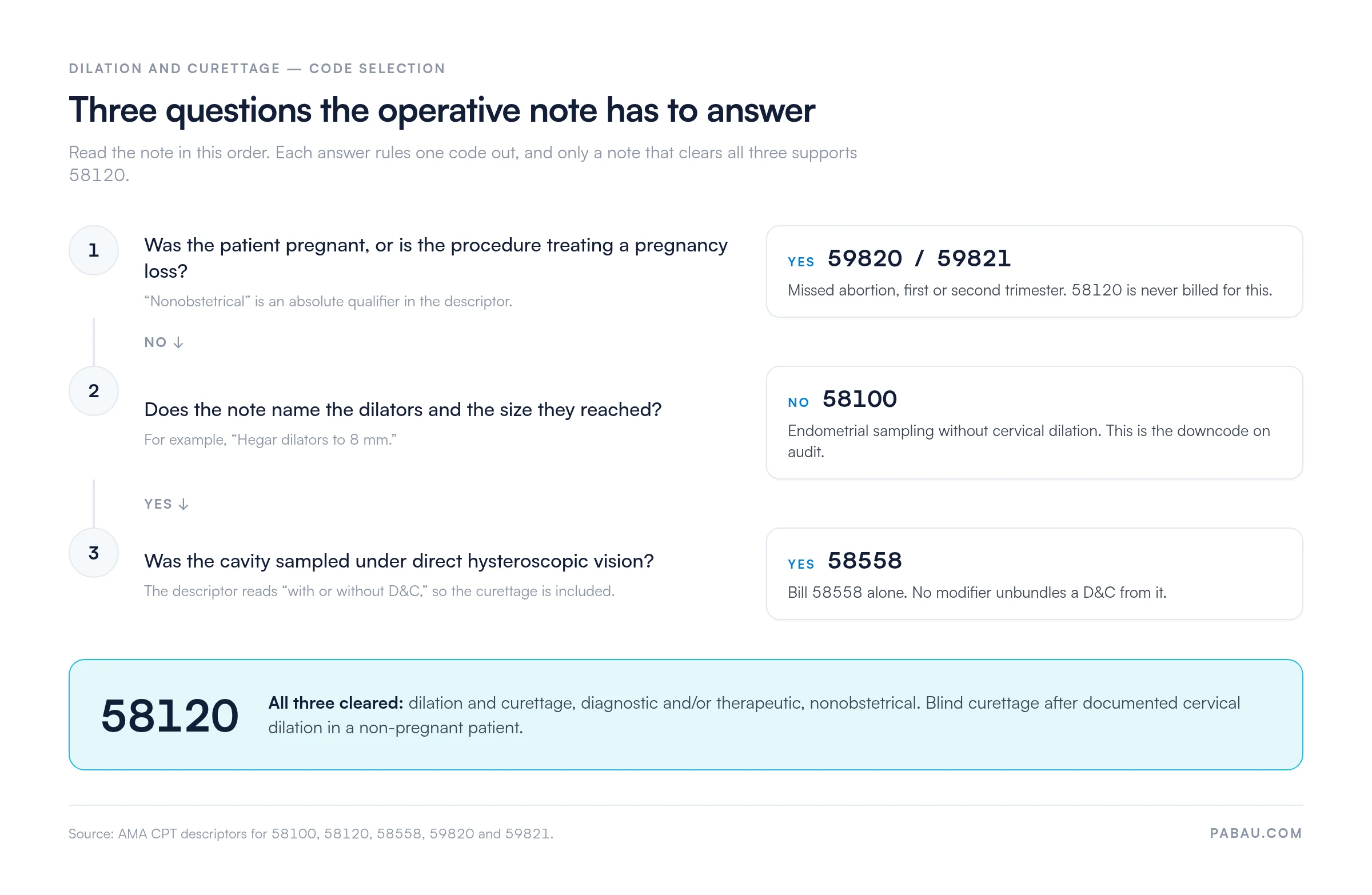
Two aspects of the descriptor carry coding weight. First, “diagnostic and/or therapeutic” means the code covers tissue sampling and treatment alike, including removal of a polyp. Second, “nonobstetrical” is an absolute qualifier. If the patient is pregnant, or the procedure relates to a pregnancy complication, this code does not apply.
The obstetric alternatives are not limited to 59820 and 59821. An induced termination performed by dilation and curettage is billed as 59840, never on 58120.
Surgeons typically perform the procedure under general or monitored anesthesia care (MAC) in a hospital outpatient or ambulatory surgery center (ASC) setting. Some practitioners perform it in an office under local anesthesia where that is clinically appropriate.
Medical necessity documentation must link the procedure to a clinical indication the payer recognizes. These are the indications most frequently covered.
Payer coverage policies vary. Some commercial plans require that a less invasive endometrial biopsy (58100) was attempted first. Document that reasoning explicitly in the operative note when it applies.
Knowing the procedural steps helps coders verify that the documentation supports 58120 rather than a less complex code. A typical case runs through six steps.
The operative report has to document cervical dilation by name, for example “Hegar dilators were used to dilate the cervix to 8 mm.” Without that language, a payer may downcode the claim to 58100 on audit.
Choosing between 58120 and 58100 is the most common coding decision in endometrial procedure billing. The core distinction is cervical dilation: 58120 requires it, 58100 does not.
A practical rule: if the note says “Pipelle biopsy” or “endometrial sampling without dilation,” the correct code is 58100. If it describes progressive cervical dilation with dilators followed by curettage, use 58120.
Thin documentation is the primary driver of 58120 claim denials and post-payment audits. The operative note has to carry each of the following elements to support the claim.
Practices working from hand-written or dictated notes are the ones that most often lose the dilation detail. A structured operative note template prompts for dilator type and size. That captures the detail while the surgeon is still at the keyboard, which is the only moment it costs nothing.
Several coding rules apply specifically to 58120 and decide whether the claim is accepted first time. Place-of-service discipline and bundling awareness account for most of them.
CPT 58120 carries two distinct Medicare payment rates depending on where the procedure is performed. Non-facility (office) rates reimburse the physician for both work and practice expense. Facility rates, meaning a hospital outpatient department or an ASC, reimburse only the physician’s work component.
That split exists because the facility bills its own separate claim for overhead and supplies. The practical consequence is that performing 58120 in an office generates higher physician reimbursement per claim. Many payers still require a facility setting for D&C, given the anesthesia typically involved, so confirm each commercial payer’s rules before scheduling.
CPT 58120 is subject to National Correct Coding Initiative (NCCI) edits. Three bundling rules matter most.
Running claims against the NCCI edit tables before submission catches these conflicts while they are still cheap to fix. Practices that scrub pre-submission rebill far less than those waiting for the remittance to tell them. The medical billing denial codes that surface on surgical claims usually trace straight back to an edit like this one.
Medicare does not require prior authorization for CPT 58120 in most circumstances, but commercial payers often do. Requirements vary by plan and sometimes by the diagnosis paired with the procedure. Abnormal uterine bleeding may require documentation of failed conservative management before authorization is granted.
Run the pre-authorization check for CPT 58120 at the time of scheduling rather than the day before surgery. Commercial plans frequently want evidence of failed conservative management, such as hormonal therapy. Gathering that documentation at scheduling prevents last-minute delays and same-day cancellations.
CMS calculates Medicare reimbursement for CPT 58120 using its Medicare Physician Fee Schedule (MPFS). Rates vary by geographic locality and by place of service. Use the CMS Physician Fee Schedule lookup tool to confirm the rate for your own locality.
Rate figures for 2026 are subject to the annual MPFS final rule, and CMS has published two conversion factors for the year. Pull locality-specific rates from the CMS relative value files before setting internal benchmarks. A dollar figure quoted without a locality and a conversion factor behind it is a compliance risk once it reaches a fee schedule.
Practice management software like Pabau submits 58120 claims electronically through Claim.MD, our US clearinghouse partner, which reaches thousands of US payers. Eligibility verification, ERA/835 remittance reconciliation, and built-in CPT and ICD-10 catalogs let OB/GYN billing teams compare expected against actual reimbursement in one place.
The Medicare payment for 58120 comes from its relative value units (RVUs), multiplied by the CMS conversion factor for the payment year. CMS updates RVU values annually in the MPFS final rule. Confirm current values against the CMS MPFS data file or the AAPC code reference.
The work RVU for 58120 reflects the physician time and complexity of a surgical D&C performed under anesthesia. It is substantially higher than the work RVU for 58100, which is where the reimbursement difference between the two codes comes from. Those values also flow into private payer contracts built on MPFS-based fee schedules, so they are worth knowing before a negotiation.
Pairing CPT 58120 with the right ICD-10-CM diagnosis code is what establishes medical necessity. The diagnoses below are the ones that most often support a nonobstetrical curettage. Verify each against the current code set before submission. ICD-10-CM is updated every October 1.
Selecting the most specific ICD-10-CM code available reduces medical necessity denial risk. Specificity at the fifth or sixth character supports a surgical claim far better than an unspecified code does. That is why N93.9 is a weak pairing for 58120 whenever the record already documents postmenopausal or postcoital bleeding.
Accurate D&C coding usually means ruling out the adjacent gynecologic and obstetric codes first. Billers handling OB/GYN claims should be able to tell these apart on sight. Drug codes work on dose ceilings instead, and the deleted HCPCS code J0970 billed one unit for any estradiol valerate dose up to 40 mg.
Read as a sequence rather than a table, the same distinctions collapse into three questions a coder can put to any operative note.
CPT 58120 claims fail at higher rates when documentation and billing live in separate systems. A coder reading a dictated note in one place while building a claim in another has to re-key the detail. The dilator size is what goes missing.
Pabau’s claims management software ties structured clinical documentation to the billing workflow, so what the surgeon enters during the encounter feeds straight into claim creation. For 58120, the dilator size recorded in the operative note sits in the same record that drives the claim.
Claims then pass through Claim.MD for validation before they reach the payer, so a rejection comes back in hours rather than weeks. On a code like 58120, where an obstetric diagnosis triggers an automatic denial, catching the pairing at that stage saves a full rebilling cycle.
Gynecology practices running high surgical volumes can also track 58120 denials by payer and by reason code inside Pabau’s reporting. That is what turns a run of denials into a specific documentation change. Without it the billing team is left with a vague sense that OB/GYN claims are hard.

Pabau connects OB/GYN clinical documentation to claim submission in one platform, so the detail that supports the code travels with the claim. Built-in CPT and ICD-10 catalogs and Claim.MD validation help gynecology practices submit cleaner surgical claims.

Nearly every 58120 denial traces back to one of two failures. Either the operative note never names the dilators, or a pregnancy-related case was billed on a nonobstetrical code. Neither is a coding judgment call. What the surgeon wrote down decides both.
So the fix sits upstream of the billing team. A template that prompts for dilator type and size removes most of the rework. A pre-submission scrub against NCCI and ICD-10 pairing rules catches the rest before a claim is sent. Book a demo to see how Pabau keeps the operative note and the 58120 claim in one record.

Need a structured claims workflow for OB/GYN procedure codes? What is revenue cycle management covers the end-to-end process of turning a clinical encounter into collected revenue.
Want to reduce claim denials across your practice? Medical billing compliance outlines the documentation and coding standards that reduce audit exposure.
Managing insurance credentialing alongside procedure billing? Getting credentialed with insurance companies walks through the provider enrollment process for new OB/GYN practices.
CPT code 58120 covers dilation and curettage (D&C), diagnostic and/or therapeutic, performed for nonobstetrical indications. The procedure includes mechanical cervical dilation followed by uterine curettage to sample or remove endometrial tissue. It does not cover obstetrical D&C procedures, which use codes 59820 or 59821.
No. Bill 58558 alone when both are documented on the same date. Its descriptor reads "hysteroscopy, surgical, with sampling (biopsy) of endometrium and/or polypectomy, with or without D&C", so the curettage is already included. The NCCI modifier indicator is 0, which means no modifier can unbundle a D&C from it.
Medicare generally does not require prior authorization for CPT 58120, but commercial payers frequently do. Requirements vary by plan and diagnosis. Some payers require documentation of failed conservative management before authorizing an elective D&C for abnormal uterine bleeding. Verify authorization requirements with each commercial payer before scheduling the procedure.
Yes. CPT 58120 is a surgical code within the Female Genital System section of the CPT manual. It carries a global surgical period, typically 10 days for Medicare. Routine post-operative care within that window is bundled into the 58120 payment. Bill a separate E&M code only when a new and unrelated problem is addressed.