CPT code 74019: Abdominal X-ray, 2 views
CPT code 74019: official descriptor and quick reference The American Medical Ass...

Last Updated: Oct 20, 2026
K0826 is the HCPCS Level II code for power wheelchair, group 2 very heavy duty, sling/solid seat/back, patient weight capacity 451 to 600 pounds.
Two variables separate K0826 from its neighboring codes: The seat type and the patient's weight class. Power options play no part inside the K0823 to K0829 range. Prior authorization has to be affirmed before the claim goes out, and the KX modifier has to be on it.
Let Pabau's smart automation suggest the right codes, reduce claim denials, and keep your practice compliant—effortlessly.
Automate repetitive tasks and focus on what matters most—your patients.
Reduce coding errors and ensure compliance with the latest regulations.
Clean claims, fewer denials, and faster reimbursements.
Powerful insights and reporting to help your practice thrive.
HIPAA compliant SOC 2 certified GDPR-compliant Trusted by 4,000+ clinics worldwide

HCPCS code K0826 covers a power wheelchair, group 2 very heavy duty, sling/solid seat/back, with a patient weight capacity of 451 to 600 pounds.
Seat type and weight class separate the K0823 to K0829 family, not power options. Single and multiple power option chairs sit in the K0835 to K0864 complex rehabilitative series.
Medicare requires prior authorization for K0826 before the claim goes out. Billing without an affirmation is one of the costliest errors in the DME category.
Modifier KX belongs on every K0826 claim where medical necessity criteria are fully documented. A missing or wrong modifier triggers an automatic denial.
Pabau’s claims management software supports prior auth tracking, documentation workflows, and clean claim submission for DME suppliers billing K0826 and related Group 2 codes.
The verbatim CMS descriptor for K0826 is: Power wheelchair, group 2 very heavy duty, sling/solid seat/back, patient weight capacity 451 to 600 pounds. Each element of that description carries a specific compliance meaning. Note what the descriptor does not contain. There is no power option clause, and the lower bound is 451 pounds, not 450.
K0826 is sometimes referred to informally as a bariatric power wheelchair code in clinical settings. That informal label is acceptable for clinical communication. It should never appear on a CMS claim form, where the HCPCS code and official descriptor govern.
K0826 reimburses under the capped rental payment methodology. Medicare pays a monthly rental allowance for the first 13 continuous months. After month 13, ownership transfers to the beneficiary and rental payments stop. The supplier retains servicing obligations for the duration of the reasonable useful lifetime.
Fee schedule amounts for K0826 vary by MAC jurisdiction and competitive bidding area status. CMS publishes the DMEPOS fee schedule annually, and updates it each January 1. Verify the current rate for your own locality against the CMS DMEPOS fee schedule before submitting claims.
Suppliers in competitive bidding areas may be paid something other than the national fee schedule amount. It depends on whether K0826 was in the most recent bidding round for their area. Confirm bid area status before assuming national rates apply.
Prior authorization is mandatory for HCPCS code K0826 under Medicare’s Prior Authorization Program for certain durable medical equipment. CMS expanded that program to cover Group 2 power wheelchairs because of historically high improper payment rates in the category.
Verify the beneficiary’s eligibility before the prior auth request goes out. That step confirms active Part B coverage and shows where the beneficiary stands against their annual deductible.
The prior authorization submission goes to the relevant DME MAC, not to the local Medicare Administrative Contractor that processes Part B professional claims. There are four DME MAC jurisdictions:
The MAC issues a provisional affirmation or a non-affirmation. A non-affirmation does not automatically mean the item is not covered, but it does move the burden of proof onto the supplier. Suppliers who proceed after one must retain every document and expect a post-payment review.
The prior auth request must include the detailed written order, face-to-face examination notes, and supporting medical records from within the required timeframe.
Submit the prior authorization request before delivery. Delivering the wheelchair and then seeking authorization retroactively is not permitted under Medicare’s prior auth program. The result is a non-covered determination, whatever the clinical picture.
Medicare coverage for K0826 rests on the medical necessity criteria in the Power Mobility Devices Local Coverage Determination, LCD L33789, and its associated Policy Article. Those criteria confirm the beneficiary needs a power wheelchair for mobility-related activities of daily living inside the home. They also confirm that lesser equipment would be insufficient, whether a manual wheelchair or a power wheelchair rated below the 451 pound threshold.
The core coverage requirements are:
The treating physician’s face-to-face examination notes must document the specific functional limitations, the patient’s weight, and why a very heavy duty power wheelchair is required. Generic notes are a leading cause of coverage denial on audit. They skip the weight classification, or the reason lesser mobility equipment will not do.
Documentation errors are the primary driver of K0826 claim denials and post-payment recoupment. Meeting medical billing compliance standards for this code means assembling a specific set of records before delivery, not after. Each document in the file serves a distinct function in the coverage determination chain.
Holding each required element in a structured digital record lowers the risk that one missing file turns into a post-payment recoupment. Suppliers should retain all K0826 documentation for at least 7 years from the date of service, consistent with CMS record retention requirements.
Correct modifier selection is non-negotiable on K0826 claims. The modifier communicates whether medical necessity criteria are met and whether an advance beneficiary notice (ABN) is on file. It also flags the nature of the transaction, rental or purchase. Submitting the wrong modifier, or omitting one entirely, triggers an automatic denial.
The errors below account for the majority of K0826 claim failures seen on audit and post-payment review. A pre-submission check on modifiers, weight documentation and authorization status catches nearly all of them before the claim leaves the clearinghouse.
Reading the denial codes returned on each rejected K0826 claim lets a billing team pattern-match the failures. Fixing the upstream workflow step is what stops the same denial arriving again next month.
K0826 sits within the Group 2 power wheelchair family, which spans K0823 through K0829. Two variables decide which code applies: The seat type and the patient’s weight class. Power options play no part in separating these seven codes. Chairs with a single or multiple power options are billed from the separate complex rehabilitative series, K0835 through K0864.
The grid below places all seven codes on those two axes. Find the patient’s weight band first, then read across to the seat the chair actually has. Billing the wrong code inside the family counts as an incorrect HCPCS code error on audit, not a documentation issue.
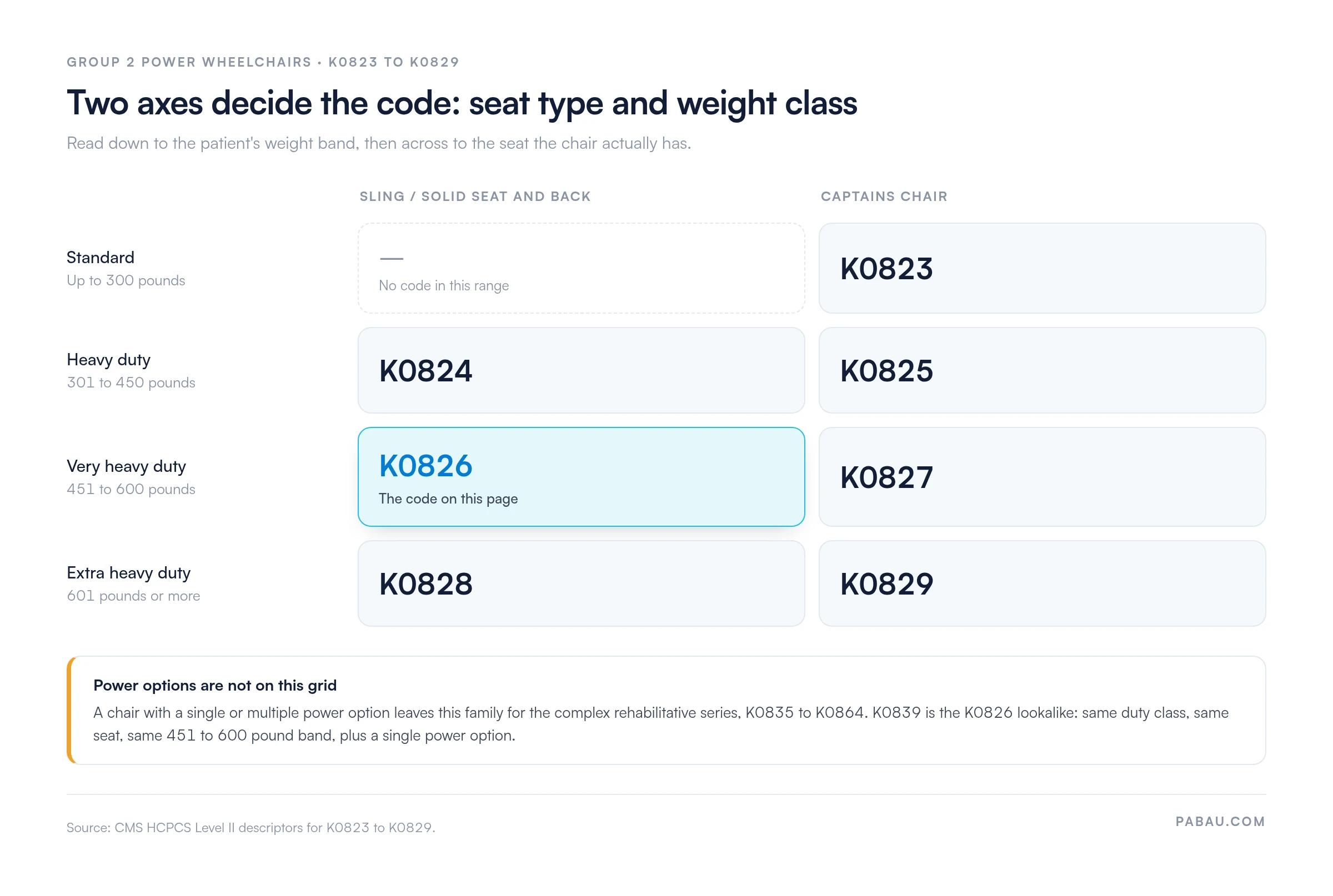
The duty rating, seat type and weight capacity for each code in the family:
K0826 and K0827 differ on seat type alone. Both cover the very heavy duty class and the same 451 to 600 pound band. K0826 is the sling or solid seat and back configuration, and K0827 is the captains chair. K0826 and K0828 differ on duty class and weight band instead. K0826 tops out at 600 pounds, while K0828 is the extra heavy duty code for patients at 601 pounds or more.
One mix-up is worth flagging, because it reaches the claim form. K0839 reads: Power wheelchair, group 2 very heavy duty, single power option, sling/solid seat/back, patient weight capacity 451 to 600 pounds. On paper it looks like K0826 with an extra clause. It is a complex rehabilitative code from the K0835 to K0864 series, and it carries its own coverage criteria and specialty evaluation requirement. Quoting the K0839 descriptor on a K0826 order is a documentation error that surfaces on audit.
DME billing for power wheelchairs creates a paper trail that spans several departments and weeks of lead time. The prior authorization request has to go out before delivery. The detailed written order has to land before the equipment ships. The proof of delivery has to be signed and filed before the first monthly claim goes out.
Miss any step in that sequence and the supplier can lose the entire revenue for that episode of care. The equipment has already left the warehouse by then, so the write-off lands on top of the hardware cost.
Pabau, our practice management software, holds every document in the K0826 file in one claims management workflow. It runs from the initial face-to-face exam request, through the monthly rental claims, to the ownership transfer at month 13.
The platform also supports structured documentation templates. The face-to-face notes, the written order, and the functional assessment land in consistent formats that satisfy LCD requirements. Generic free-text fields break down under audit review.
Prior auth status tracking is built into the claims workflow. Billing staff can see which K0826 cases hold a DME MAC affirmation, which are pending, and which came back non-affirmed. That visibility prevents the most expensive K0826 error, which is delivering the wheelchair before the decision is in hand.
Clinical documentation and claim submission sit in the same system, so the record that supports a claim never lives somewhere else. A supplier running several Group 2 cases at once can see where each file stands without opening five different tools.

Pabau centralizes prior authorization tracking, digital intake forms, and claims workflows. Your team can bill K0826 and other HCPCS codes without chasing paperwork between systems.

HCPCS code K0826 carries some of the strictest documentation and prior authorization requirements in the DME category. Weight verification, modifier selection, and delivery sequencing are the three most common failure points.
Getting all three right on every case needs a workflow, not familiarity with the descriptor. The supplier who checks the seat type and the weight band before the order is written rarely meets a K0826 denial at all.
Pabau’s claims management tools support the full K0826 billing cycle, from prior auth tracking through to clean monthly rental claims. Book a demo to see how DME documentation and claims stay together in one place.

Need a framework for reducing claim denials across your DME billing operation? Denial management in healthcare walks through root-cause analysis and workflow fixes for high-denial DME categories.
Want to know how clean claim submission protects your K0826 revenue? Clean claim submission covers the pre-submission checks that stop the most common billing errors reaching the MAC.
Looking for a guide to DME billing compliance requirements? Medical billing compliance covers documentation standards, audit risk factors, and DMEPOS supplier accreditation requirements.
Wondering how superbills support a DME documentation package? Superbill explains how a structured billing summary improves claim accuracy and audit readiness.
HCPCS code K0826 covers a group 2 very heavy duty power wheelchair with a sling or solid seat and back. Its patient weight capacity runs from 451 to 600 pounds. The descriptor contains no power option clause. It is billed to Medicare and Medicaid as durable medical equipment under the capped rental methodology.
K0823 is the Group 2 standard duty power wheelchair with a captains chair, for patients weighing up to 300 pounds. K0826 is the very heavy duty version with a sling or solid seat and back, for patients weighing 451 to 600 pounds. Seat type and weight class separate the two codes, not power options. Billing K0826 for a patient under 451 pounds is a coding error that will be flagged on audit.
K0839 is a complex rehabilitative code, and K0826 is not. Its descriptor reads group 2 very heavy duty, single power option, sling/solid seat/back, 451 to 600 pounds. K0826 covers the same duty class, seat type, and weight band with no power option in the descriptor. The added power option moves K0839 into the K0835 to K0864 series, which carries its own coverage criteria and a specialty evaluation requirement.
Yes, prior authorization is required for K0826 under Medicare’s Prior Authorization Program for certain durable medical equipment. The request must be submitted to and affirmed by the relevant DME MAC before the wheelchair is delivered to the beneficiary. Delivering the equipment before receiving prior auth affirmation results in automatic non-coverage.
The KX modifier is required on every covered K0826 claim to confirm that medical necessity criteria are fully met and documented. The RR modifier indicates a rental transaction during the capped rental period. The GA modifier is used when an advance beneficiary notice is on file because coverage may not be met. GY is used for statutory exclusions, and NU for new equipment purchases.
K0826 reimburses under the capped rental methodology for Medicare. Medicare pays a monthly rental allowance for a maximum of 13 continuous months, after which ownership transfers to the beneficiary. The RR modifier should appear on each monthly rental claim. NU applies only when the item is billed as a direct purchase rather than a rental.
K0826 can be billed for Medicaid patients, but Medicaid coverage rules and payment rates vary widely by state. Some states follow Medicare’s LCD and prior authorization requirements, and others set independent coverage policies for power wheelchairs. Verify the state Medicaid program’s own coverage criteria and prior auth requirements before billing K0826 to Medicaid.