HCPCS Code G0163: Skilled nursing observation and assessment
What is HCPCS Code G0163? HCPCS Code G0163 is a deleted Level II code for skille...

Last Updated: Oct 15, 2026

CPT code 58661 describes laparoscopic removal of adnexal structures, meaning partial or total oophorectomy and/or salpingectomy.
Bilateral procedures take modifier 50 with most payers, and Medicare’s bilateral surgery indicator of 1 pays 150% of the single procedure rate.
Payers deny 58661 claims most often over benefit classification, missing modifiers, or thin operative report documentation.
What the surgeon did to the tube or ovary decides the code, not the diagnosis that sent the patient to surgery.
Pabau’s claims management software integrates with Claim.MD to validate 58661 claims, flag missing modifiers, and post remittances automatically.
CPT code 58661 covers laparoscopic surgical removal of adnexal structures, meaning partial or total oophorectomy and/or salpingectomy. The American Medical Association (AMA) publishes and maintains the CPT codebook. Its official descriptor reads: Laparoscopy, surgical; with removal of adnexal structures (partial or total oophorectomy and/or salpingectomy).
The code sits in the surgical laparoscopy subsection of the Female Genital System, which runs from 58660 to 58679. It applies to any combination of tube and ovary removal performed through a laparoscopic approach.
The phrase “and/or” in the descriptor matters. A coder can apply 58661 when the surgeon removes only the fallopian tube, only the ovary, or both structures together. The approach has to be laparoscopic in every case. The most common use is bilateral salpingectomy for sterilization. The code also covers removal for ovarian cysts, ectopic pregnancy, adnexal torsion, and pelvic malignancy staging.
Bilateral procedures create the most confusion when billing CPT code 58661. The core question is whether to append modifier 50, or whether the code is already considered inherently bilateral.
CMS Physician Fee Schedule guidance assigns CPT 58661 a bilateral surgery indicator of 1. The descriptor is therefore not inherently bilateral. When both sides are treated, modifier 50 typically applies and Medicare pays 150% of the single procedure rate rather than 200%. Commercial payers set their own bilateral surgery rules, so check each policy before submitting the claim.
One billing mistake shows up again and again. A biller submits 58661 twice on the same claim without modifier 50, expecting payment for two units. Most payers deny or reduce the second line. Use modifier 50 on a single line, or RT and LT on two separate lines, depending on what the payer wants.
Modifier selection is where many 58661 claims break down. Four modifiers apply most often to this code, and each carries its own documentation requirement.
Modifier 22 deserves particular care. Payers scrutinize it heavily, and attaching it without a compelling operative note narrative is a fast route to denial. The note has to describe the specific anatomical findings, such as stage III endometriosis obliterating the cul-de-sac or dense bowel adhesions. It also has to explain why the case exceeded typical complexity. A brief mention of “difficult case” does not meet the threshold.
Review each commercial payer’s modifier policy for 58661 before claim submission. Some payers prefer RT/LT on two lines instead of modifier 50 on one line for bilateral procedures. Submitting in the wrong format causes denial even when the procedure was documented correctly.
Reimbursement for CPT code 58661 varies by place of service, geographic location, and payer type. CMS sets Medicare rates annually through the Physician Fee Schedule. Verify current figures for your own locality with the CMS Physician Fee Schedule lookup tool before billing. The figures below are 2026 national averages, given for reference only.
Geographic adjustment moves this figure more than most coders expect. A practice in San Francisco is paid more than one in rural Mississippi for the same procedure. Medicare applies Geographic Practice Cost Indices to each component RVU. Practices in high-cost urban markets often underestimate how far their negotiated commercial rates should sit above the national average.
Practice management software like Pabau routes 58661 claims through Claim.MD, its clearinghouse partner, to thousands of US payers. Eligibility verification runs in real time before submission, which lowers the risk of sending the claim into the wrong benefit bucket. That is a common denial trigger for this code, and it is covered below.
Every 58661 claim needs a paired ICD-10-CM diagnosis code that demonstrates medical necessity. The diagnosis has to match the clinical indication documented in the operative report. The table below lists the codes most often paired with 58661, based on the procedure’s typical clinical applications.
Diagnosis specificity carries extra weight on this code. Salpingectomy performed before IVF often falls in the same encounter as the fertility services. Coders pairing it with IVF CPT codes should confirm that each procedure has its own documented indication.
Four codes sit closest to 58661 in the CPT codebook, and picking the wrong one is a frequent coding error. What the surgeon did to the tube or ovary decides the code, not the diagnosis. The chart below maps each operative note finding to the code it supports.
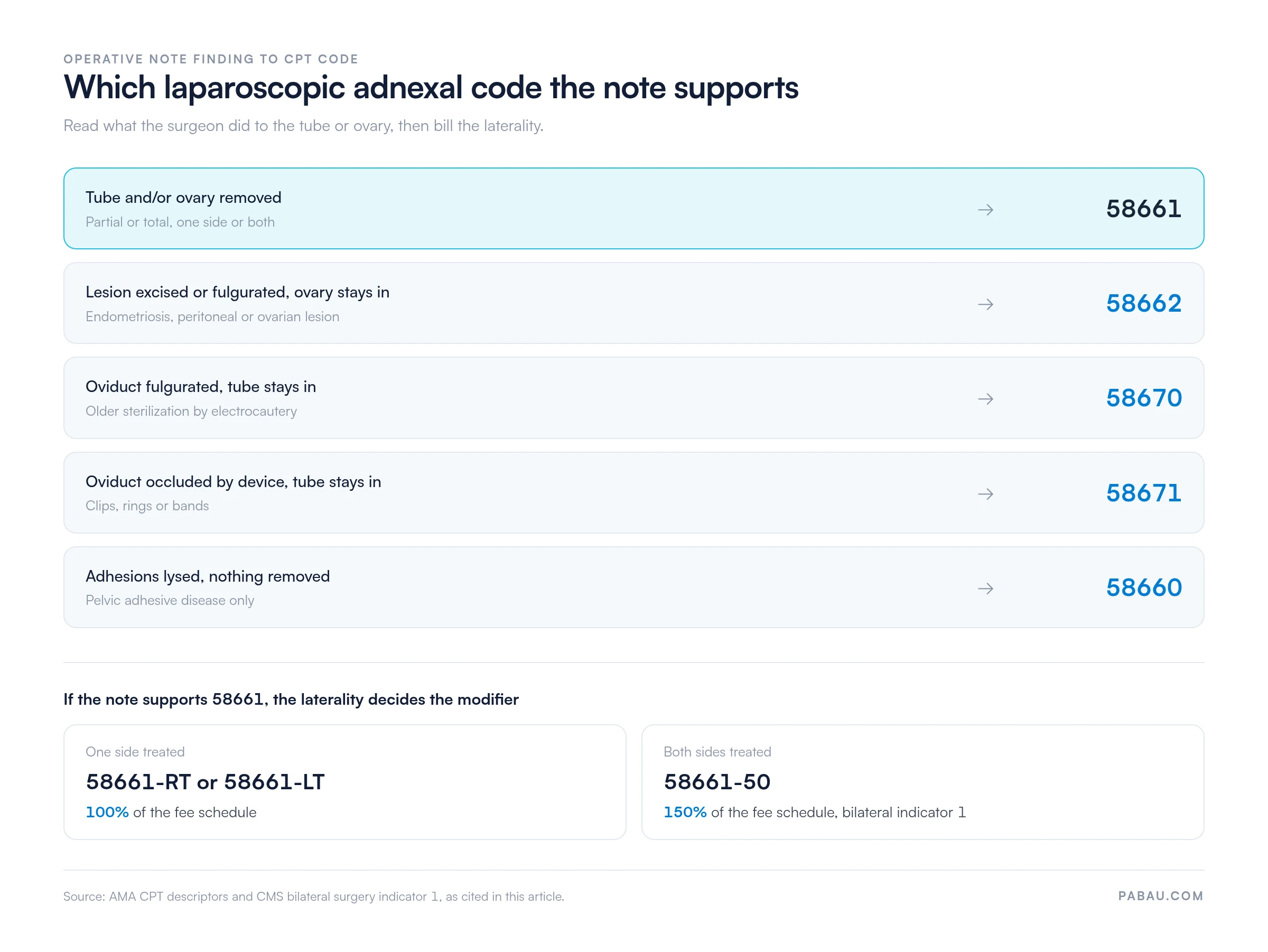
The most frequent mix-up is 58661 versus 58662. If the ovary is excised, 58661 applies. If an ovarian lesion is excised but the ovary itself stays in place, 58662 is correct. Reading the operative note for the phrase “ovary removed” rather than “lesion excised from ovary” settles almost every case.
The same logic separates 58661 from the sterilization codes. 58670 and 58671 cover methods that leave the tube in place but render it non-functional. Once the tube is physically removed, 58661 is the right code.
A hysterectomy in the same session changes the answer again. The hysterectomy descriptor already covers the adnexal removal, so 58661 does not go on the same-session claim. For a vaginal hysterectomy of a uterus 250 g or less with a tube or ovary out, that code is 58262.
CPT 58661 can be a preventive code, but only when the procedure is voluntary sterilization and the payer classifies it that way. The Affordable Care Act mandates sterilization as a preventive service for women, so it should be covered with no cost-share when billed as preventive. Many payers still route 58661 through their surgical benefit instead. Deductibles and co-insurance then land on the patient, and the provider can face different documentation requirements.
The National Women’s Law Center has documented repeated instances of insurers applying cost-sharing to sterilization procedures incorrectly. According to AMA coding resources, the CPT code itself does not decide the benefit bucket. Payer classification policy does. Practices billing bilateral salpingectomy for sterilization with Z30.2 should:
When the procedure is medically indicated for another reason, the surgical benefit classification is correct. Ectopic pregnancy and ovarian cysts sit in that group, and the preventive rules do not apply. The clinical indication in the operative report decides which pathway the claim belongs in.
Thin documentation is the second most common reason 58661 claims are denied, after benefit classification disputes. The operative report has to carry specific elements for the claim to survive payer review. A report saying “laparoscopic bilateral salpingectomy performed without complications” will usually get paid the first time, then get flagged on audit.
Required operative report elements for 58661:
Practices that use a structured operative note template for laparoscopic adnexal procedures catch missing elements before claims go out. Connecting those templates to a claims management software workflow that flags incomplete fields is the most reliable way to prevent documentation denials on 58661.
Pabau’s integration with Claim.MD also cross-references the submitted diagnosis codes against the procedure code before transmission. Mismatched pairings that would otherwise come back as a medical necessity denial get caught while the claim can still be corrected.
58661 denial patterns are predictable. The same four or five rejection triggers repeat across OB/GYN practices, which makes them preventable with the right pre-submission workflow.
When a claim is denied despite proper documentation, the appeal starts with the Explanation of Benefits and the reason code printed on the remittance. Mapping each rejection to the standard denial codes shows whether a cluster is a payer-side processing error or an internal documentation problem. Each reason code then points to its own appeal strategy, so the root cause can be fixed rather than re-argued every month.
Same-session surgery creates one more denial trigger. When the operation is a laparoscopically assisted vaginal hysterectomy, the adnexal removal already sits inside 58552. Reporting 58661 alongside it is an unbundling error.
Practice management software supports accurate 58661 billing by closing the handoffs where the claim usually breaks. Documentation, modifier, and benefit-classification requirements for this code create several failure points between the operating room and the payer. Every pass between surgeon, coder, biller, and clearinghouse is a chance for an error that surfaces as a denial weeks later.
Pabau’s integration with Claim.MD connects the billing workflow to a clearinghouse that supports CMS-1500 and 837P claim formats. It also carries real-time eligibility verification and automated ERA/835 remittance posting. For 58661 specifically, that means:
For an OB/GYN practice running a steady volume of laparoscopic cases, the payoff is fewer reworked claims. Errors get corrected before the payer processes them, rather than after. Denials get caught while the operative note is still fresh and the coder can still act on it.

Pabau integrates with Claim.MD to validate CPT 58661 claims before they reach the payer, flag missing modifiers, and automate remittance posting. See how OB/GYN practices use Pabau to reduce denials and speed up reimbursement.

CPT code 58661 covers a wide range of laparoscopic adnexal procedures, from bilateral salpingectomy for sterilization to oophorectomy for malignancy. That flexibility is also the billing risk. Without precise documentation, the right modifier, and a verified benefit classification, the claim lands in the wrong bucket or gets denied outright.
The decision worth internalizing is small: removal means 58661, and laterality sets the modifier. The rest follows from getting those two facts out of the operative note before the claim is built. The appeal template and the payer policy check both depend on them.
Pabau’s claims management platform builds that check into the submission workflow, with eligibility verification, claim scrubbing, and automated remittance posting in one place. Book a demo to see how OB/GYN practices keep 58661 claims out of the appeals queue.

Managing claims for OB/GYN laparoscopic procedures? Revenue cycle management in healthcare covers the full billing lifecycle from eligibility through remittance posting.
Need to understand clearinghouse options for surgical claims? Claim.MD vs Office Ally compares Pabau’s clearinghouse partner against a leading alternative for US practices.
Billing IVF-related procedures alongside adnexal surgery? IVF procedure CPT codes covers the billing codes most commonly encountered in reproductive medicine alongside 58661.
CPT code 58661 covers laparoscopic surgical removal of adnexal structures. That means partial or total oophorectomy, salpingectomy, or any combination of the two performed through a laparoscopic approach. It applies to bilateral salpingectomy for sterilization, unilateral oophorectomy for a cyst or malignancy, and salpingo-oophorectomy for any documented clinical indication.
CPT 58661 can qualify as an ACA-mandated preventive service when it is performed for voluntary sterilization, but payer classification varies. Billing Z30.2 as the primary diagnosis signals preventive intent, and many commercial payers still route the claim through the surgical benefit. Verify the payer’s preventive sterilization policy before the procedure, and be ready to appeal if cost-sharing is applied.
Yes. When both adnexal structures are removed in the same surgical session, append modifier 50 for most payers. Medicare’s bilateral surgery indicator of 1 then pays 150% of the single procedure rate. Some payers prefer RT and LT modifiers on two separate claim lines instead. Verify each payer’s bilateral billing preference before submission.
CPT 58661 is used when adnexal structures, meaning the tube and/or ovary, are physically removed. CPT 58662 applies when a lesion on the ovary, pelvic viscera, or peritoneal surface is excised or fulgurated while the ovary stays in place. The dividing line is removal. Misapplying these two codes is a common audit trigger.
The most common denial reasons for 58661 are incorrect benefit classification under the ACA and missing prior authorization. A missing or wrong modifier on a bilateral procedure runs a close third. Thin operative note documentation and ICD-10 codes that do not support medical necessity account for most of the rest. Pre-submission eligibility verification and claim scrubbing prevent the majority of them.
The codes most often paired with 58661 are Z30.2 for sterilization and N83.20, N83.201 or N83.202 for ovarian cysts. C56.1 and C56.2 cover ovarian malignancy. Others include O00.10 and O00.11 for ectopic pregnancy, N83.51 for adnexal torsion, N70.11 for chronic salpingitis, and Z40.02 for prophylactic ovary removal. Match the diagnosis to the clinical indication in the operative report.