CCSD code H4430: Examination of rectum under anaesthetic
CCSD code H4430 pays for the examination alone CCSD code H4430 is the UK private...

Last Updated: Oct 20, 2026
51700 is the CPT code for simple bladder irrigation, lavage and/or instillation, performed through a catheter. It covers washing clots or debris out of the bladder and instilling a non-anticarcinogenic agent, such as DMSO.
The code sits in the Introduction procedures on the bladder subsection (51600-51721). An anticarcinogenic instillation, such as BCG or mitomycin C, is reported with 51720 instead. During the 90-day global period after TURP, clot irrigation outside the operating room is part of the surgical payment.
Let Pabau's smart automation suggest the right codes, reduce claim denials, and keep your practice compliant—effortlessly.
Automate repetitive tasks and focus on what matters most—your patients.
Reduce coding errors and ensure compliance with the latest regulations.
Clean claims, fewer denials, and faster reimbursements.
Powerful insights and reporting to help your practice thrive.
HIPAA compliant SOC 2 certified GDPR-compliant Trusted by 4,000+ clinics worldwide

CPT code 51700 covers simple bladder irrigation, lavage and/or instillation, so it includes clot washouts and non-anticarcinogenic instillations such as DMSO.
The agent decides between 51700 and 51720. Anticarcinogenic agents such as BCG, mitomycin C, and gemcitabine go to 51720, which includes retention time.
Clot irrigation during the 90-day global period after TURP is part of the surgical payment. A return to the operating room is reported with modifier 78.
Under the CY2026 fee schedule, 51700 carries 2.34 total RVUs in the office and 0.78 in a facility, about $78 and $26 nationally.
Practice management software like Pabau keeps the agent, indication, and diagnosis in one note, then sends the claim through Claim.MD.
CPT code 51700 describes simple bladder irrigation, lavage and/or instillation, performed through a catheter. The official AMA descriptor reads Bladder irrigation, simple, lavage and/or instillation.
The code sits in the Introduction procedures on the bladder subsection (51600-51721) of the urinary system surgery codes. CMS assigns it a 0-day global period, so no pre- or post-procedure care is bundled into its payment.
The AMA’s CPT code set puts lavage and instillation in the same descriptor. Lavage washes clots, debris, or sediment out through the catheter. Instillation places a solution in the bladder to act on the bladder wall. Both are 51700, as long as the agent isn’t anticarcinogenic.
CPT 51700 is reported once per session, however many passes the irrigation takes. It applies in the office and in facility settings.
Clinical scenarios where 51700 is correctly reported include:
The agent itself isn’t part of 51700. Where the payer covers the drug, it is reported separately with the HCPCS code that matches it.
Place of service changes the payment, not the code. Report POS 11 for the office and POS 22 for a hospital outpatient department. CMS pays a higher non-facility rate in the office, because the practice supplies the catheter, solution, and staff time.
The line between 51700 and 51720 is drawn by the agent in the bladder, not by whether fluid comes back out. CPT 51720 reads Bladder instillation of anticarcinogenic agent (including retention time).
It applies only to anticarcinogenic agents such as BCG, mitomycin C, or gemcitabine, and its payment includes the time the agent dwells. Every other simple lavage or instillation stays with 51700. The catheter codes 51701 and 51702 describe placing a catheter, with no irrigation or instillation at all.
The agent test: read the drug name in the note before you pick the code. A saline washout or a DMSO instillation is 51700. A BCG or mitomycin C instillation is 51720. A contrast fill for imaging rather than treatment is 51600.
Getting this wrong cuts both ways. A BCG instillation coded as 51700 underpays the service and misstates what was given. A DMSO instillation coded as 51720 overstates it and invites a medical necessity denial. Record the agent, its dose or volume, and any dwell time, so the code choice is visible in the chart.
The National Correct Coding Initiative (NCCI) policy manual, Chapter 7, covers CPT codes 50000-59999. Two code pairs cause most 51700 edit denials.
51700 and the catheter codes: placing the catheter used for the irrigation is part of 51700. Report 51701 or 51702 on the same date only when the catheter served a separate purpose, such as a Foley left for urinary retention. That case needs a distinct-service modifier (59 or XS) and a note showing two separate services.
If that separately indicated catheter is a suprapubic tube rather than a urethral one, the placement is reported with CPT code 51102.
51700 and 51720: a flush done as part of an anticarcinogenic instillation belongs to 51720, and billing 51700 for it is unbundling. Both codes are reported only when a separate irrigation has its own indication, such as clot retention unrelated to the instillation. Check the current NCCI procedure-to-procedure table before you append a modifier.
A clean first submission means checking every code pair billed on the same date. The chart must also support any modifier you apply.
The global period rule causes the costliest 51700 errors. Under Medicare’s global surgery rules, clot irrigation after a major procedure such as TURP is routine post-operative care when it’s done outside the operating room.
That applies in the recovery room, on the inpatient ward, and in the office during the 90-day global period. Clot formation is an expected outcome of prostate surgery, so managing it belongs to the surgical package.
The operating room exception: a return to the operating room to manage the clot is reported with modifier 78. The note needs separate anesthesia, a new surgical setup, and its own procedure note. Without modifier 78, the claim is denied as post-operative care.
Put the agent test and the global period check together, and each bladder irrigation claim comes down to two questions asked in order.
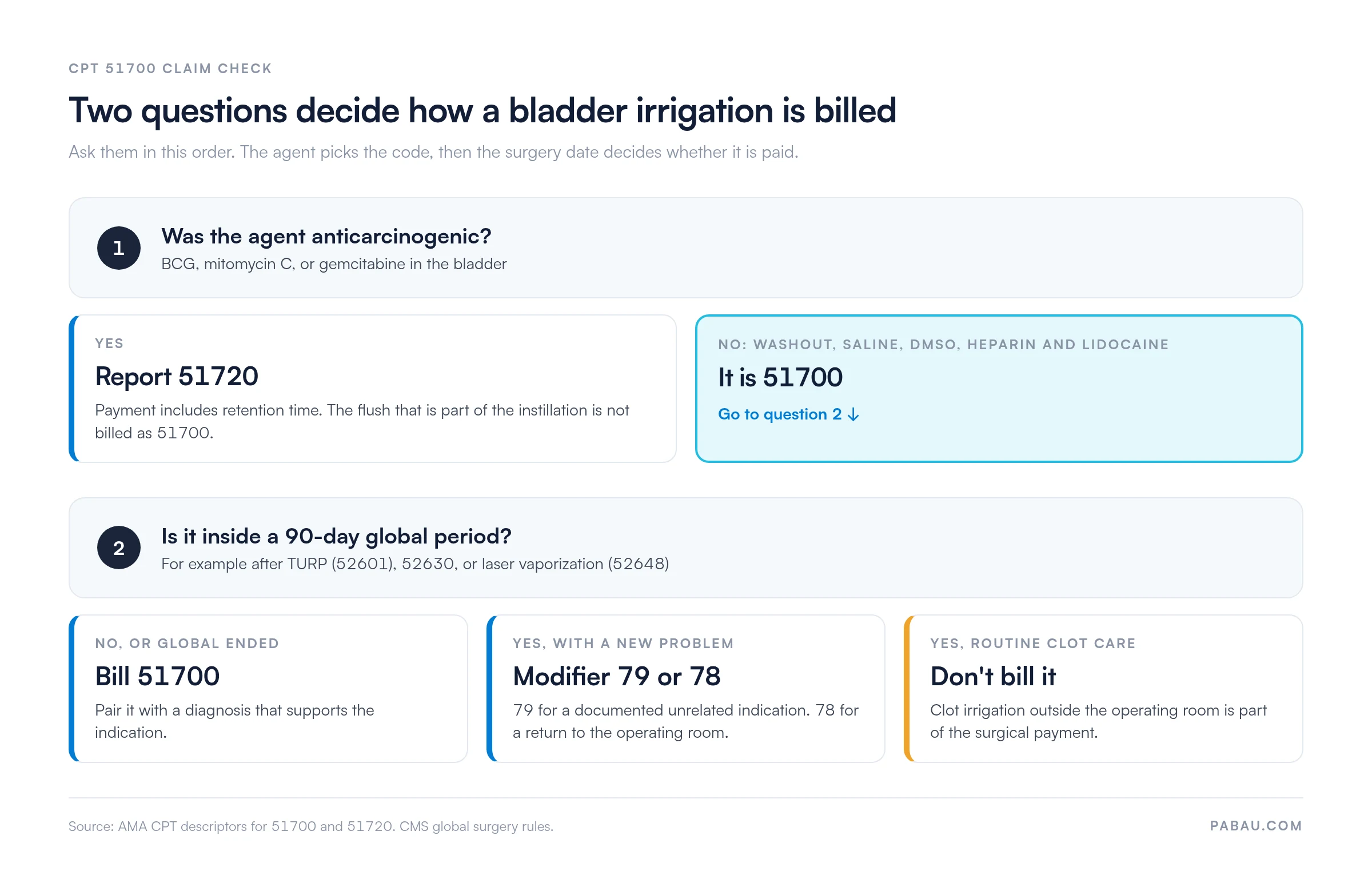
Link a global period flag to the surgical CPT code and its date of service. When 51700 is entered inside that window, your biller confirms which case applies. It is routine post-operative care, a return to the operating room (modifier 78), or an unrelated episode (modifier 79).
Medicare pays CPT 51700 under the Medicare Physician Fee Schedule (MPFS). With a 0-day global period, the full allowed amount covers the date of service only.
The figures below come from the CMS CY2026 physician fee schedule relative value file. CY2026 has two conversion factors: $33.5675 for qualifying APM participants and $33.4009 for other clinicians. Payment also varies by locality, so verify your rate with the CMS Physician Fee Schedule lookup tool.
The office rate is about three times the facility rate, because the practice supplies the catheter, solution, and nursing time. In a facility, the hospital is paid for those costs instead. For comparison, 51720 carries 2.75 non-facility RVUs, which reflects its retention time.
Private payer contracted rates often differ from Medicare allowables. For practices billing 51700 often, electronic remittance advice (ERA) through a clearinghouse makes it easier to reconcile posted payments against expected amounts.
Payers deny 51700 claims more often for thin documentation than for the wrong code. The chart must establish medical necessity, describe the procedure, and capture the outcome. A note that says “bladder irrigation done” gives an auditor nothing to accept.
Required documentation elements include:
Pair 51700 with an ICD-10-CM code that matches the documented indication. Common pairings include R31.0 (gross hematuria), N30.10 and N30.11 (chronic interstitial cystitis, without or with hematuria), and T83 codes for catheter complications.
An unspecified code such as R31.9 next to a one-line note is a red flag in payer audits. A vague note also weakens the superbill for every other charge on that encounter.
Verifying coverage before the visit prevents retroactive denials. An eligibility check confirms that the plan covers the procedure and that any referral or authorization is in place before the solution is drawn up.
Record the volume in and the volume out for every 51700 washout. A large imbalance, with more instilled than returned, supports medical necessity for clot obstruction. It also separates the service from a routine catheter flush.
Preventing 51700 denials starts with the categories that show up most often on remittance advice. Reading the denial codes billers see next to their remark codes helps staff route appeals quickly.
Urology practices that bill 51700 often see the same denials repeat. Global period conflicts, a code that doesn’t match the agent, and a vague diagnosis are the usual causes. Most of them start with a note that doesn’t show what was instilled or why.
Practice management software like Pabau keeps the treatment note, the agent, and the diagnosis together in the patient record. Pabau’s claims tools for billing teams pull those details into a pre-filled claim, so your team isn’t re-keying charges. US practices submit claims through Claim.MD and check eligibility and claim status in the same place.
Your billers still apply the coding rules. With the full encounter in one record, a post-TURP global period or a missing dwell time is easier to spot before the claim goes out. That means fewer resubmissions for every 51700 visit.

Pabau keeps your urology notes, diagnoses, and claims in one record, then submits claims through Claim.MD. Your CPT 51700 claims go out complete the first time.

CPT code 51700 is broader than its short name suggests, because lavage and instillation both sit inside it. The agent decides the code, and the surgery date decides whether it gets paid. A practice that codes by the drug name and tracks prostate surgery dates avoids the two errors payers catch most.
Pabau keeps the note, the diagnosis, and the claim in one workflow for your urology team. Book a demo to see how practices use Pabau to get codes like CPT 51700 paid on first submission.

Want a structured framework for reducing claim denials across all codes? Denial management in healthcare covers how to build a systematic approach to identifying, appealing, and preventing recurring denial patterns.
Need to understand how claims move from submission to payment? Electronic remittance advice explains the ERA format, how to read CARC/RARC codes, and how clearinghouse integration speeds up posting.
Looking for a clean-claim checklist before submission? Clean claim requirements outlines the fields payers validate on first pass and the most common fields that trigger edits.
Measuring retained urine before or after a washout? CPT code 51798 explains how post-void residual measurement by ultrasound is billed and documented.
Is the next step a look inside the bladder? CPT code 52000 walks through how a diagnostic cystourethroscopy is coded and billed.
CPT code 51700 is the procedure code for simple bladder irrigation, lavage and/or instillation through a catheter. It covers washouts of clots or debris and instillations of non-anticarcinogenic agents, such as DMSO. It sits in the Introduction procedures on the bladder subsection, codes 51600-51721.
Clot irrigation during the 90-day global period of a major procedure such as TURP is part of the surgical payment. A return to the operating room is reported with modifier 78. An unrelated indication during the global period takes modifier 79. After the global period ends, 51700 is billed normally with a supporting diagnosis.
Yes. Under the CY2026 Medicare Physician Fee Schedule, 51700 carries 2.34 total RVUs in the office and 0.78 in a facility. That comes to about $78 and $26 at national rates, before locality adjustment. Check the CMS Physician Fee Schedule lookup for your locality.
Yes. NCCI procedure-to-procedure edits bundle 51700 with related catheter and bladder procedures, including 51720 when the flush is part of the instillation. A modifier such as 59 or XS overrides an edit only when the services were distinct and the note shows it. Check the current NCCI table for each pair.