

HCPCS code E0198: Water pressure pad billing guide
HCPCS code E0198 is a water pad for a standard mattress HCPCS code E0198 is the ...

Last Updated: Oct 13, 2026
CPT code 51702 covers simple insertion of a temporary indwelling bladder catheter, usually a Foley. Report it when the catheter goes in by routine technique, with no stricture, dilation or guide wire.
Catheter type decides the code. An indwelling balloon catheter is 51702, a straight in-and-out catheter is 51701, and a difficult insertion needing special equipment is 51703. Billers who blur that line either lose the payment or invite an upcoding review. The diagnosis pairing, the modifier and the payment amount all follow from that first choice.
Let Pabau's smart automation suggest the right codes, reduce claim denials, and keep your practice compliant—effortlessly.
Automate repetitive tasks and focus on what matters most—your patients.
Reduce coding errors and ensure compliance with the latest regulations.
Clean claims, fewer denials, and faster reimbursements.
Powerful insights and reporting to help your practice thrive.
HIPAA compliant SOC 2 certified GDPR-compliant Trusted by 4,000+ clinics worldwide

CPT code 51702 covers simple insertion of an indwelling Foley catheter, filed under Introduction Procedures on the Bladder (51600-51721).
Catheter type picks the code, with 51701 for a straight catheter, 51702 for an indwelling Foley, and 51703 for a complex insertion.
Medicare pays roughly $65 in a non-facility setting and $22 in a facility for 2026, before geographic adjustment.
A same-day E/M service needs modifier 25 on the E/M code, or NCCI edits bundle it into 51702.
Pabau’s claims management software pre-fills claim fields from the patient record and checks each claim for required information before submission.
CPT code 51702 is the billable procedure code for inserting a temporary indwelling bladder catheter by simple technique.
The American Medical Association names the Foley as the example in its CPT code set. Coders reproduce that official descriptor on the claim rather than paraphrasing it.
A zero-day global period means no pre- or post-operative service is bundled into the payment. A same-day follow-up visit stays separately reportable, subject to the bundling rules further down.
Three codes cover bladder catheter insertion. Two facts in the note separate them, namely catheter type and technical difficulty. Reading those two facts wrong is the most common upcoding risk in urology billing.
Routine Foley placement with no obstruction is 51702. Move to 51703 only when the insertion needed dilation, a guide wire, a coude catheter past a stricture, or access through a Monti channel.
The note has to name the complication that raised the complexity. A line about the patient being difficult to catheterize will not support 51703.
Medicare pays two different rates for 51702, depending on where the service happens. The CMS Physician Fee Schedule lookup tool publishes current amounts by code, locality and facility status.
Figures below are 2026 national unadjusted amounts, before the geographic practice cost index is applied. Your paid rate will vary by MAC jurisdiction.
The spread between the two settings is wide. In a hospital or ASC, Medicare pays the facility an ambulatory payment classification rate for overhead. The physician side then drops to about a third. Check the fee schedule tool before you set an expected reimbursement.
Commercial payers price this code very differently. Some pay above Medicare, while others set a percentage of Medicare as a contractual floor. Practice management software like Pabau posts the remittance back to the patient ledger once the payer adjudicates. Nobody keys the payment in twice.
Relative value units are how Medicare builds the fee schedule amount. Three components make up the total for 51702.
Each one is adjusted by a geographic index, then multiplied by the CMS conversion factor, which is about $33.40 for 2026. You can check current values in the FastRVU 2026 RVU lookup tool, which mirrors CMS fee schedule data.
Practice expense is the component that moves. In-office, the practice buys the catheter and pays the nurse, so the non-facility practice expense RVU carries almost twelve times the facility figure. That difference is the whole reimbursement spread in the table above.
A CPT claim only pays when the diagnosis supports it. Payers deny 51702 when the paired ICD-10-CM code gives no clinical reason for catheterization.
Pull the diagnosis from the procedure note, not from a default the system offers. Our ICD-10-CM code library carries the full descriptors for the codes below.
Pick the most specific code the chart supports. Billing R33.9 when the note documents BPH-related obstruction leaves money on the table, and some payer LCD policies reject it outright. Confirm each code is active for FY2026 before you submit.
Modifiers tell the payer that something changed about how the service was delivered. Pick the wrong one, or leave out a required one, and the denial follows quickly.
Modifier 25 gets misapplied more than any other. It belongs on the evaluation and management code, not on 51702. The note has to show that the E/M decision-making stood apart from the decision to catheterize.
Take a man who arrives with abdominal pain and cannot void. The physician works up the pain, orders a bladder scan, and then places a Foley. That is a same-day E/M with modifier 25, plus 51702, because the evaluation covered more than the catheter decision. Drop the modifier and the payer pays only 51702.
A denied 51702 claim usually broke at a specific step, not across the whole process. Five stages sit between the catheter going in and the payment posting, and each one has a single common failure.
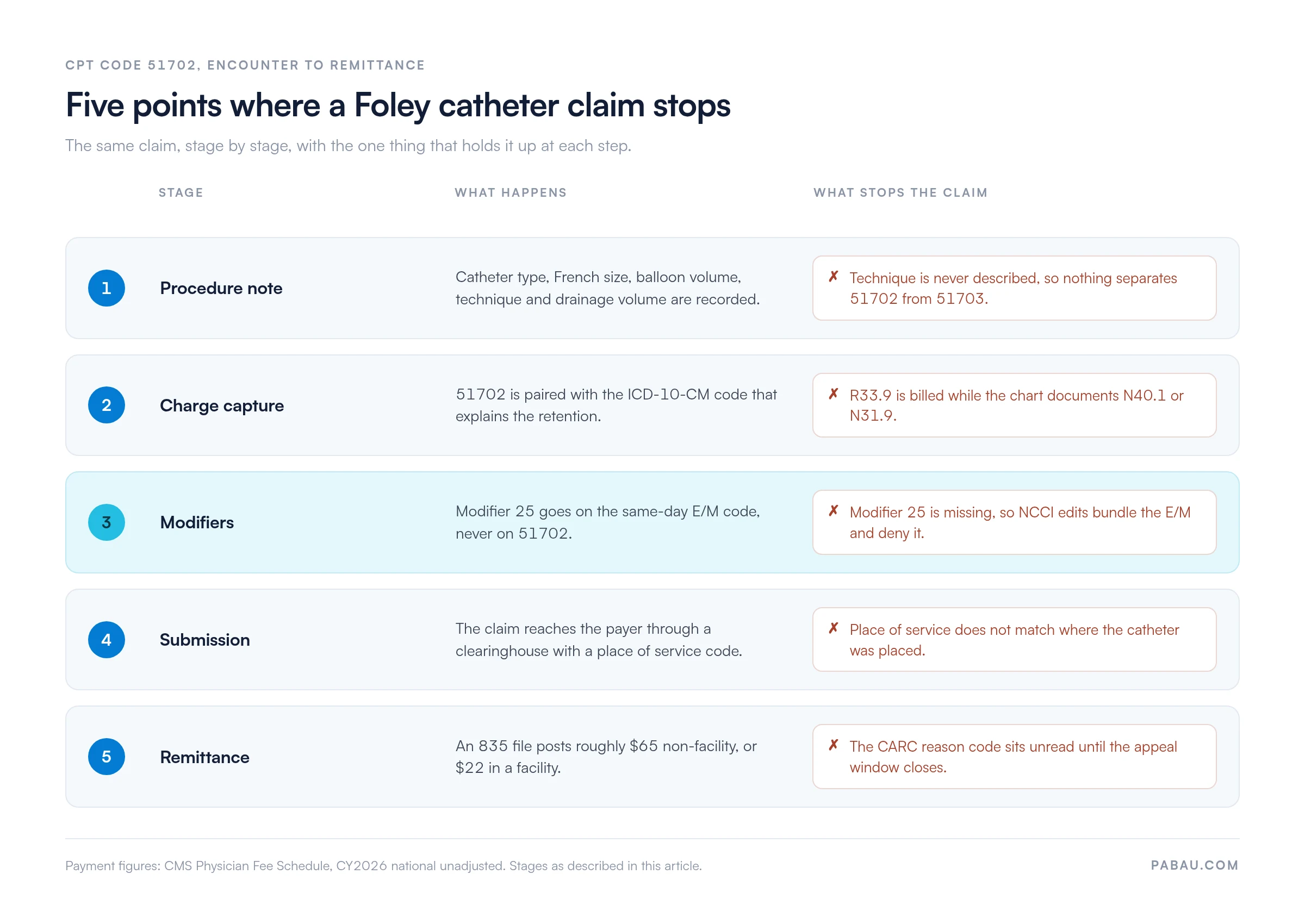
Stages one and two happen in the room and in the charge entry screen. Stage three is the modifier decision, which is where same-day E/M money is won or lost. Stage four is submission, where the place of service code has to match the setting. Stage five is the electronic remittance advice, the 835 file that reports what was paid and why.
Before the claim goes out, confirm six things:
CMS expects the record to support the medical necessity, complexity and outcome of a billed procedure. For 51702, the procedure note carries six elements. Leave one out and you raise both audit exposure and denial risk.
When catheterization follows a same-day evaluation, the note also records the separate clinical decision that led to the procedure. That entry is what supports modifier 25 if an auditor asks.
Run a quarterly spot-check on your 51702 notes. Pull five records at random. Confirm each one names catheter type, French size, balloon volume, technique, drainage volume and provider credentials. Update your charting template if any field comes back blank.
The National Correct Coding Initiative pairs codes that should not both be paid for the same encounter. Submit a bundled pair with no valid modifier and the secondary code is denied automatically. CMS updates the edit tables four times a year, so check them quarterly.
NCCI generally bundles 51702 with an E/M service on the same date. Modifier 25 on the E/M, never on 51702, unbundles the pair when the evaluation stood on its own. The documentation has to back that up.
When cystoscopy such as 52000 happens in the same session, NCCI usually treats the catheter insertion as incidental. Modifier 59 on 51702 can apply if the catheterization happened at a separate time for a distinct reason. Confirm the current edit status first.
Cystoscopic injection codes such as 51715 include the urethral access, so check the edit before billing a catheter alongside them.
Catheterization performed only to run urodynamic testing is bundled into the urodynamic code. Bill 51702 separately only when the Foley stayed in afterward for a distinct therapeutic purpose.
Drug instillation follows the same logic. A catheter placed to deliver an anticarcinogenic agent is part of 51720, so 51702 is not billed separately for it.
Catching a bundling conflict before submission beats arguing it after a rejection. Pabau checks each claim for the information a payer requires, then sends it through the clearinghouse for your region. The NCCI edit tables still need a human reading them each quarter.
Denials on this code repeat the same short list. Knowing the pattern tells a billing team where to put its checkpoints.
Start by pulling your remittance data and sorting denials for 51702 by reason code. One month of that data usually shows which of these five is costing you, and a quarterly coding audit rarely surfaces it as fast.
A 51702 claim usually fails for a reason that was fixable in the exam room. The catheter type never reached the note, or the charge sat unposted while the filing window ran down. Both problems start with documentation and billing living in separate systems.
Pabau keeps both in one record. The clinician writes the procedure note against the appointment, and the charge is raised from that same note. The biller then codes from what was documented, rather than from memory.
Claim fields pull from the patient’s file, and each claim is checked for the information a payer requires before it leaves the practice. That gives a urology practice claims management without rekeying.
Claims reach US payers through the Claim.MD clearinghouse, and remittances come back as 835 files. CARC denial reason codes show in the dashboard, so the billing team can correct and resubmit in the same system.

Pabau’s claims management software pre-fills claim fields from the patient record, checks each claim for required information, and submits it through the Claim.MD clearinghouse. See how urology and multi-specialty practices run 51702 billing end to end.

51702 is a small payment with a narrow set of ways to lose it. Confuse it with 51701 or 51703, or skip modifier 25 on a same-day E/M, and the claim comes back. Leaving the technique out of the note has the same result.
The fix sits upstream of the claim. Get the six documentation elements into the procedure note as it is written, and the coding decision makes itself. A practice that does that stops relitigating the same five denials every quarter.
Pabau handles the submission and remittance side of that workflow inside the patient record. Book a demo to see how a urology or multi-specialty practice runs 51702 billing end to end.

List Item #1
List Item #2
No. Routine removal has no separate CPT code, because it is part of the service when the same provider placed the catheter. If a different provider removes it, or removal takes a significant separate service, report an appropriate E/M code with documentation.
Yes, in an office setting, when Medicare’s incident-to requirements are met. The physician must be in the office suite providing direct supervision, and the patient needs an established plan of care. The claim then goes out under the supervising physician’s NPI.
No, not on the professional claim. Medicare builds office supplies into the practice expense component of 51702, so the catheter is already paid for. Ongoing home catheter supplies run through the durable medical equipment benefit on HCPCS codes instead.
Rarely, and only when a second insertion is medically necessary. A catheter that fails or gets dislodged can justify a repeat placement. Append modifier 76 to the second line, and record the reason for the repeat in the note.
Medicare does not require prior authorization for 51702. Some commercial and Medicaid managed care plans do apply authorization rules to urology procedures, so check the plan’s policy before a scheduled catheterization. Emergency placement is not usually affected.



