CPT code 93503: Swan-Ganz catheter billing and modifiers
CPT code 93503: Official descriptor and procedure overview In the AMA CPT code s...

Last Updated: Oct 23, 2026
44205 is the CPT code for a laparoscopic partial colectomy with removal of the terminal ileum and an ileocolostomy. In plain terms, it covers a keyhole right colectomy. The surgeon removes the end of the small bowel with a colon segment, then joins the ileum to the remaining colon.
The code fits only when the operative note confirms both the ileum resection and the ileocolostomy. Without them, the case belongs to a sibling code such as 44204 or 44207. Below, you'll see how to pick between those codes, what the op note must say, and how to avoid denials.
Let Pabau's smart automation suggest the right codes, reduce claim denials, and keep your practice compliant—effortlessly.
Automate repetitive tasks and focus on what matters most—your patients.
Reduce coding errors and ensure compliance with the latest regulations.
Clean claims, fewer denials, and faster reimbursements.
Powerful insights and reporting to help your practice thrive.
HIPAA compliant SOC 2 certified GDPR-compliant Trusted by 4,000+ clinics worldwide

CPT code 44205 needs four elements in the op note: a laparoscopic approach, a partial colectomy, terminal ileum removal, and an ileocolostomy.
Terminal ileum removal separates 44205 from 44204, and the ileum-to-colon join separates it from the colon-to-rectum join of 44207.
A case converted to open surgery moves to 44160, the open equivalent of this procedure.
Medicare gives 44205 a 90-day global period, so routine follow-up visits are bundled unless modifier -24, -78, or -79 applies.
Most commercial payers want prior authorization for an elective 44205, while traditional Medicare does not require it.
CPT code 44205 reports a laparoscopic partial colectomy that removes the terminal ileum and joins the ileum to the remaining colon. Surgeons often call it a laparoscopic right hemicolectomy.
The official descriptor from the American Medical Association reads: Laparoscopy, surgical; colectomy, partial, with removal of terminal ileum with ileocolostomy.
Each phrase in that descriptor works as a billing condition. Here’s what each one asks the op note to show:
The quick reference below pulls the code’s key facts into one place.
The laparoscopic excision family for the intestines runs from 44202 to 44213. It covers small bowel resections (44202, 44203), partial colectomies (44204-44208), and total colectomies with a splenic flexure add-on (44210-44213).
Within the partial colectomy codes, two facts pick the code. The first is whether the terminal ileum came out. The second is how the surgeon rebuilt the bowel. Because each code carries a different relative value, payers audit this family closely.
The table compares the five partial colectomy codes side by side.
The 44204 vs 44205 decision point: start with what the op note describes. If the right colon and terminal ileum came out together, with the ileum joined to the colon, that’s 44205. If the resection stops at the ileocecal valve and leaves the terminal ileum in place, report 44204 instead.
The wording matters here. A note that only says “right hemicolectomy” doesn’t confirm the ileum resection or the anastomosis type. In that case, the coder can’t assign 44205 without first querying the surgeon. The diagram below walks through the same decision in three questions.
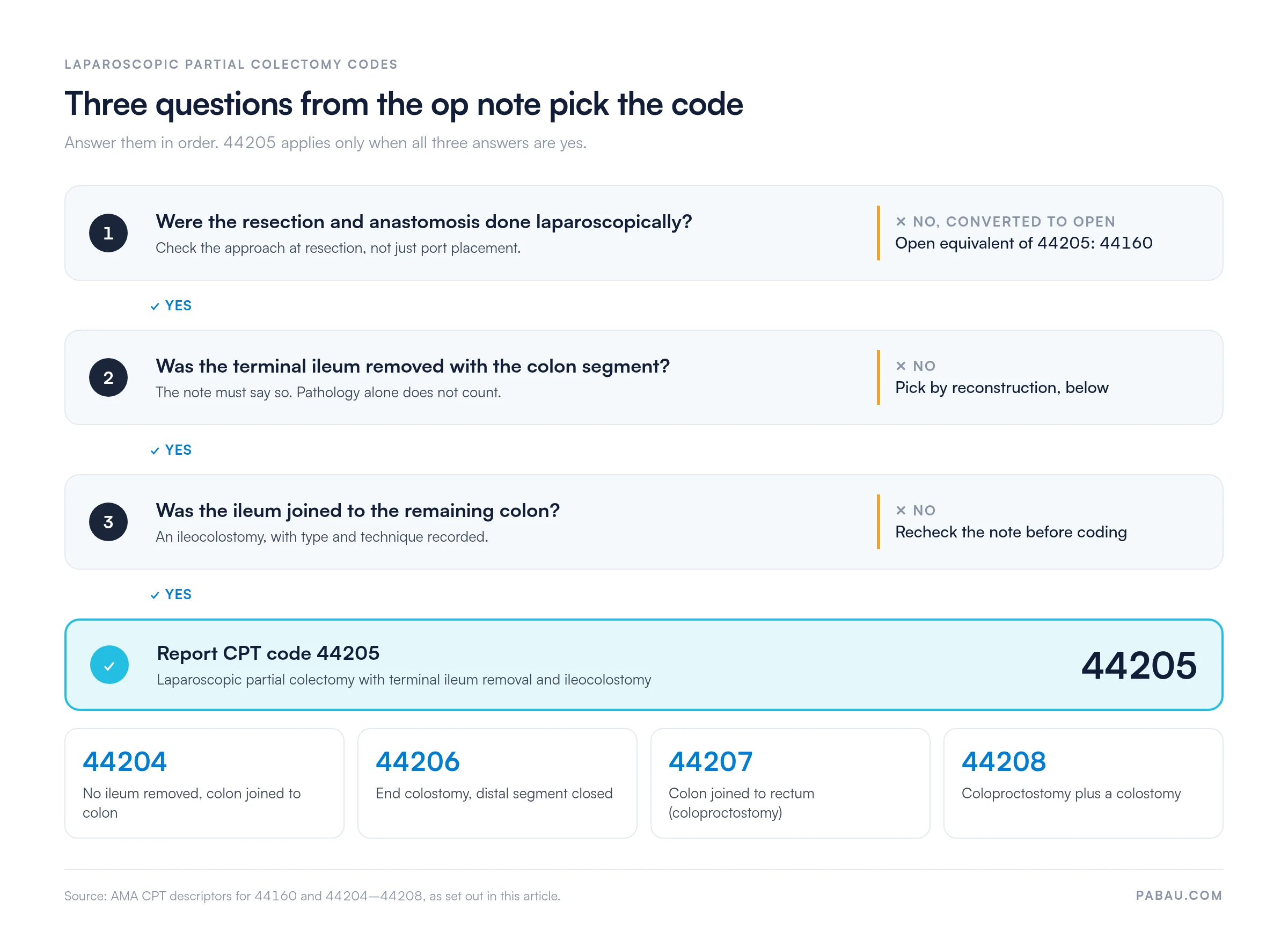
Sometimes a case starts laparoscopically and finishes open. When that happens, drop 44205 and report the open equivalent, 44160. Billing 44205 for a case that ended open is an audit trigger. So the op note needs to state the approach used for the resection and anastomosis, not just for port placement.
Payers reviewing a 44205 claim look for four details in the operative report. If one is missing, expect a denial or a downcode to 44204.
Here’s how that plays out on paper. “Laparoscopic right hemicolectomy” alone is too thin to code. By contrast, “laparoscopic resection of the right colon and terminal ileum, with stapled side-to-side ileocolic anastomosis” supports 44205 without a query.
Ideally, the coder checks all four details against the note before charge entry. That way, the superbill matches the op note from the start.
Medical necessity for 44205 depends on a diagnosis that justifies removing both colon and terminal ileum. The diagnosis must appear in the patient record.
It should also be as specific as the operative findings allow. A generic colorectal code, used when the findings point somewhere more specific, invites a medical necessity review.
For pairings outside this list, a CPT-to-ICD-10 crosswalk tool helps confirm the diagnosis fits the surgical scope of 44205. You can also check exact codes and titles in the full ICD-10-CM code list.
Check the local coverage determination (LCD) from your Medicare Administrative Contractor (MAC) before you submit. Some MACs keep specific diagnosis lists for laparoscopic colectomy. A diagnosis on that list heads off the most common medical necessity denial for 44205.
Modifier choice for 44205 follows the National Correct Coding Initiative (NCCI) edits published by CMS. These edits decide which codes can be billed alongside 44205.
They also set which modifiers can override a bundling edit. A wrong or missing modifier leads to an automatic denial or an audit finding.
Modifier -22 draws audits. Payers that receive 44205 with -22 routinely ask for the operative report. So quantify the extra work where you can, for example “procedure extended by 90 minutes due to dense adhesions from prior appendectomy.” A vague -22 note can create False Claims Act exposure if the payer decides the complexity wasn’t increased.
CPT code 44205 carries a 90-day global surgical period. Routine postoperative care from the day of surgery through day 90 is part of the surgical payment. That means you can’t bill separate E/M visits for normal recovery.
Three modifiers allow separate billing inside the global window:
Medicare sets 44205 payment through the Physician Fee Schedule, which you can search with the CMS Physician Fee Schedule lookup tool. Rates differ for facility and non-facility settings. Geographic practice cost indices (GPCIs) then adjust the payment in each MAC region.
It’s worth rechecking the rate every January, when the new fee schedule takes effect. The figures below are approximate starting points.
For exact current-year values with your locality applied, use FastRVU’s lookup tool. RVUs and the conversion factor change each year with the final rule. As a result, figures in older coding references may no longer hold.
Most commercial payers require prior authorization (PA) for an elective laparoscopic colectomy. Traditional Medicare doesn’t require PA for 44205. It does, however, review medical necessity in post-payment audits. Rules still vary by payer and plan year, so check each plan separately.
A commercial PA request for 44205 usually needs:
Build the PA check into your eligibility verification before surgery is booked. A missing PA is one of the easiest colectomy denials to prevent.
Emergency cases work differently. When PA can’t be obtained in advance, most payers accept a retrospective request if the record documents the emergency.
Flag these cases for the billing team on the day of surgery. Payer deadlines for the retrospective request commonly fall 24 to 72 hours after the procedure.
Knowing the claim’s path makes it easier to spot where a 44205 claim stalls. A typical surgeon’s claim moves through five steps:
Many 44205 delays trace back to step two. If the note is unclear, the coder has to query the surgeon before charge entry, and the claim sits waiting.
Denials for 44205 tend to come from five root causes. Each has its own fix, and a review of the op note and PA status before submission prevents most of them. When the same denial keeps coming back, fix the workflow step that caused it.
Your clearinghouse’s ERA data shows the claim adjustment reason code (CARC) behind each denial. Review 44205 denials monthly. The pattern tells you whether the practice has a documentation problem or a payer-specific PA issue.
A clean claim goes through on first submission. For 44205, run these five checks before the claim leaves the practice:
The whole check takes a few minutes. It also lines up with the five denial reasons in the table above.
Surgical billing teams often juggle the op note, the PA number, and a payer portal in separate places. Every handoff is another chance for a missing field or a lost remittance.
Claims management software like Pabau brings those steps into your practice management system. The CMS-1500 pre-fills from the patient record, including the CPT code on the service and the recorded diagnoses. Built-in CPT and ICD-10-CM lookup libraries help your coder confirm exact codes and titles.
Before a claim can go out, Pabau checks that required fields such as membership numbers and authorization codes are filled in.
In the US, claims route through Claim.MD, with real-time eligibility checks, claim-status tracking, and ERA retrieval. Denial reasons then land in your workflow, so staff don’t log in to each payer portal.

Pabau pre-fills claims from the patient record and checks required fields before sending. US claims route through Claim.MD with eligibility checks and ERA retrieval.

CPT code 44205 is straightforward to code when the op note does its job. A laparoscopic finish, the terminal ileum resection, and the ileocolostomy decide the code. Get those three on paper, and the choice between 44204, 44205, and 44207 settles itself.
The payoff comes after surgery. With PA confirmed and an LCD-matched diagnosis, a 44205 claim has a strong chance of paying on first submission. The trade-off is a few minutes of review before each claim, which costs far less than an appeal.
Book a demo to see how Pabau pre-fills, checks, and routes surgical claims like 44205 for your practice.

Coding a colectomy that leaves the terminal ileum in place? CPT code 44204 covers laparoscopic partial colectomy with a colon-to-colon anastomosis.
Is the colon joined to the rectum instead? CPT code 44207 explains coding for a laparoscopic colectomy with low pelvic anastomosis.
Chasing a denial reason code on a surgical claim? Denial codes in medical billing breaks down what each code means and how to respond.
Want to know where a claim goes after it leaves the practice? Medical claims clearinghouse guide shows how claims route from practice to payer.
Setting up billing records for complex surgery? What is a superbill walks through the fields a surgical superbill needs.
Yes. CPT reports robotic-assisted colectomy with the laparoscopic codes, so a robotic right colectomy with ileum removal and ileocolostomy is 44205. Some commercial payers also accept HCPCS S2900 for the robotic system, but Medicare doesn’t pay it separately.
Yes. CPT guidance treats hand-assisted laparoscopy as a laparoscopic approach. If the surgeon uses a hand port and completes the resection and ileocolostomy that way, report 44205. A full conversion to an open incision moves the case to 44160.
Usually not. NCCI bundles adhesiolysis into the colectomy when both happen in the same operative field. If dense adhesions added substantial time, document the extra work and append modifier -22 to 44205 instead.
No. A right colectomy normally removes the appendix with the cecum, so it comes out as part of the specimen. There’s no separate appendectomy code to add.
The surgeon bills 44205 on a professional claim. For an inpatient stay, the hospital reports the procedure with ICD-10-PCS codes on its facility claim instead of CPT.