



HCPCS code E0198: Water pressure pad billing guide
HCPCS code E0198 is a water pad for a standard mattress HCPCS code E0198 is the ...

Last Updated: Oct 13, 2026

CPT code 44204 covers a laparoscopic partial colectomy where the bowel ends are rejoined, not one that ends in a stoma.
The approach decides the code, so an open partial colectomy with anastomosis is 44140 and never 44204.
44207 replaces 44204 when the anastomosis sits at or below the peritoneal reflection.
Modifier 22 needs a sentence in the operative note explaining what made the case substantially harder.
Medicare pays 44204 from RVUs, so confirm the locality rate on the CMS fee schedule tool before you quote a number.
CPT code 44204 is the billable code for a laparoscopic partial colectomy with anastomosis. The surgeon takes out a diseased segment of colon through small ports, then rejoins the two ends. That rejoining is the whole test for this code.
A case that ends in a stoma belongs to a sibling code, and an open case belongs to 44140. Mix those up and a high-value claim denies over something the operative note already answered.
The sections below cover the sibling codes, ICD-10 pairings, modifiers, RVU basics, and the documentation payers ask for.
The American Medical Association descriptor reads: Laparoscopy, surgical; colectomy, partial, with anastomosis.
In plain terms, the surgeon removes a length of diseased colon through small incisions and joins the remaining ends. No open abdominal incision, and no stoma. The code sits under Excision in the Laparoscopy, Surgical subsection of the CPT codebook.
The word “partial” is doing the heavy lifting. CPT code 44204 covers removal of one colon segment, whether that is the sigmoid, descending, ascending, or transverse colon.
What matters for the claim is that the remaining ends were rejoined. When the surgeon fashions a stoma instead, the case moves to another code in the same family.
The case starts with a camera port and several instrument ports, usually 5 to 12 mm. Working from the video image, the surgeon mobilizes the diseased segment, divides the mesentery, and removes the specimen through a small extraction incision.
The remaining ends are then joined, either inside the abdomen or through that incision.
Two facts from that sequence carry the claim. The case stayed laparoscopic, and the bowel ends were rejoined. Lose either one and the code changes with it.
44204 and the open colectomy codes in the 44140 to 44160 range are not interchangeable. The approach described in the operative note drives the selection, and swapping one for the other is the most common billing error in this family.
A case that converts to open during the same session is billed with the open code. Most payers expect modifier 22 when the conversion added substantial time and complexity. Some carry a written conversion policy, so check the commercial payer’s rules before the claim goes out.
Robotic-assisted cases follow the laparoscopic codes too. Report 44204 for the colectomy itself and add S2900 to record that a robotic system was used. Medicare assigns no RVUs to that add-on, so the payment still comes from 44204 alone.
A small bowel resection done in the same case is not part of 44204. Open removal of a small bowel segment with anastomosis is CPT 44120, so check current NCCI edits before reporting both.
Picking between 44204 and its siblings comes down to a short interrogation of the operative note. Was bowel continuity restored? Did the specimen include the terminal ileum? And where does the join sit?
The flow below runs those questions in order.
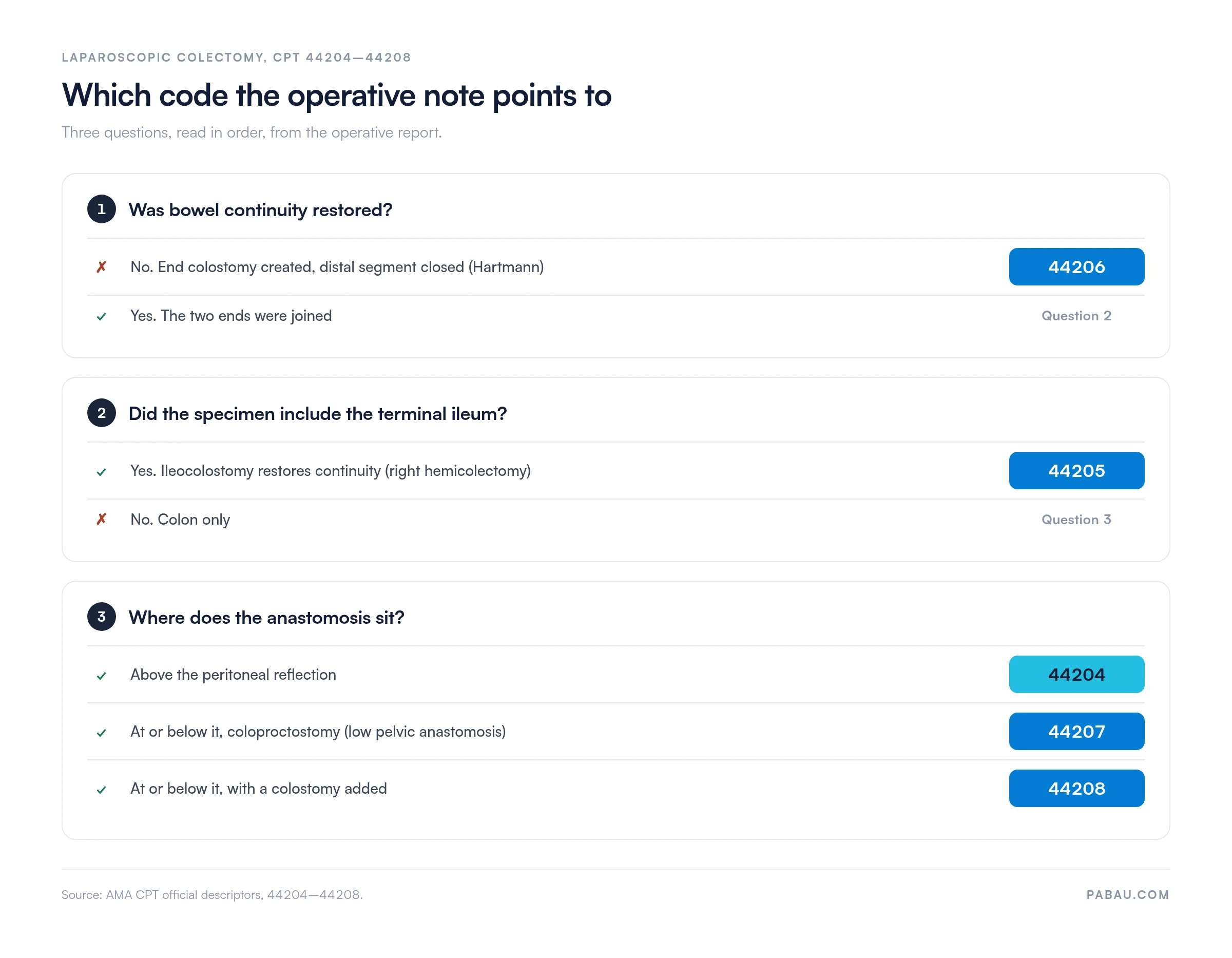
Here are the same five codes with their official descriptors, side by side.
The terminal ileum question carries its own code. When the specimen includes that segment and the surgeon joins ileum to colon, the case belongs to 44205.
44204 and 44207 are the pair coders confuse most. Both describe a laparoscopic partial colectomy with an anastomosis. What 44207 adds is the coloproctostomy, meaning the join sits at or below the peritoneal reflection.
Anything above that line stays with 44204. If the note never states the level, neither code can be defended in an audit. The AAPC Codify CPT lookup carries the full AMA descriptors if you want to read them before you finalize the choice.
Every 44204 claim needs an ICD-10-CM diagnosis that justifies taking out part of the colon. Payers read the diagnosis against the procedure and decide whether the resection made clinical sense.
Most pairings sit in four groups: cancer, diverticular disease, inflammatory bowel disease, and mechanical problems.
Use the most specific subcode the record supports. For colon cancer, the fourth character names the site: C18.2 ascending, C18.4 transverse, C18.6 descending, C18.7 sigmoid.
Reporting C18.9 when the operative report names the segment invites a medical necessity review and leaves money behind. Our ICD-10-CM code index lists the chapters if you need to confirm one. The CDC/NCHS ICD-10-CM web tool shows what is active for the fiscal year you are billing.
Modifier choice follows the operative circumstances, nothing else. Leaving off a modifier the case earned costs the practice money. Adding one the note cannot support invites an audit instead.
Payer policy governs from there. Commercial plans differ from Medicare on when modifier 22 earns extra payment and when modifier 59 clears an edit.
NCCI edits set the bundling rules on the Medicare side, and a commercial plan may bundle differently. Read the specific policy before you attach a modifier to the line.
Lysis of adhesions is the usual test case on this code. The laparoscopic version, CPT code 44180, bundles into the colectomy unless a distinct site or session takes it outside.
Medicare pays 44204 from relative value units, not from a fixed price. The CMS Physician Fee Schedule lookup tool returns the rate for a given locality and calendar year.
Geographic practice cost index adjustments move that number, so the rate for your Medicare Administrative Contractor locality is the only one worth quoting.
The payment is three RVU components multiplied by the annual conversion factor. Work RVUs are the largest piece for a procedure of this size.
National averages for 44204 have been published in the $1,200 to $1,500 range by third-party tools, so treat that as a ballpark. Confirm the figure on the CMS schedule for your locality and year before it reaches a contract or a patient estimate.
Setting changes the practice expense side of that math. A laparoscopic colectomy happens in a hospital or an ambulatory surgery center, so the facility rate applies in practice. The surgeon’s professional fee is separate from what the facility bills for the same case, on its own claim.
Auditors open the operative report first. What is missing there drives more 44204 denials than any decision made downstream in billing. A clean claim on this code starts with a complete, contemporaneous note.
Pull a sample of your 44204 operative reports before they reach billing. If the first two paragraphs do not name the segment removed, the anastomosis method, and the approach, ask the surgeon for an addendum first. An addendum filed after submission draws the attention a complete note would have avoided.
Denials on this code cluster around five patterns. Each one is catchable in a pre-submission review. Practices with high 44204 denial rates usually find the cause in their workflow, not in one bad claim.
Track denials by code and by reason. When 44204 denials cluster on one modifier or one diagnosis pairing, the cause sits in documentation or in the coding step, not in individual claims.
A 44204 claim passes through the operative note, the superbill, the claim form, and the clearinghouse. Every handoff is a chance for a code to be mistyped or a modifier to drop off. By the time the denial arrives, nobody remembers which step lost it.
Practice management software like Pabau removes most of those handoffs by holding the documentation and the claim in one system.
Pabau’s claims management software checks insurance eligibility before the visit, scrubs the claim for common errors, and submits it electronically through the Claim.MD clearinghouse.
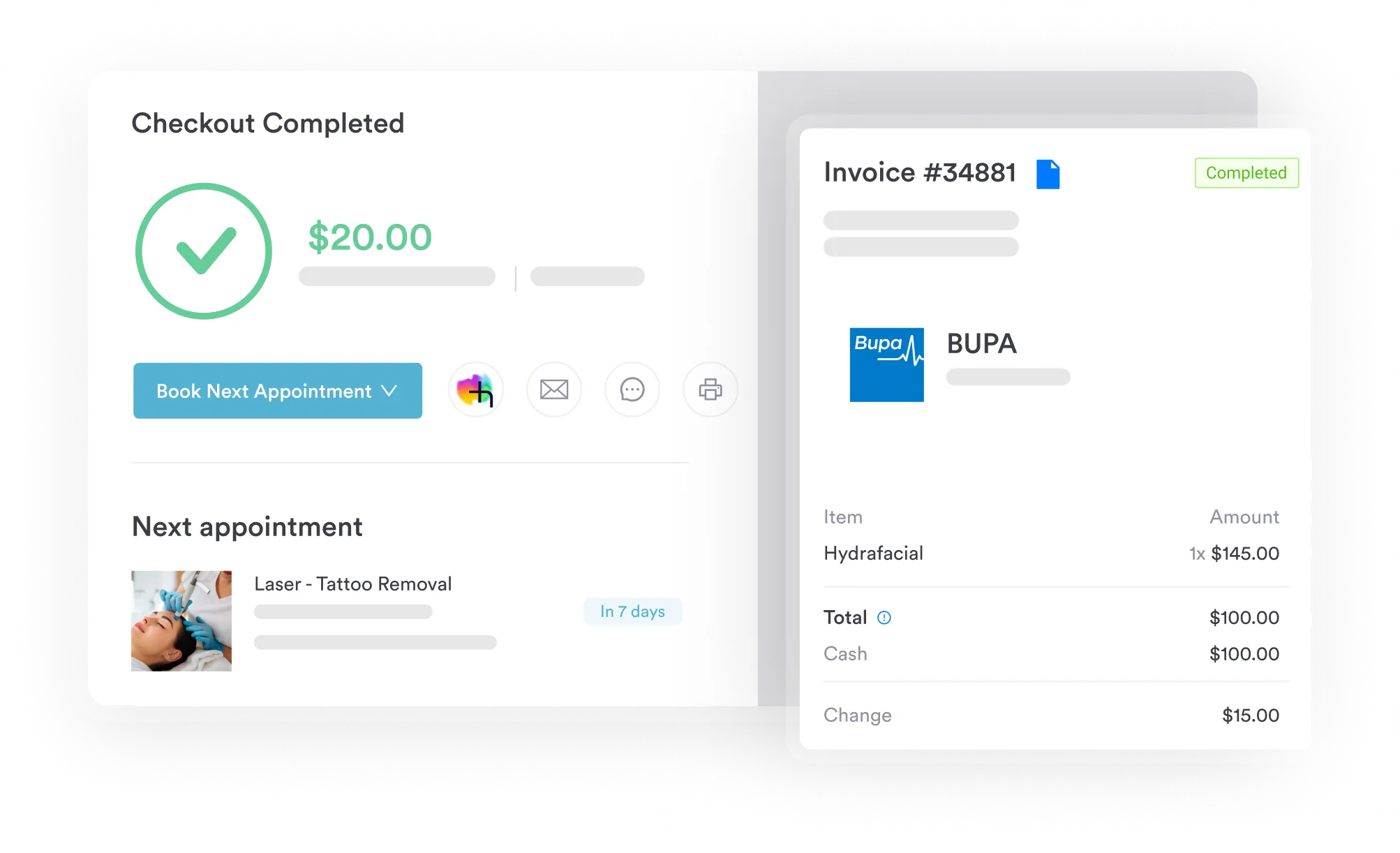
Remittances come back with CARC denial reason codes attached to the line they belong to. On a code that pays like 44204, that detail is the difference between reworking one line and rekeying a whole claim. It also gives you the denial history to spot the pattern behind repeat rejections.

Pabau connects operative documentation to the billing workflow, so procedure and diagnosis codes reach the claim without a second round of manual entry. See how it handles surgical billing for your practice.

The money on a 44204 claim turns on two sentences in the operative report. One says the case stayed laparoscopic. The other says where the bowel was rejoined. Read those before you code, and most of the guesswork disappears.
Keep the diagnosis as specific as the record allows, and hold a modifier back until the note earns it. Practices that work this way stop seeing the same denial twice, which matters more on surgical codes than on any routine visit.
If your operative notes and your claims sit in separate systems, the rekeying between them is where the errors start. Book a demo to see how Pabau carries surgical documentation into the claim without a second round of entry.

Need to understand how clearinghouse submission works for surgical claims? Medical claims clearinghouse explained covers how claims move from practice to payer and where errors enter the submission chain.
Want to reduce insurance eligibility denials before surgery day? Insurance eligibility verification guide outlines how real-time verification prevents authorization-related claim rejections.
Tracking down the reason a surgical claim was denied? 837 file format guide explains the electronic claim transaction structure and how denial reason codes map back to specific claim fields.
44204 carries a 90-day global period. Routine follow-up care inside that window is bundled into the surgical payment and is not billed separately. Unrelated care during the same 90 days needs modifier 24 on an E/M visit, or modifier 79 on an unrelated procedure. Confirm the global-days indicator on the CMS fee schedule for the year you are billing.
A laparoscopic sigmoidectomy with the ends rejoined is reported as 44204, since the sigmoid is one segment of the colon. If the surgeon fashions an end colostomy instead and closes the distal segment, the case is 44206. An open sigmoidectomy with anastomosis is 44140.
44210 covers a laparoscopic total abdominal colectomy without proctectomy, with an ileostomy or an ileoproctostomy. 44204 takes one segment and leaves the rest of the colon in place. Extent of resection decides between them, so the note has to say how much colon came out.
The surgeon bills the professional fee under the place of service where the surgery happened. That is usually 21 for inpatient hospital or 22 for on-campus outpatient hospital. The facility bills its own charge on a separate claim. Place of service also decides whether the facility or non-facility rate applies.



