

HCPCS code E0198: Water pressure pad billing guide
HCPCS code E0198 is a water pad for a standard mattress HCPCS code E0198 is the ...

Last Updated: Oct 13, 2026
44207 is the CPT code for laparoscopy, surgical; colectomy, partial, with anastomosis, with coloproctostomy (low pelvic anastomosis). The surgeon removes a segment of colon through laparoscopic ports, then joins the remaining colon to the rectum deep in the pelvis.
One word separates it from 44208, and that word is colostomy. Report 44207 when the low pelvic anastomosis is completed and no colostomy is created. The operative note has to confirm the laparoscopic approach, the segment resected, and the level of the anastomosis. Those three lines are what a payer reads first.
Let Pabau's smart automation suggest the right codes, reduce claim denials, and keep your practice compliant—effortlessly.
Automate repetitive tasks and focus on what matters most—your patients.
Reduce coding errors and ensure compliance with the latest regulations.
Clean claims, fewer denials, and faster reimbursements.
Powerful insights and reporting to help your practice thrive.
HIPAA compliant SOC 2 certified GDPR-compliant Trusted by 4,000+ clinics worldwide

CPT code 44207 covers a laparoscopic partial colectomy with a coloproctostomy, the low pelvic anastomosis joining colon to rectum
The only descriptor difference between 44207 and 44208 is a colostomy, which 44208 adds and 44207 does not
No code in this family names a diverting loop ileostomy, so payer policy decides between 44207 plus 44187 and 44208 alone
The operative note must record the approach, the segment resected, the level of the anastomosis, and any stoma created
Medicare prices 44207 from GPCI-adjusted RVUs and applies a 90-day global period, so check the current year in the CMS look-up tool
CPT code 44207 describes: Laparoscopy, surgical; colectomy, partial, with anastomosis, with coloproctostomy (low pelvic anastomosis). That wording is the verbatim AMA CPT descriptor, and a claim should never paraphrase it.
In plain language, the surgeon removes part of the colon through laparoscopic ports. The remaining colon is then joined to the rectum deep in the pelvis. That reconnection is the coloproctostomy. Because the anastomosis sits so low, the dissection is demanding and the code carries a 90-day global period.
Not every laparoscopic partial colectomy ends in the pelvis. A right-sided resection that removes the terminal ileum and joins the ileum to the colon belongs to 44205 instead.
That colostomy row is where the trouble usually starts, so take the next pair of codes slowly.
CPT 44207 and CPT 44208 differ by one element of the AMA descriptor, and that element is a colostomy. The descriptor for 44208 repeats the wording of 44207 and then adds “with colostomy”. So 44207 is the code when the surgeon completes the low pelvic anastomosis and creates no colostomy.
Neither descriptor mentions a loop ileostomy. Coders who read 44208 as the version with a diverting stoma will pick the wrong code. The descriptor turns on a colostomy specifically, not on the presence of any stoma, and the operative note is what settles it.
A diverting loop ileostomy is common after a low anterior resection, and no code in this family describes that combination. 44208 names a colostomy.
The only nearby code whose descriptor names a loop ileostomy is 44211, a total abdominal colectomy with proctectomy and an ileal reservoir. That is a different operation.
Two respected coding authorities answer the ileostomy question differently, so the practice’s payer policy decides which reading applies.
Until the payer publishes its own instruction, document the stoma precisely and follow the policy you have in writing. Record whether the stoma is an ileostomy or a colostomy, whether it is loop or end, and why it was created. That detail is what supports either choice on appeal.
Step back from the ileostomy debate and the family sorts itself out quickly. Three questions do the work, and the operative note answers all of them. Was the bowel rejoined? Where does the anastomosis sit? Was a colostomy created?
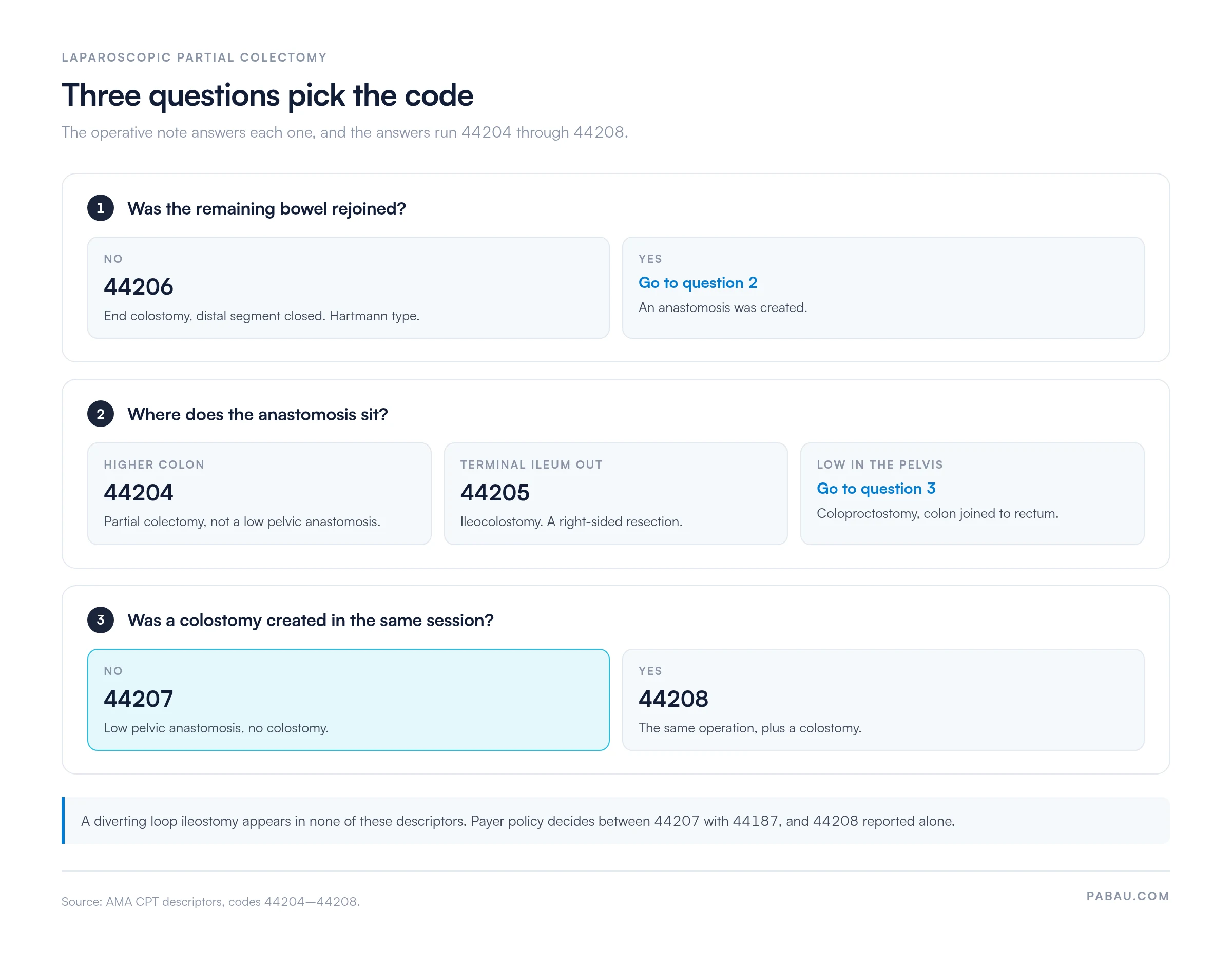
The table below carries the abbreviated descriptors behind each branch, plus the two stand-alone stoma codes that come up in the same conversation.
A small bowel resection in the same session sits outside this family. That work needs an enterectomy code, such as CPT code 44120 for an open single resection with anastomosis. None of the colectomy codes above include it.
With the code settled, the next decision is what rides alongside it. Modifier choice on CPT code 44207 follows payer rules and what the operative note actually supports. An unsupported modifier trips National Correct Coding Initiative edits, and the claim comes back downcoded or denied.
A payer approves this operation on the strength of the diagnosis, not the procedure code. The ICD-10-CM codes below are the ones most often paired with a laparoscopic partial colectomy at the low pelvic level.
Confirm the official descriptor before the claim goes out. Our library of ICD-10-CM codes in full gives the exact wording for each one.
Check each pairing against the Local Coverage Determination or National Coverage Determination for your MAC region. Specificity carries weight on review. C18.7 supports a sigmoid resection far better than C18.9, the unspecified colon code, when the pathology report names the site.
Medicare prices 44207 through the resource-based relative value scale. Each RVU component is multiplied by its local Geographic Practice Cost Index. The adjusted components are then added together and multiplied by the annual conversion factor.
The CMS Physician Fee Schedule Look-Up Tool is the authoritative source for the current-year allowable. Because the conversion factor moves every January, any figure carried over from last year will be wrong by the time the claim is paid.
Facility and non-facility amounts differ because the practice expense RVU changes. In a hospital or ASC the facility bills separately for the room, nursing and equipment, so the surgeon’s practice expense RVU is lower. Almost every 44207 case is performed in a facility setting.
Verify the current-year Medicare allowable for CPT code 44207 in the CMS Physician Fee Schedule Look-Up Tool before you project revenue. The conversion factor changes every January 1. Quoting last year’s figure in a contract negotiation or a patient estimate is an avoidable error. It usually surfaces months later, in a variance report.
Payment rests on the operative note, which is the claim support document for CPT code 44207. Thin documentation is the leading trigger for medical necessity denials and post-payment audits on laparoscopic colorectal surgery, so five elements need to be explicit.
Once the note is clean, the claim still has to travel, and knowing the route tells you where to look when payment stalls. It leaves the practice as an 837 electronic claim file and passes three checkpoints before money moves.
Claims that stall on 44207 almost always stop at the second checkpoint. That is also the one your operative note can influence, which is why the five elements above matter more than any appeal letter.
Most denials on this code trace back to five patterns. Catching them before submission is the difference between first-pass payment and a 30 to 60 day appeal cycle.
Audit every CPT code 44207 claim submitted in the previous 90 days, then group the denials by reason code. If one CARC accounts for more than 10 percent of them, the cause sits upstream in the operative template or the coding workflow. Fix it there rather than appealing claim by claim.
Practices billing laparoscopic colorectal surgery hit the same workflow problem. The operative note, the code selection and the claim sit in three separate systems, and the coder retypes the same details into each one. Errors creep in at the keyboard, not at the operating table.
Practice management software like Pabau closes that loop by putting coding and submission in one claims management workflow. A coder confirms the approach, the anastomosis level and the stoma type before the 44207 claim is queued. Fewer screens means fewer transcription errors on complex cases.
Pabau also tracks outcomes by CPT code. Denial rates, paid amounts and days to payment for a code like 44207 appear in the reporting dashboard. A billing manager sees a pattern forming, instead of reading about it in a quarterly variance report.

Pabau brings CPT code workflows, claim submission and denial tracking together. Your billing team switches between fewer systems and spends more time collecting on high-value surgical cases.

CPT code 44207 pays well, and the operative note is what protects it. The descriptor difference between 44207 and 44208 is a colostomy, nothing else. A diverting loop ileostomy is a separate question that payer policy answers, so record the stoma type in words before the claim leaves.
Fix the operative template once and the coding argument mostly disappears. Ask your surgeons to state the approach, the anastomosis level and the stoma type in every low anterior resection note. The alternative is a coder guessing, then an appeal three months later.
Pabau’s claims management software gives surgical billing teams one workflow, from operative documentation through submission and denial tracking. To see how it handles high-value codes like 44207, book a demo with our team.

Want a repeatable way to work denied surgical claims? Denial management in healthcare sets out how to identify, appeal and prevent denials across specialties.
Not sure what a clearinghouse checks before the payer sees a claim? Medical claims clearinghouse guide explains front-end edits and what a clean claim looks like.
Need the whole workflow, from encounter to payment posting? Revenue cycle management overview maps every stage, including the documentation each one asks for.
Reconciling payments on high-RVU surgical codes? Electronic remittance advice shows how to read an ERA and catch an underpayment early.
Building an audit trail your payers will accept? Medical billing compliance covers the rules and records that keep a surgical claim defensible.
Yes. A surgical laparoscopy always includes the diagnostic laparoscopy, so the diagnostic portion is never reported separately alongside 44207.
With 44207, because CPT carries no separate robotic colectomy code. Some payers accept HCPCS S2900 on the same claim, and many treat it as not separately payable.
CPT 44145 is the open version of the same operation, a partial colectomy with coloproctostomy. Its counterpart 44146 applies when a colostomy is created as well.
Yes. The operating surgeon appends modifier 54 for the surgical care, and the physician taking over the global period appends modifier 55.
No. An unplanned return to the operating room for a related complication is reported with modifier 78, which pays the intraoperative portion only.
No. The pathologist reports the specimen examination under its own surgical pathology code, on a claim separate from the surgeon’s.



