



HCPCS code E0198: Water pressure pad billing guide
HCPCS code E0198 is a water pad for a standard mattress HCPCS code E0198 is the ...

Last Updated: Oct 13, 2026

CPT code 36591 describes collection of a blood specimen from a completely implantable venous access device (VAD) such as a Porta-Cath or Mediport.
The code applies only to fully implanted ports. Semi-implantable or external catheters do not qualify; use CPT 36592 for those.
The 2026 national average Medicare reimbursement for CPT code 36591 is approximately $30.39; in hospital outpatient settings it carries OPPS status indicator Q1 (conditionally packaged), so it is paid separately only when it is the only service on the claim.
Pabau’s claims management software helps practices flag NCCI bundling conflicts and track VAD-related billing across patients.
CPT code 36591 is the billing code for collection of a blood specimen from a completely implantable venous access device (VAD), such as a Porta-Cath or Mediport. It applies only when blood is drawn from a fully implanted port; using it for an external catheter or a routine peripheral draw results in a denial.
This guide covers everything billing teams and clinicians need to know about CPT code 36591: its official description, device eligibility criteria, applicable modifiers, 2026 Medicare rates, NCCI bundling rules, and when to choose it over related codes 36592 and 36415. The American Medical Association (AMA) maintains the CPT code set and publishes the official definitions used throughout this article. For guidance on CPT billing workflow guidance across other specialty codes — for example.
The official AMA descriptor for CPT code 36591 is: Collection of blood specimen from a completely implantable venous access device. This code sits within the range 36591-36598, which the AMA groups under “Other Central Venous Access Procedures.”
Completely implantable venous access devices are surgically placed entirely beneath the skin. Common examples include the Porta-Cath and the Mediport. A clinician accesses the device by inserting a non-coring needle through the skin and into the port reservoir. No external tubing or catheter extends outside the body.
CPT code 36591 replaced CPT code 36540, effective for dates of service on or after January 1, 2008, per CMS Transmittal R1530CP. Practices still using 36540 in their billing templates are submitting an invalid code and should update their charge capture systems immediately.
Device type determines code selection. Only completely implanted ports qualify for CPT code 36591. Semi-implantable devices, such as a tunneled catheter (e.g., Hickman or Broviac), or external peripherally inserted central catheters (PICCs) do not qualify. Misapplying the code to a non-implanted device is a documentation error with audit consequences.
Three codes cover most specimen collection scenarios, and selecting the right one depends on device type. The choice is mutually exclusive: because a given specimen is drawn from a single device, you report only the one code that matches that device, so 36591 and 36592 are not reported together for the same collection. Per the NCCI Policy Manual, these specimen-collection codes are also payable only when the blood draw is the sole non-laboratory service on the claim.
CMS Medicare Coverage Article A52470 is explicit: submit CPT code 36415 for all routine venipunctures that do not require a physician’s skill. Submitting CPT code 36591 for a routine peripheral draw inflates the claim and is a common audit trigger. The CMS Medicare Coverage Database (Article A52470) provides the full billing and coding guidance on venipuncture necessitating physician skill.
For practices managing complex venous access procedure billing across multiple service lines, building a clear internal decision tree for code selection reduces downstream denials significantly.
Modifier selection depends on the clinical situation and payer requirements. Using the wrong modifier can result in automatic denial, and in some cases, submitting a modifier without clinical justification constitutes a billing integrity issue.
Do not append modifiers speculatively. Each modifier requires specific clinical and documentation justification. Payer modifier rules vary; verify requirements against the specific payer’s reimbursement policy before submission. The AAPC Codify CPT lookup provides modifier crosswalk data and bundling indicators useful during charge review.
Before submitting CPT code 36591 with Modifier 59, pull the specific NCCI edit pair from the CMS NCCI table for the date of service. Modifier 59 is appropriate only when the edit is modifier-allowable (indicator ‘1’). If the indicator is ‘0’, the edit is absolute and no modifier overrides it.
Reviewing the best EHRs for primary care pays off when cardiopulmonary testing is part of your routine workload.
Medicare reimburses CPT code 36591 differently depending on the billing setting. Professional (non-facility) claims and hospital outpatient (facility) claims follow separate payment pathways. Understanding both is essential for practices that bill across multiple settings.
The 2026 non-facility rate of approximately $30.39 is sourced from MedFeeSchedule.com citing the 2026 MPFS. Practices should cross-verify this figure directly against the CMS Physician Fee Schedule lookup tool, as national average rates reflect the conversion factor before geographic adjustments. The actual payment in any given locality will differ based on the geographic practice cost index (GPCI) applied to each RVU component.
For hospital outpatient billing, CPT code 36591 carries OPPS status indicator Q1 (an STV-packaged, or conditionally packaged, service). It is packaged into the primary procedure’s payment when it appears on the same claim as a service with status indicator S, T, or V; when the blood collection is the only service on the claim, it is paid separately. Billing staff should confirm the code’s current status indicator on the quarterly OPPS Addendum B before assuming a line-item payment.
Revenue code assignment for UB-04 facility billing typically maps specimen collection services to Revenue Code 300 (Laboratory) or 301 (Chemistry). Verify the specific revenue code requirement against each payer’s facility billing manual, as some payers have payer-specific policies that differ from the CMS default. Reviewing clinical documentation standards from similar coding workflows can help billing teams build consistent internal policies.

Pabau’s claims management software helps practices catch NCCI edit conflicts before submission, track implantable device encounters, and reduce denials across CPT codes including 36591. See how it works for IV therapy and infusion practices.

The National Correct Coding Initiative (NCCI) governs code pair bundling for Medicare. Understanding which codes bundle with CPT code 36591 prevents avoidable denials and reduces the risk of overpayment demands.
Because 36591 and 36592 describe specimen collection from different device types, you report only the single code that matches the device used; the two are not billed together for the same collection. If both are submitted for one specimen, payers will reimburse only one. These specimen-collection codes are also not separately payable when reported alongside a non-laboratory service other than the blood draw itself.
Billing CPT code 36591 alongside an E/M code (99202-99215) for the same encounter carries denial risk under many payer policies. The clinical question is whether the blood collection was the primary reason for the visit or an incidental service performed during a separately identifiable evaluation. Where the blood draw is the sole reason for the visit, submitting an E/M code alongside 36591 is unlikely to be supported by payer policy. Where a separately identifiable E/M service took place, Modifier 25 on the E/M code (not on 36591) may support separate billing. Practices should consult their HIPAA-compliant documentation practices and payer-specific NCCI edit tables before submitting this combination. First-pass rate measures how often a claim is paid without anyone touching it again.
For practices managing infusion and IV therapy practice management, port access and specimen collection are frequent billing scenarios. Having a pre-built code combination checklist in the EHR or billing system reduces the time spent on manual NCCI review at claim submission.
Run a monthly CPT 36591 denial report filtered by denial reason code CO-4 (procedure code inconsistent with modifier) and CO-97 (payment included in the allowance for another service). These two denial codes catch the most common NCCI-related errors for VAD blood collection billing.
Accurate documentation is the first line of defense against CPT code 36591 claim denials. Payers audit specimen collection codes as a matter of routine, and the documentation requirements are specific.
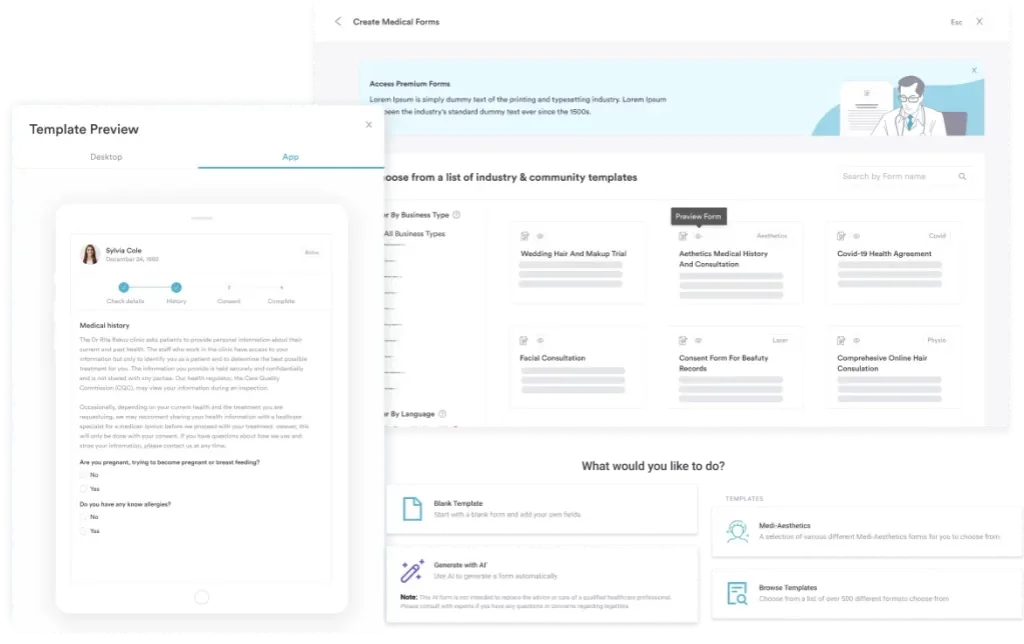
Using digital clinical documentation forms within an integrated practice management system helps ensure every required field is captured at the point of care, before the claim reaches the billing team. Missing documentation is far harder to correct after the fact than to prevent in the first place.
When coding related central venous access procedures, practices billing both Medicare and commercial payers should maintain separate documentation checklists that reflect each payer’s specific requirements rather than relying on a single generic template.
Most CPT code 36591 denials fall into a small number of repeatable patterns. Identifying and correcting the root cause is more efficient than re-submitting individually without process change.
A proactive approach to reducing denials starts before the claim is submitted. Reviewing your outpatient billing compliance processes and claims management software setup can surface systematic errors before they become revenue cycle problems. Pabau’s claims workflow tools allow billing teams to build pre-submission edit checks that flag common code pairing errors for review.
Medicare provides a national baseline, but commercial payer policies for CPT code 36591 vary meaningfully. Some payers bundle 36591 into their facility fee regardless of the setting. Others apply their own code pairing edits that differ from the CMS NCCI tables.
The following considerations apply across common payer types. For specific current rates, always verify against the payer’s published fee schedule or reimbursement policy document.
Denial edits do not always turn on code pairing. Consumable supply codes are commonly capped by quantity per period. Medicare and Medi-Cal allow A7038 at 2 units per month, and units billed past that ceiling trigger automatic claim edits and overpayment liability.
Building a payer-specific coverage matrix for the codes most frequently used in your practice is a one-time investment that prevents recurring billing uncertainty. Practices can use their medical billing compliance checklist to track payer-policy verification as part of annual credentialing and contract review cycles. For broader documentation workflow management.
CPT code 36591 is device-specific and the documentation requirements are precise. Getting the device type wrong, pairing the code incorrectly, or missing a key clinical note are the three fastest routes to a denial. The guidance in this article reflects current CMS and NCCI policy, but payer-specific rules can differ, so direct policy verification remains essential.
Pabau’s claims management software helps practices build pre-submission edit checks and track VAD-related billing patterns across their patient population. If your team wants to see how Pabau can reduce 36591-related denials in your specific practice setting, book a demo and we will walk you through the workflow.

Need guidance on related infusion billing codes? CPT code 96413 covers intravenous infusion administration, a frequent companion service when drugs are delivered through an implanted port.
Coding a urethral caruncle excision? CCSD code M5580 is the precisely defined UK billing code for excising a urethral caruncle.
Coding a prostate biopsy claim? CCSD code M6580 covers the billing code urology teams use for endoscopic biopsy of the prostate.
CPT code 36591 is the billing code for collecting a blood specimen from a completely implantable venous access device, such as a Porta-Cath or Mediport. It covers fully subcutaneous devices only — not external catheters, tunneled lines, or routine peripheral draws.
36591 applies to fully implanted ports; 36592 applies to non-fully-implanted devices such as PICC lines or tunneled catheters. Because a specimen is drawn from one device, you report only the code matching that device — the two are not billed together for the same collection.
The 2026 national average non-facility rate is approximately $30.39 under the Medicare Physician Fee Schedule. In hospital outpatient settings, the code carries OPPS status indicator Q1 (conditionally packaged), so it is paid separately only when it is the only service on the claim. Confirm the current rate via the CMS MPFS lookup tool, as geographic adjustments apply.
Generally no. If a separately identifiable visit did occur, apply Modifier 25 to the E/M code — not to 36591. When the blood draw is the only reason for the encounter, a concurrent E/M will likely be denied. Always verify against the payer’s NCCI edit table.
CPT 36591 replaced CPT 36540 on January 1, 2008, per CMS Transmittal R1530CP. Practices still using 36540 are submitting an invalid code and should update their charge description master immediately.
Modifier 59 applies when the blood collection is a distinct service from others billed on the same date. Modifier GY applies when the service is statutorily excluded from Medicare. Each modifier requires documented clinical justification before submission.



