CCSD code H4430: Examination of rectum under anaesthetic
CCSD code H4430 pays for the examination alone CCSD code H4430 is the UK private...

Last Updated: Oct 20, 2026
28298 is the CPT code for correction, hallux valgus (bunionectomy), with sesamoidectomy, when performed; with proximal phalanx osteotomy, any method. The defining step is an osteotomy at the base of the great toe's proximal phalanx, often called an Akin osteotomy.
It sits beside 28296, which cuts the distal first metatarsal, and 28299, which reports a double osteotomy. To support 28298, the operative report must name the proximal phalanx as the cut site. Sesamoid removal at the same session is included.
Let Pabau's smart automation suggest the right codes, reduce claim denials, and keep your practice compliant—effortlessly.
Automate repetitive tasks and focus on what matters most—your patients.
Reduce coding errors and ensure compliance with the latest regulations.
Clean claims, fewer denials, and faster reimbursements.
Powerful insights and reporting to help your practice thrive.
HIPAA compliant SOC 2 certified GDPR-compliant Trusted by 4,000+ clinics worldwide

CPT 28298 requires an osteotomy of the great toe’s proximal phalanx, and without one a different hallux valgus code applies.
Sesamoidectomy is included in 28298 when performed at the same session and can’t be billed separately.
A chevron plus an Akin osteotomy on the same toe is a double osteotomy, reported with 28299 rather than 28296 plus 28298.
Medicare and most commercial payers expect an RT or LT modifier that matches the laterality of the ICD-10 code.
Practice management software like Pabau submits your coded 28298 claims through Claim.MD and tracks their status and remittance.
CPT code 28298 is a surgical code in the musculoskeletal section of the AMA CPT code set. It sits within the repair, revision, and reconstruction procedures on the foot and toes. It describes correction of hallux valgus (bunionectomy) with a proximal phalanx osteotomy by any method, plus sesamoidectomy when performed. What sets 28298 apart is the osteotomy site. The surgeon makes the cut in the proximal phalanx of the great toe, not in the first metatarsal.
The “when performed” language covering sesamoidectomy matters for billing. It means the code already includes sesamoid removal at the same operative session. As a result, billing it as a separate line is unbundling and triggers a National Correct Coding Initiative (NCCI) edit denial.
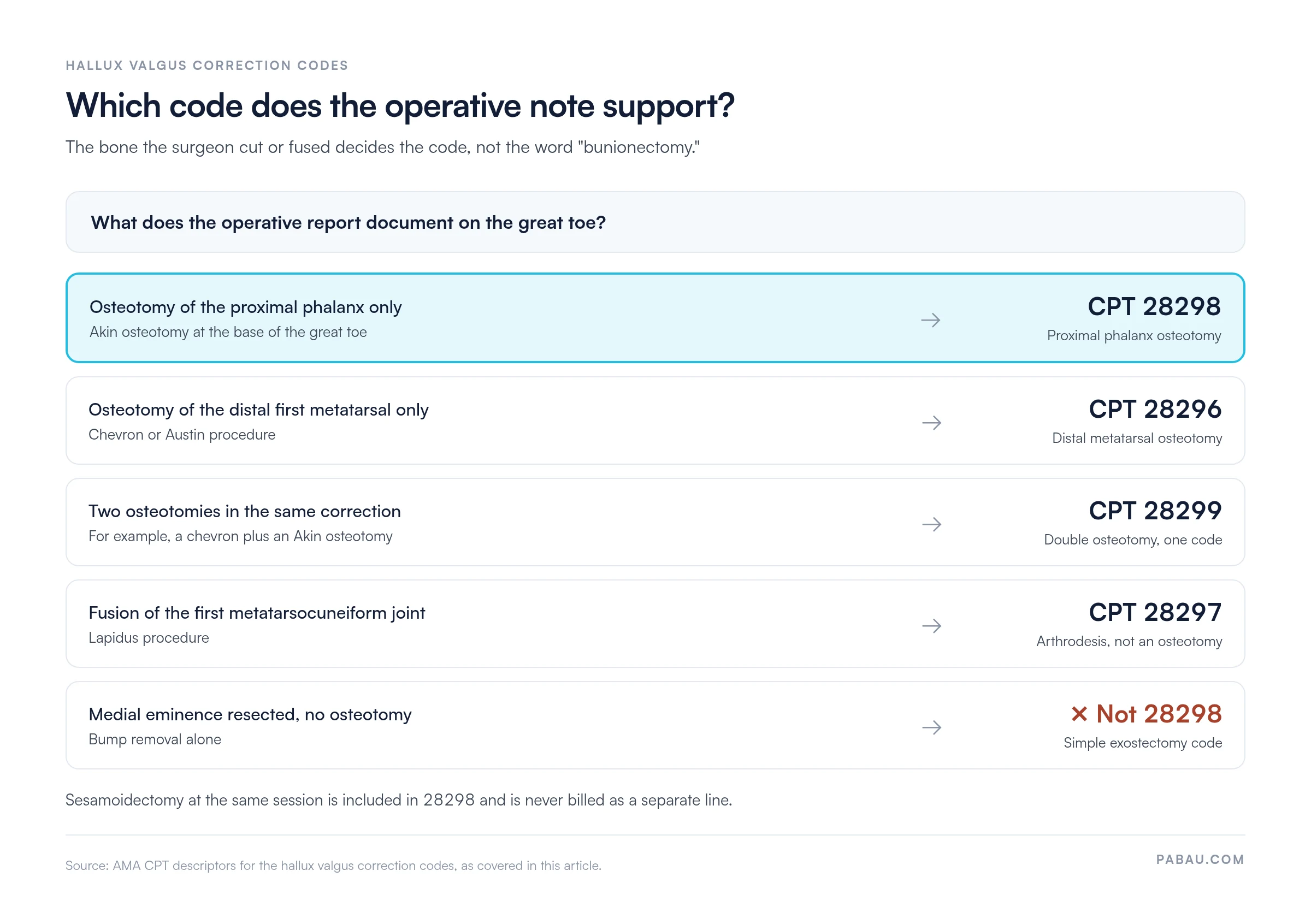
The choice between CPT codes 28296, 28298, and 28299 depends on where the surgeon performs the osteotomy and how many osteotomies there are. All three correct the same deformity, but each describes a different surgical approach. A Lapidus joint fusion reports as CPT code 28297 instead. Pick the code from the operative report, never from habit.
Not every Akin osteotomy accompanies a bunionectomy, and the table above covers only the three hallux valgus codes. When the surgeon corrects the proximal phalanx alone, with no hallux valgus correction on the same claim, coders report 28310.
When a surgeon pairs a chevron osteotomy of the first metatarsal with an Akin osteotomy of the proximal phalanx, the combination is a double osteotomy. Report it with 28299 rather than billing 28296 and 28298 together. The chart below maps each documented finding to its code, so confirm the operative note names every osteotomy site first.
CPT code 28298 covers a multi-step correction of hallux valgus, and the operative report must reflect each step. Coders who know the surgical sequence can confirm faster that the documentation supports the code.
The operative report must name the proximal phalanx as the osteotomy site and document the fixation method. A note that only describes medial eminence resection, with no phalangeal osteotomy, won’t support 28298. That scenario maps to a simple exostectomy code instead.
For foot surgery, billing compliance starts with the operative report. For CPT 28298, the documentation must confirm several elements that payers check on post-payment review.
Missing any of these elements gives the payer grounds to deny or downcode the claim. A generic operative note template that doesn’t capture the phalangeal osteotomy is a recurring source of avoidable claim losses in podiatric practices.
The diagnosis code must match the operative site and carry specific laterality. Avoid the unspecified code (M20.10) on Medicare claims, because payers increasingly cross-check side-specific diagnoses against the CPT modifier. For a left-foot case, the M20.12 reference covers the diagnosis code in more detail.
When the surgeon corrects both feet in the same session, bill CPT 28298 twice, once per foot, with modifiers RT and LT. Some payers prefer modifier 50 on a single line instead. Link each line to its side-specific ICD-10 code.
Modifier selection is a frequent point of failure for CPT code 28298. The right modifiers depend on laterality, bilateral status, and whether the procedure took unusual extra work.
Audit your 28298 claims monthly for missing RT/LT modifiers. A single missing laterality modifier on a claim triggers an automatic denial, and the correction requires a timely appeal with the original operative note attached. Most billing software can flag absent foot modifiers at scrubbing, saving the rework.
The CMS Physician Fee Schedule (MPFS) sets Medicare reimbursement for CPT code 28298. It varies by geographic practice cost index (GPCI), facility vs. non-facility setting, and annual relative value unit (RVU) updates. Three RVU components build the allowed amount: work, practice expense, and malpractice.
Track 28298 collections against the expected allowed amount for your locality and setting. The non-facility rate usually runs higher than the facility rate, because the practice carries the overhead of an office setting.
Don’t treat payerprice.com or other third-party fee databases as authoritative 2026 rates. CMS updates the MPFS file each January. Pull the current year’s file from CMS before quoting expected reimbursement to patients or contracting with ambulatory surgery centers (ASCs).
Prior authorization rules for CPT code 28298 vary by payer type, and no single rule covers them all. A claim submitted without a required authorization is a preventable write-off. Make the authorization check a standard step before scheduling surgery.
Document conservative treatment in the chart for at least three to six months before the surgical date. Notes should list the specific interventions tried (custom orthotics, wider footwear, padding, corticosteroid injection, physical therapy) and the patient’s response to each.
NCCI edits govern which codes coders can and can’t bill together with CPT code 28298. CMS updates the edit tables regularly, so check the current tables and the CMS NCCI Policy Manual rather than prior-year guidance.
When coders bill 28298 alongside 28285, the operative report has to show that the hammertoe correction was on a different toe from the hallux. Both procedures also need their own documented medical necessity. Resection of a bunionette on the fifth metatarsal head follows the same site logic, and coders report it with 28110.
Practices that track medical billing denial codes for 28298 see the same triggers come up again and again. As a result, fixing the root cause of each denial type cuts rework and protects reimbursement.
A structured denial management process for foot surgery codes starts with a monthly denial log, sorted by CPT code and denial reason code. As a result, most 28298 denials cluster around two or three root causes in any given practice, which makes systematic correction practical.
Run a quarterly crosswalk of your 28298 operative notes against your submitted claims. Flag every claim where the note describes only medial eminence resection without documenting phalangeal osteotomy. Those cases either lack documentation or carry the wrong code, and both represent a reimbursement risk and an audit liability.
CPT code 28298 carries a 90-day global surgical package. Medicare bundles the pre-operative visit the day before surgery, the intraoperative services, and routine post-operative care for the next 90 days into a single payment. Billing separately for services inside the global package is a compliance violation.
Knowing what falls inside and outside the global period prevents both under-billing and compliance exposure. A routine check of the surgical wound during the global period isn’t separately billable, no matter how you document the visit.
Once the coder has confirmed the osteotomy site and assigned 28298, the claim still has to reach the payer and get paid. Many podiatric practices key it into a separate clearinghouse portal, then match remittances to billed charges by hand.
Practice management software like Pabau connects to the Claim.MD clearinghouse. With Pabau’s claims software for podiatrists, the claims your team has coded go out from the system that holds the appointment and patient record. You can follow each claim’s status and pull electronic remittance advice (ERA) back in to reconcile allowed amounts against billed charges.
Pabau doesn’t choose codes or modifiers for you, and your coder still owns that call. What changes is the follow-up. Your team has fewer logins and one place to see which 28298 claims are paid, pending, or denied.

Pabau sends the claims your team codes through the Claim.MD clearinghouse, tracks their status, and brings ERAs back for reconciliation. You spend less time switching portals and follow up on denials sooner.

CPT 28298 is a narrow code, and that’s what makes it easy to get wrong. It fits one documented finding: an osteotomy of the proximal phalanx, with or without sesamoid removal. A chevron cut, a second osteotomy, or a Lapidus fusion each moves the claim to a different code.
The practical fix is a pre-submission check against the operative note. Confirm the cut site, the laterality modifier, and the matching ICD-10 code before the claim leaves the practice. That single step heads off the wrong-code, laterality, and mismatch denials covered above.
Book a demo to see how Pabau keeps your coded foot surgery claims moving from submission to reconciled payment.

Need to understand clearinghouse submission for surgical codes? Claim.MD clearinghouse guide explains how electronic claim routing works for CPT codes including foot surgery procedures.
Tracking post-payment denials across your surgical case mix? Medical claims clearinghouse overview covers how to reconcile ERA files against expected reimbursement for high-value surgical codes.
Want to verify insurance eligibility before scheduling 28298 cases? Insurance eligibility verification guide walks through the checks that confirm coverage and authorization needs before surgery day.
Seeing the same 28298 denials every month? Denial management in healthcare sets out how to log, sort, and fix denials by root cause.
Want 28298 claims paid on first submission? What is a clean claim explains what payers need to see before they process a claim without rework.
CPT Code 28298 covers correction of hallux valgus (bunionectomy) with sesamoidectomy when performed and proximal phalanx osteotomy by any method. The code describes a surgical correction of a bunion deformity at the great toe, where the defining procedure is an osteotomy of the proximal phalanx. The code includes sesamoidectomy performed at the same session, so coders can’t bill it separately.
The Akin osteotomy is a closing-wedge osteotomy of the proximal phalanx of the great toe. Coders report it with CPT 28298 when it’s the only osteotomy in the hallux valgus correction. When a surgeon combines it with a metatarsal osteotomy such as the chevron, the pair counts as a double osteotomy, and coders report it with CPT 28299 instead.
Yes, coders may bill CPT 28298 and 28285 (hammertoe correction) together when the surgeon performs them on different toes in the same operative session. CPT 28285 addresses a lesser toe, while 28298 addresses the hallux. 28285 typically needs modifier 59 to bypass NCCI edits. Check the current NCCI table and make sure the operative note documents both procedures separately.
The usual denial reasons for CPT 28298 are missing laterality modifiers (RT or LT) and wrong code selection, such as 28296 submitted instead of 28298. Other frequent triggers are missing prior authorization from commercial or Medicare Advantage payers and NCCI bundling violations from billing sesamoidectomy separately. A monthly denial audit segmented by root cause resolves most of these systematically.