ICD-10 code S52.311P: Right radius shaft greenstick malunion
ICD-10 code S52.311P covers a right radius that healed out of line ICD-10 code S...

Last Updated: Oct 16, 2026
Billable Code Specific Code
M20.12 is the billable ICD-10-CM code for hallux valgus (acquired), left foot.
Assignment turns on two documented facts. The record must show the deformity is acquired rather than congenital, and it must name the left foot. Coding M20.10 (unspecified) when the chart states the left foot breaks the ICD-10-CM specificity rule, and that substitution drives many musculoskeletal denials.
Let Pabau's smart automation suggest the right codes, reduce claim denials, and keep your practice compliant—effortlessly.
Automate repetitive tasks and focus on what matters most—your patients.
Reduce coding errors and ensure compliance with the latest regulations.
Clean claims, fewer denials, and faster reimbursements.
Powerful insights and reporting to help your practice thrive.
HIPAA compliant SOC 2 certified GDPR-compliant Trusted by 4,000+ clinics worldwide

M20.12 is the left-foot code for acquired hallux valgus, and it is billable on its own.
Laterality is mandatory: ICD-10-CM guidelines rule out M20.10 once the record names the left foot.
The note must confirm acquired etiology, the left side, examination findings, and symptom severity.
Practice management software like Pabau adds ICD-10 search and claim validation, so podiatry teams catch laterality errors before submission.
ICD-10 Code M20.12 is a billable, specific ICD-10-CM diagnosis code describing hallux valgus (acquired) of the left foot. Its billable status means it may be reported directly on a claim for reimbursement, without a more granular child code.
The code sits in chapter 13 of ICD-10-CM, which covers diseases of the musculoskeletal system and connective tissue (M00-M99). Within that chapter it falls under category M20, acquired deformities of fingers and toes.
Two attributes decide whether the code fits. The first is the acquired qualifier, which separates M20.12 from congenital hallux valgus under Q66.6. The second is left-foot laterality. Both must be explicit in the clinical record before M20.12 can be selected.
Hallux valgus is a deformity of the first metatarsophalangeal joint in which the great toe angles laterally toward the second toe. That angulation pushes the metatarsal head outward and creates the medial prominence commonly called a bunion.
The acquired qualifier in M20.12 specifies that the deformity developed after birth, which separates it from presentations present at delivery. Most acquired cases trace back to biomechanical factors including footwear, pronation, and hereditary joint laxity.
Left-foot laterality is integral to the code. It records which side was treated, which drives surgical planning and every post-operative note that follows. Bilateral hallux valgus, for example, requires both M20.11 (right foot) and M20.12 (left foot) on the same claim, not M20.10 (unspecified).
Understanding the parent and sibling code structure helps coders select the most specific code available and avoid defaulting to unspecified alternatives when laterality is documented.
M20.10, M20.11, and M20.12 are siblings at the same code level. M20.10 exists only for cases where laterality genuinely cannot be determined from the record.
ICD-10-CM guidelines require the most specific code available, so M20.12 applies whenever documentation confirms the left foot. The diagram below runs the same two questions a coder answers before picking any of the four codes.
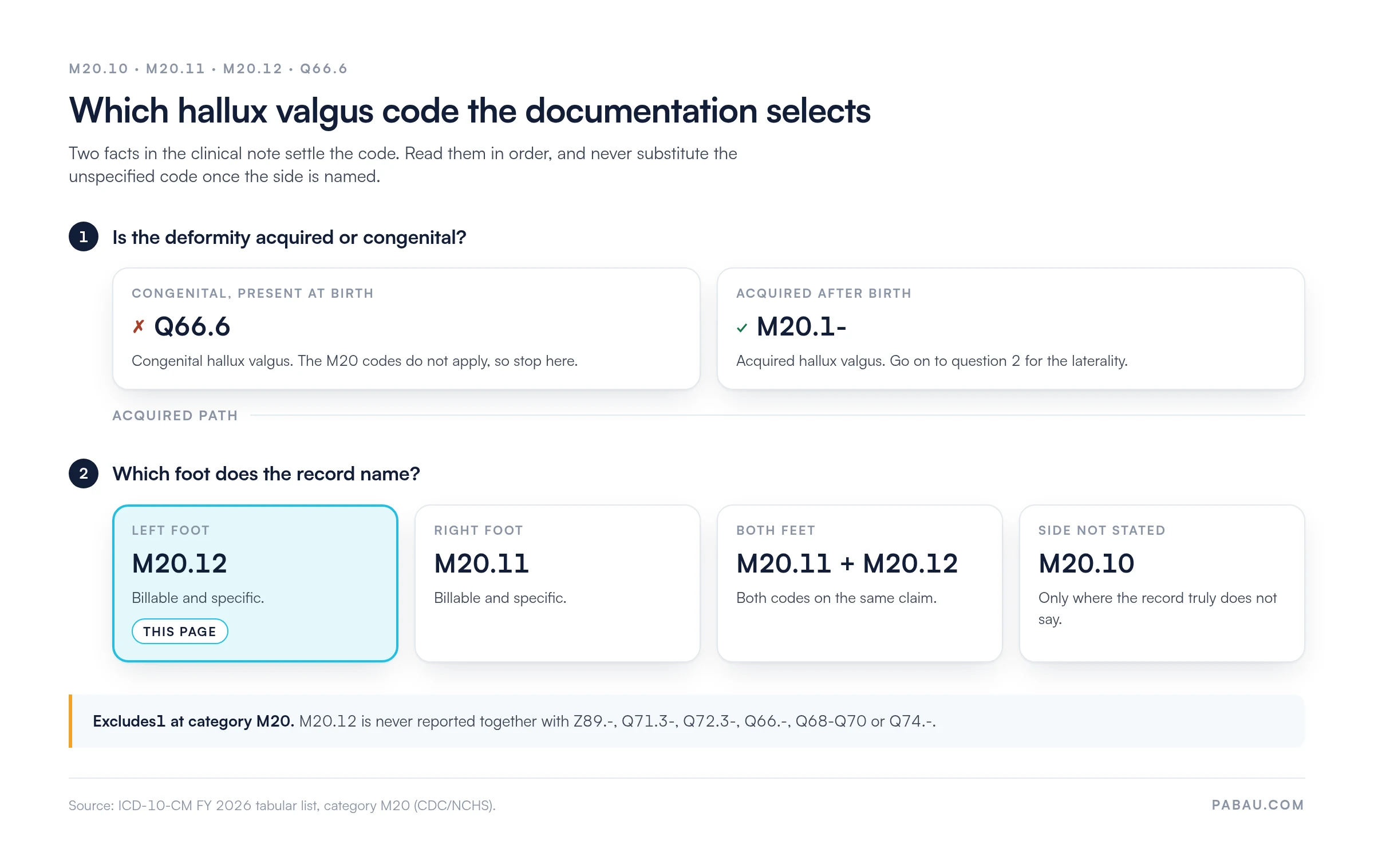
Neighboring musculoskeletal codes follow the same parent-and-sibling structure, which you can work through in our ICD-10 code reference.
The ICD-10-CM alphabetic index maps several clinical and lay terms directly to M20.12. Coders using any of these phrasings in documentation should select M20.12 when the left foot is specified.
Note that “bunion” alone, without laterality, maps to M20.10 (unspecified) in most lookup tools. Coders should not use a synonym search shortcut without confirming that laterality is also captured in the index entry.
The clinical record must support M20.12 before it can be selected. Per the ICD-10-CM Official Guidelines for Coding and Reporting, documentation must substantiate both the diagnosis and the laterality. Treat the list below as coding best practice, and consult a certified coder or compliance officer for guidance specific to your practice.
Three errors account for most M20.12-related claim issues in podiatry and orthopedic billing.
The M20 category carries Excludes1 notes that govern how M20.12 interacts with related codes. An Excludes1 note means the two conditions are mutually exclusive. M20.12 and an excluded code are never reported together on the same claim. Three groups are excluded at category level.
A congenital great-toe deformity documented in the same record routes to Q66.6 on its own, and M20.12 is not added beside it. Where a note appears to support both an acquired and a congenital diagnosis, query the provider before either code goes on the claim.
M20.12 is commonly paired with CPT codes from the 28290-28299 range for bunionectomy procedures. The table below lists the most frequently associated codes.
Verify all pairings against individual payer policies before submission, as coverage and medical-necessity criteria vary. The AAPC ICD-10-CM code lookup cross-references associated procedure codes for each diagnostic code.
The double osteotomy at the top of that range carries its own documentation and prior-authorization requirements. Those are set out on the reference page for CPT code 28299. Non-surgical management of hallux valgus may instead pair M20.12 with evaluation and management codes (99202-99215) and orthotics-related HCPCS codes such as L3100-L3170.
Pabau’s claims validation software pairs ICD-10 diagnosis codes with CPT procedure codes and submits them through the Claim.MD clearinghouse integration.

MS-DRG mapping for M20.12 applies in inpatient hospital settings. Outpatient podiatry visits using M20.12 are not DRG-grouped, and MS-DRG assignment is relevant only when the code appears on an inpatient claim.
The specific DRG depends on comorbidities, procedures performed, and the presence of a major complication or comorbidity (MCC) or complication or comorbidity (CC).
Under the CMS MS-DRG system, a hallux valgus correction performed in the operating room maps to one of three DRGs. Those are DRG 515 with MCC, DRG 516 with CC, and DRG 517 without CC or MCC.
DRG 564-566 are the medical, non-surgical musculoskeletal diagnoses group, so they do not apply to a bunionectomy admission. Coders should verify current assignments against the CMS MS-DRG classifications and software for the applicable fiscal year.
M20.12 is a chronic musculoskeletal condition. For inpatient hospital claims, it is typically documented as present on admission (POA indicator “Y”) because the deformity predates the admission.
POA indicators are required only for inpatient claims billed to Medicare and Medicaid, and outpatient claims do not carry one. The code is not on the POA exempt list, so the indicator must be populated on every inpatient claim that includes M20.12.
Practices transitioning legacy records or working with older claim data will encounter ICD-9-CM code 735.0, which described hallux valgus without laterality specificity. The crosswalk to ICD-10-CM is approximate, not exact, because ICD-9 did not capture laterality.
When converting legacy claims or records coded under 735.0, the correct ICD-10-CM code requires a chart review to determine laterality. Defaulting to M20.10 (unspecified) is permissible only when the underlying documentation genuinely does not specify the affected foot.
The ResDAC guidance on ICD codes in Medicare files addresses the crosswalk methodology and its limitations for research and billing purposes.
When reviewing legacy ICD-9 records coded as 735.0, pull the original operative or clinical note before assigning a laterality-specific ICD-10 code. A chart review at that point costs a few minutes. Reworking the denied claim afterwards costs a great deal more. Build the step into your retrospective coding workflow.
ICD-10 Code M20.12 is valid and unchanged for fiscal year 2026. The 2026 ICD-10-CM edition became effective on October 1, 2025. No revisions were made to the M20.1 subcategory or its child codes (M20.10, M20.11, M20.12) in the FY2026 update cycle. The code’s description, billable status, and coding guidelines carry forward without modification.
Coders should verify code validity annually using the official CDC/NCHS ICD-10-CM web tool, which publishes the tabular list for each fiscal year. The FY2026 tool reflects October 1, 2025 effective dates. For other ICD-10-CM changes affecting musculoskeletal coding this cycle, review the full CMS tabular list of addenda.
Laterality errors on codes like M20.12 come from two points in the workflow. The clinician’s note omits the side, and nothing checks the claim before it goes out. Software that combines ICD-10 search, structured note templates, and claim validation covers both points. The laterality prompt appears while the clinician is still in the note. That is the only moment the side can be confirmed from the patient in the room.
Pabau integrates with Claim.MD, our US clearinghouse partner, to handle electronic claim submission for podiatry and orthopedic practices. The integration covers real-time eligibility verification and the CMS-1500 and 837P claim formats. It also returns electronic remittance advice (ERA/835), so payments post back against the specific ICD-10 codes that earned them.
When a claim carrying M20.12 is denied, Claim.MD returns the CARC reason with it. That reason names the cause, whether it is a code specificity problem, a missing modifier, or a payer policy exclusion. Your billing team then works the denial from a stated cause instead of guessing at one.
Code search at the point of selection surfaces M20.12 next to M20.10 and M20.11. Seeing the three siblings together prevents the most common laterality error in podiatry. Pabau also exports CMS-1500-ready superbills with the diagnosis codes already populated from the clinical encounter, which removes a manual transcription step.

Pabau integrates with Claim.MD to validate ICD-10 codes against CPT pairings, check patient eligibility in real time, and submit clean claims electronically. See how podiatry and orthopedic practices close the loop from diagnosis code to payment.

M20.12 is a simple code to assign and a simple one to lose. Once the note records an acquired deformity on the left foot, the coding decision is settled. Practices lose money at the step after that, where M20.10 reaches the claim anyway.
Put the check at the encounter rather than at the denial. A coder reading the note a week later can only query the provider. A clinician still with the patient can confirm the side in seconds, and that timing is what moves a first-pass rate.
Book a demo to see how Pabau surfaces M20.12 beside its sibling codes and validates the claim before it goes out.

Need a structured approach to claim submission for musculoskeletal codes? Revenue cycle management for practices covers the end-to-end workflow from diagnosis coding to payment posting.
Dealing with denied claims on foot deformity codes? Denial codes in medical billing explains the CARC and RARC reason codes payers return on musculoskeletal rejections.
Want to know how clearinghouses validate ICD-10 codes before submission? Medical claims clearinghouse guide explains how claim validation, eligibility checks, and 837P submission work together.
ICD-10 Code M20.12 is the billable ICD-10-CM diagnosis code for hallux valgus (acquired) of the left foot, commonly called a bunion of the left foot. It is valid for fiscal year 2026, effective October 1, 2025. It may be used directly on HIPAA-covered claim submissions without a more specific code.
M20.11 describes hallux valgus (acquired) of the right foot, and M20.12 describes the same condition on the left foot. Both are billable ICD-10-CM codes under the M20.1 subcategory. Bilateral hallux valgus requires both codes on the same claim rather than the unspecified M20.10.
Yes, M20.12 is a billable and specific ICD-10-CM code. It may be used directly on claims to indicate a diagnosis for reimbursement and does not require a child code for greater specificity.
CPT codes 28290-28299 are commonly paired with M20.12 for bunionectomy procedures, including 28296 (correction with metatarsal osteotomy) and 28292 (correction with sesamoidectomy). Verify pairings against individual payer policies, as coverage criteria vary by insurer and procedure type.
The closest ICD-9-CM equivalent is 735.0 (Hallux valgus, acquired). The crosswalk is approximate, because ICD-9 code 735.0 did not capture laterality. Converting legacy records coded as 735.0 needs a chart review to assign M20.10, M20.11, or M20.12 based on the documented foot.
The clinical record must document confirmed left-foot laterality, acquired rather than congenital etiology, physical examination findings at the first metatarsophalangeal joint, and symptom severity. Radiographic findings documenting the hallux valgus angle further support medical necessity when imaging is performed.