Pabau Engage inbox

Pabau Engage is here: every patient conversation in one inbox.

Learn more
CPT Code

CPT code 28192 – Deep foot foreign body removal


Code Definition

28192 is the CPT code for removal of foreign body, foot; deep. It covers removing an object lodged below the subcutaneous tissue of the foot, reached through an incision and dissection.

It sits between 28190, for subcutaneous removal, and 28193, for a complicated one. The operative note decides which applies, so it has to name the layer reached. 28192 carries a 90-day global period.

Section
10004-69990 Surgery
Subsection
20100-29999 Musculoskeletal system
Code range
28190-28193 Removal of foreign body, foot and toes
Billable
No
Code also known as
foreign body in foot, embedded foreign object foot, deep splinter removal foot, subfascial foreign body foot
Save time. Improve accuracy. Get paid faster.
Automate coding with Pabau

Let Pabau's smart automation suggest the right codes, reduce claim denials, and keep your practice compliant—effortlessly.

  • AI-powered code suggestions
  • Real-time compliance checks
  • Faster claims, fewer denials
Why practices choose Pabau
Save hours every week

Automate repetitive tasks and focus on what matters most—your patients.

Improve accuracy

Reduce coding errors and ensure compliance with the latest regulations.

Get paid faster

Clean claims, fewer denials, and faster reimbursements.

Grow with confidence

Powerful insights and reporting to help your practice thrive.

HIPAA compliant SOC 2 certified GDPR-compliant Trusted by 4,000+ clinics worldwide

Key takeaways

Key takeaways

CPT code 28192 covers removing a foreign body from the deep tissue of the foot, below the subcutaneous layer that 28190 covers.

No millimeter threshold separates superficial from deep, so the operative note must name the layer reached and the dissection needed.

28192 carries a 90-day global period, so a decision-for-surgery E/M takes modifier 57 and an unrelated, significant E/M takes modifier 25.

A missing or mismatched RT or LT modifier is one of the most common reasons 28192 claims are denied.

Pabau’s claims management software pre-fills 28192 claims from the patient record and submits US claims through Claim.MD.

CPT code 28192 is for foreign bodies lodged deep in the foot

CPT code 28192 is the code for removal of foreign body, foot; deep. Use it when the object sits below the subcutaneous tissue and has to be reached by dissection.

AAPC’s 28192 code summary describes it as removing a foreign body situated deep beneath the skin of the foot. It carries a 90-day global period, so routine follow-up in that window is bundled into the payment.

The code belongs to the Musculoskeletal System surgery section of the AMA CPT code set, in the 28190-28193 family for the foot. No published rule sets a millimeter line between superficial and deep. The operative note decides it, which is why documentation controls whether a payer accepts 28192 or downcodes it to 28190.

CodeOfficial descriptorWhat the note must showSetting
28190Removal of foreign body, foot; subcutaneousObject removed from subcutaneous tissueOffice / procedure room
28192Removal of foreign body, foot; deepIncision and dissection below the subcutaneous layerOR or procedure room
28193Removal of foreign body, foot; complicatedA complicated removal, per operative noteOR

The operative note has to walk through each step

A 28192 removal follows a surgical sequence, and the note should read like that sequence. Each step below is something an auditor looks for when deciding between 28192 and 28190.

  1. Pre-operative workup: Confirm the foreign body and its estimated depth, ideally with X-ray or bedside ultrasound. The AMA descriptor doesn’t require imaging, but it supports medical necessity and strengthens the claim on audit.
  2. Anesthesia: Local, regional or general anesthesia, depending on depth, patient tolerance and setting. Document the type used.
  3. Incision: The surgeon incises over or near the foreign body. State the incision’s length and the anatomical layer it reaches.
  4. Dissection: Blunt or sharp dissection through fascia or deeper tissue reaches the object. This is the defining step for 28192, and payers may argue for 28190 if dissection stops in subcutaneous fat.
  5. Retrieval: Identify and remove the object. Record the material, the size where measurable, and whether it came out intact or in fragments.
  6. Wound closure: Layered closure is part of the global surgical package and can’t be billed separately on the same date.
  7. Post-operative diagnosis: Confirm removal and state the final anatomical location of the object.

28190 vs 28192 vs 28193: Depth and complexity pick the code

The three foot codes split on one question, how deep and how complicated the removal was. Getting it wrong costs money both ways. Undercoding 28192 as 28190 loses revenue, and overcoding it as 28193 invites an audit.

Feature281902819228193
DepthSubcutaneousDeep (below the subcutaneous layer)Complicated, per operative note
Global period10 days90 daysCheck the CMS fee schedule
Complicating factorNoneNoneDocumented in the operative note
Typical RVU (non-facility)LowerMid-rangeHigher
Documentation triggerObject removed from subcutaneous tissueDissection below the subcutaneous layer documentedNote explains what made the removal complicated

Use 28193 only when the operative note documents a complicated removal. CPT doesn’t define “complicated” any further, so the note has to say what made this removal harder than a standard deep one.

If the note describes deep dissection and nothing more, 28192 is the right code. The decision path below runs the three questions in the order a coder should ask them.
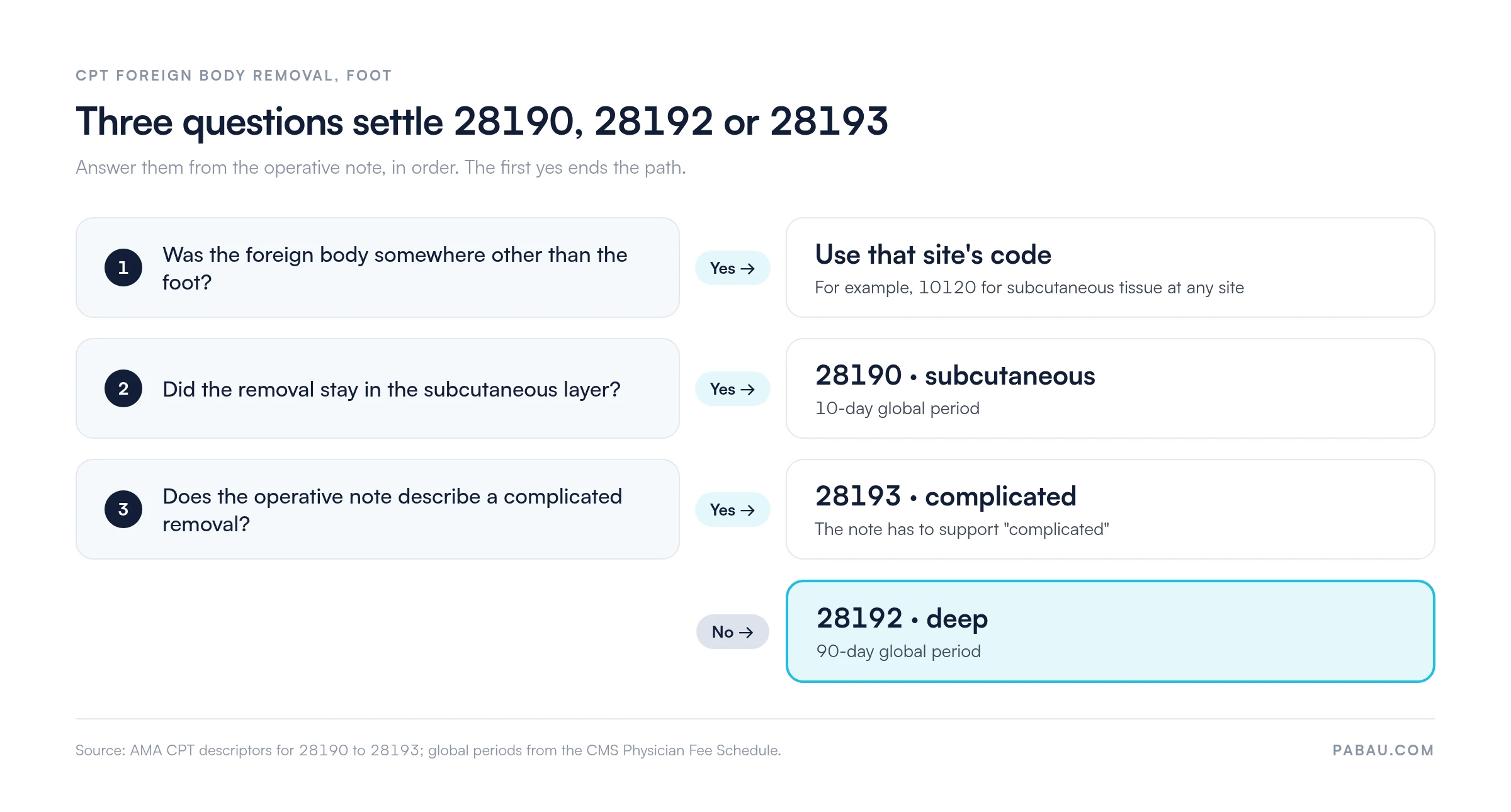
Decision path for foot foreign body removal codes
Most deep foot removals end at the last box, 28192, once the note rules out a subcutaneous or complicated removal. Descriptors are from AMA CPT, and global periods from the CMS fee schedule.

CPT 28192 vs CPT 10120: The foot code wins when it fits

CPT 10120 (incision and removal of foreign body, subcutaneous tissues; simple) is a generic code that applies at any body site. 28192 is foot-specific and covers the deeper layer. The two aren’t interchangeable, and defaulting to 10120 for a deep foot removal is a coding error.

CriterionCPT 10120CPT 28192
Anatomic siteAny body siteFoot only
Tissue layerSubcutaneousDeep (below the subcutaneous layer)
IncisionSimple incisionSurgical incision with dissection
Use when…Foreign body is subcutaneous at any site (hand, arm, neck, etc.)Foreign body is deep in the foot and needs dissection beyond the subcutaneous layer
Payer downcode riskAccepted, but undervalues a deep foot procedureMay be downcoded if the operative note doesn’t document depth

When the object is in the foot and below the subcutaneous layer, 28192 is the site-specific code to use. Billing 10120 instead loses revenue, and an auditor may also flag it as miscoded, because the more specific code takes precedence under AMA guidelines.

ICD-10 codes that prove medical necessity for 28192

Every 28192 claim needs an ICD-10-CM code that describes the foreign body, its side where the code carries one, and the episode of care. Vague or truncated codes are a leading denial trigger.

ICD-10-CM codeDescriptionUse when…
M79.5Residual foreign body in soft tissueAn object stays in the soft tissue after the original wound has healed; no side or 7th character
S91.341- / S91.342-Puncture wound with foreign body, right foot / left footAn acute puncture with an embedded object; add the 7th character
S91.321- / S91.322-Laceration with foreign body, right foot / left footA cut with debris or an object in it; add the 7th character
W45.0XXANail entering through skin, initial encounterExternal cause code when a nail is the foreign object (initial encounter)
W26 seriesContact with knife, sword or daggerExternal cause for metallic foreign bodies from sharp objects

7th character extension: The S91 wound codes need an episode-of-care character, A for initial encounter, D for subsequent and S for sequela. Leaving it off fails the claim edit automatically. For an object left behind once the wound has closed, use M79.5. It takes no side digit and no 7th character, so the RT or LT modifier carries the side.

Medicare pays 28192 from RVUs, with a 90-day global period

Medicare pays CPT code 28192 under the Medicare Physician Fee Schedule (MPFS), with separate non-facility and facility rates. Rates update every January 1 and vary by locality through the Geographic Practice Cost Index (GPCI).

Check the current figure in the CMS Physician Fee Schedule lookup tool before you quote a patient or sign a contract.

RVU componentWhat it representsNotes
Work RVU (wRVU)Physician effort: Time, skill, intensityFixed nationally; not adjusted by locality
Practice expense RVU (PE)Office overhead, equipment, clinical staffHigher in non-facility setting (office) than facility (hospital/ASC)
Malpractice RVU (MP)Liability insurance costSmall component; adjusted by specialty risk
Global periodPost-operative care windowCMS assigns 28192 a 90-day (090) global period; 28190 carries 10 days

The 90-day global period means routine post-operative visits within 90 days of the procedure are bundled into the 28192 payment. They can’t be billed separately unless modifier 24 (unrelated E/M during the global period) or modifier 79 (unrelated procedure during the global period) applies.

The FastRVU lookup tool returns the current wRVU, PE and MP values for 28192 by locality. If those terms are new, our guide to relative value units explains how the three components become a payment.

Modifiers for 28192: Laterality first, then the E/M question

Which modifiers a 28192 claim needs depends on the side, the visit around the surgery and any other procedure on the same date. A wrong or missing modifier is a direct path to denial.

ModifierUseWhen to apply
LTLeft sideRequired by most payers; submit on every 28192 claim with the matching side
RTRight sideAs above; match the diagnosis side (S91.341- right, S91.342- left). M79.5 has no side, so the modifier carries it
57Decision for surgeryAppend to the E/M on the day before or day of surgery when that visit decided on 28192, a 90-day global procedure
25Significant, separately identifiable E/M same dayAppend to the E/M code (not 28192) when a significant, unrelated evaluation happened on the same date
59Distinct procedural serviceOnly to override an NCCI edit with another procedure done at a separate, documented site. Never used to separate an E/M from 28192
51Multiple proceduresWhen 28192 is the secondary procedure on the same date; payers cut secondary codes to 50% of the fee schedule
78Unplanned return to OR during global periodIf a complication sends the patient back to the OR within the 90-day global period

A superbill that lists 28192 with RT and LT beside it catches the most common omission before the claim is built.

Pro Tip

Always confirm the side in both the modifier and the ICD-10 code. Submitting RT with S91.342A (puncture wound with foreign body, left foot) is a mismatch that payers deny as a data inconsistency. The modifier and the diagnosis side must match on every claim line.

Prior authorization for 28192 depends on the payer

Traditional Medicare generally doesn’t require prior authorization for CPT code 28192. Medicare Advantage plans and commercial insurers set their own rules, so assuming no authorization is needed is a revenue risk.

  • Traditional Medicare (Part B): No prior authorization required. The claim processes on submission with a valid ICD-10 diagnosis and documentation.
  • Medicare Advantage plans: Requirements vary by plan. Check the plan’s coverage policy or run an eligibility check before the procedure date.
  • Commercial insurers: Many require prior authorization for surgical procedures, 28192 included, especially in an ambulatory surgery center. Send imaging results, clinical notes on the object’s presence and depth, and any failed conservative care.
  • Documentation for prior auth requests: Include the X-ray or ultrasound showing depth, notes on the object’s location and failed non-surgical extraction, and the planned procedure.

Before you submit 28192, run this checklist

A 28192 claim moves from the signed operative note to the charge entry, then through the clearinghouse to the payer. Most rejections trace back to the first two stops, so check these before the claim leaves the building.

  • The note names the layer. Look for words like “subfascial” or “below the plantar fascia”, not just “deep”.
  • The side matches twice. RT or LT on the claim line agrees with the diagnosis code’s side.
  • The diagnosis is complete. An S91 code has its 7th character, or the claim uses M79.5 for a retained object.
  • The E/M modifier is right. Use 57 for the decision-for-surgery visit and 25 for an unrelated, significant visit.
  • Nothing bundled is billed. Simple closure and same-site incision and drainage stay off the claim.
  • Authorization is on file. A Medicare Advantage or commercial plan that asks for one has its number on the claim.

Why 28192 claims get denied, and how to appeal

28192 denials cluster around five causes. Knowing them before submission prevents most of them, and knowing them after a denial speeds the appeal.

  1. Depth not supported in the operative note: The most common denial. The payer downcodes to 28190 because the note describes subcutaneous tissue only. Appeal with an addendum from the surgeon stating the layer where the object was found and the dissection needed.
  2. Bundled with I&D on the same date: NCCI bundles same-site incision and drainage (28002, 28005) into 28192. Modifier 59 applies only when the other procedure was at a separate site and the note documents it.
  3. Missing laterality modifier: RT or LT is missing or conflicts with the diagnosis side. Correct the modifier and resubmit; a data correction needs no appeal letter.
  4. Non-specific ICD-10 code: An unspecified or truncated code, such as S91.34 with no side digit or 7th character, triggers an edit. Use M79.5, or a complete code such as S91.341A or S91.342A.
  5. Duplicate service flag: A prior 28192 claim for the same patient, date and foot triggers a duplicate edit. Confirm the date of service and side match the original claim before resubmitting.

Match each remittance code against our list of common denial codes. Then route repeat patterns to a denial management workflow that sets a root cause, a fix and an appeal deadline for each claim.

NCCI edits decide what bills alongside 28192

The National Correct Coding Initiative (NCCI) publishes quarterly edit tables that decide which code pairs can’t be billed together. For CPT code 28192, the edits that matter most involve wound closure and incision and drainage at the same site on the same date.

Bundled codeDescriptionEdit typeModifier 59 bypass?
12001-12018 (wound closure)Simple wound repair codesColumn 2 (bundled into 28192)No, closure is part of the global surgical package
28002Incision and drainage below fascia, with or without tendon sheath involvement, foot; single bursal spaceColumn 2 (same site)Only if performed at a separate anatomical site with separate documentation
28005Incision, bone cortex, footColumn 2 (same site)Only if separate anatomical site; document distinctly
99202-99215 (E/M)Office evaluation and managementBundled unless it is the decision for surgery or separately identifiableNot a 59 case. Use 57 on the E/M for the decision for surgery, or 25 for a significant, unrelated E/M

Check the pairs against the current quarterly NCCI file from CMS, because edit pairs and modifier indicators change each quarter. Claim scrubbing at a medical claims clearinghouse catches many conflicts before submission rather than after a denial.

Document 28192 so it survives an audit

Payer audits on CPT code 28192 target the same weak spot every time. The operative note doesn’t support the depth claim. The checklist below covers each element an auditor reviews.

  • Pre-operative diagnosis: Confirm the foreign body and state its suspected depth, subcutaneous or deep.
  • Imaging: Reference X-ray or ultrasound findings if available. Note the modality, date and finding, such as a radiopaque object at a stated depth.
  • Anesthesia type: State whether local, regional or general anesthesia was used.
  • Incision details: Record the incision site, length and layer reached. “Incised through skin and subcutaneous tissue to the plantar fascia” defends far better than “deep incision made”.
  • Dissection details: Describe the dissection path and the structures encountered. This is the documentation that separates 28192 from 28190.
  • Retrieval description: State the object’s material, size and removal method, intact or fragmented.
  • Closure technique: Record the layered closure, which confirms the surgical nature of the procedure.
  • Post-operative diagnosis: Confirm removal and record where the object was found.

An operative note template with a required depth field stops most of these omissions at the source. The AAPC CPT code reference adds guidance on documenting surgical foreign body removal codes.

Pro Tip

Add an EHR template field that asks the surgeon to state the anatomical layer at retrieval, not just ‘deep.’ A note that reads ‘foreign body retrieved from subfascial plane, below the plantar fascia’ is unambiguous. A note that reads ‘deep removal performed’ leaves depth to the payer, and payers read ambiguity as 28190.

How Pabau keeps 28192 claims clean from note to payment

In many practices, 28192 still reaches the payer through retyping, with the code copied from the operative note into a claim form. Each handoff is a chance to drop the RT or LT modifier or pick the wrong 7th character.

Pabau, the practice management and billing platform we build, takes the CPT code attached to the service straight onto the charge line. Our claims management software pre-fills the claim from the patient record and checks required fields before it sends. US claims go out through Claim.MD.

Eligibility checks before the appointment, remittance posting and claim-status tracking sit in the same place. Your billing team spends its time on the denials that need a coder, not on rekeying.
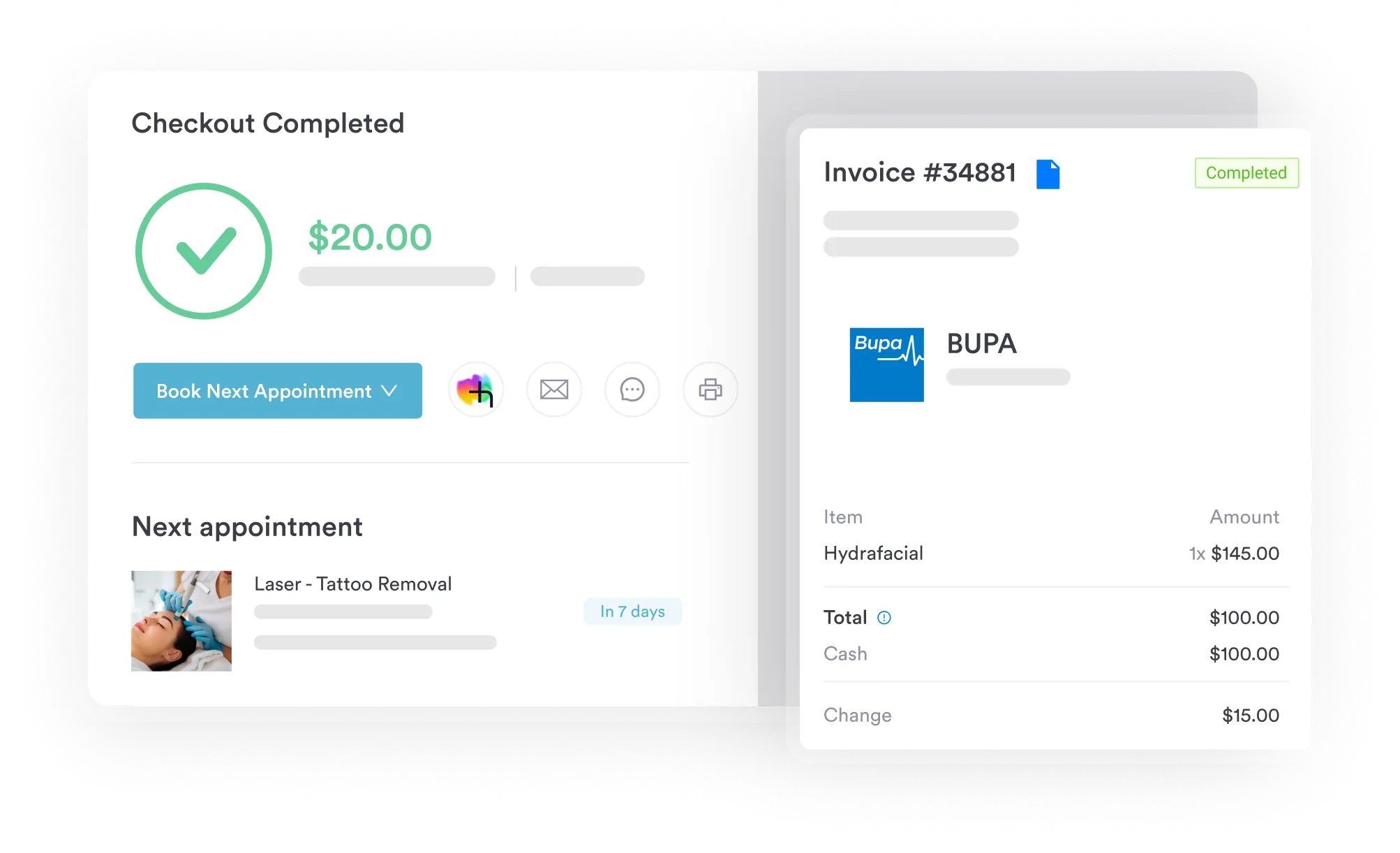
Pabau claims management screen
Pabau’s claims management pre-fills each claim from the patient record, so the 28192 charge line and its diagnosis codes reach the payer without retyping.

Bill 28192 from the record, not by retyping

Pabau pre-fills claims from the patient record, checks required fields before sending and submits US claims through Claim.MD. Eligibility checks and claim-status tracking sit alongside.

Pabau claims management dashboard

Conclusion

28192 is one of the easier surgical codes to defend, as long as the operative note names the layer. Get the depth, the dissection and the retrieval into the note, and most downcodes to 28190 never happen.

The trade-off to remember is the 90-day global period. Follow-up visits are already paid for, so the money is made or lost on day one. Put 57 or 25 on the right E/M and the right side on the claim line before it goes out.

Book a demo to see how Pabau carries a 28192 claim from the patient record to the payer without retyping.

Continue your research

Continue your research

Was the object complicated but not in the foot? CPT code 10121 covers complicated foreign body removal from subcutaneous tissue at any site.

Located the object with ultrasound first? CPT code 76882 explains billing for a limited extremity ultrasound.

Looking for a reference on medical billing fundamentals? What is revenue cycle management explains how claims flow from service delivery to payment posting and where 28192 fits in the cycle.

Want to understand electronic claim file formats? 837 file format guide covers how CPT codes including 28192 are structured in an 837P professional claim for payer submission.

Frequently asked questions

What is the global period for CPT 28192?

28192 has a 90-day global period. Medicare bundles the visit on the day before or the day of surgery, the procedure and routine follow-up for 90 days into one payment. Bill unrelated care in that window with modifier 24 or 79.

When do 20520 or 20525 apply instead of 28192?

20520 covers simple removal of a foreign body from muscle or tendon sheath, and 20525 covers deep or complicated removal. They are general musculoskeletal codes. For an object in the foot, the site-specific 28190-28193 family is the better fit.

Can you bill the X-ray or ultrasound separately?

Usually, yes. Imaging that locates the object before surgery is a separate diagnostic service with its own CPT code. That covers a foot X-ray or a limited extremity ultrasound. Document the reading and check payer rules for same-day imaging.

Which diagnosis code fits an old, retained foreign body?

M79.5, residual foreign body in soft tissue, fits an object left behind after the wound has healed. A fresh puncture wound with an embedded object takes S91.341 or S91.342 with a 7th character instead.

Who usually performs and bills 28192?

Podiatrists and foot and ankle surgeons perform most 28192 removals, in the office, an ambulatory surgery center or a hospital. The setting changes the payment, because Medicare pays a facility rate and a non-facility rate.
Avatar photo
Monika Lazarevska
Content Writer

Monika Lazarevska writes content for owners and healthcare professionals who want clear, no-fluff content that actually helps them run their practice better. With a background in storytelling and SEO, she knows how to make even the driest topics worth reading. Off the clock, you'll find her in a café somewhere in Europe, probably with a good book and an even better coffee.
×