ICD-10 Code Y76.0: Diagnostic obstetric and gynecological devices
ICD-10 Code Y76.0: Definition and billable status ICD-10 Code Y76.0 is a valid, ...

Last Updated: Oct 23, 2026
Billable Code Specific Code
M79.5 is the billable ICD-10-CM code for residual foreign body in soft tissue.
Let Pabau's smart automation suggest the right codes, reduce claim denials, and keep your practice compliant—effortlessly.
Automate repetitive tasks and focus on what matters most—your patients.
Reduce coding errors and ensure compliance with the latest regulations.
Clean claims, fewer denials, and faster reimbursements.
Powerful insights and reporting to help your practice thrive.
HIPAA compliant SOC 2 certified GDPR-compliant Trusted by 4,000+ clinics worldwide

ICD-10 code M79.5 is residual foreign body in soft tissue, and it is billable at four characters with no subcodes.
M79.5 carries no site axis and no laterality axis, so the detail has to live in the note and on the procedure line.
Two Excludes1 codes outrank it, because L92.3 and M60.2- apply once a foreign body granuloma has formed.
Add a Z18 code to name the retained material, since M79.5 never says whether the fragment is metal, glass, or wood.
Practice management software like Pabau captures material, site, and imaging findings during the visit, so claims reach the payer with support attached.
ICD-10 code M79.5 is the ICD-10-CM diagnosis code for residual foreign body in soft tissue. It is a complete four-character code and it is valid for FY2026 submission. There is no fifth or sixth character, so M79.5 is the terminal code for this diagnosis.
That last point is where coders lose time. Most musculoskeletal codes push you toward a site and a side, and this one does neither. If you are hunting for a laterality subcode beneath M79.5, stop looking, because the CDC/NCHS tabular list does not contain one.
This guide covers the code’s place in the hierarchy, what qualifies clinically, and the two Excludes1 codes that outrank it. It also covers Z18 material pairings, documentation requirements, common coding errors, CPT links, and the ICD-9 crosswalk.
M79.5 sits in Chapter 13 of the tabular list, among the soft tissue disorders. The path runs from the chapter down to a single terminal code.
Sibling codes in the same category behave differently, which feeds the confusion. M79.1 (myalgia) and M79.6 (pain in limb, hand, foot, fingers and toes) both subdivide further. M79.5 and M79.7 (fibromyalgia) do not.
A residual foreign body is material that stayed behind in soft tissue after entering the body, almost always through a penetrating injury. The wound itself may have closed months or years earlier. The fragment is still in there.
The cases that reach a coder tend to look like this:
Imaging carries a lot of weight on these claims, because the record has to show the fragment exists. Radiography finds metal and most glass. Wood, thorns, and plastic are frequently radiolucent, so ultrasound or MRI does the work instead.
Timing matters as much as material. M79.5 describes the fragment that remains once the injury episode is over. The patient may return with symptoms, or the fragment may appear incidentally on imaging ordered for something else.
In software built for chiropractic practices, M-code diagnoses drive care plans measured visit by visit.
Once the body has walled the fragment off in a granuloma, M79.5 is the wrong code. The tabular list places two Excludes1 codes under it, and an Excludes1 note means the two codes never appear on the same claim.
M60.2- deserves a second look, because it does what M79.5 cannot. It subdivides by anatomic site and by side, down to codes such as M60.271 for the right ankle and foot. A documented granuloma therefore gives you the specificity that the retained-fragment code withholds.
So the note has to state whether a granuloma formed. Without that line, no coder can choose between these three codes with any confidence.
M79.5 says a fragment is retained. It does not say what the fragment is made of, how it got there, or whether it is causing a complication. Other code families carry that information.
The Z18 range is the one most worth building into your workflow. It subdivides by material, and several branches need a fifth character before they are billable.
M79.5 carries no instructional note demanding a Z18 code, so treat the pairing as a specificity habit rather than a rule. Confirm the terminal Z18 code in the tabular list before you submit. Z18 also excludes look-alike situations, including an object left during a procedure and a superficial splinter. Secondary payers often allow a shorter window than the primary, so the filing deadline differs by claim. Coding names the service; medical billing gets it submitted, adjudicated and paid.
An M79.5 claim survives review when the note answers four questions. What is the fragment, where is it, how did it get there, and what happens next?
The record should carry all of the following:
Two of those items decide the code by themselves. Material drives the Z18 pairing, and granuloma status decides whether M79.5 survives at all. Everything else supports medical necessity.
Add a mandatory foreign body material picklist and a granuloma present yes-or-no field to your soft tissue exam template. Those two fields decide between M79.5, L92.3, and M60.2-, and the first one also drives the Z18 code. Collect them during the visit rather than after a denial.
Five errors account for most M79.5 problems. Each one is a documentation problem before it becomes a coding problem.
M79.5 has no children. Codes written as M79.50, M79.51, or M79.52 appear nowhere in ICD-10-CM, and a claim carrying one will fail validation. Report M79.5 as it stands, then put the side on the procedure line with an RT or LT modifier.
M79.5 is about foreign material, not about limbs. Amputation stump complications live in the T87 range, with T87.3- for neuroma of the stump and T87.8- for other stump complications. Phantom limb syndrome sits at G54.6 and G54.7, and general limb pain sits at M79.6-.
The two topics get conflated because the word residual opens both descriptors. Read the descriptor in the tabular list rather than trusting a search result or a coding cheat sheet.
When the patient presents with the fresh wound, code the injury. Chapter 19 carries open wound and puncture wound codes with foreign body for each site, and they take a seventh character for the encounter. M79.5 covers the fragment that remains once that episode is behind you.
A superficial splinter in the chest wall stays in Chapter 19, where the follow-up visit takes S20.95XD.
The Excludes1 note is absolute. If the pathology report or the exam documents a foreign body granuloma, the granuloma code replaces M79.5 instead of joining it on the claim.
An instrument, sponge, or fragment left behind during a procedure is a procedural complication. It belongs to T81.5-, which specifies both the procedure type and the resulting complication. Coding it as M79.5 understates a reportable safety event.
Most M79.5 encounters end in one of two ways: watchful waiting or removal. The removal codes are where the site and the side finally get recorded, since the diagnosis code cannot hold either.
Attach the RT or LT modifier so the claim records the side. That step matters more than usual on these claims, because M79.5 cannot carry laterality at all.
Coverage then follows medical necessity rather than the diagnosis code on its own. Payers want the imaging report, the current symptoms, and a reason the fragment needs to come out now. A fragment deliberately left in place is usually better represented by a Z18 status code than by a removal claim.
Local Coverage Determinations vary by Medicare Administrative Contractor and change annually. Check your own jurisdiction before you rely on any policy, and confirm code validity against the CMS ICD-10-CM annual update files.
The crosswalk here is unusually clean. ICD-9-CM 729.6 carried an identical descriptor, and the CMS General Equivalence Mappings link it to M79.5 one to one.
That makes legacy record reviews and workers’ compensation audits straightforward for this code. GEMs remain a mapping aid rather than a coding authority, so verify against the current files before leaning on a mapping in an appeal.
Retained foreign body claims fail at the note, not at the code. The coder needs the material, the side, the imaging finding, and the granuloma status. All four are easy to lose across a busy clinic day.
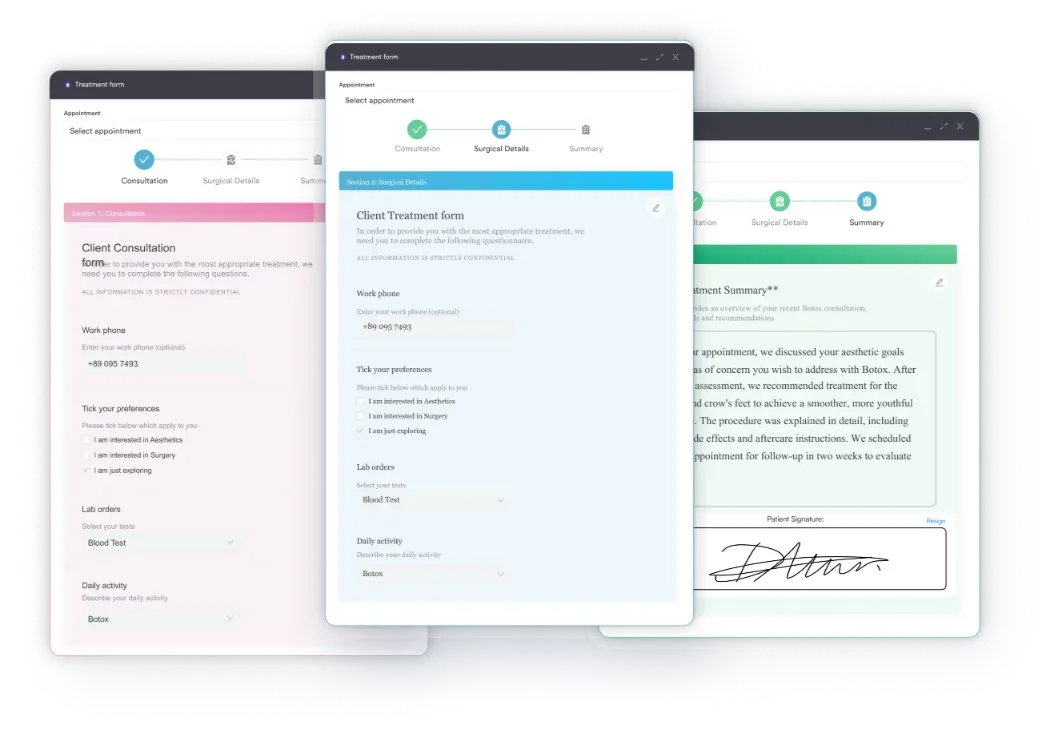
Practice management software like Pabau keeps them together. Customizable clinical forms turn the material and granuloma questions into required fields, so the note is finished before it reaches billing. Imaging reports and wound photographs attach to the same client record.
Pabau’s claims management software then carries the diagnosis and the procedure line through to submission. The coder sees the exam detail and the plan in one place instead of chasing a scanned imaging report.
The outcome is fewer queries between coders and clinicians, and fewer claims returned because a detail was recorded somewhere nobody thought to look.

Pabau’s customizable forms and client records capture the fragment material, the side, the imaging finding, and the granuloma status as structured data. Your claim then reaches the payer with its support already attached.

M79.5 is one of the simplest codes to select and one of the easiest to misapply. There is a single code, no fifth character, and no side to choose.
The risk sits in the choices around it. A documented granuloma moves the claim to L92.3 or M60.2-. A fresh wound belongs in Chapter 19. Amputation stump pain is a different body system altogether.
Get the material, the site, the side, and the granuloma status into the note, and the coding follows on its own. Pabau builds those fields into the visit itself. Book a demo to see how the documentation reaches the claim intact.

Coding another M79 soft tissue code? ICD-10 code M79.7 covers fibromyalgia, the other terminal code in the same category.
Coding a radial neck fracture once it has healed? ICD-10 code S52.133S covers a healed displaced radial neck fracture, billable once imaging confirms the bone has united.
Coding an ulna fracture that failed to heal? ICD-10 code S52.209K covers an unspecified closed ulna shaft fracture at a follow-up visit where the bone failed to unite.
Coding a wound that has already healed? ICD-10 code S01.05XS walks through sequela coding and the seventh character.
Coding a soft tissue rupture instead? ICD-10 code M66.9 covers spontaneous tendon rupture and what the note has to show.
M79.5 is the ICD-10-CM diagnosis code for residual foreign body in soft tissue. It sits in Chapter 13, block M70-M79, category M79. It describes material that remains in soft tissue after entering the body, usually through a penetrating injury.
Yes. M79.5 is a complete four-character code and it is valid for FY2026 claim submission. It has no fifth or sixth character, so nothing has to be added before the claim goes out.
No. M79.5 has no child codes and no laterality axis. Codes written as M79.50, M79.51, or M79.52 do not exist in ICD-10-CM. Record the side in the clinical note and on the procedure line with an RT or LT modifier.
No. That mix-up comes from the word residual. Amputation stump complications are coded in the T87 range, including T87.3- for stump neuroma. Phantom limb syndrome is G54.6 or G54.7, and general limb pain is M79.6-.
It is good practice. M79.5 does not say what the fragment is made of, and the Z18 range does. No instructional note forces the pairing, so follow payer guidance and extend Z18 to its terminal code first.
Use them when a foreign body granuloma is documented. L92.3 covers skin and subcutaneous tissue, and M60.2- covers deeper soft tissue. Both carry an Excludes1 relationship with M79.5, so they replace it rather than joining it.
ICD-9-CM 729.6 carried the same descriptor, residual foreign body in soft tissue. The CMS General Equivalence Mappings link 729.6 to M79.5 as a one-to-one match with no approximation flag.