



CCSD code G5100: Bypass of duodenum billing guide
CCSD code G5100 bills a bypass that leaves the duodenum in place CCSD code G5100...

Last Updated: Oct 16, 2026

CPT Code 76882 describes a limited, anatomically specific nonvascular extremity ultrasound with real-time image documentation required on every claim.
76881 covers a complete exam of one joint, while 76882 covers every other nonvascular extremity structure, including non-joint areas like the groin or calf.
Medicare’s 2026 fee schedule pays about $64 for 76882 and $54 for 76881, so the limited code reimburses more than the complete exam.
Pabau’s claims management software enforces documentation checklists at the point of care, reducing 76882 denials before submission.
CPT Code 76882 is a billable code for a limited, anatomically specific nonvascular extremity ultrasound performed in real time with image documentation.
Coders often submit it without the anatomic specificity notation the payer expects. Or they bill a limited study under the complete code’s descriptor, and the claim gets flagged. The medical billing workflows that catch these errors before submission are worth building now.
According to the American Medical Association (AMA), CPT Code 76882 is maintained within the Diagnostic Ultrasound Procedures section of the CPT code set. Its correct use depends on understanding scope, documentation, and how it interacts with companion codes such as 76881, 76883, and 76942.
This guide covers the official descriptor, clinical indications, ICD-10 crosswalk, 2026 Medicare reimbursement, modifiers, documentation requirements, bundling rules, and common denial reasons.
CPT Code 76882 carries the official AMA descriptor:
Ultrasound, limited, joint or other nonvascular extremity structure(s) (e.g., joint space, peri-articular tendon[s], muscle[s], nerve[s], other soft-tissue structure[s], or soft-tissue mass[es]), real-time with image documentation.
Three elements in that descriptor drive every billing and documentation decision.
Common clinical applications include evaluating a specific tendon, such as the Achilles or rotator cuff. Others include assessing a palpable soft-tissue mass at a single site, guiding aspiration at a defined joint, or confirming a suspected ganglion cyst. Physical therapy practices and sports medicine clinics that perform in-office musculoskeletal ultrasound are among the most frequent billers of this code.
Selecting between 76882 and 76881 is the most consequential coding decision on any nonvascular extremity ultrasound claim. Using the wrong code is the leading cause of upcoding allegations and post-payment audits for this family of codes.
These figures are 2026 Medicare national averages before geographic adjustment. Run both codes through the CMS PFS Look-Up Tool with your locality’s GPCI factors before setting your practice’s fee schedule.
The practical rule: if the sonographer evaluated only a specific named structure, such as “the distal Achilles tendon insertion,” 76882 is correct. If the report documents every visualized structure within one joint, 76881 may apply, provided the documentation supports the complete exam.
Non-joint regions, such as the groin, axilla, or calf, always fall under 76882, regardless of how thorough the scan is.
A third code, CPT 76883, covers a comprehensive ultrasound of one or more nerves. It examines their accompanying structures throughout their entire course in a single extremity. It was added to the CPT code set in 2023.
It applies when the study is a full-length nerve evaluation, such as ruling out entrapment along a nerve’s complete course. That differs from a joint or soft-tissue exam.
Medical necessity is the payer’s primary test for any ultrasound claim. Under CMS ICD-10 coding guidelines, the diagnosis code paired with 76882 must reflect the specific clinical question the limited study was ordered to answer.
Accepted indications typically include localized joint pain with suspected effusion, a palpable soft-tissue mass requiring characterization, or tendon tear evaluation at a single site. Suspected ganglion cyst and post-procedural assessment of a specific anatomic region also qualify. Screening studies or routine surveillance without a documented symptom or clinical question generally do not satisfy medical necessity for this code.
Pairing 76882 with a supported ICD-10 diagnosis code is the fastest way to prevent a medical-necessity denial. The table below lists the most commonly accepted pairings. They come from CMS Billing and Coding Article A56787, which implements the Nonvascular Extremity Ultrasound LCD for your MAC jurisdiction.
Always verify the most current accepted ICD-10 pairings against your MAC’s version of the LCD, since coverage determinations can be updated. CMS Billing and Coding Article A56787, not itself an LCD, is where that guidance is published. Use the AAPC Codify CPT lookup tool to cross-reference supporting diagnosis codes for any ultrasound CPT.
Medicare reimburses CPT Code 76882 through the Medicare Physician Fee Schedule (MPFS), published annually by CMS. The 2026 national average for the global service, professional plus technical components combined, is about $64. That figure is based on a total RVU of 1.92 and the $33.4009 conversion factor.
CPT 76881, the complete single-joint exam, pays less nationally at about $54, since its total RVU of 1.61 is lower despite covering more structures. Payment still varies by MAC jurisdiction and geographic adjustment factor.
Use the CMS Physician Fee Schedule lookup tool to confirm your practice’s locality-specific rate before setting your internal fee schedule. Billing at an outdated 2025 rate into 2026 creates reconciliation errors that compound across high-volume ultrasound practices.
Claims submitted electronically through Pabau’s integration with electronic claims via Claim.MD go through the same check. The clearinghouse validates payer enrollment and applies current fee schedule data before transmission.
Once ERA files return from payers, reconciling the allowed amount against your posted rate is straightforward with electronic remittance advice workflows. Practices that skip manual ERA reconciliation often miss underpayments on high-volume codes like 76882.
The MPFS payment is derived from the RVU table below, multiplied by the 2026 conversion factor and the practice’s geographic GPCI values. Confirm current RVU values using the FastRVU 2026 RVU lookup tool, which pulls directly from the CMS MPFS data file.
Unlike many diagnostic ultrasound codes, CPT 76882’s practice expense RVU is the same in facility and non-facility settings. The site of service doesn’t change the national payment amount for this code.
Modifier selection affects whether the claim pays in full, splits between the professional and technical components, or triggers a bilateral review. Getting modifiers wrong on 76882 is the second most common source of reduced payments after documentation failures.
When a physician both performs and interprets the study in an office setting (global service), no component modifier is appended. Modifier -26 and -TC together should always equal the global payment. If they do not add up to the expected total, a billing configuration error exists in your fee schedule.
Run a quarterly audit of 76882 claims split by modifier. If more than 20% of your -26 claims are posting at zero or reduced payment, the most likely cause is a missing provider enrollment with the relevant MAC for professional component billing. Fix enrollment before resubmitting.
CMS Billing and Coding Article A56787 sets the documentation floor for nonvascular extremity ultrasound, implementing the Nonvascular Extremity Ultrasound LCD for your MAC. Every element below must appear in the medical record before CPT Code 76882 is billed. Missing any single element is enough to convert a payable claim into a denial or a post-payment recoupment target.
Enforcing these requirements at the point of care, rather than catching missing elements during billing review, is what separates high-denial practices from low-denial ones. Building a documentation checklist directly into your clinical workflow ensures medical billing compliance before the claim is ever generated.
A structured form or pre-built template that prompts for each element takes roughly 60 seconds to complete. It eliminates the most common denial triggers for this code. When documentation is complete, submitting a clean claim becomes the natural outcome rather than the exception.

Pabau’s claims management software embeds documentation checklists directly into the clinical record. Coders see complete, compliant notes before submitting a single ultrasound claim.

Ultrasound code denials follow predictable patterns. The five errors below account for the majority of rejected 76882 claims across payer types.
Proactive denial management for ultrasound codes starts with understanding your top denial reason codes. Pull a monthly report filtered to CPT 76882 and sort by CARC denial reason.
If CO-4 (incorrect modifier) or CO-50 (not medically necessary) lead the list, the fix is upstream in documentation, not in rework. Review denial codes in medical billing to match each CARC to the correct corrective action and a target resubmission timeline.
Strong revenue cycle management means treating denial patterns as system signals rather than individual errors. A cluster of CO-50 denials on 76882 in a single month usually points to a payer policy change on medical necessity criteria. Billing staff often haven’t absorbed the update yet.
CPT Code 76882 can be billed alongside certain companion codes, but bundling edits govern each pairing. The National Correct Coding Initiative (NCCI) defines which codes are considered components of 76882 and which may be billed separately with the appropriate modifier.
The most common question involves CPT 76942 (ultrasound guidance for needle placement). According to CMS NCCI policy, the bundling relationship between 76882 and 76942 is edit-specific. It depends on whether the diagnostic ultrasound and the guidance were genuinely separate, distinct services.
Do not assume they can always or never be billed together. Check the current NCCI edit table for this specific code pair before submitting. When they are separately billable, modifier -59 on 76882 signals the distinct nature of each service.
Injection procedure codes, such as joint injection CPT codes, may be billed on the same date as 76882. This applies when the ultrasound was a diagnostic study performed for a separate clinical purpose, not solely as guidance for the injection. Again, the documentation must support the independent medical necessity of the diagnostic ultrasound.
When insurance eligibility verification is run before the appointment, it also catches prior authorization requirements that apply to ultrasound codes under specific payer contracts. Some commercial payers require auth for 76882 even when Medicare does not.
Generating a superbill that itemizes each service with its modifier helps billers review bundling risk before submission.
The documentation and modifier requirements for CPT Code 76882 create a predictable set of checkpoints that practice management software can enforce automatically. Rather than relying on a coder to catch missing elements after the clinical encounter, the right system flags them at the point of documentation.
Pabau’s claims management software integrates documentation workflows with the billing cycle. When a clinician completes the ultrasound note, the system can surface a structured checklist.
It confirms that anatomic specificity, image storage, and clinical indication are all captured before the chart closes. This moves the denial prevention step to the point of care rather than a billing desk review that happens days later.
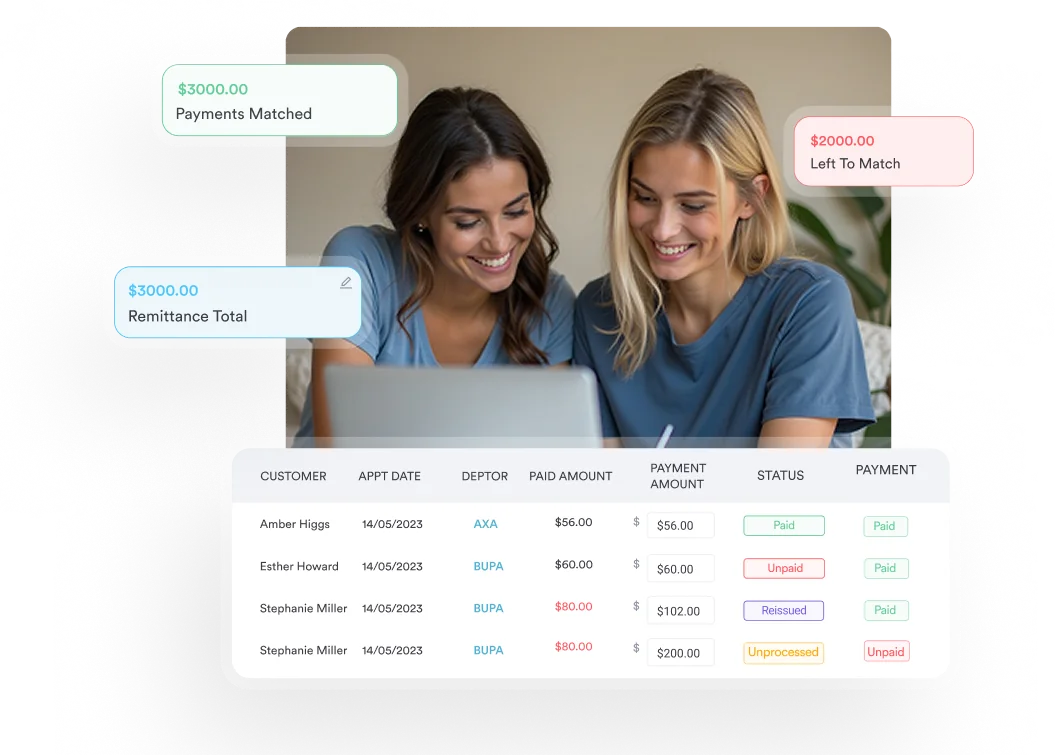
The integration with the Claim.MD clearinghouse handles the submission side. Claims pass through a medical claims clearinghouse that validates payer enrollment, checks for NCCI edits, and confirms the claim format before it reaches the payer. Claims with known bundling conflicts are flagged before transmission rather than returned as denials 30 days later.
Fee schedule updates are another friction point. When CMS publishes the annual MPFS, practices billing from an outdated rate table collect less than the allowed amount. They often don’t discover the shortfall until an audit or reconciliation project. An integrated system that updates rates systematically removes that manual step from the billing team’s annual workload.
Check: before submitting any 76882 claim with modifier -TC, confirm your facility has completed the appropriate Medicare administrative contractor enrollment for technical component billing. Unenrolled facilities billing -TC will receive consistent CO-4 denials that accumulate into significant revenue loss before the root cause is identified.
CPT Code 76882 is a straightforward code to bill correctly when documentation is built into the clinical workflow rather than bolted on at billing. The anatomic specificity requirement, the limited-vs-complete distinction from 76881, and the modifier rules for split billing cover the majority of denial risk.
Get those three elements right and the code performs predictably across both Medicare and commercial payers.
Pabau’s integrated claims management keeps documentation, coding, and submission in one connected workflow, reducing the manual handoffs where 76882 errors most often occur. To see how that workflow operates in practice, book a demo with the Pabau team.

Need a clearinghouse that catches NCCI edits before submission? Medical claims clearinghouse guide explains how clearinghouse validation reduces denial rates on diagnostic imaging codes.
Want to understand how payments post after a claim is paid? 837 electronic claim file guide covers EDI formats, CARC codes, and reconciliation workflows for ultrasound billing.
Looking to verify coverage before scheduling ultrasound appointments? Insurance credentialing guide walks through the enrollment steps that unlock MAC participation for professional and technical component billing.
CPT Code 76882 is used to bill a limited, anatomically specific nonvascular extremity ultrasound performed in real time with image documentation. It applies when the study evaluates one defined structure or region rather than the full extremity. Examples include a focused Achilles tendon assessment or a single-site soft-tissue mass evaluation.
CPT 76881 is a complete ultrasound exam of a single joint, evaluating every structure within that joint. CPT 76882 is the limited code, covering one named structure, such as a tendon, muscle, nerve, or soft-tissue mass. It also covers any nonvascular extremity structure outside a joint. Non-joint regions, like the groin or calf, always use 76882, regardless of how thorough the exam is.
Medicare’s 2026 fee schedule pays about $64 nationally for CPT 76882 as a global service. That’s more than the $54 it pays for CPT 76881’s complete single-joint exam. Rates vary by MAC jurisdiction, so confirm your locality-adjusted amount with the CMS Physician Fee Schedule Look-Up Tool before posting your internal fee schedule.
The most common modifiers are -26 (professional component, physician interprets only) and -TC (technical component, facility owns the equipment and performs the scan). -LT/-RT indicates left or right laterality for bilateral studies. Modifier -59 applies when 76882 is billed on the same date as another procedure and represents a genuinely distinct service.
Required documentation includes the ordering provider’s name, clinical indication, and a specific anatomic notation naming the structure evaluated. Stored real-time images and a final written interpretation signed by the interpreting physician round out the record. CMS Billing and Coding Article A56787 governs these requirements for Medicare by implementing the Nonvascular Extremity Ultrasound LCD. Commercial payer requirements may differ but typically follow the same framework.
They may be billed together when the diagnostic ultrasound (76882) and the ultrasound guidance for needle placement (76942) were genuinely separate and distinct services. This depends on the current NCCI edit table for this code pair. Always check the active NCCI edits before submitting both codes on the same date. If a bundling edit exists, modifier -59 may be required to override it with adequate documentation of medical necessity.
The 2026 Medicare Physician Fee Schedule assigns CPT 76882 a work RVU of 0.67 and a practice expense RVU of 1.20. Add a malpractice RVU of 0.05, and the total RVU is 1.92. That comes to a national payment of about $64, identical in facility and non-facility settings. Use the CMS PFS Look-Up Tool to find your specific MAC jurisdiction rate.
Common conditions include suspected tendon tears or tendinopathy at a single site, such as the rotator cuff or Achilles, and palpable soft-tissue masses requiring characterization. Bursal or ganglion cyst evaluation, joint effusion at a specific location, and post-procedure assessment of a defined anatomic region also qualify. Each must be supported by a matching ICD-10 diagnosis code reflecting the clinical question.



