CPT Code 96573: Photodynamic therapy billing guide
CPT Code 96573: Definition and official descriptor CPT Code 96573 is a medicine/...

Last Updated: Nov 13, 2026
23550 is the CPT code for open treatment of acromioclavicular dislocation, acute or chronic. The surgeon opens the AC joint, reduces the clavicle and holds it with internal fixation such as pins, screws, a hook plate or sutures.
Its neighbors split on the procedure. CPT 23540 is closed treatment without manipulation, and 23545 is closed treatment with manipulation. CPT 23552 is open treatment with a fascial graft, including obtaining the graft. Use 23550 when the joint is opened and no fascial graft is used, with LT or RT for the side.
Let Pabau's smart automation suggest the right codes, reduce claim denials, and keep your practice compliant—effortlessly.
Automate repetitive tasks and focus on what matters most—your patients.
Reduce coding errors and ensure compliance with the latest regulations.
Clean claims, fewer denials, and faster reimbursements.
Powerful insights and reporting to help your practice thrive.
HIPAA compliant SOC 2 certified GDPR-compliant Trusted by 4,000+ clinics worldwide

CPT code 23550 reports open treatment of an acute or chronic AC joint dislocation, repaired with internal fixation and no fascial graft.
A fascial graft moves the case to 23552, while closed care is 23540 without manipulation or 23545 with it.
Every 23550 line needs LT or RT, and the S43.1- diagnosis needs a laterality 6th character and an encounter 7th character.
CPT 29826 is an add-on to arthroscopic shoulder codes, so it never attaches to an open 23550 repair.
Commercial payers set prior authorization rules in their own medical policies, so check the plan before the case is scheduled.
CPT code 23550 reports open treatment of an acromioclavicular dislocation, whether the injury is acute or chronic. AAPC’s CPT 23550 summary files it under fracture and dislocation procedures on the shoulder. It describes the repair as open treatment held with internal fixation, such as pins or screws.
The acromioclavicular (AC) joint links the acromion of the scapula to the end of the clavicle. When it dislocates, the clavicle rides up and the shoulder loses its stable strut. In a 23550 case, the surgeon opens the joint, reduces it and holds it with pins, screws, a hook plate or sutures.
The American Medical Association publishes the CPT code set, and the descriptor below is the one to match against the operative note.
The AC dislocation family splits on what the surgeon did, never on the injury grade or the patient’s age. First, was the joint opened? Then, if it stayed closed, was it manipulated, and if it was opened, was a fascial graft used?
The diagram maps those two answers to the four codes.
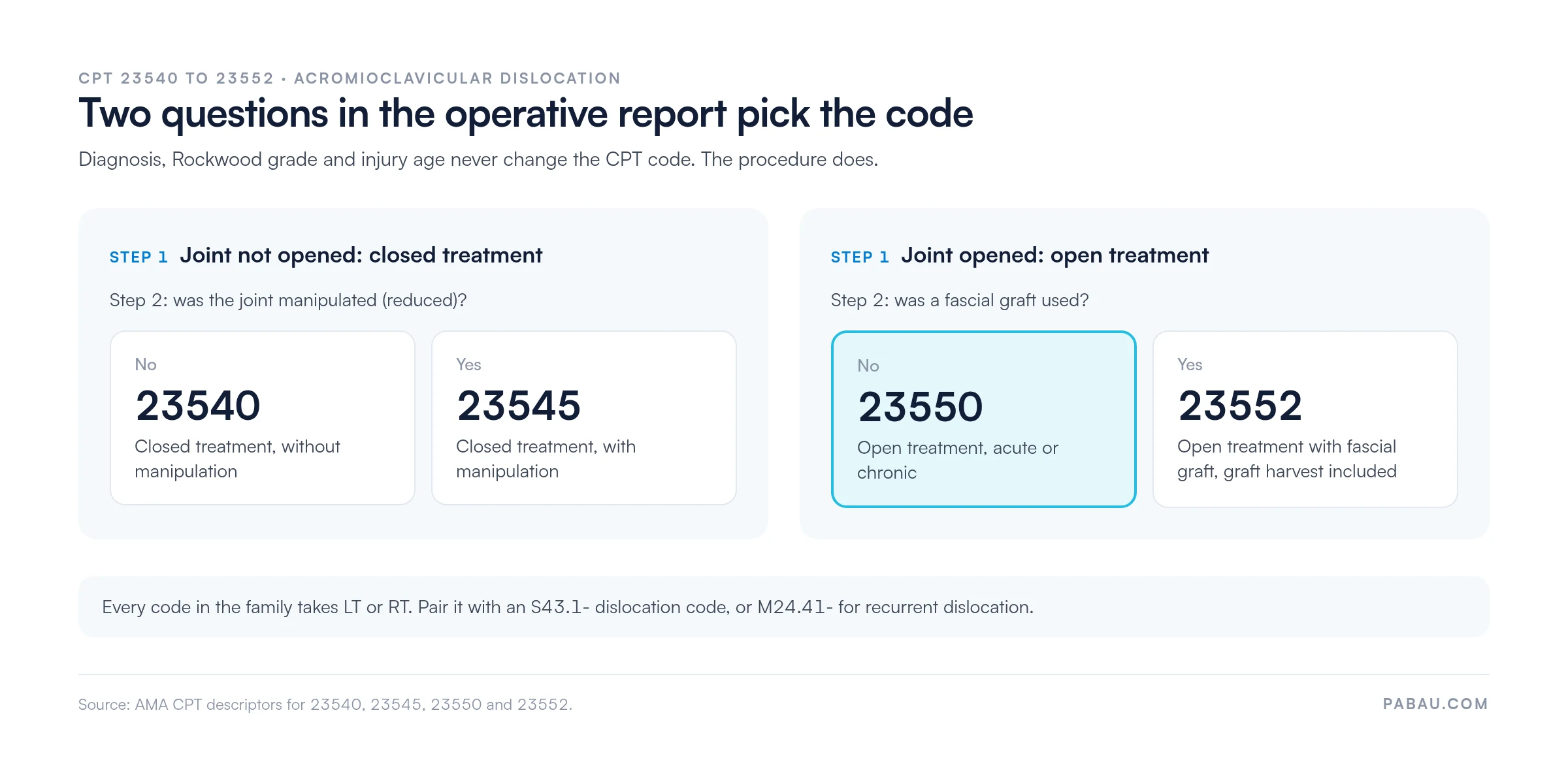
The operative report governs the choice. Billing 23550 when the note describes a fascial graft undercodes the case. Billing 23552 when no graft was harvested overcodes it, and that’s the version auditors look for.
Before you code an open AC repair, search the operative note for ‘fascia’, ‘fascial’ and ‘graft’. If a graft was harvested and placed, the case is 23552, and the harvest is already included. If none of those words appear, 23550 is the fit.
Knowing the package stops two opposite mistakes: billing pieces the code already pays for, and missing work that’s reportable later. The global surgical package for 23550 covers the whole open repair episode.
CPT code 23550 covers acute and chronic dislocations under one descriptor, so the injury’s age never changes the CPT code. It changes two other parts of the claim instead: the diagnosis code, and the evidence the payer wants before surgery.
For a chronic case, the record should show why conservative care failed, such as physical therapy, activity changes or bracing. For an acute high-grade dislocation, the imaging and the documented displacement usually carry the medical necessity argument.
Acute injuries pair with S43.1- dislocation codes. A chronic, recurrent dislocation maps to M24.41- (recurrent dislocation, shoulder), or to S43.1- with the 7th character that fits the encounter.
Every 23550 claim needs an ICD-10-CM code that supports open repair. The main family is S43.1-, and each code needs a laterality 6th character plus a 7th character for the encounter. The full tabular list sits in our ICD-10-CM code library.
For the S43.1- codes, the 6th character is 1 for right, 2 for left and 9 for unspecified. The surgery claim takes A for the initial encounter, and follow-up visits switch to D, as in S43.139D. Check codes against the current year in the CDC/NCHS ICD-10-CM browser.
Every 23550 claim needs a laterality modifier, and leaving it off is one of the quickest ways to a rejection. The table covers the modifiers that show up most on AC repair claims.
No, CPT code 29826 can’t be reported with 23550. It’s an add-on code for decompression of the subacromial space with partial acromioplasty, with coracoacromial ligament release when performed. An add-on code needs a primary arthroscopic shoulder procedure, and 23550 is an open procedure.
Sometimes a surgeon does perform a separate arthroscopic procedure in the same session. In that case, 29826 attaches to that arthroscopic primary code, never to 23550. Check the CMS NCCI edit tables for the pair before you build the claim, because they’re updated every quarter.
Whether 23550 needs prior authorization depends on the payer and the plan. Original Medicare doesn’t generally require it, while many Medicare Advantage and commercial plans do. Sound medical billing compliance means checking before the case goes on the surgery schedule, not after the claim comes back.
Most insurers offer a lookup by CPT code, such as the Wellcare authorization lookup, so staff can confirm the rule while booking the case.
The operative report is the document that carries a 23550 claim, and the pre-op and post-op notes complete the picture. A clean claim starts with checking that each element below is in the record before anyone files.
Take an illustrative case. A cyclist lands on his right shoulder, and X-rays show the clavicle displaced more than 200% compared with the other side. Ten days later, the surgeon opens the joint, reduces it and fixes it with a hook plate. No graft is taken.
Change one fact and the claim changes with it. Had the surgeon harvested fascia to rebuild the joint, the whole procedure line would become 23552-RT.
Nearly all of these are preventable at the front end. Good denial management treats each one as a fix to make upstream, so the next claim doesn’t repeat it.
Medicare pays 23550 through the Medicare Physician Fee Schedule (MPFS). The schedule assigns the code relative value units, adjusts them for your locality and multiplies by the year’s conversion factor. The CMS Physician Fee Schedule lookup returns the current allowed amount for your area.
Third-party tools such as FastRVU’s RVU lookup show the same values in a quicker format. Rates reset every January 1, so check the effective year before you quote a figure to a patient. Commercial rates come from each payer contract, which often sets them as a percentage of the Medicare rate.
In many orthopedic practices, the surgery claim is still built by hand from the op note, the auth email and the patient’s insurance card. Each handoff is a chance to drop a modifier or key the wrong member number.
Pabau, the practice management platform we build, pre-fills the claim from the patient record. The CPT code and diagnosis codes already attached to the visit land on the claim without rekeying. Its orthopedic practice claims software checks that required fields, such as authorization numbers, are complete before the claim can be sent.
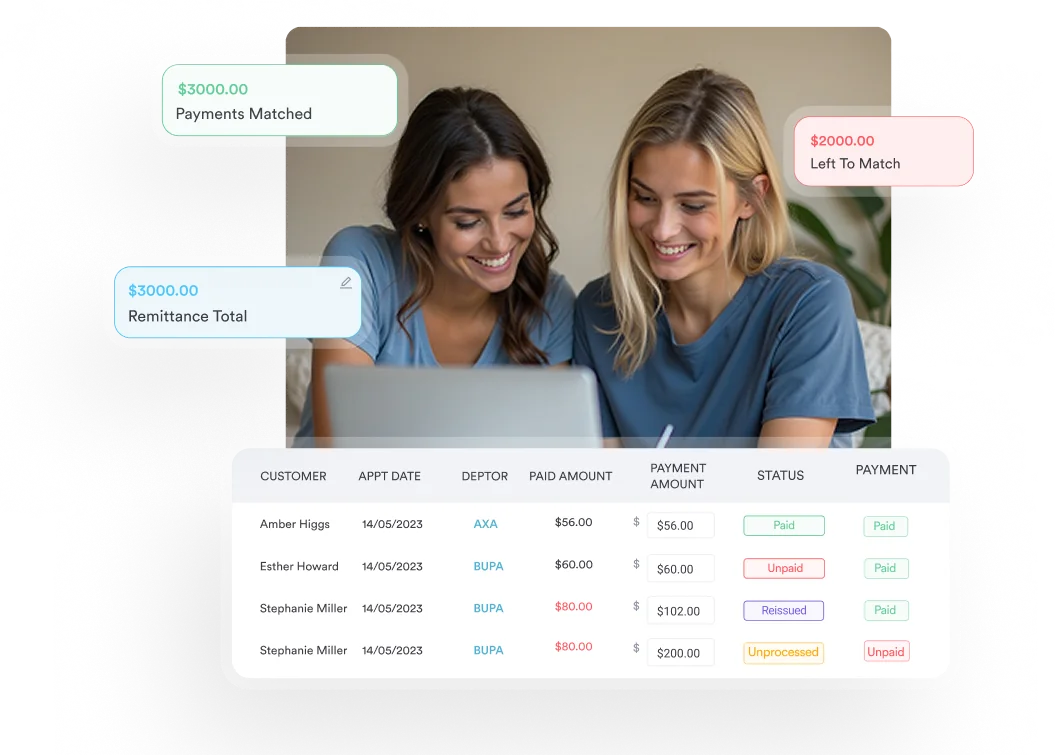
In the US, claims go out through Pabau’s Claim.MD integration, which connects to thousands of US payers. It runs real-time eligibility checks before the surgery, then tracks claim status and posts the remittance when payment arrives.

Pabau pre-fills 23550 claims from the patient record, checks required fields before submission and tracks each claim to payment. Book a demo to see it for orthopedic and sports medicine practices.

CPT code 23550 is simple to choose once the operative note answers two questions. Was the joint opened, and was a fascial graft used? Most denials on this code come from the details around that choice. Think of a missing LT or RT, an incomplete S43.1- code or an expired authorization.
So make the check routine. Code from the note rather than the surgery schedule, and run the six-point list before every AC repair claim leaves the practice. The trade-off is a few minutes per case, against weeks of rework on a denied claim.
Book a demo to see how Pabau pre-fills shoulder surgery claims and tracks every one to payment.

Coding a clavicle fracture instead? CPT code 23500 covers closed treatment of a clavicular fracture without manipulation.
Billing a partial AC separation? ICD-10 code S43.111A explains the right AC joint subluxation code and when it applies.
Need to track claim denials across CPT codes? What is revenue cycle management explains how end-to-end RCM workflows reduce denial rates across a practice’s code set.
Submitting surgery claims electronically? Understanding the 837 file format covers how electronic claim files are structured, including the claim frequency code.
New to the billing side of the practice? Medical billing fundamentals walks through claim submission basics that apply across the musculoskeletal CPT range.
No. CPT 23550 is a primary surgical code with a 90-day global period. It’s billed on its own line with LT or RT, and add-on codes can’t attach to it.
Open treatment means the surgeon surgically opens the injury site to see it and treat it, often with internal fixation. Closed treatment, such as 23545, reduces the joint without an incision.
No. An AC separation involves the joint between the acromion and the clavicle. A shoulder dislocation involves the glenohumeral joint, which has its own CPT codes, 23650 to 23680, and ICD-10-CM codes under S43.0-.
No. Routine follow-up in the 90-day global period is part of the surgical package. Many practices report those visits as 99024 at no charge to track them.
Hardware removal is usually reported as 20680. Inside the 90-day global period, a removal planned at the first surgery takes modifier 58, and an unplanned return to the operating room takes 78.