

HCPCS Code E0272: Foam rubber mattress billing guide
HCPCS Code E0272: official descriptor and code overview HCPCS Code E0272 is the ...

Last Updated: Nov 6, 2026
23500 is the CPT code for closed treatment of a clavicular fracture without manipulation. In plain terms, the collarbone is broken, the alignment is acceptable, and the physician immobilizes it in a sling or strap without reducing the fragments.
The fact that decides the code is manipulation. If the notes record any reduction attempt, even a brief one, the claim belongs under 23505 instead. Getting it right protects the fee, because 23500 also carries a 90-day global period that bundles routine follow-up. The sections below follow a 23500 claim from the clinical note to payment, including the ICD-10 pairings and denials that trip it up.
Let Pabau's smart automation suggest the right codes, reduce claim denials, and keep your practice compliant—effortlessly.
Automate repetitive tasks and focus on what matters most—your patients.
Reduce coding errors and ensure compliance with the latest regulations.
Clean claims, fewer denials, and faster reimbursements.
Powerful insights and reporting to help your practice thrive.
HIPAA compliant SOC 2 certified GDPR-compliant Trusted by 4,000+ clinics worldwide

CPT code 23500 covers closed treatment of a clavicle fracture without manipulation, meaning conservative care with no reduction performed.
A 90-day global period applies, so routine follow-up visits, sling checks, and dressing changes are bundled and not billed separately.
Pair 23500 with an ICD-10 S42.0- code, and check laterality and the 7th character, since a wrong encounter suffix is a common denial trigger.
Use CPT 23505 when closed reduction is performed and CPT 23515 for open treatment, based on what was done, not fracture severity alone.
Pabau’s claims management software pre-fills 23500 claims from the patient record and checks required fields. It adds CPT and ICD-10 lookup libraries, Claim.MD submission, eligibility checks and ERA posting.
CPT code 23500, as defined by the American Medical Association, reads: Closed treatment of clavicular fracture; without manipulation. It sits in the Musculoskeletal System section of CPT, inside the Shoulder subsection (23000-23929).
Orthopedic surgeons, emergency physicians and primary care providers all bill it when they treat a clavicle fracture conservatively. The code fits only when the clinician decides not to manipulate the fracture. That decision has to be written in the note, because a payer won’t infer it.
Closed treatment without manipulation means nobody moves the bone fragments. It suits non-displaced or minimally displaced midshaft fractures where the alignment is already acceptable.
The clavicle is one of the most commonly fractured bones, and roughly 80% of clavicle fractures occur at the midshaft. Most of them heal well with conservative care.
These clinical criteria support coding to 23500:
If the clinician performs any manual reduction, even a brief attempt, the code shifts to 23505. Don’t choose between the two on fracture grade alone. The note has to describe what was done, not just what was found.
Only one clinical act separates CPT 23500 from CPT 23505, and that act is manipulation. With no reduction, 23500 applies. When the physician performs a closed reduction to move the fragments into better alignment, 23505 is correct.
Example: An ED physician briefly tries to reduce a midshaft fracture, then decides a sling is enough. Because the attempt is documented, the claim goes out as 23505, not 23500. The documentation drives the code, not the final treatment alone.
Every CPT code 23500 claim needs an ICD-10-CM diagnosis from the S42.0 subcategory (fracture of clavicle). The 5th character gives the location, and the 6th gives displacement and laterality. The 7th character gives the encounter type, and getting it wrong is a common reason these claims are denied.
For superbill documentation and claim submission, pick the S42.0 code that matches the imaging report:
7th character guidance: Use A (initial encounter) on the visit where active treatment starts, which is when 23500 is billed. Use D (subsequent encounter) for routine healing visits, which fall inside the global period. Later visits for delayed healing take G, as in S42.002G for a left clavicle. Nonunion takes K, and malunion takes P.
Building a clean claim for CPT code 23500 starts with the clinical note. Payers audit fracture care closely because the 23500 versus 23505 split depends on documentation alone. No image or report can prove that manipulation did not occur.
Every note should carry these elements:
Same-day E/M billing needs care. Because 23500 carries a 90-day global period, Medicare expects modifier 57 on the E/M where the decision to treat the fracture is made.
Modifier 25 doesn’t fit that visit. A same-day E/M for an unrelated problem takes modifier 25 instead. Some payers don’t allow a separate E/M with non-manipulative fracture care at all, so check the payer’s policy first.
CMS assigns CPT code 23500 a 90-day global period under the Medicare Physician Fee Schedule. The package covers the treatment day and the 90 days after it. The chart below shows what stays billable inside that window.
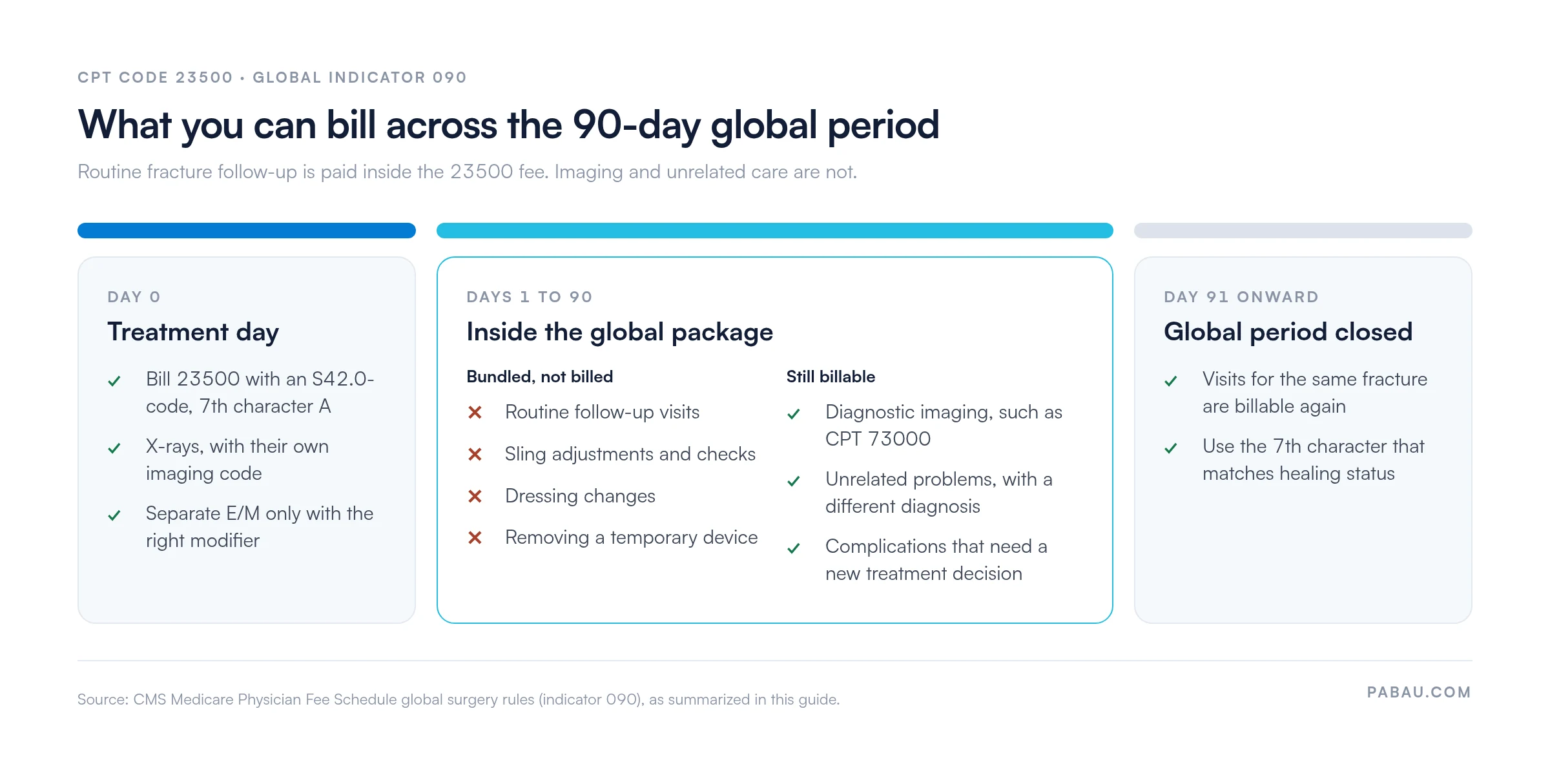
Bundled (not billed separately during the global period):
Separately billable during the global period (with documentation):
A follow-up clavicle film, for instance, is reported with CPT 73000 rather than folded into the 23500 fee.
Watch the handoff between providers. The ED often identifies the fracture, and an orthopedic surgeon takes over conservative care at a follow-up visit. When the surgeon bills 23500 at that visit, the global period runs from that date. The ED evaluation is a separate encounter under a different provider, so it isn’t bundled.
Note the 90-day end date on every 23500 patient record. A visit after that date for a new problem related to the same fracture is separately billable, so a missed date means unpaid work.
Most 23500 claims pass through the same six steps. Knowing where each one can stall makes a denial much easier to trace.
Steps two and four are where a wrong suffix or a blank field can stop the claim before a payer ever reviews it.
A quick check before submission costs far less than an appeal. Compare each item against the note and the imaging report:
Medicare reimbursement for CPT code 23500 comes from the Medicare Physician Fee Schedule (MPFS), which CMS updates every year. Three RVU components set the rate: work, practice expense, and malpractice. They’re multiplied by the annual conversion factor and a geographic adjustment.
Rates change every year and vary by locality, so check current amounts in the CMS Physician Fee Schedule lookup tool. The FastRVU 2026 RVU lookup gives a quick facility and non-facility breakdown by locality. Avoid quoting a fixed dollar figure in documentation or patient materials, because the rate resets each January 1.
Commercial payer rates for 23500 vary widely. Compare each contract against Medicare, and flag any that pay less. A real-time eligibility check before the visit also catches coverage problems that would otherwise delay payment.
Denials for CPT code 23500 cluster around a few predictable problems. These are the encounter suffix, missing imaging, the 23500 versus 23505 choice, and E/M bundling. Good denial management workflows catch them before submission.
Remittance codes tell you which of these errors hit the claim, and medical billing denial codes explains each one. The fastest fix is usually the encounter suffix. A corrected claim with the right 7th character typically passes on resubmission without extra documentation.
Clavicle fracture claims often sit next to other shoulder codes in the 23500-23680 range. Knowing where 23500 fits prevents mix-ups on multi-injury claims. The AAPC Codify CPT lookup lists the full range with descriptors.
Acromioclavicular (AC) joint dislocations (23540, 23545, 23550) often appear alongside clavicle fractures in trauma patients. When both are present, code each one separately with its own ICD-10 code. A proximal humerus fracture treated without manipulation is a different bone again, billed as CPT 23600.
When a trauma patient presents with both a clavicle fracture and an AC joint injury, check imaging carefully before selecting codes. A distal clavicle fracture near the AC joint can look clinically similar to an AC dislocation. The imaging report drives the diagnosis code, and the diagnosis drives the CPT code.
Orthopedic and musculoskeletal practices billing 23500 often send claims with a blank field that only shows up later as a rejection. Pabau, the practice management platform we build, checks that required claim fields are complete before the claim is sent.
Pabau’s medical billing software pre-fills claims from the patient record and submits them through Claim.MD’s clearinghouse. Coders get CPT and ICD-10 lookup libraries plus required-field validation before the Send button unlocks. ERA remittances return CARC denial reasons, so billing staff can act on rejections the day they arrive.
Real-time eligibility checks are included too. Your team can confirm a patient’s coverage for fracture care before the visit rather than after it.
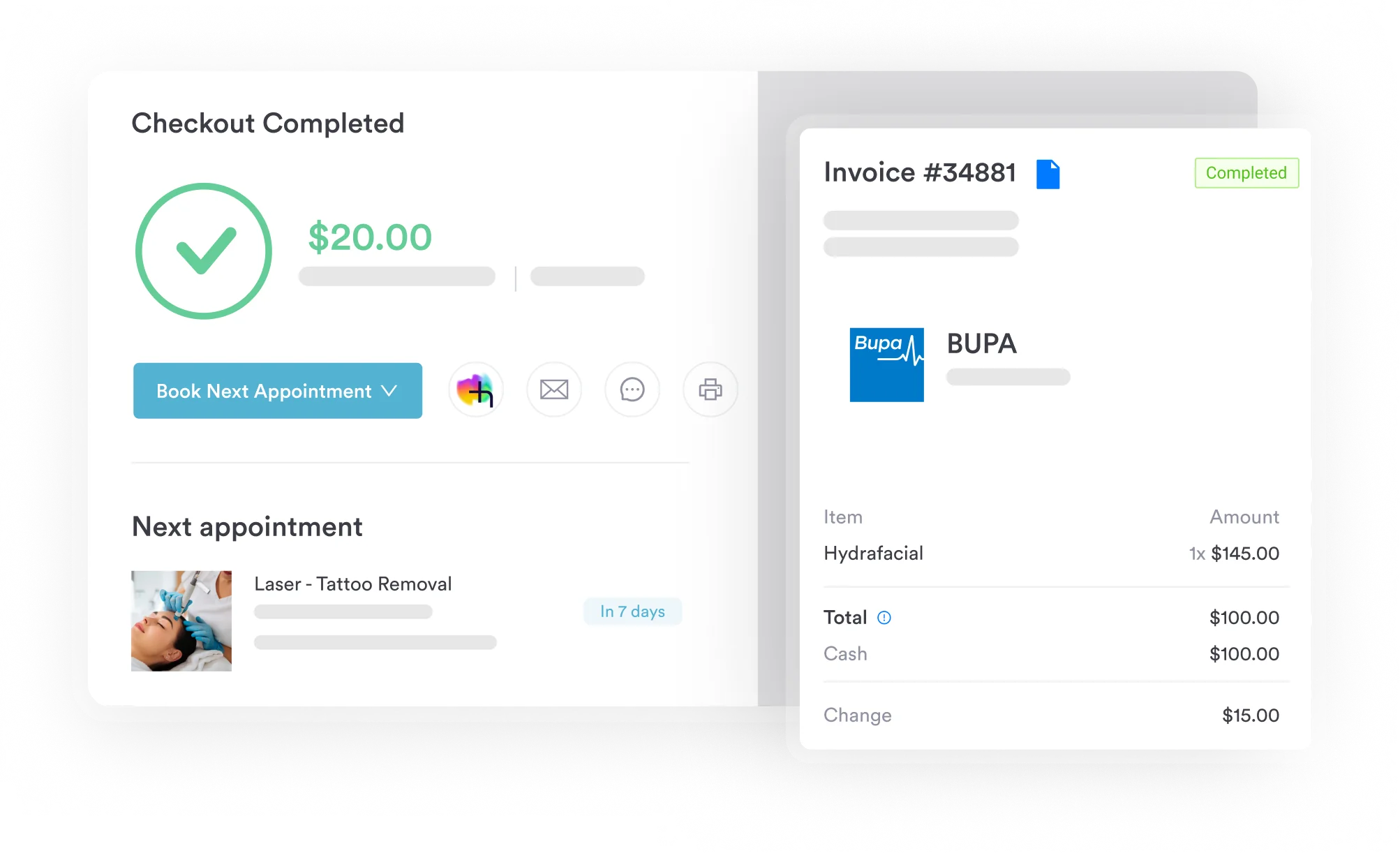

Pabau pre-fills claims from the patient record and checks required fields before sending. It submits through Claim.MD with eligibility checks and ERA posting, so your team spends less time on rework.

Treat every 23500 claim as a documentation claim first. When the note says plainly that no manipulation happened, names the device, and matches the imaging, the right code follows.
The trade-off worth remembering sits in the global period. 23500 pays once for 90 days of routine care, so bill the imaging and unrelated visits that fall outside the package, and leave the rest.
If your team keeps reworking the same fracture claims, claim-field validation and clearinghouse submission cut that rework at the source. Book a demo to see how Pabau handles fracture care claims from encounter to payment.

Need to understand denial codes on your 23500 remittance? Denial codes in medical billing explains CARC and RARC codes so your team can act on rejections quickly.
Billing a clavicle X-ray during the global period? CPT code 73000 covers the clavicle imaging code and the modifiers it needs.
Treating a proximal humerus fracture instead? CPT code 23600 walks through closed humerus fracture care without manipulation.
Billing fracture care alongside other procedures? Superbill documentation covers how to structure multi-code claims to reduce unbundling flags.
Want faster eligibility checks before fracture care visits? Insurance eligibility verification shows how to automate coverage checks so payer issues surface before the visit.
Yes. CPT 23500 sits in the Surgery section of CPT, even though no incision is made. Fracture care counts as a procedure, which is why 23500 carries a 90-day global period like other major surgical codes.
Yes. When one physician treats the fracture and another takes over follow-up, the first bills 23500 with modifier 54 (surgical care only). The second bills 23500 with modifier 55 (postoperative management only). Document the transfer of care in both records.
CPT 73000 covers a complete radiologic exam of the clavicle. It’s billed separately from 23500, including follow-up films taken during the global period.
A clavicle fracture from birth injury takes ICD-10 code P13.4, not a code from the S42.0 subcategory. If the physician provides closed treatment without manipulation, 23500 still describes the procedure.




