



CCSD code G5100: Bypass of duodenum billing guide
CCSD code G5100 bills a bypass that leaves the duodenum in place CCSD code G5100...

Last Updated: Oct 16, 2026

CPT 29826 is an add-on code, listed separately in addition to a primary shoulder arthroscopy code and never reported on its own.
Its only accepted primary codes are 29806, 29807, 29819, 29820, 29821, 29822, 29823, 29824, 29825, 29827, and 29828.
The code carries 2.93 work RVUs and a ZZZ global period, so it pays only its incremental work on top of the primary procedure.
Modifier 51 never applies, and modifiers 59, XS, and XU are not needed to pair 29826 with one of its listed primary codes.
When arthroscopic subacromial decompression is the only work performed, report 29822 or 29823 instead, based on the number of discrete structures debrided.
Practice management software like Pabau submits the claim through Claim.MD, runs eligibility checks, and posts electronic remittance advice.
CPT code 29826 is an add-on code for arthroscopic subacromial decompression with partial acromioplasty. Since 2012 it has been an add-on, which means it never goes out on a claim by itself. The code has to travel with one of eleven shoulder arthroscopy codes, or the payer rejects it by rule.
That single detail decides whether the acromioplasty gets paid or written off. It also explains why 29826 turns up so often in orthopedic denial reports.
Below are the accepted primary codes, the payment values, the modifier rules, and the documentation an auditor will look for.
The American Medical Association (AMA) maintains the official descriptor for CPT code 29826 as follows:
Full descriptor: “Arthroscopy, shoulder, surgical; decompression of subacromial space with partial acromioplasty, with coracoacromial ligament (i.e., arch) release, when performed.”
Add-on instruction that closes the entry: “(List separately in addition to code for primary procedure).”
That closing parenthetical is the whole story. The plus sign in front of +29826 marks it as an add-on code, so it describes incremental work performed during a larger arthroscopic operation. There is no scenario in which 29826 is the only code on the claim line.
The phrase “when performed” matters too, but it applies only to the ligament release. Coracoacromial ligament release is not required to report the code, and partial acromioplasty alone satisfies the descriptor. When the release is performed, it is included in 29826 and is not billed separately.
Subacromial decompression creates more space between the rotator cuff tendons and the undersurface of the acromion.
The surgeon resects a portion of the inferior acromion, which is the partial acromioplasty, and releases the coracoacromial ligament when indicated. The result is a widened subacromial space that reduces impingement on the cuff.
Before 2012, 29826 was a standalone code that coders reported alongside other shoulder arthroscopy codes and then defended with modifiers. The 2012 CPT revision converted it to an add-on code and stripped out the duplicated pre-operative and post-operative work.
Guidance from AAPC on the 2012 add-on conversion confirms the practical effect. Any workflow still treating 29826 as a primary procedure is running on pre-2012 rules.
CPT 29826 may be reported with eleven shoulder arthroscopy codes and no others. CMS treats it as a Type 1 add-on code, meaning the edit file names a fixed list of acceptable primary procedures.
A claim that carries 29826 without one of these codes is rejected by rule rather than by clinical review.
The first row covers 29806, arthroscopic shoulder capsulorrhaphy. That instability repair carries a 90-day global period of its own, and the ZZZ period on 29826 follows it. Check the 29806 billing rules before you post the combined claim.
In practice, most 29826 lines sit under 29827. Surgeons repair the cuff and decompress the space in the same session often enough that this pair drives most of the code’s volume.
Because this is a designed add-on relationship, the pairing is not an NCCI procedure-to-procedure edit. The pair needs no unbundling, and no override modifier belongs on the line. You can confirm the current list against the Medicare NCCI add-on code edit file, which CMS republishes each quarter.
The codes below come up constantly in shoulder cases, and none of them supports an add-on line for 29826. Two of them describe the open route to the same decompression, so they replace 29826 rather than accompany it.
The open rotator cuff scenario is where the old modifier habit still shows up. Practices used to append modifier 59 to 29826 alongside 23410 or 23412 to force the line through. AAPC guidance is explicit that appending modifier 59 in that situation was done in error, and the edit is not one a modifier can override.
Most 29826 questions collapse into a single decision, and the note answers it. The branch below shows where each answer lands. The table underneath adds the detail for the five patterns that come up most.
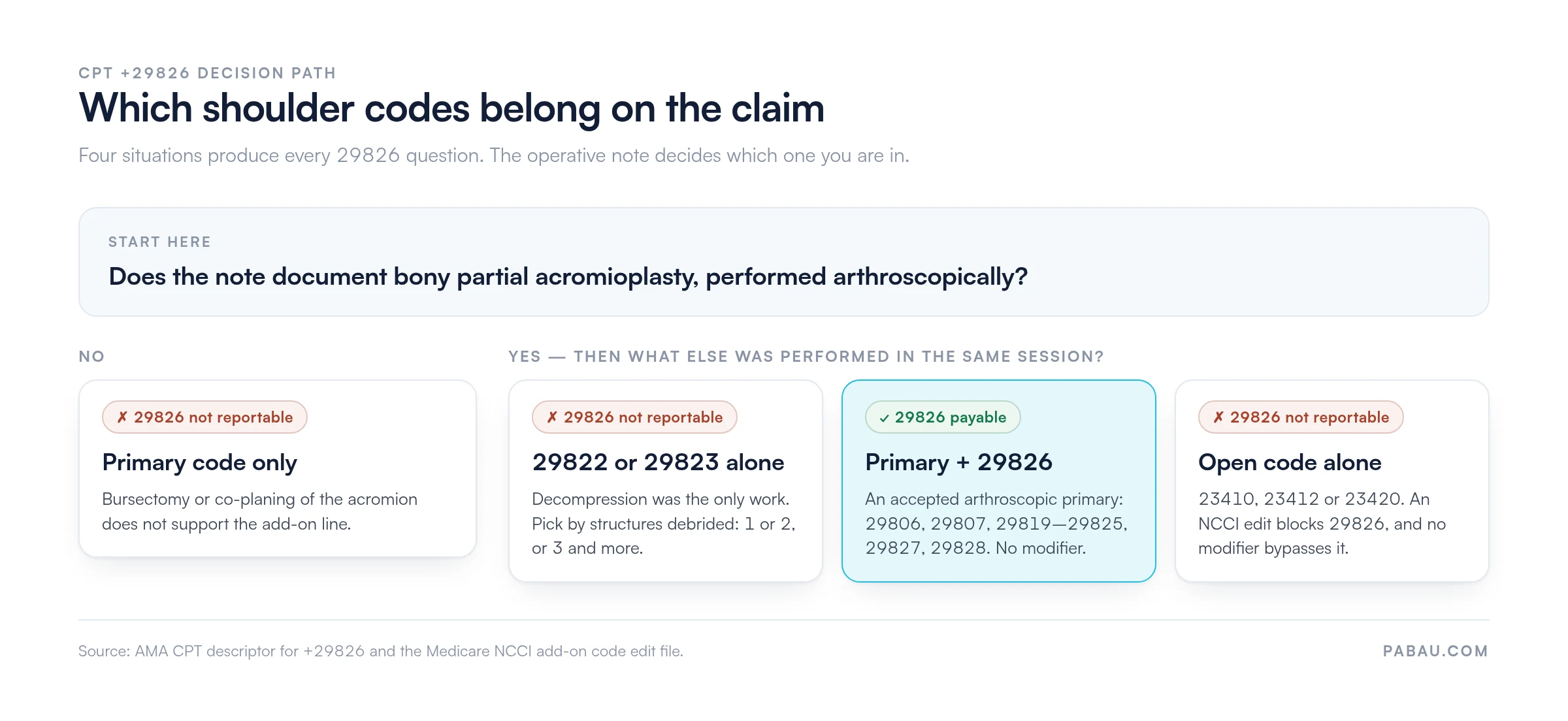
Cases two and three are the ones worth memorizing. When decompression is the only service performed, the correct code is a debridement code. The choice between 29822 and 29823 turns on how many discrete structures the surgeon treated.
Payers do not assess medical necessity for 29826 on its own. They review the necessity of the primary arthroscopic procedure, then look for documentation that the acromioplasty happened in the same session. So the record has two separate questions to answer.
Local Coverage Determinations (LCDs) issued by Medicare Administrative Contractors (MACs) govern the coverage criteria for the operation. Criteria vary by MAC jurisdiction, but most look for the following clinical evidence before the operation is approved or paid.
Diagnosis coding carries that evidence onto the claim. The ICD-10 diagnosis codes you report should name the impingement, bursitis, or cuff pathology the record documents, on the operative side.
The second question is narrower and specific to the add-on line. Payers want evidence of bony resection, not soft tissue work described in acromioplasty language. A note that records a bursectomy or co-planing of the acromion does not support 29826.
Not every code draws its criteria from a local determination. HCPCS code J1955 is governed by a national coverage determination that sets one fixed threshold: a plasma free carnitine level below 40 micromol/L.
CPT 29826 has no standalone Medicare payment line, because add-on codes are valued at incremental work only. The relative value units below reflect the extra intra-operative work of the acromioplasty. Pre-operative and post-operative work already sits in the primary procedure’s payment.
The dollar figure comes from multiplying total RVUs by the year’s conversion factor. For CY 2026 that factor is $33.4009 for a non-qualifying alternative payment model (APM) participant and $33.5675 for a qualifying participant. Verify the locality-adjusted amount with the CMS Physician Fee Schedule lookup tool before you quote a rate.
Run the math once and it stops being abstract. At 4.42 total RVUs and the $33.4009 factor, the national allowable works out to about $148. Add that to the primary code’s allowable, because an add-on line takes no reduction.
The exemption from multiple procedure reduction is worth noting. A second primary procedure on the same claim is typically paid at 50 percent of its allowable, while an add-on code is paid in full. Dropping 29826 from a legitimate pairing therefore costs the practice the entire add-on allowable.
Modifier handling for 29826 is mostly a list of modifiers to leave off. Because the add-on relationship is built into the code set, there is no bundling edit between 29826 and its listed primaries to override.
One caveat is worth keeping in view. A separate procedure on a genuinely different anatomic site may still need modifier 59 or an X modifier. That modifier belongs on the other code. It never goes on the 29826 line to justify the add-on itself.
Documentation drives almost every avoidable 29826 denial. The operative note has to establish the primary procedure on its own terms and then show the bony work that supports the add-on line.
Audits on this code most often cite vague resection language. Phrases like “decompression performed” or “acromion co-planed” leave a reviewer no way to confirm partial acromioplasty. A structured operative note template that prompts for resection detail resolves most of these findings.
Coverage rules for shoulder arthroscopy sit with the payer, not with CPT. Medicare requirements differ by MAC jurisdiction, and Aetna, UnitedHealthcare, Cigna, and Blue Cross Blue Shield each maintain their own clinical policies.
Authorization applies to the planned operation, so the add-on line follows whatever the primary code was approved for.
You request authorization for the primary arthroscopic procedure, and 29826 rides along with it. Requirements change annually with payer policy updates, so verify each plan rather than applying a blanket rule.
Run eligibility and benefits verification the day before surgery, not at the time of scheduling. Authorization status can lapse, plans can change, and prior authorization numbers can expire between the approval date and the procedure date. Catching that 24 hours out prevents a same-day rescheduling disaster.
Run this list on the claim, not on the appeal. Each item takes seconds at the scrubber stage and costs weeks once the remittance comes back.
Four of those five are claim-build checks, so a scrubber rule can carry them. The note is the one that needs a person, which is why a template that prompts for resection detail pays for itself.
Denials on this code cluster into a handful of predictable causes, and most of them are claim-build problems rather than clinical disputes. Fixing the cause recovers revenue faster than appealing case by case, so read the pattern before you write the letter.
Pull every 29826 line from the past 90 days and check which primary code sat on the same claim. Any line without one of the eleven accepted primaries was never going to pay. The fix is a claim-scrubber rule rather than an appeal letter. That single audit usually clears the largest block of denials on this code.
Add-on codes fail quietly. A claim built without its primary code looks complete on screen, passes a visual review, and comes back denied weeks later. The sooner the practice sees that rejection, the cheaper it is to fix.
Practice management software like Pabau keeps the clinical record, the schedule, and claim submission in one system. For a practice billing 29826 and the wider shoulder arthroscopy family, that means:
None of that replaces a coder’s judgment about which primary code belongs on the claim. What it shortens is the distance between hitting send and getting an answer. Our claims management follow-up covers submission, status, and remittance in one place.

Pabau submits orthopedic claims through the Claim.MD clearinghouse, tracks each claim’s status, and posts remittances against it. See how the billing workflow handles CPT 29826 and the shoulder arthroscopy family.

Treat 29826 as a passenger and most of its problems disappear. Put an accepted primary code on the same claim, keep the override modifiers off, and the line has no reason to bounce.
The part that still needs a person is the note. A reviewer cannot infer bony resection from the word “decompression”, so the surgeon has to write what came off the acromion. Fix that once in a note template and you stop rebuilding the same appeal every quarter.
The rest is claim hygiene, and software can carry it. Book a demo to see how Pabau submits, tracks, and reconciles orthopedic claims like this one.

Need to understand how clearinghouse claim submission works? Medical claims clearinghouse guide explains how electronic claims route from your practice management system to payers and where errors get caught.
Struggling with claim denials across multiple codes? Denial codes in medical billing breaks down the most common CARC and RARC codes and what each one means for your appeal strategy.
Want to understand the 837 EDI transaction behind your claims? 837 EDI file guide covers the electronic claim format that payers receive and how each data element maps to your billing information.
Denials piling up across more than one code? Denial management in healthcare sets out the workflow for working a denial queue and stopping repeat causes at the source.
Impingement and cuff diagnoses do, matched to the operative side. M75.41 and M75.42 cover impingement syndrome of the right and left shoulder, and M75.51 and M75.52 cover shoulder bursitis. Rotator cuff tears sit in the M75.1 range.
One. The decompression is a single piece of work, so a second unit is not supported even when two accepted primary codes were performed. Report a bilateral case per shoulder, following the payer’s rule on modifier 50.
Not for payment. List the primary procedure first and 29826 on the next line, so the pairing is obvious to a reviewer and to your scrubber. Line order will not rescue a claim that is missing the primary code.
Medicare allows one calendar year from the date of service to file or refile. Commercial payers set shorter windows, often 90 to 180 days from the date of service. Appeal deadlines run from the remittance date, so track the two separately.
Most do, but they are not obliged to. Some publish their own edits or add a documentation requirement. Check the payer’s reimbursement policy before you assume the eleven-code list applies to a commercial plan.



