CCSD Code Q0750: Subtotal abdominal hysterectomy
CCSD Code Q0750: definition and official descriptor CCSD Code Q0750 covers ̶...

Last Updated: Nov 10, 2026
21121 is the CPT code for genioplasty; sliding osteotomy, single piece. The surgeon makes one horizontal cut through the chin, moves the freed piece, and fixes it with plates and screws.
Two or more osteotomies move the case to 21122, and an interpositional bone graft moves it to 21123. Most denials on 21121 trace to missing medical necessity records or a skipped prior authorization. Both can be fixed before surgery.
Let Pabau's smart automation suggest the right codes, reduce claim denials, and keep your practice compliant—effortlessly.
Automate repetitive tasks and focus on what matters most—your patients.
Reduce coding errors and ensure compliance with the latest regulations.
Clean claims, fewer denials, and faster reimbursements.
Powerful insights and reporting to help your practice thrive.
HIPAA compliant SOC 2 certified GDPR-compliant Trusted by 4,000+ clinics worldwide

CPT Code 21121 is genioplasty; sliding osteotomy, single piece, meaning one horizontal chin cut with the freed piece repositioned and fixed
Two or more osteotomies move the case to 21122, and an interpositional bone graft at the cut moves it to 21123
Payers want cephalometric analysis, recorded functional impairment, and matching ICD-10-CM codes, because many plans treat genioplasty done only for appearance as cosmetic
Pabau’s practice software tracks prior authorization on the case, flags a missing auth code, and submits 21121 claims through Claim.MD
CPT Code 21121 is the code for a single-piece sliding genioplasty. Its official descriptor is Genioplasty; sliding osteotomy, single piece. The American Medical Association (AMA) publishes it in the Musculoskeletal System section, under the Head subsection (21010-21499). Also, the code sits in the genioplasty family, 21120 through 21123.
A sliding osteotomy genioplasty is a chin surgery. The surgeon makes a horizontal bone cut below the tooth roots and frees the lower chin as one piece. Then the surgeon moves that piece forward, back, up, or down, or rotates it to correct asymmetry, and secures it with titanium plates and screws.
In short, the key billing variables are the number of osteotomies and whether a bone graft goes into the cut. So CPT Code 21121 covers one osteotomy, one piece, and no interpositional graft.
Included in 21121: Namely, the code bundles the intraoral incision, the single osteotomy, repositioning of the chin piece, rigid internal fixation, and wound closure. If the surgeon places an interpositional bone graft in the osteotomy, the case is coded 21123, not 21121 plus a graft code.
Not part of 21121 (reported with a different or separate code):
The most common unbundling error on 21121 claims is billing the fixation hardware as a separate line item. In fact, hardware placement is integral to the osteotomy and is not billable on its own under NCCI edits.
Selecting the wrong code in this family is a common audit trigger for genioplasty claims. Instead, the differences are the number of osteotomies and whether an interpositional graft is placed, not the number of planes of movement.
First, read the op note closely before code selection. If the surgeon describes two or more osteotomies, CPT 21122 applies no matter how many planes of movement are used. If bone graft is placed between the cut surfaces, 21123 is correct, and harvesting the autograft is included in it.
A chin built up with an implant or graft and no bone cut is 21120. In short, three questions about the op note settle which code applies when you ask them in the order below.
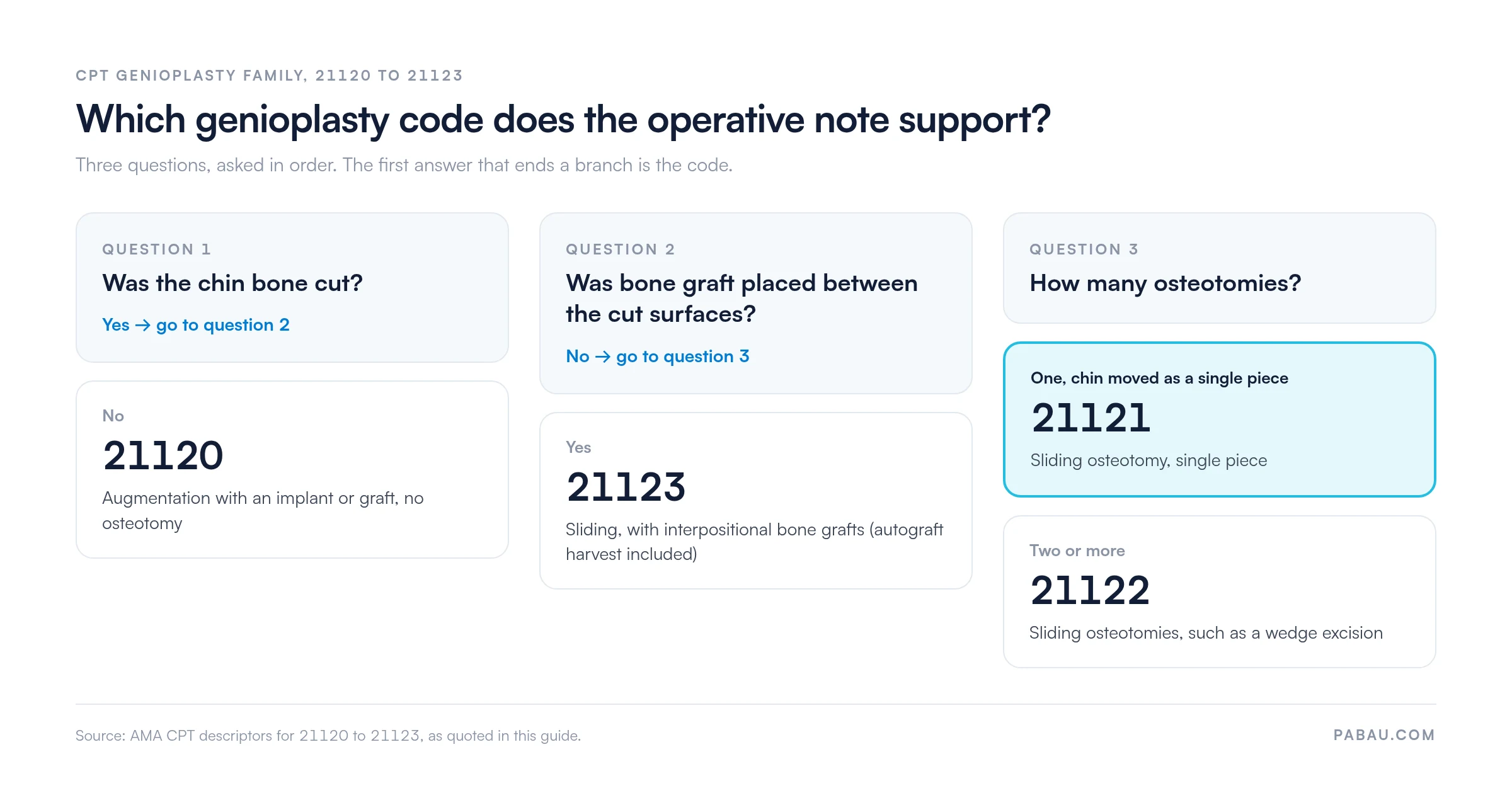
The op report has to show this sequence to support CPT Code 21121. As a result, coders can check each step against the note before the claim goes out.
The op note must describe a single osteotomy that frees one piece, state whether any graft was placed, and confirm rigid fixation. For example, vague language such as “chin repositioning was performed” does not name the osteotomy method. As a result, payer reviewers treat it as lacking detail, and it often ends in a denial over missing detail.
Payers do not cover CPT Code 21121 based on the surgery alone. Instead, coverage depends on showing a functional or reconstructive reason, supported by objective evidence in the medical record. Meeting billing compliance needs for surgical codes starts with building the right set of records before the case is booked.
The records a payer reviewer will look for include all of the following:
So, check each diagnosis against the current ICD-10-CM code set before filing. Indeed, code boundaries within the M26 family are refined annually, and using a retired or invalidated code is a top denial trigger.
Many private plans review orthognathic and chin surgery before the case, so plan on prior authorization for CPT Code 21121. Cigna’s Medical Coverage Policy 0209 lists 21121 among the codes it treats as cosmetic when done with orthognathic surgery only to improve appearance.
Also, confirm the current plan year’s review needs with each payer before scheduling. A clean claim submission starts with getting the authorization number before the case is performed, not after.
What to include in a prior authorization submission for CPT Code 21121:
So, allow at least 10 to 15 business days for payer review. Faster review is offered when surgery is urgent, but standard planned genioplasty rarely qualifies. Then record the authorization number, approval date, and effective date range in the patient record and billing system before the case is booked.
Medicare’s position on CPT Code 21121 depends entirely on the clinical reason for surgery. Procedures labeled cosmetic are excluded from Medicare coverage under Section 1862(a)(10) of the Social Security Act. As a result, a genioplasty performed only to improve facial appearance, without a documented functional impairment, will be denied.
Coverage pathways for CPT Code 21121 under Medicare and private payers:
The 2026 Medicare Physician Fee Schedule values for CPT Code 21121 are national unadjusted figures. CY2026 has two conversion factors: $33.5675 for qualifying APM participants and $33.4009 for everyone else. The payment row below uses $33.4009.
CPT 21121 carries a 90-day global period, so routine postoperative visits in that window are included. Also, Geographic Practice Cost Indices (GPCIs) adjust these values by Medicare locality. So, check your rate with the CMS Physician Fee Schedule lookup tool or the FastRVU entry for 21121.
At the same time, private payers set their own rates, often as a percentage of the Medicare fee schedule. The figures above reflect Medicare only, so confirm contract rates with each payer. Besides, CMS updates these values every January 1.
Before submitting CPT Code 21121 to Medicare, check whether the diagnosis codes support a functional indication rather than appearance alone. Look for local coverage guidance from your Medicare Administrative Contractor on orthognathic or facial surgery. Otherwise, the claim rests on the medical necessity in the record and the cosmetic exclusion. In fact, skipping that review is the fastest route to a cosmetic-exclusion denial.
Denials on CPT Code 21121 cluster around five root causes. Also, each can be stopped with the right pre-filing checklist. Structured denial management workflows catch these before a claim ever leaves the practice.
Surgeons often pair genioplasty with other jaw procedures. So, when billing same-session codes, review the CMS National Correct Coding Initiative (NCCI) edits before submitting. NCCI edit pairs are updated quarterly, so use the version for the date of service, not one from a prior quarter.
For example, when billing 21121 alongside other surgical CPT codes in a combined orthognathic case, the -51 modifier signals multiple procedures performed during the same operative session. Then apply it to the secondary and tertiary codes, not to the primary (highest RVU) code. Yet some payers prefer -59 to override an NCCI edit when procedures are truly distinct. So, confirm the payer’s modifier rule before filing.
Surgical billing for CPT Code 21121 involves more pre-submission steps than most evaluation and management codes. Prior auth tracking, records review, code-family choice, NCCI edit checking, and claim routing all happen before the claim goes out. As a result, practices that run these steps in spreadsheets or manual logs see more of them slip.
Pabau keeps those steps on the patient’s case. Its surgical claims management tracks the authorization code, dates and sessions, and warns when the auth code is missing. Then claims go out through the Claim.MD clearinghouse, which handles 837P claims, eligibility checks and ERA remittances. Pabau tracks the authorization, while the request itself still goes to the payer.
For plastic and oral surgery practices, Pabau’s digital forms collect pre-surgery intake on the patient record. The functional history the surgeon documents then sits with the case when the authorization request and the claim are prepared.

Pabau tracks prior authorization on each case, warns when the auth code is missing, and submits claims through Claim.MD. Oral and maxillofacial surgery practices keep surgical billing on one record.

Code 21121 only after the op note confirms one osteotomy and no interpositional graft. Otherwise, any other combination belongs to 21120, 21122 or 21123, and catching that before filing spares you a corrected claim.
Yet the bigger risk sits upstream of the code. So, build the prior auth packet, with cephalometrics, photos and a recorded functional deficit, before the case is scheduled. Otherwise, a genioplasty reads as cosmetic to Medicare and to many private plans.
Book a demo to see how Pabau keeps the auth code, the op note and the 21121 claim on one surgical case.

Coding a chin case with two or more cuts? CPT 21122 covers sliding osteotomies, such as a wedge excision for an asymmetrical chin.
Need a claims management overview for surgical practices? Claims management software from Pabau covers claim submission, eligibility checks, ERA remittances and prior authorization tracking for surgical billing.
Want to understand how the clearinghouse integration works? Claim.MD clearinghouse guide explains how Pabau routes 837P claims and matches ERAs for US surgical practices.
Looking for denial prevention strategies across all claim types? Revenue cycle management guide covers the full billing lifecycle from eligibility check through payment posting.
CPT code 21121 covers genioplasty; sliding osteotomy, single piece. The surgeon makes one horizontal cut, repositions the freed chin piece in one or more planes, and secures it with rigid internal fixation. Augmentation alone is 21120, two or more osteotomies are 21122, and a sliding osteotomy with interpositional bone grafts is 21123.
The difference is the number of osteotomies and whether a graft is placed. CPT 21121 is a sliding osteotomy that moves the chin as a single piece. CPT 21122 covers two or more osteotomies, such as a wedge excision or bone wedge reversal for an asymmetrical chin. CPT 21123 adds interpositional bone grafts and includes obtaining the autografts.
Medicare covers CPT code 21121 only when the procedure is classified as reconstructive, meaning it corrects a functional impairment from disease, trauma, or congenital anomaly. Medicare excludes genioplasty performed solely for cosmetic improvement under Section 1862(a)(10). To support coverage, the claim must include objective documentation of functional deficit and appropriate ICD-10-CM diagnosis codes.
Commonly paired ICD-10-CM codes include M26.04 (mandibular hypoplasia), M26.05 (macrogenia), and M26.06 (microgenia). M26.00, M26.09, and Q67.4 cover unspecified, other specified, and congenital jaw anomalies. The diagnosis code must reflect a functional or reconstructive indication. Verify each code against the current year’s code set before submission.