

CPT Code 30801: Superficial turbinate ablation billing guide
CPT Code 30801: Official descriptor and procedure overview The American Medical ...

Last Updated: Nov 27, 2026
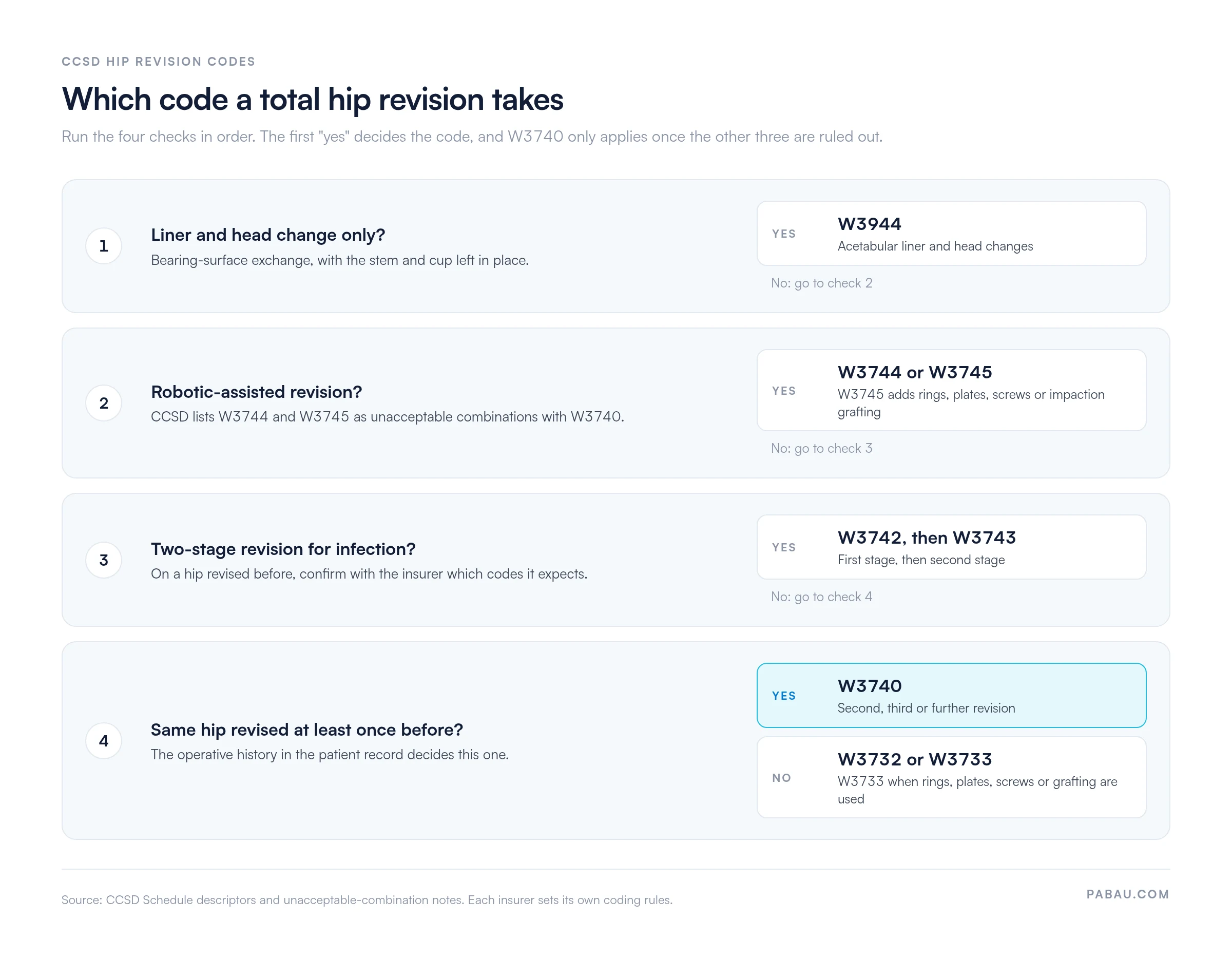
W3740 is the CCSD code for a second, third or further revision total hip replacement, excluding acetabular liner and head changes. It applies when the same hip has already been revised at least once.
Insurers that use the CCSD Schedule, including Bupa, AXA Health, Aviva and Vitality, set their own fees and rules for the code. A liner and head change on its own takes W3944, and a two-stage revision for infection takes W3742 and W3743.
Let Pabau's smart automation suggest the right codes, reduce claim denials, and keep your practice compliant—effortlessly.
Automate repetitive tasks and focus on what matters most—your patients.
Reduce coding errors and ensure compliance with the latest regulations.
Clean claims, fewer denials, and faster reimbursements.
Powerful insights and reporting to help your practice thrive.
HIPAA compliant SOC 2 certified GDPR-compliant Trusted by 4,000+ clinics worldwide

CCSD Code W3740 covers a second, third or further revision total hip replacement, excluding acetabular liner and head changes.
Use W3740 only when the operative history shows the same hip has already been revised at least once.
A liner and head change on its own takes W3944, and a two-stage revision for infection takes W3742 and W3743.
Insurers generally require pre-authorisation for revision hip surgery, so confirm the rules with each insurer before the operating date.
CCSD lists the robotic-assisted revision codes W3744 and W3745 as unacceptable combinations with W3740.
CCSD Code W3740 is the CCSD Schedule code for a second, third or further revision total hip replacement, excluding acetabular liner and head changes. The CCSD Schedule files it under section 16.9.2, Repair / Reconstruction, in chapter 16 for bones, joints and connective tissue. The code was added to the schedule on 2 November 2017.
The qualifier that decides the code is the revision count. W3740 describes an operation on a hip that has already been revised at least once. It applies to total hip replacement (THR) components, meaning the femoral stem and the acetabular cup.
Insurers that use the CCSD Schedule, such as Bupa, AXA Health, Aviva and Vitality, set their own fees and code rules. CCSD itself notes that its coding principles are guidelines, and each insurer decides which code combinations it accepts.
W3740 describes the whole operation of a re-revision hip replacement. In surgical terms, a re-revision usually includes these steps:
A re-revision is usually more complex than an earlier revision. Bone stock loss, retained cement and scar tissue from previous operations all add operative time and implant cost. That is why the schedule gives repeat revisions their own code.
The W3740 descriptor names one exclusion, acetabular liner and head changes. Other revision scenarios also sit under their own codes, as the table shows.
A liner and head change is a bearing-surface exchange. It leaves the stem and the cup in place, so it is far less invasive than a full re-revision. Billing W3740 for a liner and head swap will not match the operative note, and the insurer will query it.
W3732 and W3733 are the general unilateral revision codes for a total hip replacement. W3740 is the code whose descriptor is limited to a second, third or further revision. Neither W3732 nor W3733 states a revision count, so the operative history decides between them and W3740.
Review the operative history in the patient record before choosing between these codes. If the notes from the earlier revision are missing, request them before you submit. W3740 on a hip with no documented earlier revision will not survive an insurer query.
The revision count is the last of four checks a coder runs on a revised hip. The decision path puts them in order, so W3740 is only reached once the other codes are ruled out.
W3740 sits within a cluster of hip arthroplasty codes, and our CCSD codes reference covers the wider schedule. Knowing the neighbouring codes prevents unbundling errors and misdirected claims. Pinning of the femoral head, which preserves the joint rather than replacing it, sits elsewhere in chapter 16 as CCSD code W1912. Excision of ectopic bone around a total hip replacement, with the implant left in place, is coded separately as W0702. A greater trochanter osteotomy or transfer performed as a stand-alone operation, rather than as the approach for a revision, is coded under CCSD code W1648.
Always confirm code numbers and descriptors against the current schedule at ccsd.org.uk and your insurer’s own fee schedule. Codes are reviewed and added regularly, as the 2024 robotic-assisted codes show.
Insurers expect documented clinical need before they authorise a re-revision hip procedure. These are the common indications, with the evidence insurers typically ask for:
Infection is often treated in two stages. The first operation removes the infected implant and usually places an antibiotic-loaded spacer. The second operation, weeks later, implants the new prosthesis once the infection has cleared. Bone infection with no implant involved takes a different route: drainage and debridement of the bone is billed under code W1800.
CCSD lists a dedicated pair for this pathway. W3742 is the first stage of a two-stage revision total hip replacement for infection, and W3743 is the second stage. The W3740 descriptor does not mention infection or staging, so confirm with the insurer which code it expects before stage one.
Documentation for an infected re-revision should include culture results, serial CRP and ESR readings, a multidisciplinary team note and the operative record for each stage.
An incomplete operative note is the most preventable cause of a W3740 query. These elements should be submitted with the claim or held on file for it:
Before submitting a W3740 claim, check seven items. Confirm the earlier revision, the removed implant details, the new implant details, the fixation method, the graft record, any cultures and the pre-operative outcome score. A missing item can hold up payment while the insurer asks for more information.
Insurers generally require pre-authorisation for revision hip surgery, so confirm the rules with each insurer before the procedure. Record the authorisation reference before the patient is listed for theatre.
Pre-authorisation rules and checklists change, so check them again for each case. For Bupa, the Bupa CCSD procedure codes guide explains how Bupa uses the CCSD Schedule.
W3740 claims fail for a small set of repeating reasons. Each one is preventable with the right checks before submission:
Two-stage infection revision is where W3740 is most often misapplied. CCSD gives the staged pathway its own codes, W3742 and W3743. Billing W3740 for either stage without the insurer’s agreement risks a query.
Insurers do not all handle staged revisions the same way. Where the hip has been revised before, ask the insurer before stage one whether it expects W3742 and W3743 or W3740.
For two-stage infection revisions, ask the insurer in writing how it will authorise stage two before stage one goes ahead. Some insurers authorise both stages together, while others want a fresh clinical submission after the infection clears.
CCSD flags W3744 and W3745, the robotic-assisted revision codes, as unacceptable combinations with W3740. A robotic-assisted revision is coded with its own robotic code rather than added to W3740.
CCSD describes its coding principles as non-exhaustive guidelines. Each insurer decides which combinations it accepts, so check the insurer’s unbundling rules before submitting more than one code for the same operation.
A W3740 claim depends on several documents reaching the billing desk together. The operative note, implant details, authorisation reference, blood results and imaging reports all need to line up.
Pabau, a practice management platform, tracks the pre-authorisation code, its dates and sessions on the patient’s case, and warns when one is missing. Its integrated claims management software sends claims through Healthcode and BUPA for UK practices.
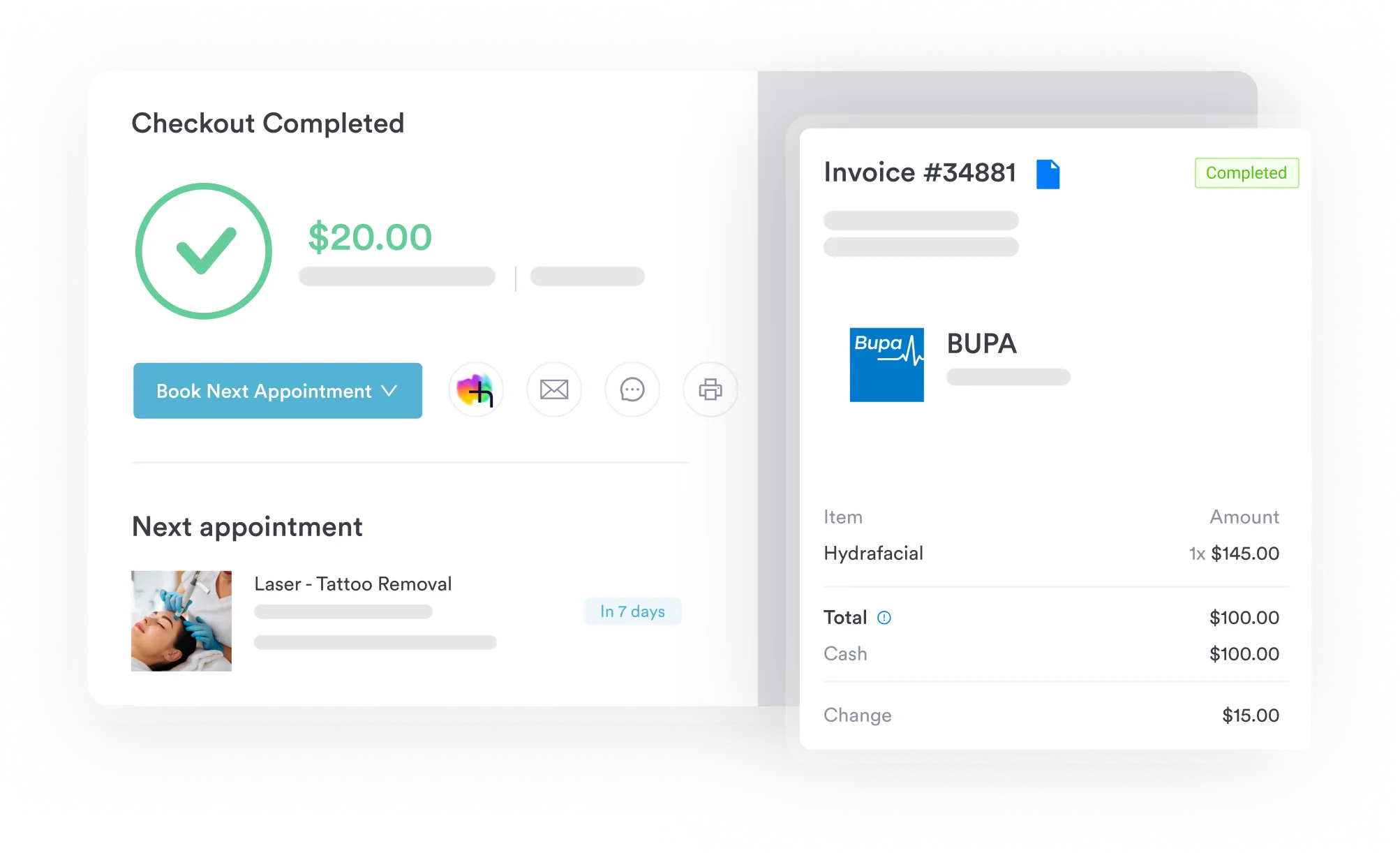
The clinical record in Pabau also holds the patient’s surgical history. Billing staff can confirm an earlier revision before choosing W3740 over W3732 or W3733.
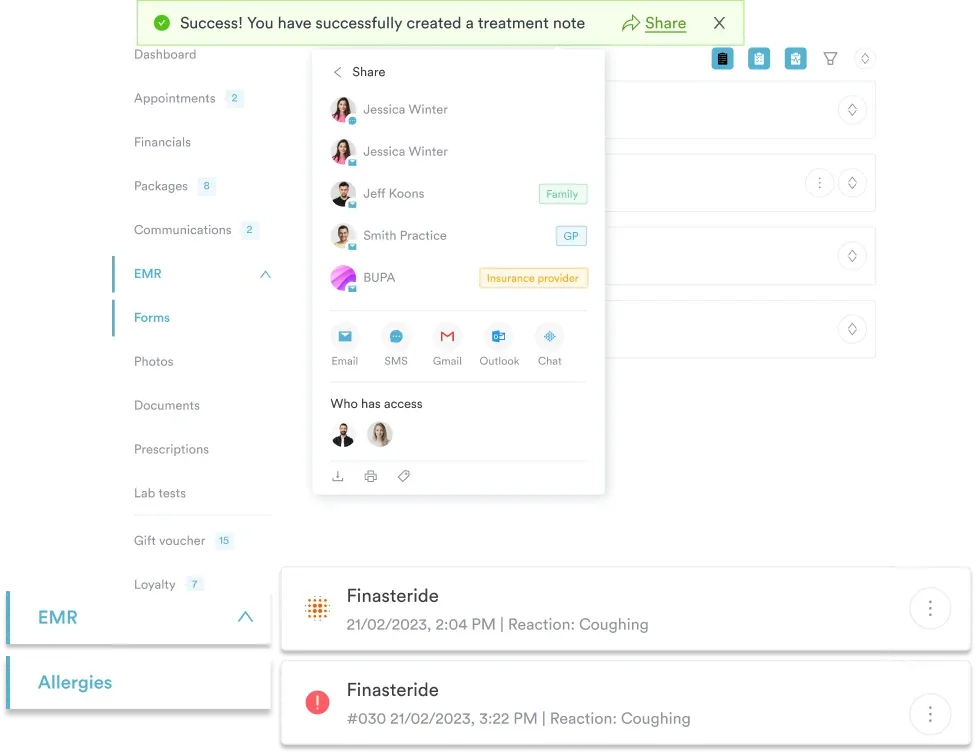

Pabau tracks pre-authorisation codes, dates and sessions on the patient case and sends claims through Healthcode and BUPA. Your team submits revision hip claims with the paperwork in place.

CCSD Code W3740 belongs to one situation, a hip that has already been revised and now needs revising again. Get the revision history on file first, and the code choice between W3732, W3733 and W3740 follows from it.
Keep liner and head changes on W3944 and staged infection work on W3742 and W3743 unless the insurer says otherwise. Confirm pre-authorisation with each insurer before the theatre date, and the claim has little left to query.
Book a demo to see how Pabau keeps authorisations and claims together for orthopaedic billing.

Need a Bupa CCSD billing reference? Bupa CCSD procedure codes covers how Bupa uses the CCSD Schedule for private practice billing in the UK.
Sending claims to UK insurers? Claims management software from Pabau tracks pre-authorisation on the case and sends claims through Healthcode and BUPA.
Coding another orthopaedic procedure? CCSD codes collects the schedule codes Pabau covers, with descriptors and billing notes for UK private practice.
CCSD Code W3740 covers a second, third or further revision total hip replacement, excluding acetabular liner and head changes. It applies when the same hip has already been revised at least once. CCSD files it under 16.9.2 Repair / Reconstruction.
The W3740 descriptor excludes acetabular liner and head changes. A liner and head change on its own takes W3944. Robotic-assisted revisions take W3744 or W3745, which CCSD lists as unacceptable combinations with W3740.
No. A liner and head change is excluded from W3740, and CCSD lists it under W3944 Acetabular liner and head changes. Billing W3740 for a bearing-surface exchange will not match the operative note.
W3733 is a unilateral revision of a total hip replacement with reconstruction rings, plates, screws or impaction bone grafting. Its descriptor sets no revision count. W3740 is limited to a second, third or further revision of the hip.
Insurers generally require pre-authorisation for revision hip surgery, but rules differ. Confirm the requirements with each insurer, such as Bupa, AXA Health, Aviva or Vitality, before the operating date.
The usual causes are a liner and head change billed as W3740, no earlier revision in the record, and a missing authorisation reference. Missing implant details and a wrong membership number cause queries too.




