
Pabau Engage inbox

Pabau Engage is here: every patient conversation in one inbox.

Learn more
Book a demo Book a demo
☰
CCSD Code

CCSD code W1648 – Greater trochanter osteotomy transfer


Code Definition

W1648 is the CCSD code for osteotomy/transfer of greater trochanter (as sole procedure). The surgeon cuts the greater trochanter free with the abductor muscles attached and moves it to a new position. Screws, cables or wires then fix it there.

The code applies only when the trochanteric work is the main operation. When the trochanter is cut just to reach the joint during a hip replacement, the replacement code covers it. That is W3712 for a primary replacement, or W3732/W3733 for a revision.

Chapter
16.0.0 Bones, Joints & Connective Tissue/Tendon Muscle
Category
16.9.0 Hip, Leg and Pelvis
Subcategory
16.9.2 Repair / Reconstruction
Code also known as
trochanteric transfer, trochanteric advancement, greater trochanter transfer, distal trochanteric transfer, GT osteotomy
Save time. Improve accuracy. Get paid faster.
Automate coding with Pabau

Let Pabau's smart automation suggest the right codes, reduce claim denials, and keep your practice compliant—effortlessly.

  • AI-powered code suggestions
  • Real-time compliance checks
  • Faster claims, fewer denials
Why practices choose Pabau
Save hours every week

Automate repetitive tasks and focus on what matters most—your patients.

Improve accuracy

Reduce coding errors and ensure compliance with the latest regulations.

Get paid faster

Clean claims, fewer denials, and faster reimbursements.

Grow with confidence

Powerful insights and reporting to help your practice thrive.

HIPAA compliant SOC 2 certified GDPR-compliant Trusted by 4,000+ clinics worldwide

Key takeaways

Key takeaways

W1648 covers a greater trochanter osteotomy or transfer only when it is the sole procedure, not the approach to another hip operation.

Trochanteric work done to reach the joint during a hip replacement is billed within W3712 (primary) or W3732/W3733 (revision).

Major UK private insurers, including Bupa, AXA Health, Aviva and Vitality, require prior authorization before W1648 is performed.

The operative note must give the direction and distance of the trochanteric transfer for the claim to survive insurer review.

Pabau, a practice management platform, tracks prior authorization on the patient case and sends UK insurer claims through Healthcode.

CCSD code W1648: Definition and clinical description

CCSD code W1648 is the procedure code for osteotomy/transfer of greater trochanter (as sole procedure). It sits in the CCSD schedule, the standard set of procedure codes that UK private insurers use for surgical billing. The descriptor covers two steps, the bone cut (osteotomy) and the repositioning of the freed fragment (transfer).

The words “as sole procedure” decide when the code applies. W1648 is the right code only when the trochanteric procedure is the reason for the operation, not one step inside a wider hip reconstruction.

Take an orthopedic surgeon who performs a distal trochanteric advancement for a patient with a high-riding greater trochanter. The aim is to restore the abductor lever arm, so W1648 is the primary code.

The same surgeon may detach and reattach the trochanter for lateral exposure during a primary total hip replacement. That work is covered by the hip replacement code instead. A second or later revision follows the same logic, so trochanteric access work there sits under the re-revision code, W3740.

ElementWhat it means for W1648
OsteotomyPlanned surgical bone cut through the base of the greater trochanter
TransferRepositioning of the trochanteric fragment (advancement, medialization or distalization) and rigid fixation
As sole procedureThe trochanteric procedure is the principal and only major procedure in this episode. It is not the approach to a hip replacement or other major hip surgery done at the same time.
Code systemCCSD (Clinical Coding & Schedule Development group schedule), used by UK private insurers for procedure billing

What the procedure involves: Anatomy and surgical technique

The greater trochanter is the bony prominence on the upper outer femur where the gluteus medius and gluteus minimus attach. Its position relative to the femoral head sets the mechanical advantage of the hip abductor muscles. When it sits too high, too far out or in a weak position, the abductors underperform.

The result is a Trendelenburg gait, pain and long-term joint loading problems.

The surgical steps follow a consistent sequence, though the direction of transfer varies by indication:

  1. Lateral approach: The hip is exposed through a lateral or posterolateral incision to reach the greater trochanter with the abductor mass attached.
  2. Osteotomy: A planned bone cut separates the greater trochanter from the femoral shaft, keeping the gluteus medius and minimus attached to the freed fragment.
  3. Repositioning: The fragment is moved to its target position. It goes distally to lengthen the abductor lever arm in coxa vara, medially to reduce offset in impingement, or anteriorly to improve coverage.
  4. Rigid fixation: The fragment is secured with lag screws, cables or a tension band construct. Stability is confirmed under fluoroscopy before wound closure.
  5. Closure and rehabilitation planning: Protected weight-bearing follows until the osteotomy site heals, typically six to twelve weeks.

The fixation hardware (screws, cables or wires) is generally included in the insurer’s fee for W1648 and not billed separately. Some insurer contracts allow a separate implant claim, so confirm with each payer before coding implants on their own line.

Clinical indications for a W1648 claim

W1648 applies when the trochanteric procedure is the main clinical objective. Indications that support coding it as a sole procedure include:

  • High-riding greater trochanter (coxa vara): The trochanter sits above its best position relative to the femoral head, which shortens the abductor lever arm. Distal transfer restores normal mechanics.
  • Abductor insufficiency or weakness: A persistent Trendelenburg gait after earlier hip surgery, where the abductor attachment is at a mechanical disadvantage.
  • Failed prior trochanteric fixation: Non-union or malunion of an earlier greater trochanter repair that needs revision fixation as a standalone procedure.
  • Isolated greater trochanteric avulsion fracture: Acute or chronic avulsion of the trochanteric fragment with the abductor mass, treated surgically after conservative care has failed.
  • Greater trochanteric pain syndrome (GTPS): Selected refractory cases where the position of the trochanter contributes to the problem.
  • Staged revision access: Trochanteric mobilization and re-fixation planned as a distinct surgical episode, not as part of a simultaneous reconstruction. The related codes section below covers this case.

W1648 does not apply when femoroacetabular impingement (FAI) correction or hip arthroscopy is the principal procedure. If the trochanter is moved only to improve surgical access, the claim follows the main procedure instead.

The most consequential decision around W1648 is telling it apart from trochanteric work done as the approach to a total hip replacement. Coders at practices that bill Bupa CCSD codes meet this distinction often in orthopedic episode reviews.

Code / scenarioUse W1648?Why
Isolated trochanteric transfer (the only major procedure)YesW1648 is the correct principal code. The sole-procedure test is met.
Trochanteric osteotomy used as the approach to a primary THR (W3712)NoThe trochanteric work is covered by W3712 (primary total hip replacement). W1648 cannot be claimed on top.
Trochanteric osteotomy used as the approach to a revision THR (W3732/W3733)NoThe same bundling principle applies. The osteotomy is part of the revision procedure, not a standalone event.
Staged revision where trochanteric re-fixation is a separate operative episodeLikely yesIf the trochanteric repair is a distinct planned procedure on a separate date, W1648 may apply. Confirm with the insurer and document the staged rationale in the operative note.
Isolated greater trochanteric avulsion fracture repairYesFixing an isolated avulsion fracture meets the sole-procedure test when no other major hip procedure happens at the same time.

The key test is simple. Ask whether the osteotomy would have happened without the need to reach the joint for a replacement. If not, it is an approach rather than a standalone procedure. The decision path below maps each scenario to the code that carries it.
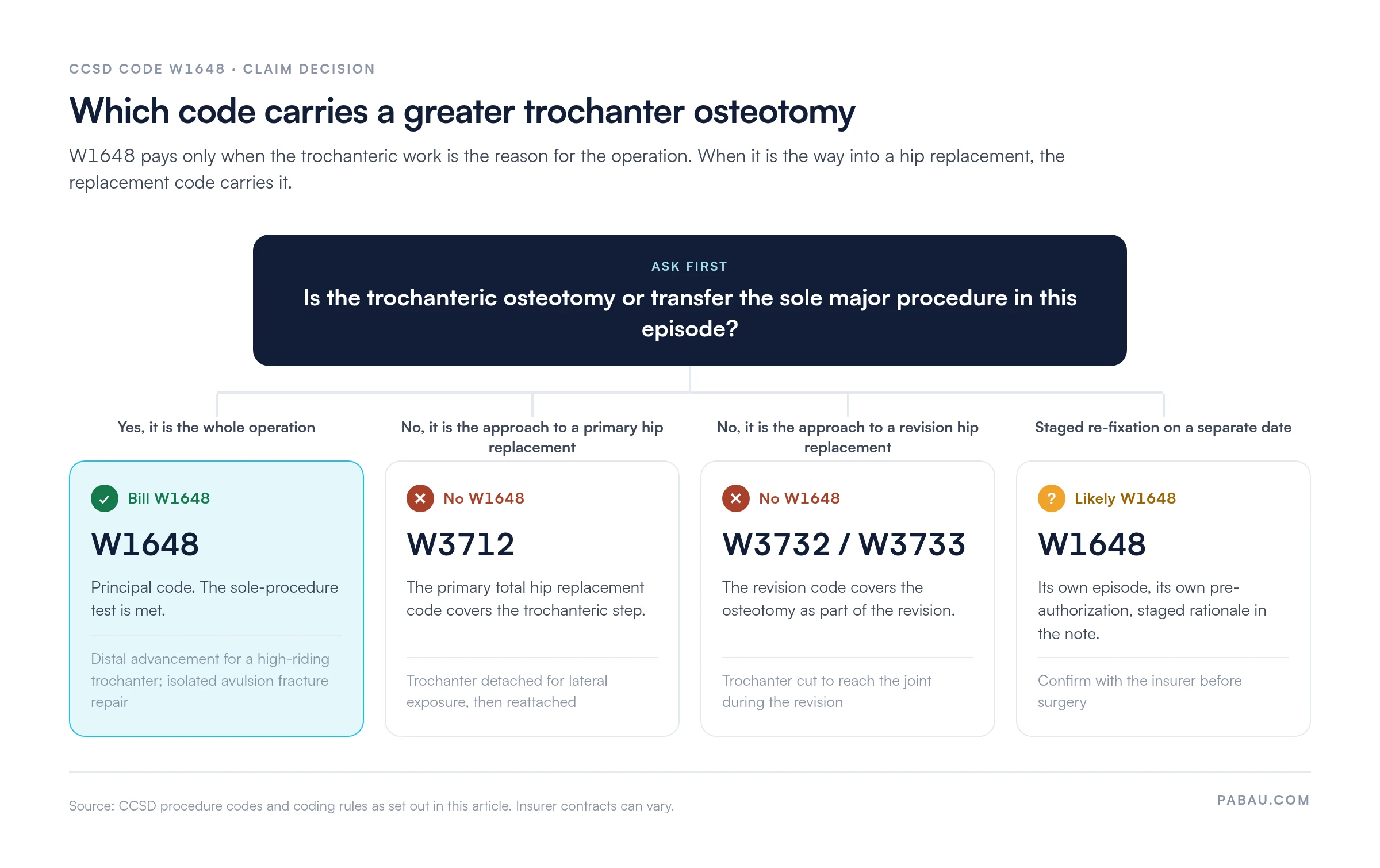
Decision diagram for CCSD code W1648: if the trochanteric osteotomy or transfer is the sole major procedure, bill W1648; if it is the approach to a primary hip replacement, bill W3712 and no W1648; if it is the approach to a revision hip replacement, bill W3732 or W3733 and no W1648; a staged re-fixation on a separate date is likely W1648 with its own pre-authorization.
Only a trochanteric osteotomy done for its own sake carries W1648, while an approach to a hip replacement is billed within W3712 or W3732/W3733. Codes as listed in the CCSD schedule.

W1648 is one of many hip and pelvis procedures in chapter 16 of the CCSD code schedule. A simple pelvic osteotomy with fixation is a different procedure and takes its own code, W1640. Osteotomies lower in the leg are coded by site as well, so cutting and realigning the tibia at the knee falls under W1660. Pinning of the femoral head, whether open or percutaneous, is another separate procedure with its own code, W1912.

Billing W1648 on a private insurer claim: Step-by-step

A clean W1648 claim takes six steps in a set order. Skipping one is a common reason UK private insurers query or deny these claims.

  1. Confirm the procedure qualifies as a sole procedure: Review the operative plan before surgery. If the trochanteric osteotomy is the principal and only major hip procedure, W1648 is the correct code. Record this in the pre-operative notes.
  2. Obtain prior authorization: Contact the patient’s insurer (Bupa, AXA Health, Aviva, Vitality, WPA or another) before the procedure. Submit the clinical justification and imaging evidence. Without a valid pre-authorization reference, most insurers reject the claim on submission.
  3. Code the claim with W1648 as the primary CCSD code: Add any diagnostic codes from the CCSD diagnostic schedule that support medical necessity. Note laterality (left, right or bilateral) on the claim form.
  4. Attach supporting documentation: Include the operative note, relevant imaging reports and the clinical justification used to obtain pre-authorization.
  5. Submit via Healthcode or the insurer’s portal: Most UK private insurers receive electronic claims through the Healthcode gateway. Some also accept direct portal submission, so confirm the route with the insurer before filing.
  6. Confirm remittance and reconcile: When the remittance advice arrives, check the paid amount against the expected fee. Make sure W1648 was not downgraded or bundled. Flag any discrepancy promptly.

Prior authorization requirements

Major UK private insurers require prior authorization (pre-auth) for elective orthopedic procedures like W1648. The table below summarizes what each insurer typically asks for. Requirements change, so confirm them against current insurer guidance.

InsurerPre-auth required?What to submit
BupaYesClinical justification letter, X-ray or MRI evidence, GP or consultant referral, proposed CCSD code
AXA HealthYesPre-authorization request via the specialist forms portal, with clinical rationale and imaging
AvivaYesPrior approval request including the CCSD code, diagnostic code and clinical justification
VitalityYesPre-authorization via the Vitality provider portal, with imaging evidence and consultant referral
HealixYesPrior approval via the Healix fee schedule portal, with supporting clinical documentation

Missing pre-auth is the most common reason W1648 claims go unpaid. Fees, referral pathways and submission rules all vary by contract, so verify them with each insurer before proceeding.

Documentation requirements to support a W1648 claim

An operative note that only records “greater trochanter osteotomy performed” will almost always trigger an insurer query. The note must show that the trochanteric procedure was the principal surgical objective. It also needs enough detail for the insurer’s clinical reviewer to verify the code.

The operative note for a W1648 claim should contain all of the following:

  • Confirmation that the trochanteric osteotomy was the principal procedure, not incidental to other hip surgery in the same anesthetic episode.
  • Direction of transfer: Whether the fragment was advanced anteriorly, medialized or transferred distally, with the distance in millimeters where measurable.
  • Fixation method and implants used: Lag screws, tension band wire, cables or plate fixation. Name the hardware by type, as this affects any separate implant claim.
  • Laterality: State left or right explicitly. Bilateral procedures need a separate note entry for each side and may need separate claim lines, depending on insurer policy.
  • Intraoperative findings: The position of the greater trochanter before the osteotomy, the reason the transfer was indicated and the position achieved after fixation.
  • Tourniquet use: Record tourniquet time if one was used, as some insurers audit it for plausibility.
  • Post-operative plan: Rehabilitation protocol, weight-bearing status and planned follow-up.

A note that captures each element above before submission heads off the most common documentation-triggered denials. It also cuts the number of insurer queries the practice has to answer.

Comprehensive EMR & patient record management
Pabau’s patient record keeps the operative note, imaging reports and pre-authorization letter together, so a W1648 query is answered from one file.

Common claim errors and denial reasons for W1648

Insurers audit the sole-procedure test on W1648 closely, so the same few denial triggers come up again and again. The table below maps each one to its corrective action.

Denial reasonWhat triggers itCorrective action
Bundled with THR codeW1648 submitted alongside W3712 or W3732/W3733 in the same episodeRemove W1648 if the osteotomy was an operative approach. If it was a staged separate procedure, submit it on a separate claim with its own episode date and supporting documentation.
Missing pre-authorizationNo valid pre-auth reference on the claim, or pre-auth obtained for a different procedure codeObtain pre-auth for W1648 itself before the procedure. If the claim is denied on this ground, appeal with a retrospective pre-auth request and clinical justification.
Insufficient operative note detailThe note does not confirm the osteotomy was the principal procedure, omits transfer direction and distance, or lacks fixation detailsResubmit with an addendum to the operative note that answers the insurer’s specific query. Use the documentation checklist above as a guide.
Laterality errorLaterality not specified, or the stated side conflicts with other claim documentsSpecify left, right or bilateral every time. For bilateral cases, confirm whether the insurer wants separate claim lines or a bilateral indicator.
Separate hardware claim rejectedFixation implants billed as a separate line when the insurer includes them in the W1648 feeCheck the insurer’s implant policy before billing hardware separately. When in doubt, leave the hardware line off.
Anesthesia bundling queryAnesthesia coded in a way that conflicts with the insurer’s expectation for this procedureThe anesthetist usually bills separately using CCSD anesthetic codes. Confirm with the insurer whether that charge is billed independently by the anesthetic provider.

Pro Tip

Audit your W1648 rejections every quarter. Track whether they cluster on one denial reason, usually ‘bundled with THR’ or ‘missing pre-auth’, or spread across several. One recurring reason points to a single workflow fault that a targeted fix resolves quickly.

Modifier and add-on code considerations

Several coding scenarios arise alongside W1648, and each needs specific handling.

  • Bilateral procedures: Bilateral trochanteric osteotomy in one operative episode is uncommon, but it happens in some revision or pediatric hip conditions. When both sides are treated, confirm whether the insurer wants a bilateral indicator or two separate claim lines.
  • Concurrent implant removal: Hardware from an earlier trochanteric fixation may come out in the same procedure. Check the current CCSD schedule for a separate removal code. Some insurers treat removal as part of W1648, while others accept a second code. Document the removal in the operative note either way.
  • Anesthesia: The W1648 fee does not include anesthesia. The anesthetist bills independently with CCSD anesthetic codes, in a submission separate from the surgeon’s claim.
  • Staged procedures: When trochanteric re-fixation is a planned second stage after a hip reconstruction, bill each stage as a distinct episode. Each episode needs its own pre-authorization reference. The operative note for the trochanteric stage must confirm it was the sole major procedure.

How Pabau prevents W1648 pre-auth and bundling denials

Orthopedic practices that run CCSD claims by hand keep three records for every W1648 episode. The pre-auth sits in an insurer email, the operative note in the clinical system and the claim in a billing spreadsheet. A missing reference or a W1648 line beside a hip replacement code only shows up when the remittance comes back short.

Pabau, a practice management platform with built-in claims management software, keeps those records on one patient case. The prior authorization code, its dates and its sessions are tracked on the case, with a warning when one is missing. UK insurer claims then go out electronically through Healthcode from the same record.
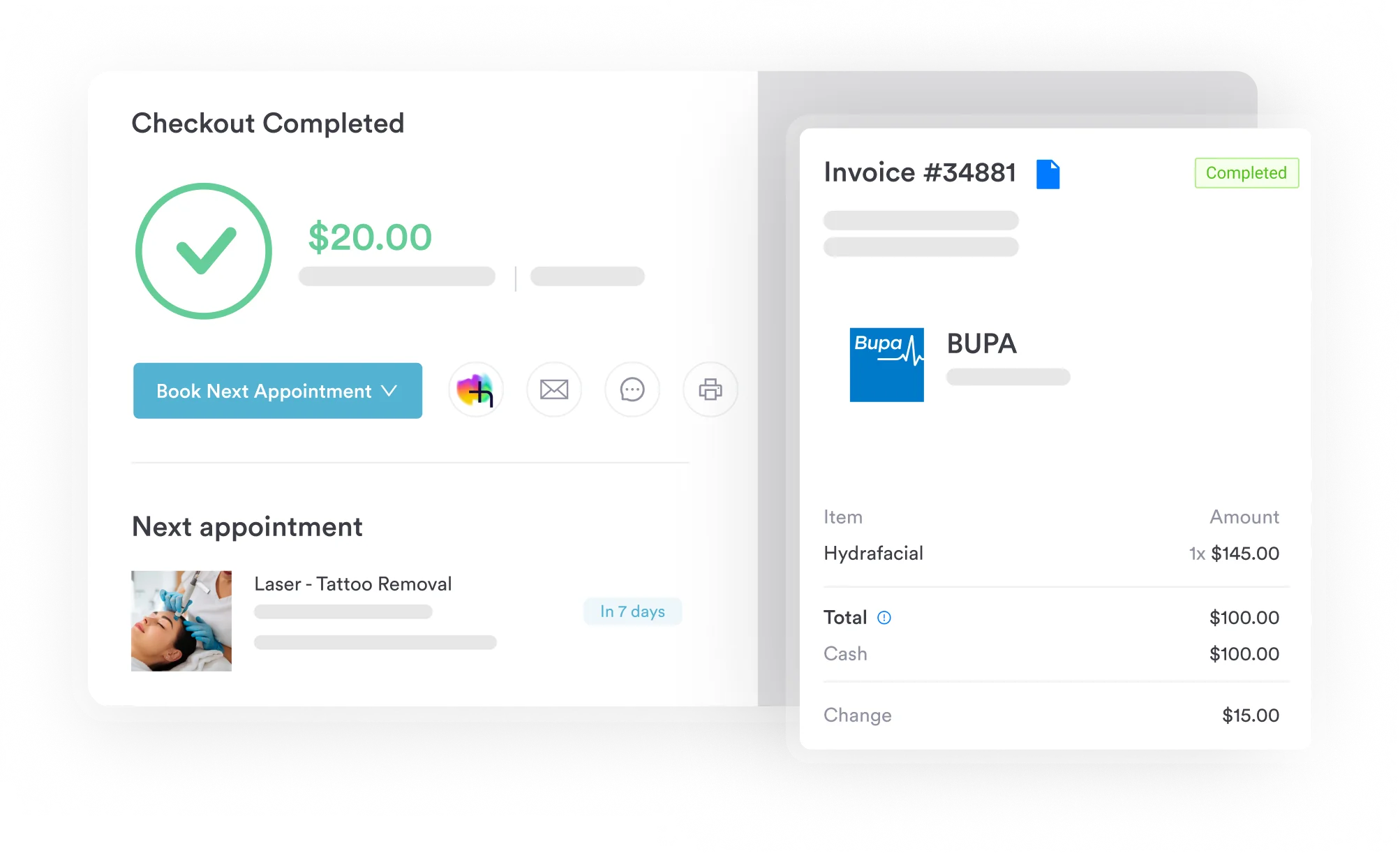
Automate claims through Healthcode
Pabau submits insurer claims electronically through Healthcode, so a W1648 claim leaves from the record that already holds its pre-authorization code.

The operative note, imaging and pre-auth letter stay with the claim, so an insurer query on W1648 is answered from one place. Practices with several surgeons stop relying on paper notes that go missing before submission.


HIPAA compliance toggle
Pabau’s compliance settings apply access and data-protection controls to patient records, including the operative notes an insurer may request in a W1648 audit.

Keep W1648 claims clean from pre-auth to payment

Pabau tracks prior authorization on the patient case and sends UK insurer claims through Healthcode. The pre-auth code, operative note and W1648 claim stay in one record.

Pabau practice management software for UK private practice

Conclusion

Code W1648 when the trochanteric osteotomy or transfer is the reason for the operation, and nowhere else. If the trochanter was cut to reach the joint for a replacement, W3712 or W3732/W3733 carries the work and W1648 stays off the claim.

Make that call before surgery, when the pre-auth request goes in, rather than after a denial. Record the sole-procedure rationale, the transfer direction and the fixation in the operative note. That shuts the two commonest denial routes before the claim leaves the practice.

The trade-off is more paperwork up front for a claim that pays on first submission. Book a demo to see how Pabau keeps pre-auth, operative notes and insurer claims on one case for orthopedic practices.

Continue your research

Continue your research

Need the wider Bupa schedule for orthopedic billing? Bupa CCSD codes covers how Bupa applies the CCSD procedure schedule to UK private practice claims.

Coding a pelvic rather than a trochanteric osteotomy? CCSD code W1640 covers simple pelvic osteotomy and fixation, including Salter and Chiari osteotomies.

Billing surgery around an existing hip replacement? CCSD code W0702 covers excision of ectopic bone around a total hip replacement.

Want to see how Pabau handles insurer billing end to end? Claims management software details how Pabau tracks pre-authorization and submits UK insurer claims in one workflow.

Frequently asked questions

What does CCSD code W1648 cover?

CCSD code W1648 covers osteotomy/transfer of greater trochanter (as sole procedure). The surgeon detaches the greater trochanter with its abductor muscles still attached and moves it to a better position. Screws, cables or a tension band then hold it in place. The code applies only when this is the principal and only major hip procedure in the episode.

How does W1648 differ from related CCSD hip codes?

W1648 is for a trochanteric osteotomy performed as a standalone procedure. When the osteotomy is the approach to a primary (W3712) or revision (W3732/W3733) total hip replacement, the replacement code covers it. W1648 cannot be claimed on top. The test is whether the osteotomy would have happened without the need to reach the joint.

Does W1648 need prior authorization from private insurers?

Yes. Major UK private insurers, including Bupa, AXA Health, Aviva, Vitality and WPA, require prior authorization for elective orthopedic procedures like W1648. Missing or inadequate pre-auth is the most common reason these claims go unpaid. Get authorization for W1648 itself before surgery, and put the reference number on the claim.

What documentation supports a W1648 claim?

The operative note must confirm that the trochanteric osteotomy was the principal procedure. It should give the direction and distance of transfer in millimeters, the fixation method and hardware, the side treated and the intraoperative findings. A note that only says “trochanteric osteotomy performed” will usually trigger an insurer query or denial.

Can W1648 be billed alongside a hip replacement code?

No, not when the osteotomy is the surgical approach to the hip replacement. The replacement code, W3712 or W3732/W3733, covers that work. W1648 can be billed only when the trochanteric procedure is the principal procedure in its own episode. That includes a staged revision where it is the only major procedure on that date.

Why are W1648 claims commonly denied?

The most frequent reason is billing W1648 next to a total hip replacement code when the osteotomy was only the approach. Missing prior authorization comes next. Insurers also deny claims for thin operative notes, a missing side and fixation hardware billed as a separate line. Pre-submission checks on each of these points prevent most denials.


Avatar photo
Maja Popovska
Content Writer

Maja is a Senior Content Writer at Pabau, where she covers everything from practice management and compliance to medical aesthetics and patient experience. Off the clock: binging true crime docuseries, baking and dreaming about travel.
×

