CPT Code 25210: Excision of a single carpal bone
CPT Code 25210: Official descriptor and quick-reference data CPT Code 25210 is a...

Last Updated: Nov 26, 2026
W1640 is the CCSD code for simple pelvic osteotomy and fixation, such as a Salter or Chiari osteotomy. It covers a single cut through the ilium above the hip socket, plus the internal fixation that holds the bone in its new position.
UK private insurers that use the CCSD Schedule, including Bupa, AXA Health, Aviva and Vitality, recognise the procedure under this code. Pelvic osteotomies with two or more cuts, such as a triple or peri-acetabular osteotomy, take W1649 instead.
Let Pabau's smart automation suggest the right codes, reduce claim denials, and keep your practice compliant—effortlessly.
Automate repetitive tasks and focus on what matters most—your patients.
Reduce coding errors and ensure compliance with the latest regulations.
Clean claims, fewer denials, and faster reimbursements.
Powerful insights and reporting to help your practice thrive.
HIPAA compliant SOC 2 certified GDPR-compliant Trusted by 4,000+ clinics worldwide

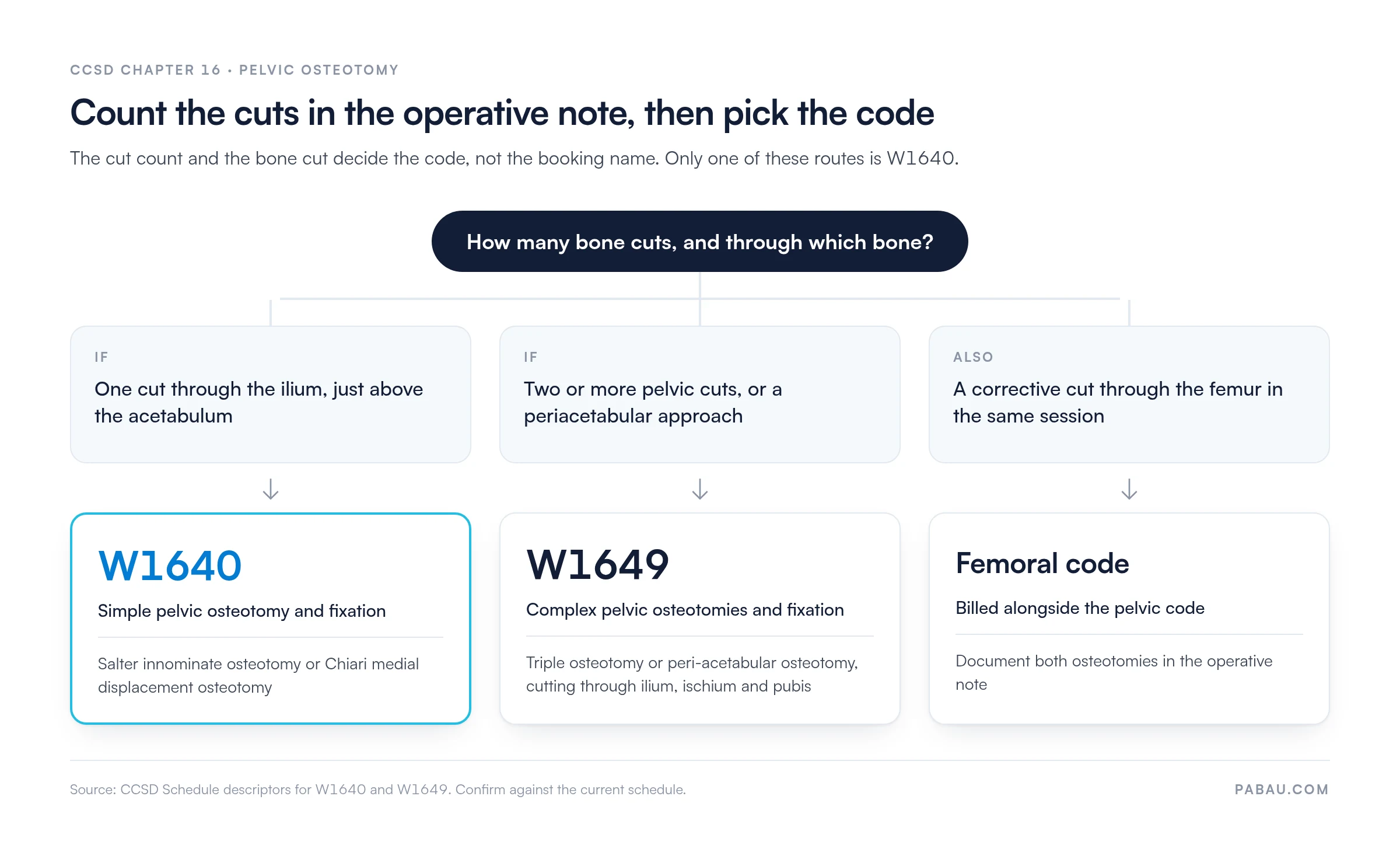
W1640 covers a simple pelvic osteotomy with fixation, meaning one cut through the ilium, as in a Salter or Chiari osteotomy.
Two or more pelvic cuts, or a periacetabular approach, take W1649 (complex pelvic osteotomies) instead of W1640.
The act of fixation is part of W1640, while implant hardware is usually billed separately under the insurer’s implant policy.
Almost all UK private insurers require pre-authorisation before W1640 surgery, and they rarely grant it retrospectively.
The operative note must name the technique, Salter or Chiari, because a vague entry is a leading cause of denial.
CCSD Code W1640 covers a simple pelvic osteotomy and fixation, with the official descriptor naming the Salter and Chiari osteotomies as the primary examples. The code sits in chapter 16 (bones, joints and connective tissue/tendon) of the CCSD Schedule, which holds the standard procedure codes for UK private healthcare. In addition, the CCSD Group behind it represents Bupa, AXA Health, Aviva and Vitality.
“Simple” in this context means a single cut through the pelvic bone. It separates W1640 from W1649, the code for complex pelvic osteotomies such as a triple or peri-acetabular osteotomy, which need more bone cuts. The W1640 procedure scope includes both fixation and the osteotomy itself.
A simple pelvic osteotomy is a single controlled cut through the ilium (innominate bone) to reposition or reinforce the acetabulum. In short, the aim is better coverage of the femoral head. The surgeon then secures the bone in its new position using internal fixation before closing.
Understanding the surgical steps helps billing staff read operative notes correctly and identify whether the procedure maps to W1640 or to W1649.
The Salter innominate osteotomy and the Chiari medial displacement osteotomy are both single-cut pelvic procedures. The CCSD Code W1640 descriptor names both of them. Despite their different anatomical mechanisms, they share a code because both involve one iliac osteotomy with fixation.
Therefore, the operative note must state which technique was performed. Writing only “pelvic osteotomy performed” is a leading cause of denial because the insurer cannot confirm the procedure maps to W1640 rather than W1649.
Developmental dysplasia of the hip (DDH) is the primary indication for W1640. In addition, other recognised indications include Legg-Calvé-Perthes disease and residual acetabular dysplasia following earlier treatment.
In addition, the ICD-10 diagnosis code accompanying the W1640 claim should reflect the documented indication. Coders should verify the specific code with current NHS Classifications guidance, as the Q65.x range carries several sub-codes for different DDH presentations.
W1640 bundles the osteotomy and primary internal fixation into a single procedure code. However, providers usually bill several associated costs separately, and insurers treat them differently. Always check the specific insurer’s schedule before submitting.
See Bupa CCSD code guidance for Bupa-specific rules on implant billing and procedure fee schedules.
Implant billing is the most variable element of a W1640 claim. Bupa, AXA Health, and Aviva each have distinct implant policies. Each one sets which hardware categories need an invoice and which fall within the surgical fee. Request and retain the implant invoice before submitting the claim. A missing invoice is an avoidable denial.
W1640 covers only a simple (single-cut) pelvic osteotomy. Complex pelvic osteotomies have one code of their own, W1649. In fact, choosing between them is an audit risk. Downcoding a complex procedure to W1640 underpays the surgeon, while upcoding a simple osteotomy invites a denial or a repayment demand. Osteotomies outside the pelvis carry codes of their own, such as code W1641 for a small bone of the hand. A long bone osteotomy, such as a cut through the femur or tibia, falls outside both pelvic codes and is coded as W1080.
Check both codes against the live CCSD schedule before you submit, since entries can change between annual revisions. Our CCSD codes library covers the other procedure entries insurers recognise.
The question for coders is how many bone cuts were made, and through which bone. One cut through the ilium above the acetabulum is W1640. In contrast, two or more pelvic cuts, or a periacetabular approach, make it W1649, the single complex pelvic osteotomy code. Therefore, confirm the count from the operative note, not from the procedure booking name.
A complete W1640 claim requires specific clinical detail that generic operative templates rarely capture. Indeed, missing documentation is the single largest fixable cause of denial for pelvic osteotomy claims. Also, using claims management software with structured operative note templates reduces this risk greatly.
Pabau, a practice management platform with a custom form builder, lets an orthopaedic team build an operative note template with a required technique field. The note then names Salter or Chiari before anyone drafts the claim.
W1640 is a major elective procedure. Almost all UK private medical insurers require pre-authorisation before surgery takes place, and insurers rarely grant retrospective authorisation. Billing staff should obtain written authorisation before the patient’s admission date.
Build pre-authorisation into the admission workflow as a required step that sits ahead of theatre booking. Each insurer has a different process, but the information required is broadly consistent.
However, authorisation granted by one insurer does not transfer to another. Where a patient has changed insurer between referral and admission, obtain fresh authorisation from the current provider. Authorisation is usually time-limited; check the expiry date before the admission, especially if surgery moves.
Insurers deny pelvic osteotomy claims for predictable, avoidable reasons. Each denial below has a matching prevention step that billing teams can build into their standard workflow.
A pre-submission checklist built from these six causes stops most of them before the claim leaves. If you are choosing a system to run that checklist, compare the UK medical billing software options built for private practice.
Billers almost always bill W1640 as part of a multi-code claim because the index procedure generates several separately billable concurrent services. The table below sets out the most common co-billed items and flags those that W1640 bundles.
A typical W1640 admission produces these claim lines:
Therefore, each line needs its own authorisation confirmation and clinical justification in the notes.
W1640 denials usually trace back to a document missing at submission: the authorisation number, the implant invoice, or the technique name. Chasing it after the insurer queries the claim delays payment and adds a resubmission.
First, Pabau holds the operative note, the pre-authorisation reference and the implant invoice on the same patient record. Then its claims management pulls that record data into the claim, sends it to UK insurers through Healthcode, and tracks its status.
As a result, a W1640 claim leaves complete, with each separately billed line backed by its own document. Your billing team spends its time on new claims rather than on insurer queries.

Pabau keeps the operative note, pre-authorisation reference and implant invoice on one patient record. Claims then go to Bupa, AXA Health and other UK insurers through Healthcode.

W1640 pays cleanly when the operative note and the code tell the same story. Count the cuts before you code. One iliac cut is W1640, while two or more cuts, or a periacetabular approach, is W1649.
However, the trade-off sits in the paperwork. For example, every extra line on the claim, from implants to imaging, needs its own invoice, report or authorisation. Collect them before submission and you skip the query-and-resubmit cycle.
Book a demo to see how Pabau keeps the operative note, the authorisation and the implant invoice together for every W1640 claim.

Need a full reference for Bupa procedure codes? Bupa CCSD billing guide covers how Bupa codes map to procedures, pre-auth requirements, and fee schedule navigation for private practice teams.
Coding another orthopaedic procedure? CCSD code W0282 walks through trapezium excision billing, documentation and insurer rules.
Choosing a billing system for CCSD claims? Best medical billing software in the UK compares the platforms UK private practices use to send and track insurer claims.
CCSD Code W1640 covers a simple pelvic osteotomy and fixation, including the Salter innominate osteotomy and the Chiari medial displacement osteotomy. The code bundles the single-cut iliac osteotomy and the act of internal fixation into one procedure fee. However, providers bill implant hardware costs, anaesthetic fees and imaging separately.
W1640 includes the surgical act of fixation. Providers usually bill the implant hardware itself (plates, screws, K-wires) as a separate implant surcharge under the insurer’s implant policy, with a manufacturer invoice. Check the specific insurer’s schedule, as policies vary.
The Salter innominate osteotomy redirects the acetabulum to improve true articular coverage of the femoral head. It is most common in children aged 18 months to 6 years with DDH. The Chiari medial displacement osteotomy displaces the ilium medially to create a bone shelf above the femoral head. It suits older children or adults where the Salter technique is not anatomically feasible. Both involve a single iliac cut, and both are covered by W1640.
Yes, almost all UK private insurers require pre-authorisation before a W1640 procedure takes place. In addition, insurers rarely grant retrospective authorisation. Obtain written authorisation before the patient’s admission date, and confirm it has not expired if surgery is rescheduled.
W1640 is used mainly in paediatric patients, because DDH and Perthes disease primarily affect children. The code is not restricted to children, though. For example, the Chiari osteotomy is sometimes performed in young adults with symptomatic residual acetabular dysplasia.