

CPT Code 30801: Superficial turbinate ablation billing guide
CPT Code 30801: Official descriptor and procedure overview The American Medical ...

Last Updated: Nov 27, 2026
W3090 is the CCSD code for core decompression of knee. Surgeons drill channels into the femoral condyle or tibial plateau to relieve pressure in bone affected by osteonecrosis.
The code sits in the knee repair and reconstruction section of the CCSD schedule. It is used for early-stage disease, before the joint surface collapses. UK insurers generally expect pre-authorization and an MRI report that confirms the diagnosis.
Let Pabau's smart automation suggest the right codes, reduce claim denials, and keep your practice compliant—effortlessly.
Automate repetitive tasks and focus on what matters most—your patients.
Reduce coding errors and ensure compliance with the latest regulations.
Clean claims, fewer denials, and faster reimbursements.
Powerful insights and reporting to help your practice thrive.
HIPAA compliant SOC 2 certified GDPR-compliant Trusted by 4,000+ clinics worldwide

CCSD code W3090 covers core decompression of the knee, where channels are drilled into an affected condyle or plateau to relieve pressure in osteonecrosis.
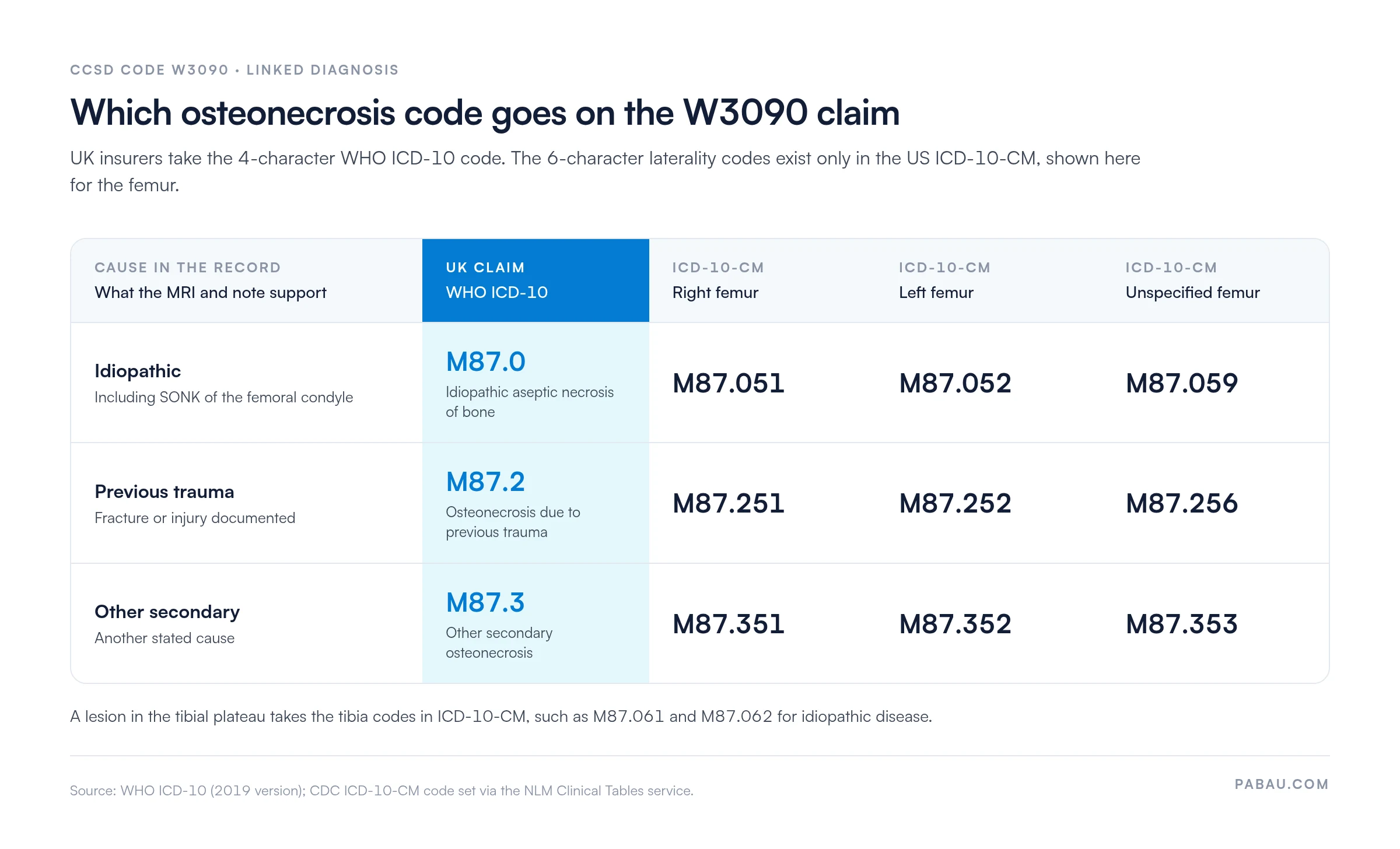
UK claims link the WHO ICD-10 code for the cause, such as M87.0 for idiopathic disease or M87.2 after trauma.
The 6-character laterality codes, such as M87.051 and M87.052 for the femur, belong to the US ICD-10-CM and not to UK claims.
Insurers generally require pre-authorization for elective inpatient surgery, so confirm each insurer’s rule before the procedure date.
Pabau, a practice management platform, handles CCSD code entry, linked diagnosis codes, and Healthcode submission in one workflow.
CCSD code W3090 covers core decompression of the knee, a procedure in which the surgeon drills channels into the femoral condyle or tibial plateau. It belongs to the CCSD schedule of standard codes, set by the CCSD Group, whose members represent Bupa, AXA Health, Vitality and Aviva. The drilling relieves raised pressure inside the bone, restores local blood supply, and prompts bone repair.
The descriptor does not say whether the code is unilateral or bilateral. Where both knees are decompressed in the same operative episode, confirm with the insurer how to bill the second side before you submit. W3090 sits in the knee repair and reconstruction section of the schedule, alongside the arthroscopy and replacement codes covered below. You can browse more CCSD codes by section.
Avascular necrosis of the femoral condyle is the primary clinical indication for W3090. Core decompression is used in early-stage disease, before the subchondral bone collapses, when drilling can decompress the ischemic zone. Spontaneous osteonecrosis of the knee (SONK) is a closely related indication. It typically presents as acute medial knee pain with characteristic MRI changes and no history of trauma or steroid use.
Bone marrow edema syndrome, where the MRI shows subchondral edema without confirmed osteonecrosis, is a contested indication. Some UK insurers fund W3090 for it once conservative care has failed. Others treat it as experimental for this indication, so confirm coverage with the specific insurer before you proceed.
Confirm the stage of disease from the operative or pre-operative MRI report before you select W3090. Collapse of the joint surface usually moves the case away from joint-preserving surgery.
Every W3090 claim submitted through Healthcode needs a linked ICD-10 diagnosis code. UK insurers work from WHO ICD-10, where the M87 category covers osteonecrosis at four characters, by cause. A diagnosis code outside M87 with no clinical rationale is a common trigger for insurer review.
The 6-character laterality codes are US ICD-10-CM, not WHO ICD-10. The WHO ICD-10 browser lists M87 only to the 4-character subcategories that UK claims use. Where the record gives no cause at all, the code is M87.9. The grid below maps each cause to both code sets. A coder trained on US claims can see at a glance why M87.051 has no place on a UK claim.
W3090 is often confused with neighboring knee codes that share anatomical territory but differ in technique or clinical intent. Picking the wrong one is a frequent cause of W3090 claim queries. Tibial osteotomy, billed as W1660, is another joint-preserving knee operation, but it realigns the leg rather than drilling into bone.
Do not bill W8520 alongside W3090 when arthroscopy only provides access for the decompression. Its descriptor limits it to arthroscopy as the sole procedure. W8500 overlaps more closely, because its descriptor includes drilling and microfracture. If an arthroscopic procedure had its own documented clinical rationale, check the CCSD bundling rules before submitting both codes. When in doubt, ask the insurer’s medical team for written guidance before surgery.
Confirm staging before selecting W3090. If the MRI report shows subchondral collapse or joint-space narrowing, W3090 is unlikely to be appropriate. The insurer may then reclassify the claim toward a replacement code. Record the staging classification used in the MRI report in the operative note.
Insurers reviewing W3090 claims focus on the operative note. A note that describes bone drilling without the indication, site, or technique invites manual review or rejection. Expect insurers to look for these elements in every W3090 operative note.
Finalize the operative note and link it to the patient episode before the claim goes out. Insurers treat notes amended after a denial with suspicion, which can complicate an appeal.
Insurers generally require pre-authorization for elective inpatient surgery, so plan for it on every W3090 case. Confirm the rule with each insurer before the procedure date. A claim without a valid pre-auth reference is likely to be rejected, and retrospective requests for elective orthopedic surgery are rarely granted. The Bupa CCSD billing guide covers Bupa-specific coding conventions alongside the insurer contacts below.
Insurer coverage criteria and pre-authorization rules change periodically. Check current requirements in each insurer’s provider portal before the procedure date. The table reflects common UK private billing conventions and does not replace insurer-specific policy confirmation.
Insurers look closely at W3090 because some of its indications still need case-by-case justification. The denial patterns below come up repeatedly.
The CCSD schedule has no edit system like the US National Correct Coding Initiative (NCCI), but insurers apply their own bundling logic to W3090 claims. As a rule, work that is integral to the core decompression is included in W3090 and cannot be billed separately.
The CCSD Technical Guide (October 2025) sets out the schedule’s coding principles. Confirm whether an adjunct code is eligible against the current schedule before submission, as the rules are revised over time.
Healthcode is the standard clearinghouse for UK private medical billing, and the major insurers receive CCSD-coded claims through it. A W3090 submission needs the procedure code, the linked ICD-10 code, the pre-authorization reference, and the surgeon’s provider number on the same claim line.
Run a side audit before batch-submitting W3090 claims. For each claim, confirm the side in the operative note matches the pre-authorization request. If the practice also bills a US payer, check that ICD-10-CM codes such as M87.051 (right femur) and M87.052 (left femur) match the operated side.
In many orthopedic practices, the surgeon writes the operative note, a secretary requests pre-authorization, and a coder keys the claim days later. Each handoff is a chance for the side, the diagnosis code, or the pre-auth reference to drift.
Pabau’s error-catching claims management keeps those steps on one patient episode. Coders enter W3090 against the episode, link the M87 diagnosis, attach the pre-auth reference, and send the claim to Healthcode without switching systems.
The result is fewer avoidable rejections from side mismatches and missing diagnosis codes. Your team spends less time rebuilding surgical detail for an insurer weeks after the case.

Pabau supports CCSD code entry, Healthcode submission, and linked ICD-10 coding. Your practice can send W3090 and other orthopedic claims with the right data from the start.

W3090 claims rarely fail on the procedure code itself. They fail when the diagnosis, the side, or the pre-auth reference disagrees with the operative note. Settle the cause of the osteonecrosis and the disease stage before surgery, and code from that record.
For a UK claim, that means the 4-character WHO code, not a US laterality code borrowed from a lookup tool. A check before submission costs far less than an appeal.
Pabau keeps the note, the diagnosis, and the Healthcode claim on one patient episode. Book a demo to see how your orthopedic practice can submit W3090 claims that match the operative note.

Need the full picture on Bupa CCSD coding conventions? Bupa CCSD codes guide covers Bupa-specific procedure code requirements and submission rules for UK private practice.
Billing a diagnostic knee arthroscopy instead? CCSD code W8520 explains when knee arthroscopy can be billed as the sole procedure.
Coding the first stage of cartilage repair? CCSD code W3122 covers chondrocyte harvest for autologous chondrocyte implantation in the knee.
Working on another knee procedure? CCSD code W0630 explains how patellectomy is coded and documented for UK private insurers.
CCSD code W3090 covers core decompression of the knee. The surgeon drills one or more channels into the femoral condyle or tibial plateau to relieve pressure and restore blood supply to necrotic bone. It is used mainly for avascular necrosis and spontaneous osteonecrosis of the knee (SONK) in early-stage disease, before the bone collapses.
On a UK claim, use the WHO ICD-10 code for the cause. That is M87.0 for idiopathic disease including SONK, M87.2 after trauma, or M87.3 for another secondary cause. Codes such as M87.051 and M87.052 are US ICD-10-CM laterality codes. They do not exist in WHO ICD-10, so they belong on US claims only.
Insurers generally require pre-authorization for elective inpatient surgery, including Bupa, AXA Health, Vitality Health, and Cigna UK. Confirm the rule with each insurer before the procedure date. Retrospective applications are rarely approved for elective orthopedic surgery, and policies change periodically.
Only when the arthroscopy had its own documented clinical rationale beyond providing access for the drill. W8520 is limited to arthroscopy as the sole procedure, so it does not sit alongside W3090. Where both procedures are independent, check the current CCSD bundling rules before submitting both codes.
Five denial triggers come up repeatedly. They are a missing pre-auth reference, a diagnosis code outside the M87 group, and an operative note that omits AVN findings. A side mismatch between the note and the pre-auth request is the fourth. The fifth is bone marrow edema treated without confirmed osteonecrosis.
Usually not. Fluoroscopy used by the operating surgeon to position the drill is generally treated as included in W3090. Image guidance from an independent imaging service may be billable, depending on the insurer. Confirm with the insurer before billing it as a separate line, and document the imaging service separately.




