

CPT Code 30801: Superficial turbinate ablation billing guide
CPT Code 30801: Official descriptor and procedure overview The American Medical ...

Last Updated: Nov 27, 2026
Q0920 is the CCSD code for myomectomy (including laparoscopically): the surgical removal of uterine fibroids while the uterus is preserved. UK private medical insurers such as Bupa, AXA Health, Aviva, and Vitality use it for open and laparoscopic myomectomy.
Robotic-assisted myomectomy bills under a separate code, Q0930, and the two codes cannot appear together on one claim. Pair Q0920 with the most specific ICD-10 D25 code for the fibroid's location.
Let Pabau's smart automation suggest the right codes, reduce claim denials, and keep your practice compliant—effortlessly.
Automate repetitive tasks and focus on what matters most—your patients.
Reduce coding errors and ensure compliance with the latest regulations.
Clean claims, fewer denials, and faster reimbursements.
Powerful insights and reporting to help your practice thrive.
HIPAA compliant SOC 2 certified GDPR-compliant Trusted by 4,000+ clinics worldwide

Q0920 is the UK CCSD code for open or laparoscopic myomectomy. It does not cover hysterectomy or endometrial ablation.
Robotic-assisted myomectomy bills under Q0930, not Q0920, and the CCSD lists the two codes as an unacceptable combination.
Pair every Q0920 claim with the most specific ICD-10 D25 code: D25.0, D25.1, D25.2, or D25.9 as a last resort.
UK private insurers such as Bupa, AXA Health, Aviva, and Vitality expect pre-authorization before elective myomectomy.
CCSD Code Q0920 is the UK Clinical Coding and Schedule Development code for myomectomy, with the official descriptor Myomectomy (including laparoscopically).
The CCSD schedule holds the standard procedure codes for UK private healthcare. The group that maintains it represents four insurers: Bupa, AXA Health, Aviva, and Vitality. Q0920 applies when a gynecologist removes one or more uterine fibroids and preserves the uterus.
The parenthetical “(including laparoscopically)” is intentional. Open abdominal and laparoscopic myomectomy share Q0920, so the approach changes the documentation, not the code. Robotic-assisted myomectomy is the exception, with its own code, Q0930. The full list of CCSD codes shows where Q0920 sits among the other uterus procedures in chapter 14.
A myomectomy removes uterine fibroids while leaving the uterus intact. It is often the surgical option for patients who want to preserve fertility or keep the uterus. That sets it apart from hysterectomy. The organ stays, and only the fibroid tissue is excised. Fibroid embolisation, a minimally invasive alternative that also keeps the uterus, is billed under CCSD code XR360 instead.
Two operative approaches fall within CCSD Code Q0920’s scope:
A robotic-assisted variant also exists, but it does not bill under Q0920. The CCSD gives it a separate code, Q0930, covered in its own section below. State the approach clearly in the operative note so the insurer can match it to the right code.
Confirm uterine preservation in the closing summary of the operative note, not only in the operative steps. Insurer reviewers often read the summary first. A line such as “Uterus left in situ, hemostasis confirmed, abdomen closed in layers” separates Q0920 from a hysterectomy code at a glance.
Open and laparoscopic myomectomy use the same CCSD Code Q0920. The difference shows up in the operative note, which must name the approach.
Every Q0920 claim should carry at least one ICD-10 diagnosis code from the D25 category, Leiomyoma of uterus. In the WHO ICD-10 classification browser, D25 is split by the fibroid’s position in or on the uterine wall. Select the most specific code the imaging and operative records support. Use D25.9 only when the records do not state a location.
When fibroids of different types are removed in one session, record each type present. Insurers differ on how many diagnosis codes they accept, so check with the patient’s insurer. A missing or vague D25 code is one of the most common reasons a Q0920 claim is queried.
UK private medical insurers generally expect pre-authorization before elective surgery such as myomectomy. Treatment without it can leave the patient, or the practice, paying the bill. Each insurer runs its own process, so check the policy before you book the surgery.
A typical pre-authorization process for Q0920:
Cover limits and exclusions vary from policy to policy. Ask the insurer what the patient’s policy pays for the procedure, and agree any shortfall with the patient in writing before surgery.
Other providers often bill for the same episode of care as CCSD Code Q0920. Whether an extra code is payable depends on the CCSD schedule’s combination rules and the insurer’s own policy. The table below shows common scenarios, not guaranteed payment.
Coders in gynecology often meet procedures that share a patient group with myomectomy but map to different CCSD codes. The most serious substitution is coding a hysterectomy as a myomectomy, or the reverse. Once the uterus is removed, the claim moves to a hysterectomy code such as Q0750 or Q0800. The flow below turns the operative note into the right code in three questions.
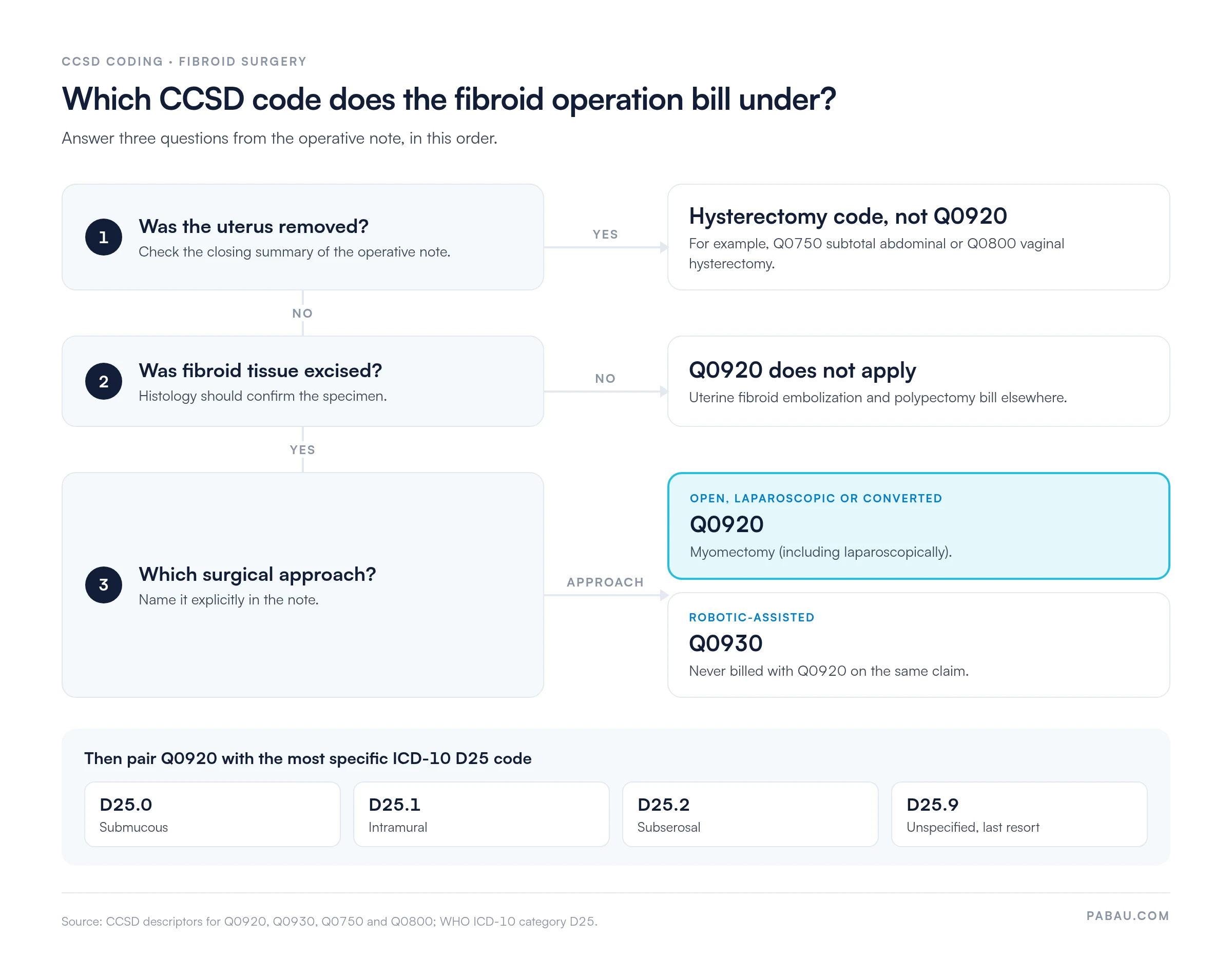
Within the same uterus range, Q0950 covers plastic reconstruction of the uterus, and the CCSD bars billing it alongside Q0920. For the wider schedule and how Bupa applies it, see our guide to Bupa CCSD codes.
An incomplete operative note is a common reason Q0920 claims stall, alongside a weak ICD-10 pairing. The GMC expects doctors to keep clear, accurate, and legible records made at the time of care. Insurers use the operative note as the main evidence when they review a Q0920 claim. Digital clinical forms in Pabau, a practice management platform, can standardize what gets captured at each surgery.
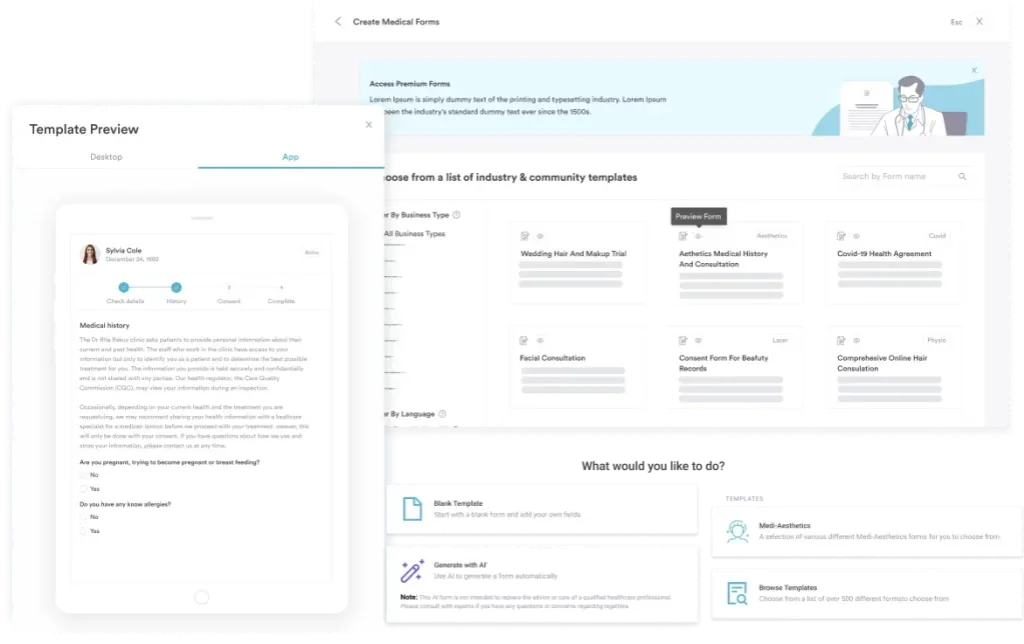
The operative note should contain each of the following:
Knowing why Q0920 claims fail helps practices fix errors before the invoice goes out. These are the triggers UK insurers most often query or reject.
Robotic-assisted myomectomy does not bill under Q0920. The CCSD schedule gives it its own code, Q0930, Robotic assisted myomectomy. The schedule lists Q0920 and Q0930 as an unacceptable combination, so a claim never carries both.
This matters because robotic surgery is laparoscopic in character, with ports and insufflation. Coders sometimes assume the “(including laparoscopically)” wording in Q0920 covers it. It does not, and a robotic case billed under Q0920 is likely to be queried or rejected.
Before booking a robotic myomectomy, name Q0930 at pre-authorization, not Q0920. Ask the insurer whether the policy covers robotic surgery and on what terms. Keep the robotic approach clearly stated in the operative note.
When a patient is listed for robotic myomectomy, give the insurer Q0930 at pre-authorization and keep Q0920 off the case. If the surgeon switches to a standard laparoscopic or open approach on the day, update the authorization to Q0920 before invoicing.
Gynecology practices billing CCSD Code Q0920 run into the same three problems: untracked pre-authorizations, incomplete operative notes, and weak ICD-10 pairing. Pabau keeps the case, the codes, and the notes on one record.
Key capabilities relevant to Q0920 claims:
The invoice then reflects what the surgeon did, in the terms the insurer approved. When a Q0920 claim is queried, the authorization, the codes, and the operative note are already in one place.

Record the CCSD code, ICD-10 pairing, and authorization number on each case in Pabau, and see a warning when an authorization is missing.

Before a myomectomy claim leaves the practice, read the operative note the way an insurer reviewer will. If it names the approach, confirms the uterus stayed in place, and locates each fibroid, Q0920 and the right D25 code follow from it. If it falls short, an addendum before submission is quicker than answering a query after it.
The robotic case is the one to watch. A change of approach on the day means a change of code and authorization too, so build that check into surgery booking. Book a demo to see how Pabau keeps codes, authorizations, and operative notes together for gynecology billing.

Looking for a broader CCSD billing reference? Pabau’s guide to UK CCSD codes and Bupa billing explains how the schedule is structured and how insurers use it.
Billing reconstructive uterine surgery? CCSD Code Q0950 covers plastic reconstruction of the uterus, a neighboring code in the same chapter.
Need the hysterectomy alternative? CCSD Code Q0750 covers subtotal abdominal hysterectomy, where the uterus is removed rather than preserved.
Records don’t name the fibroid location? ICD-10 Code D25.9 explains when the unspecified leiomyoma code is the right pairing.
Want to reduce claim rejections across procedure codes? Pabau’s claims management tools keep each insurer claim and its status in one place.
CCSD Code Q0920 covers myomectomy, the surgical removal of uterine fibroids while the uterus is preserved. The official descriptor is “Myomectomy (including laparoscopically),” so open and laparoscopic approaches share one code. Robotic-assisted myomectomy bills under Q0930 instead. Q0920 does not cover hysterectomy, endometrial ablation, or uterine fibroid embolization.
Use the WHO ICD-10 D25 category, leiomyoma of uterus. D25.0 is submucous, D25.1 intramural, and D25.2 subserosal. Use D25.9 only when the records do not state the fibroid’s position. Choosing D25.9 when imaging or the operative note names a location is a common error that prompts insurer queries.
In most cases, yes. Bupa, AXA Health, Aviva, and Vitality generally ask the patient to get pre-authorization before elective surgery. The patient gives the insurer the CCSD code and diagnosis from the consultant. Treatment without authorization can leave the patient or practice paying the bill, so confirm cover before booking surgery.
The defining difference is uterine preservation. Q0920 requires the uterus to stay in place after the fibroids are removed, while hysterectomy codes cover removal of the uterus. The operative note should state “uterus left in situ” for a Q0920 claim. Coding one procedure as the other is a serious claims error.
The leading triggers are a missing or vague ICD-10 D25 code and a missing authorization number. Other causes include incomplete operative notes and diagnostic laparoscopy billed alongside Q0920 in the same session. Robotic cases billed under Q0920 instead of Q0930 also fail. Policy limits and exclusions are avoidable by checking cover before admission.
No. The CCSD schedule has a separate code, Q0930, for robotic-assisted myomectomy. Q0920 and Q0930 are listed as an unacceptable combination, so a robotic case is billed under Q0930 alone. Name Q0930 at pre-authorization, because insurers may apply their own rules to robotic surgery.




