ICD-10 code B02.9: Zoster without complications
ICD-10 code B02.9: Quick reference ICD-10 code B02.9 is the billable ICD-10-CM c...

Last Updated: Nov 24, 2026
Billable Code Specific Code
D25.9 is the billable ICD-10-CM code for leiomyoma of uterus, unspecified. It covers a uterine fibroid, myoma or fibromyoma whose location in the uterus is not stated in the record.
Use D25.0, D25.1 or D25.2 when any imaging, operative or pathology report names a submucous, intramural or subserosal fibroid. The Official Guidelines accept an unspecified code when the record holds no further detail. A provider query is good practice when the location is unclear.
Let Pabau's smart automation suggest the right codes, reduce claim denials, and keep your practice compliant—effortlessly.
Automate repetitive tasks and focus on what matters most—your patients.
Reduce coding errors and ensure compliance with the latest regulations.
Clean claims, fewer denials, and faster reimbursements.
Powerful insights and reporting to help your practice thrive.
HIPAA compliant SOC 2 certified GDPR-compliant Trusted by 4,000+ clinics worldwide

D25.9 codes a uterine leiomyoma (fibroid) when no report in the record states where in the uterus it sits.
Use D25.0, D25.1 or D25.2 whenever an imaging, operative or pathology report names a submucous, intramural or subserosal fibroid.
UFE and most myomectomy and hysterectomy procedures need prior authorization, so confirm it before you schedule the case.
Report documented symptoms such as menorrhagia (N92.0) or iron deficiency anemia (D50.0) as secondary diagnoses to support medical necessity.
Pabau, a practice management platform, lets the practice record the fibroid location in the patient record, where the biller reads it before coding.
ICD-10 Code D25.9 is the billable ICD-10-CM code for leiomyoma of uterus, unspecified: a uterine fibroid whose location in the uterus is not documented. The FY 2027 ICD-10-CM tabular list from CDC/NCHS places it in category D25, next to D25.0 submucous, D25.1 intramural and D25.2 subserosal leiomyoma.
Confirm current validity each fiscal year against the CDC/NCHS ICD-10-CM web tool, which CMS and NCHS update annually.
D25.9 represents a histologically or clinically confirmed uterine leiomyoma whose location within the uterus has not been recorded. The tabular list names uterine fibroid, uterine fibromyoma and uterine myoma as inclusion terms for category D25. Location matters because it drives treatment selection, medical necessity arguments and payer review criteria.
A typical case runs like this. A patient presents with heavy menstrual bleeding or pelvic pressure, and a pelvic ultrasound confirms one or more fibroids. The report does not say whether they are submucous, intramural or subserosal, and the coder cannot add specificity the documentation does not support.
D25.9 is benign. Leiomyosarcoma is a malignant smooth muscle tumor, coded to malignant uterine neoplasms rather than to D25. Never use D25.9 when pathology returns malignancy.
D25.9 is one of four codes in category D25. Choosing the wrong sibling is a frequent coding error on uterine fibroid claims.
The CMS ICD-10-CM code files and the annual Official Guidelines are the authoritative sources for category D25. The guidelines accept an unspecified code when the record holds no further detail. When the location is unclear, a provider query is still recommended practice before you settle on D25.9.
Choosing D25.9 follows three steps, and none of them treats “unspecified” as a default for uncertain coding. The chart below maps each documented location to its code.
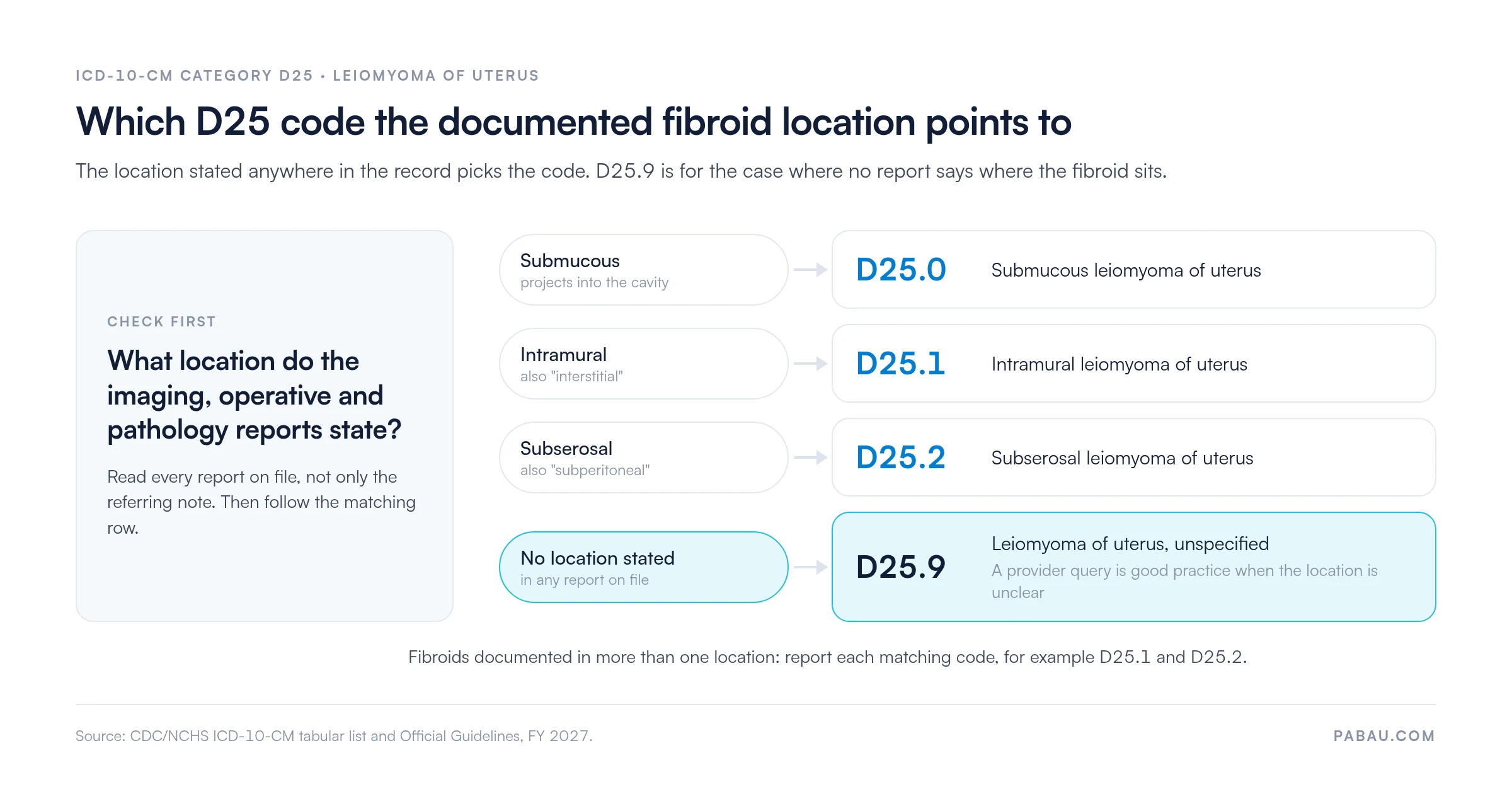
Here is a common mistake. The interventional radiologist’s pre-procedure MRI maps three fibroids, two intramural and one subserosal. The claim still goes out with D25.9, because the referring physician’s note said only “uterine fibroids.” The imaging is part of the medical record, so the location is documented, and D25.1 and D25.2 should have been reported.
Secondary diagnoses document the clinical burden that justifies treatment and supports medical necessity. Menorrhagia, reported with N92.0, is the presenting symptom you will code most often. These are the codes most frequently reported alongside D25.9.
Sequencing: D25.9 is typically the principal diagnosis when the fibroid is the reason for the encounter, such as outpatient surgery, UFE or an office consult. It moves to secondary when the reason for admission is a complication, such as the anemia or the bleeding episode itself.
Every D25.9 claim for a surgical or interventional procedure needs a paired CPT code. The procedure determines reimbursement, and the diagnosis supports medical necessity. A CPT code that doesn’t match the approach invites a CO-11 denial. D25.9 reported when a location was documented, or thin documentation, invites a CO-50 medical necessity denial.
Myomectomy approach coding note: The operative report must state the approach (abdominal, laparoscopic or hysteroscopic), the number of fibroids removed and their combined weight. If it names intramural fibroids and the coder submits D25.9 with 58140, both elements of the claim are wrong. Use D25.1 and confirm the weight bracket for the CPT selection.
A hysteroscopic resection billed with 58561 points to a submucous fibroid, so check the report for D25.0 before you keep D25.9. Verify current reimbursement rates through the CMS Physician Fee Schedule lookup tool.
Run a claim scrubber cross-check before submission. If CPT 58561 (hysteroscopic myomectomy) is paired with D25.9 and the operative report is on file, expect the payer to query location. Hysteroscopic approach is specific to submucous fibroids. If the report confirms submucous location, change the diagnosis to D25.0 before filing.
Prior authorization (PA) requirements for fibroid procedures vary by payer and change annually. The patterns below reflect typical commercial and Medicare Advantage requirements, but coders must verify each payer’s current coverage policy. Insurance eligibility verification before scheduling cuts the risk of a post-service PA denial.
Reviewing medical billing workflows and building a PA checklist for fibroid procedures reduces claim lag and prevents post-service denials on high-cost interventions.
D25.9 draws a distinctive denial pattern, because the “unspecified” designation invites payer scrutiny that the specific D25 codes avoid. These are the five denial types coders meet most often on uterine fibroid claims.
Reviewing denial management workflows and mapping each denial type to a root cause shortens the appeals cycle. A clean first submission is always faster than a corrected claim. The medical billing denial codes reference defines the CARC codes used in remittance advice.
A D25.9 claim needs a medical record that supports the unspecified designation. These elements should be in place before the claim goes out.
Submitting a clean claim on the first pass means confirming all five elements before billing, not discovering them during the appeals process.
Build a five-point fibroid checklist into your pre-bill review. Review the imaging report for location language, and confirm the operative approach and fibroid count. Record the PA authorization number and add secondary diagnoses such as AUB and anemia. Then check NCCI bundling edits for the CPT combination. Five minutes before submission saves two weeks on appeals.
Payer legacy systems occasionally flag crosswalk claims for review. When re-coding pre-2015 encounters for retrospective audits, record the GEM crosswalk source (the CMS-published GEMs) in the audit trail.
Specificity errors on D25.9 claims share a root cause. The fibroid location sits in an imaging or operative report that the person choosing the code never opens. That happens most when the clinical record and the billing work live in separate systems.
Pabau keeps the patient record and billing in one platform for OB/GYN and women’s health practices. Practices record the fibroid location in the patient record or treatment notes, and the biller reads it there before coding. Pabau’s claims management software then turns the invoice into an electronic claim.
US practices submit those claims through Claim.MD, Pabau’s US clearinghouse partner, which reaches thousands of US payers and runs real-time eligibility checks. ERA remittances come back linked to their claims, so you can see which fibroid claims were paid, are pending or were denied.
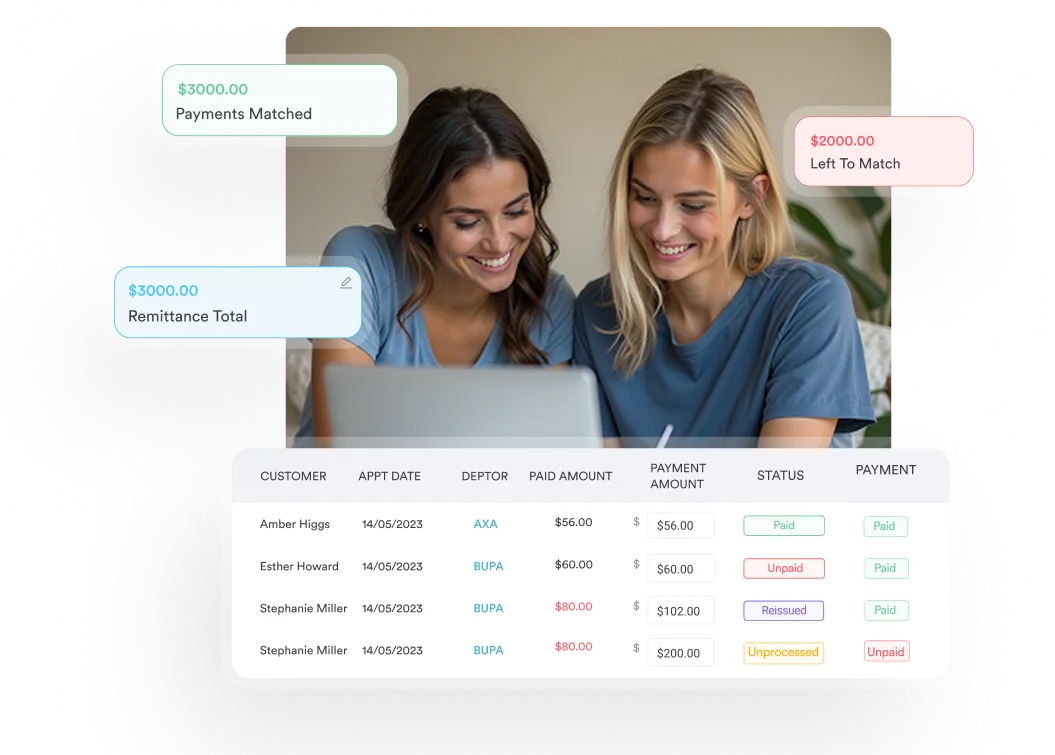

Pabau keeps imaging reports, treatment notes and prior authorization details on one patient record. US practices then submit claims and track remittances through the Claim.MD integration.

D25.9 is a valid, billable code, and the risk lies in reaching for it too early. A location named in one report but missing from another is still documented, and the claim should carry the specific code.
Make the imaging and operative reports part of every fibroid coding review, and query the provider when the location is unclear. That habit stops the specificity denials described above before a payer ever sees the claim.
Book a demo to see how Pabau keeps fibroid documentation and claims on one patient record for OB/GYN practices.

Need a clearinghouse integration for OB/GYN claims? Claim.MD clearinghouse overview explains how Pabau connects OB/GYN practices to thousands of US payers for electronic claim submission.
Want to understand denial code patterns on remittance advice? Electronic remittance advice guide covers how to read ERA 835 files and act on CARC denial codes.
Looking for revenue cycle context for women’s health billing? Revenue cycle management overview outlines the end-to-end billing workflow from eligibility to payment posting.
Coding the anemia that heavy bleeding causes? ICD-10 code D50.0 covers iron deficiency anemia secondary to chronic blood loss.
Billing a hysterectomy for fibroids? CPT code 58150 walks through total abdominal hysterectomy billing.
ICD-10 Code D25.9 is the billable ICD-10-CM diagnosis code for leiomyoma of uterus, unspecified. It applies when a uterine fibroid is confirmed clinically or on imaging, but no record documents its location. Category D25 covers all uterine leiomyomas, whatever their location.
Yes. D25.9 is a valid billable ICD-10-CM code for a principal or secondary diagnosis on claims to any HIPAA-covered payer. It carries a billable marker in the official ICD-10-CM tabular list and is active for FY 2027.
D25.0 is a submucous leiomyoma, beneath the endometrium. D25.1 is intramural, within the myometrial wall. D25.2 is subserosal, projecting outward from the uterine surface. D25.9 applies only when no record source documents the location, imaging reports included.
Use D25.9 when no record source documents the fibroid location. Check the imaging report, operative note, pathology report and clinical note first. If any of them states submucous, intramural or subserosal, report D25.0, D25.1 or D25.2. A provider query is recommended practice when the location is unclear, but it is not a precondition for D25.9.
The most common are a specificity query when imaging on file documents the location, and a missing prior authorization for UFE or myomectomy. CO-11 follows when CPT 58561 is paired with D25.9 and no submucous fibroid is confirmed. CO-50 medical necessity denials follow when the record lacks symptom duration, failed conservative treatment or imaging. Hysteroscopy billed separately from the myomectomy is another frequent edit.
The codes most often reported with D25.9 are N92.0 (menorrhagia), N93.9 (unspecified abnormal bleeding), R10.2 (pelvic pain) and D50.0 (iron deficiency anemia from blood loss). Report them whenever they are documented and treated, because they strengthen medical necessity.