CCSD Code X1420: Billing guide for UK private practice
CCSD Code X1420: Definition and clinical description CCSD Code X1420 is a proced...

Last Updated: Nov 23, 2026
Billable Code
Q0950 is the CCSD code for plastic reconstruction of the uterus, the surgical reshaping or repair of uterine anatomy. UK private medical insurers accept it for procedures such as open metroplasty to correct a bicornuate uterus.
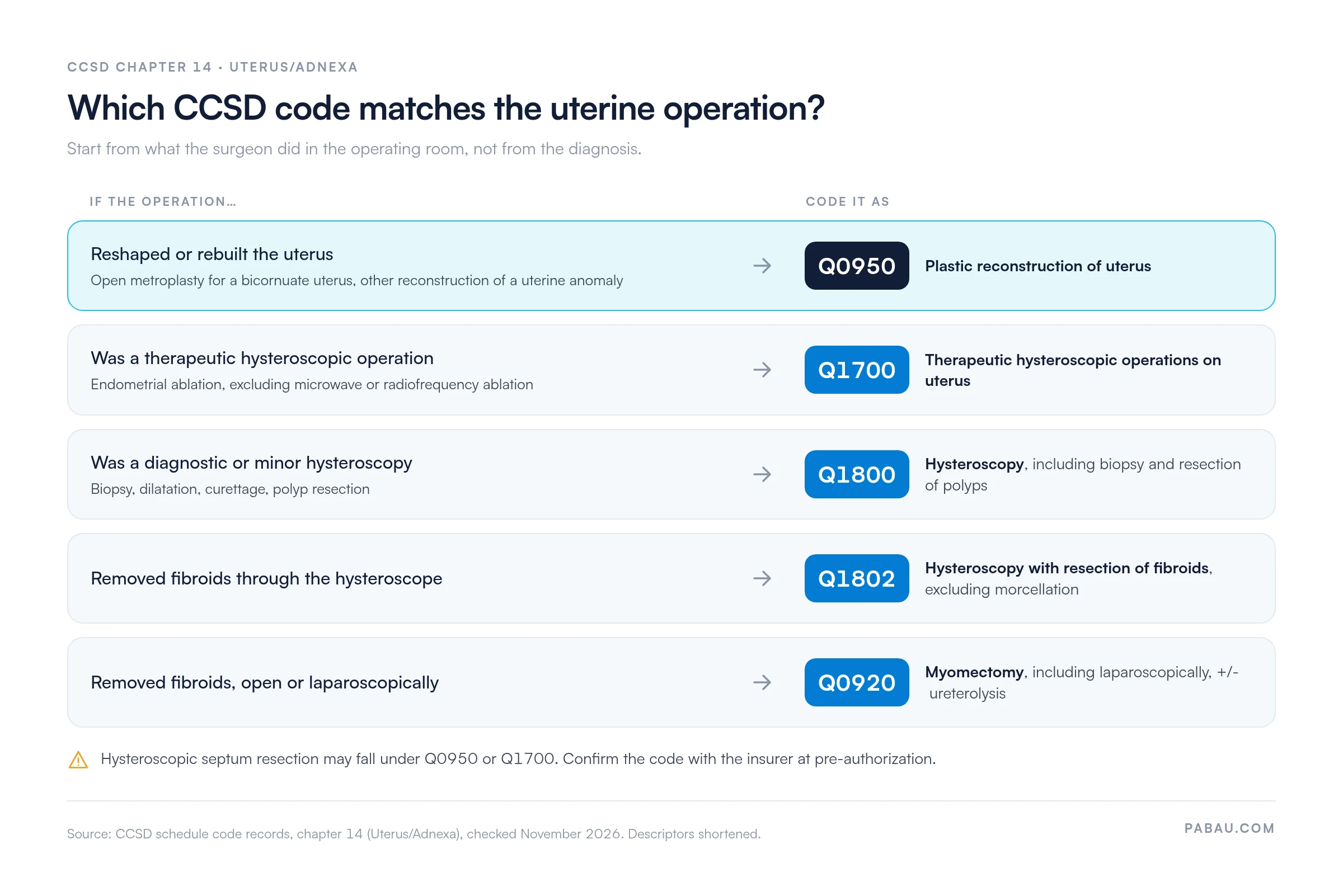
The code sits in CCSD chapter 14 (Uterus/Adnexa). Diagnostic hysteroscopy (Q1800), myomectomy (Q0920) and endometrial ablation (Q1700) are coded separately. Hysteroscopic septum resection may fall under Q0950, so confirm the code with the insurer before surgery.
Let Pabau's smart automation suggest the right codes, reduce claim denials, and keep your practice compliant—effortlessly.
Automate repetitive tasks and focus on what matters most—your patients.
Reduce coding errors and ensure compliance with the latest regulations.
Clean claims, fewer denials, and faster reimbursements.
Powerful insights and reporting to help your practice thrive.
HIPAA compliant SOC 2 certified GDPR-compliant Trusted by 4,000+ clinics worldwide

CCSD code Q0950 covers plastic reconstruction of the uterus, not diagnostic hysteroscopy (Q1800), myomectomy (Q0920) or endometrial ablation (Q1700).
Accepted indications include septate uterus, bicornuate uterus and recurrent pregnancy loss, while some UK insurers exclude reconstruction done for fertility alone.
Operative notes must state the surgical approach (hysteroscopic or open), the anatomical findings and the reconstructive technique performed.
Hysteroscopic septum resection may fall under Q0950 or Q1700, so confirm the code with the insurer before surgery.
Major UK private medical insurers require pre-authorization before Q0950 surgery, and a claim without an authorization reference is usually rejected outright.
CCSD code Q0950 is the code for plastic reconstruction of the uterus in UK private healthcare. CCSD’s own code record gives that exact descriptor, with schedule reference Fn.007, in chapter 14 (Uterus/Adnexa). The code applies when a gynecologist surgically reshapes, repairs or rebuilds uterine anatomy. Examining or evacuating the uterine cavity is coded elsewhere.
The code is maintained by the Clinical Coding and Schedule Development (CCSD) Group. It publishes the procedure code set used across UK private medical insurance (PMI). Q0950 is accepted by the major UK insurers, including Bupa, AXA Health, Aviva, Vitality and Healix. Each applies its own pre-authorization and clinical justification rules. Our library of CCSD codes for specialists lists billing guides for other procedures in the schedule.
Q0950 captures the reconstructive surgery on the uterus itself. It does not capture a standalone diagnostic hysteroscopy (Q1800), an endometrial ablation (Q1700) or a myomectomy (Q0920). Never substitute Q0950 for those codes when the clinical work was not plastic reconstruction.
Plastic reconstruction of the uterus covers any operative technique that corrects uterine anatomy to restore or improve uterine function. UK private practice uses two main surgical approaches.
Hysteroscopic septum resection, also called hysteroscopic septoplasty, is a common reconstructive uterine procedure in UK private gynecology. The surgeon passes a hysteroscope through the cervix and divides the uterine septum under direct vision, using a resectoscope or scissors. The approach is minimally invasive and carries a shorter recovery. RCOG clinical guidance on recurrent miscarriage and uterine anomalies treats it as the preferred method for correcting a septate uterus.
Its coding is less settled than the surgery. Hysteroscopic septum resection may fall under Q0950, but insurers can also treat it as a therapeutic hysteroscopic operation under Q1700. Check which code the insurer expects before you request pre-authorization.
Open metroplasty via laparotomy is used when hysteroscopic access is not feasible, or when the anomaly needs external uterine reconstruction. The Strassmann metroplasty is the standard open technique for correcting a bicornuate uterus. The surgeon incises the fundus transversely and sutures the two uterine horns together into a single cavity. It is more complex surgery than the hysteroscopic approach, with a longer recovery.
Open reconstruction also falls under Q0950. Check the current CCSD schedule for whether the open approach needs a supplementary code, and confirm with the insurer before the claim goes in.
Q0950 is appropriate when the procedure reconstructs uterine anatomy for a recognized clinical indication. Billing Q0950 for a procedure that is mainly cosmetic or exploratory is miscoding, and the claim risks denial.
Accepted indications for plastic reconstruction of the uterus in UK private practice include:
Documentation is the main defense against claim denial. UK private insurers scrutinize Q0950 claims closely because the procedure sits on a boundary. Reconstructive surgery is covered, while fertility treatment may be excluded. The operative note must leave no doubt about what was done and why.
A compliant operative note for Q0950 should include all of the following:
Insurer medical reviewers routinely query notes that say only “hysteroscopy and septal resection performed”. The note needs the reconstructive intent and the diagnostic context as well.
The ICD-10 diagnosis code submitted with Q0950 must reflect the confirmed anatomical finding. The Q51 range covers congenital malformations of the uterus and cervix, and it holds the most common pairings:
Pabau, a practice management platform with built-in digital forms, lets a gynecology practice build a structured pre-op template. The template captures the ICD-10 pairing, the imaging evidence and the clinical justification before the procedure date. Missing detail then surfaces weeks before the claim, not on the day it is due.
The surgical approach shapes how the operative note is written and may influence insurer review. The table below sets out the coding considerations for each approach:
Several gynecology CCSD codes sit next to Q0950 and are sometimes confused with it. The right choice depends on whether the procedure reconstructed the uterus or did something narrower.
These are neighboring codes in CCSD chapter 14 (Uterus/Adnexa). Always verify current descriptors on the CCSD schedule before billing. If the hysteroscopy removed fibroids instead, our billing guide for Q1802 covers that claim.
The code follows the operation the surgeon performed, and the guide below maps each operation to its code.
Before submitting Q0950, search the CCSD schedule for any supplementary codes that apply to your surgical approach. If a diagnostic hysteroscopy and a hysteroscopic septoplasty took place in the same session, check whether Q0950 already includes the diagnostic element.
Knowing what CCSD code Q0950 excludes matters as much as knowing what it covers. Claiming extra codes for services bundled within Q0950 is unbundling, a frequent trigger for insurer audit and clawback.
Services typically included within Q0950, and not separately billable in the same episode:
Services that may be separately billable alongside Q0950, subject to the insurer and the CCSD schedule:
When you’re unsure whether a service is bundled, check the insurer’s own fee schedule rules. Healix’s fee schedule guidelines, for example, bar billing the component parts of a single procedure separately. They also require providers to follow the CCSD unbundling guidelines.
Major UK private medical insurers require pre-authorization before Q0950 is performed as an elective procedure. A Q0950 claim without a valid pre-authorization reference is typically rejected outright rather than queried.
The Bupa CCSD billing guide covers Bupa’s pre-authorization process in detail. The principles below apply across the major UK insurers.
Frame the clinical justification around the structural anomaly and its symptomatic or obstetric consequences, not the fertility outcome. A request that leads with “patient wishes to conceive” is more likely to meet a fertility exclusion. One that leads with “confirmed septate uterus causing recurrent pregnancy loss” stands on its clinical harm.
Q0950 claim denials fall into five categories, and a correct pre-operative workflow prevents most of them.
UK private insurers treat Q0950 as reconstructive when it corrects a congenital or pathological abnormality that is causing documented clinical harm. That harm includes recurrent miscarriage, menstrual dysfunction or structural infertility due to the anomaly. The same procedure is treated as cosmetic, and excluded, when it is done mainly to optimize fertility without documented clinical harm.
The clinical justification letter sent with the pre-authorization request should therefore:
A reconstruction backed by documented recurrent pregnancy loss and a confirmed structural anomaly is far less likely to be reclassified as cosmetic. One backed only by a wish to conceive is the case insurers reclassify most often.
A complete Q0950 billing workflow runs in seven steps, from the first consultation to claim settlement:
Build a Q0950 pre-authorization checklist and attach it to the consent bundle. At the pre-operative assessment, it confirms four items: Imaging report obtained, pre-auth submitted, reference number on file and ICD-10 code selected. Procedures that reach surgery without a pre-auth reference are almost always denied, and UK private insurers rarely grant retrospective authorization.
In most gynecology practices, a Q0950 claim depends on records that live in different places. The referral letter, the imaging report, the pre-authorization reference and the operative note each sit in a separate inbox or folder. When the insurer sends a query, billing staff rebuild the case by hand.
In Pabau, those records attach to the patient’s file as the case moves forward. The pre-auth reference sits next to the booked procedure date, and the operative note travels with the claim. Pabau’s private practice claims management then tracks each claim’s status by insurer and flags missing documentation before the submission deadline.
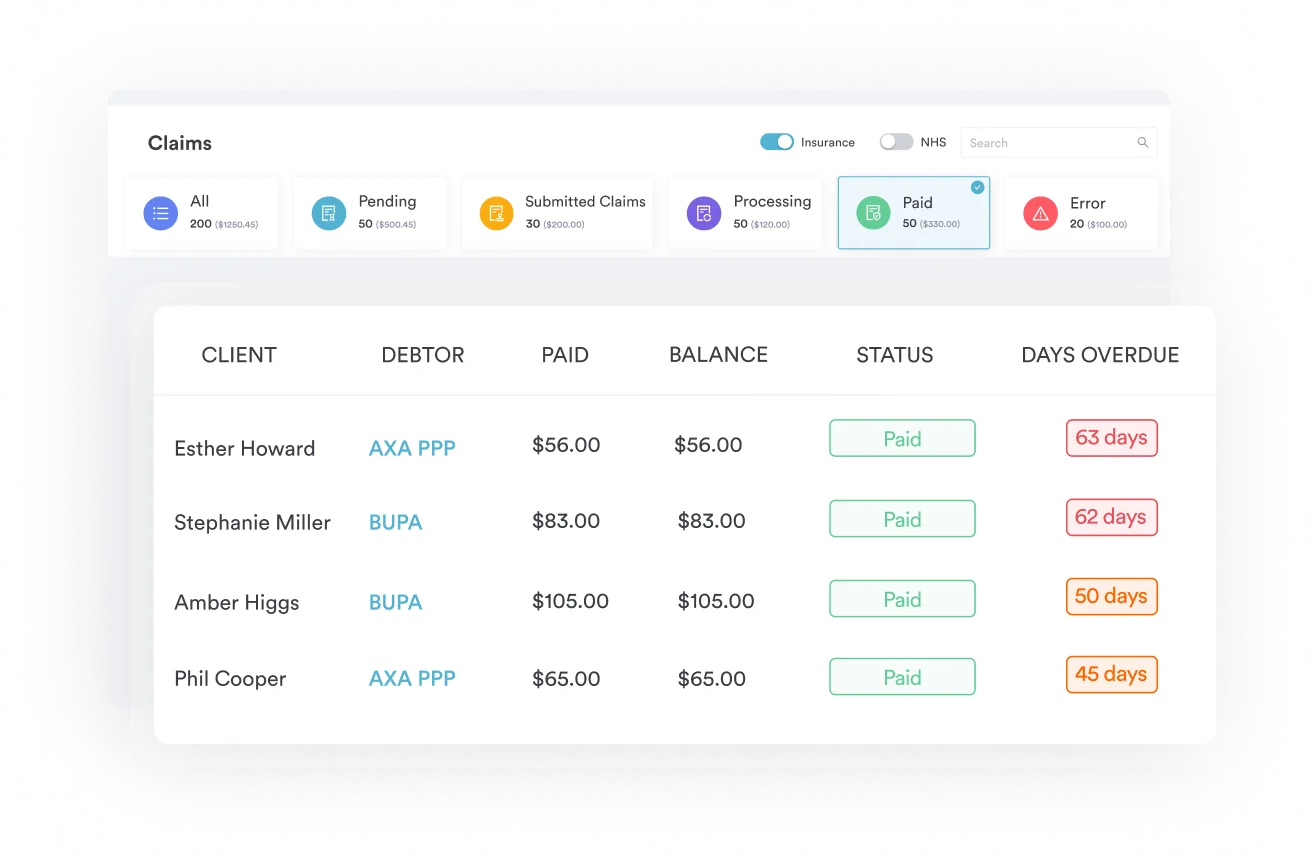
The claim then reaches the insurer with its authorization reference, ICD-10 pairing and operative detail already in place. Fewer Q0950 claims come back as queries, and your team stops reconstructing surgical detail weeks after the case.

Pabau helps UK private gynecology practices track pre-authorization status, attach operative notes to patient records and submit CCSD-coded claims in one workflow.

Q0950 claims rarely fail on the code itself. They fail when the pre-authorization, the operative note or the justification letter tells a different story from the claim. Frame every case as reconstruction of a documented anomaly before surgery, and the insurer has little room to apply a fertility exclusion.
For a hysteroscopic case, settle the Q0950 or Q1700 question with the insurer at pre-authorization, not after a query. Agreeing the code up front is cheaper than a denial and a resubmission.
Pabau keeps the pre-auth reference, the imaging and the operative note on one patient record, so the claim matches the case. Book a demo to see how Pabau handles private insurer billing for gynecology procedures.

Billing other CCSD gynecology procedures? Bupa CCSD billing guide covers the full Bupa procedure code set for private gynecology and other specialties.
Coding a therapeutic hysteroscopy instead? CCSD code Q1700: Therapeutic endoscopic uterus operations covers ablation and other hysteroscopic operations on the uterus.
Did the hysteroscopy remove fibroids? CCSD code Q1802: Hysteroscopic fibroid resection explains the documentation and pairing for that claim.
Repositioning the uterus rather than reshaping it? CCSD code Q2080: Ventro-suspension of uterus is the billing guide for uterine suspension surgery.
CCSD code Q0950 covers plastic reconstruction of the uterus, such as open metroplasty for a bicornuate uterus. Hysteroscopic septum resection may also fall under Q0950, but check Q1700 with the insurer first. Q0950 does not cover diagnostic hysteroscopy (Q1800), myomectomy (Q0920) or uterine evacuation.
Open metroplasty, including the Strassmann technique, is billed under Q0950 because it reconstructs the uterus. Hysteroscopic septoplasty may also fall under Q0950, but some insurers expect Q1700, which covers therapeutic hysteroscopic operations on the uterus. Confirm the code and any supplementary item against the current CCSD schedule before submission.
Missing pre-authorization is the leading cause of outright rejection. Insurers also deny Q0950 claims under fertility exclusion clauses, for thin operative documentation, for a mismatched ICD-10 pairing and for unbundling errors. A correct pre-operative billing workflow prevents all five.
Bupa accepts CCSD code Q0950 for plastic reconstruction of the uterus, subject to pre-authorization. Bupa also has to confirm the procedure falls outside its fertility exclusion. Claims backed by a documented structural anomaly and obstetric history, such as recurrent pregnancy loss, are more likely to be authorized. Check current coverage in the Bupa code search portal.
Major UK private medical insurers, including Bupa, AXA Health, Aviva, Vitality and Healix, require pre-authorization before elective Q0950 surgery. The request carries the CCSD code, the ICD-10 code, imaging evidence of the anomaly and the specialist’s clinical justification letter. Retrospective authorization is rarely granted.
A separately performed laparoscopy with its own clinical purpose may be coded alongside Q0950, and the anesthetist bills separately. Implanted devices may be added where the CCSD schedule permits. Diagnostic hysteroscopy and routine operative imaging are usually bundled into Q0950 and cannot be claimed separately in the same episode.