CCSD code J1900: Gallbladder anastomosis billing guide
CCSD code J1900 joins the gallbladder to another organ CCSD code J1900 is the UK...

Last Updated: Oct 22, 2026
K1800 is the CCSD code for placement of valve to cardiac conduit. Cardiac surgeons bill it to UK private medical insurers when they fit a valve into a heart conduit. The code sits in Chapter 8 of the CCSD schedule, under Heart - Cardiac Surgery.
The CCSD record lists K1850, K3500 and 64302 as unacceptable combinations, so none of them belongs on a K1800 claim. The record also carries an inactive date, so confirm with the insurer that K1800 is payable before surgery.
Let Pabau's smart automation suggest the right codes, reduce claim denials, and keep your practice compliant—effortlessly.
Automate repetitive tasks and focus on what matters most—your patients.
Reduce coding errors and ensure compliance with the latest regulations.
Clean claims, fewer denials, and faster reimbursements.
Powerful insights and reporting to help your practice thrive.
HIPAA compliant SOC 2 certified GDPR-compliant Trusted by 4,000+ clinics worldwide

CCSD code K1800 covers placement of a valve to a cardiac conduit, under Heart – Cardiac Surgery in Chapter 8.
The CCSD record carries an inactive date, so confirm the code is payable with the insurer before surgery.
K1850, K3500 and 64302 are unacceptable combinations with K1800, so keep them off its claim.
A matching authorization and an operative note that describes a placement carry most of the claim.
CCSD code K1800 is the code for placement of valve to cardiac conduit. Cardiac surgeons bill it to UK private medical insurers when they fit a valve into a heart conduit. CCSD stands for Clinical Coding and Schedule Development, the group that sets the codes insurers use.
A cardiac conduit is a tube that carries blood between the heart and a major vessel. Surgeons often place one during congenital heart repairs. The valve inside it stops blood flowing backward, and K1800 covers fitting that valve. Replacing the heart’s own aortic valve is a separate operation, coded K2600.
The code sits in Chapter 8 of the schedule, Thorax and intra-thoracic organs, under Heart – Cardiac Surgery. Its earlier narrative read “Creation of valved cardiac conduit.” Older insurer documents may still use that wording.
The CCSD record for K1800 shows an inactive date of January 1, 2006. Yet the same record lists combination rules created in January 2010. From the record alone, its current status is unclear.
Make status the first check on every K1800 case. Ask the insurer whether the code is payable on the patient’s policy before you request authorization. If they name another code, record it alongside their reference number.
CCSD schedule searches sit behind a login. Practices with an account can confirm the entry there. Others should rely on the insurer’s own code lookup. Our CCSD codes library covers neighboring cardiac procedures too.
The CCSD record lists three unacceptable combinations for K1800. Each one blocks a pairing that would charge for overlapping work.
An unacceptable pair on the claim invites a query. Remove it before the claim leaves the practice, rather than after a rejection.
Cardiac cases run over weeks, so each step needs its own record. The diagram below pairs each step with the check that protects it.
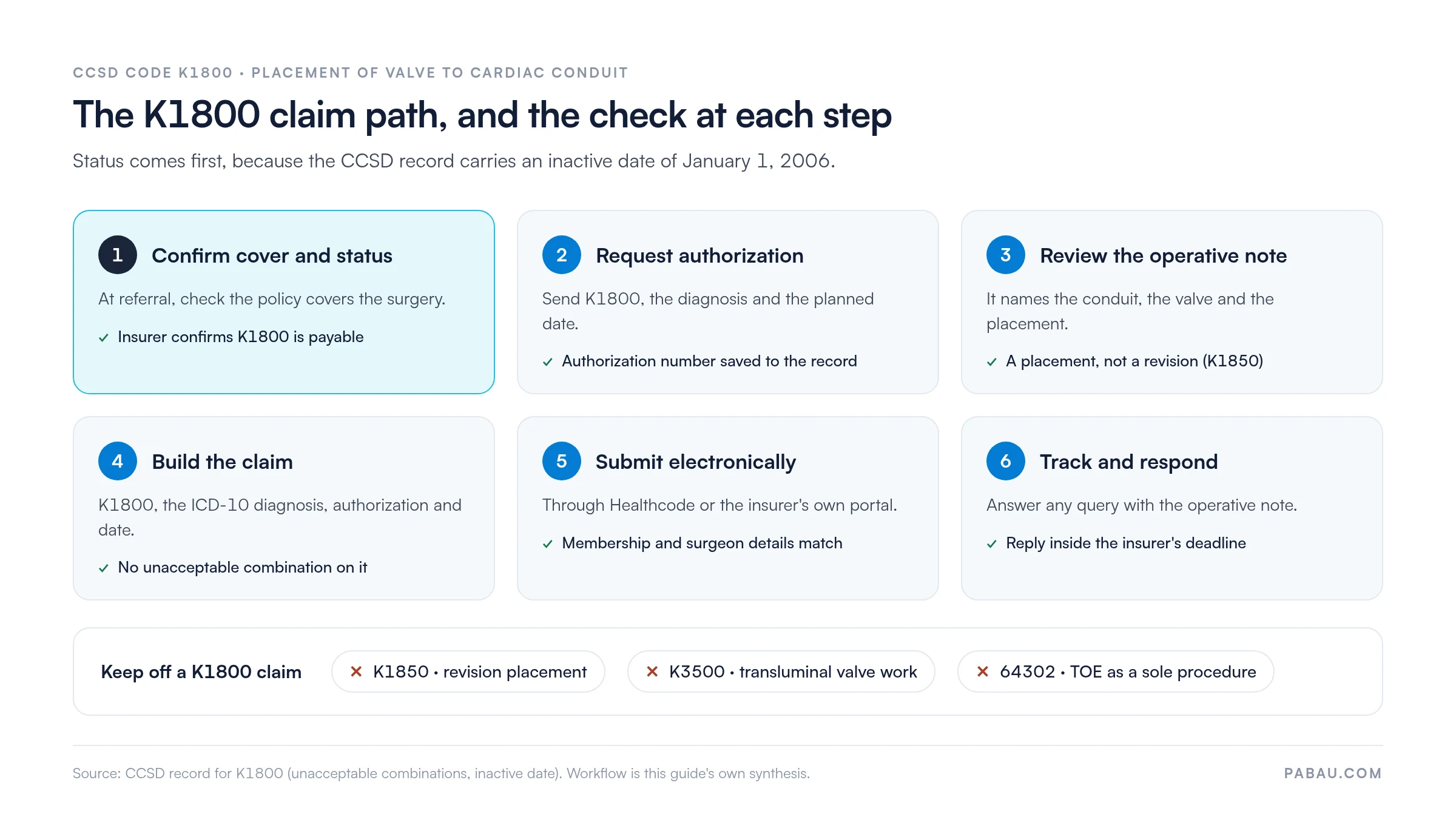
The anesthesiologist bills separately, under their own codes. Their fee never belongs on the surgeon’s K1800 claim.
Run these checks on every K1800 claim. Each one takes seconds and matches a common reason for a query.
Most K1800 problems start before the claim is built. Watch for these four.
A cardiac case can run for weeks between referral, authorization and surgery. Details retyped into a claim that late are where errors slip in.
Pabau, the practice management software we build, connects directly to Healthcode for UK private insurance billing. Claims are built from the patient record, so the code, authorization number and membership details carry across. Before you send, Pabau checks the required claim fields are complete.
After submission, you can follow each claim’s status and reconcile the payment against it. See how claims management in Pabau works. The result is fewer returned claims and one place to answer an insurer query.

Pabau builds Healthcode claims from the patient record and checks required fields before you send. Your team spends less time chasing returned claims.

K1800 is a narrow code with one open question: whether the insurer still pays it. Settle that at referral, and the rest of the claim becomes routine.
After that, two habits matter most. Keep the three unacceptable pairings off the claim, and make sure the operative note describes a placement. Together, they prevent the queries that hold up cardiac claims.
Book a demo to see how Pabau sends CCSD claims to Healthcode straight from the patient record.

Billing imaging alongside heart surgery? CCSD code 64302 billing guide explains how transoesophageal echo is coded and when it can’t be added.
Need the wider picture on CCSD codes? Bupa CCSD codes reference covers how Bupa uses the schedule and what it expects on a claim.
Want fewer returned insurer claims? Private healthcare claims management shows how Pabau prepares and submits claims through Healthcode.
Replacing a native heart valve instead? CCSD code K2600 billing guide covers aortic valve replacement and how to claim it.
Coding a repeat valve operation? CCSD code K2542 guide explains revision replacement of the mitral valve.
K1800 is the CCSD code for placement of valve to cardiac conduit. It sits in Chapter 8, under Heart – Cardiac Surgery. CCSD stands for Clinical Coding and Schedule Development.
Its status is unclear. The CCSD record shows an inactive date of January 1, 2006, but also rules added in 2010. Confirm with the insurer before treatment.
K1800 covers placement of a valve to a cardiac conduit. K1850 covers revision of that placement. The two are an unacceptable combination, so bill only one.
No. CCSD lists 64302, transoesophageal echocardiography, as an unacceptable combination with K1800. Keep it off the claim.
No. CCSD sets codes and their narratives, not fees. Each insurer applies its own fee schedule, so check it before you quote a price.