

HCPCS Code E0272: Foam rubber mattress billing guide
HCPCS Code E0272: official descriptor and code overview HCPCS Code E0272 is the ...

Last Updated: Nov 6, 2026
Billable Code
K3500 is the CCSD code for therapeutic transluminal operation(s) on valve of heart. It covers catheter-based treatment of any of the four heart valves, such as balloon valvuloplasty. The operator works through a blood vessel instead of opening the chest.
A diagnostic-only catheterization does not qualify, and open valve surgery takes a different CCSD code. Some insurers list their own codes for TAVI and newer mitral repair devices, so check the payer schedule before billing K3500.
Let Pabau's smart automation suggest the right codes, reduce claim denials, and keep your practice compliant—effortlessly.
Automate repetitive tasks and focus on what matters most—your patients.
Reduce coding errors and ensure compliance with the latest regulations.
Clean claims, fewer denials, and faster reimbursements.
Powerful insights and reporting to help your practice thrive.
HIPAA compliant SOC 2 certified GDPR-compliant Trusted by 4,000+ clinics worldwide

CCSD code K3500 covers catheter-based treatment of any heart valve, and a diagnostic-only catheterization does not qualify.
Balloon valvuloplasty of the aortic, mitral, or pulmonary valve is the procedure most often billed under this code.
Some insurers list their own codes for TAVI and newer mitral repair devices, so check the payer’s schedule before using K3500.
The major UK private medical insurers require pre-authorization for K3500, and claims without a valid reference are routinely denied.
Pabau, the practice management software we build, keeps the pre-authorization reference on the episode so it reaches the K3500 claim.
CCSD code K3500 is the procedure code for therapeutic transluminal operation(s) on a valve of the heart. The Clinical Coding and Schedule Development (CCSD) Group maintains it, filed under 8.8.0 Heart – Cardiac Surgery. “Transluminal” means the operator works through the lumen of a blood vessel instead of opening the chest. K3500 therefore applies to catheter-based valve work only, and open valve repair or replacement takes a different code.
The plural “operation(s)” lets one code span several catheter-based techniques at any of the four valves. A diagnostic catheterization with no treatment of the valve falls outside it.
The official CCSD descriptor reads: Therapeutic transluminal operation(s) on valve of heart. “Valve of heart” names no valve site, so all four cardiac valves are in scope. The table below sets out each valve, its common pathology, and the catheter-based work that fits K3500.
Some payers have issued bespoke codes for TAVI and for newer transcatheter mitral repair devices. Check the payer’s current schedule before defaulting to K3500 for these procedures. The table reflects the general scope of the CCSD descriptor, not any one insurer’s rules.
K3500 covers catheter-based valve procedures whose purpose is to treat the valve. The interventional cardiologist crosses or works on the valve to correct the pathology. Measuring pressure gradients or imaging the anatomy alone does not meet the descriptor.
These procedures typically fall within K3500 scope, subject to the current CCSD schedule edition:
What K3500 does NOT cover:
Each stage of the procedure leaves something the operative report must record to support K3500. A typical cath lab session runs in five steps:
The operative or cath lab report must state four facts explicitly:
A report that describes catheter advancement and hemodynamic measurement, but never confirms the therapeutic step, is the most common documentation reason for K3500 denial. The four checks below show where a case leaves the K3500 path.
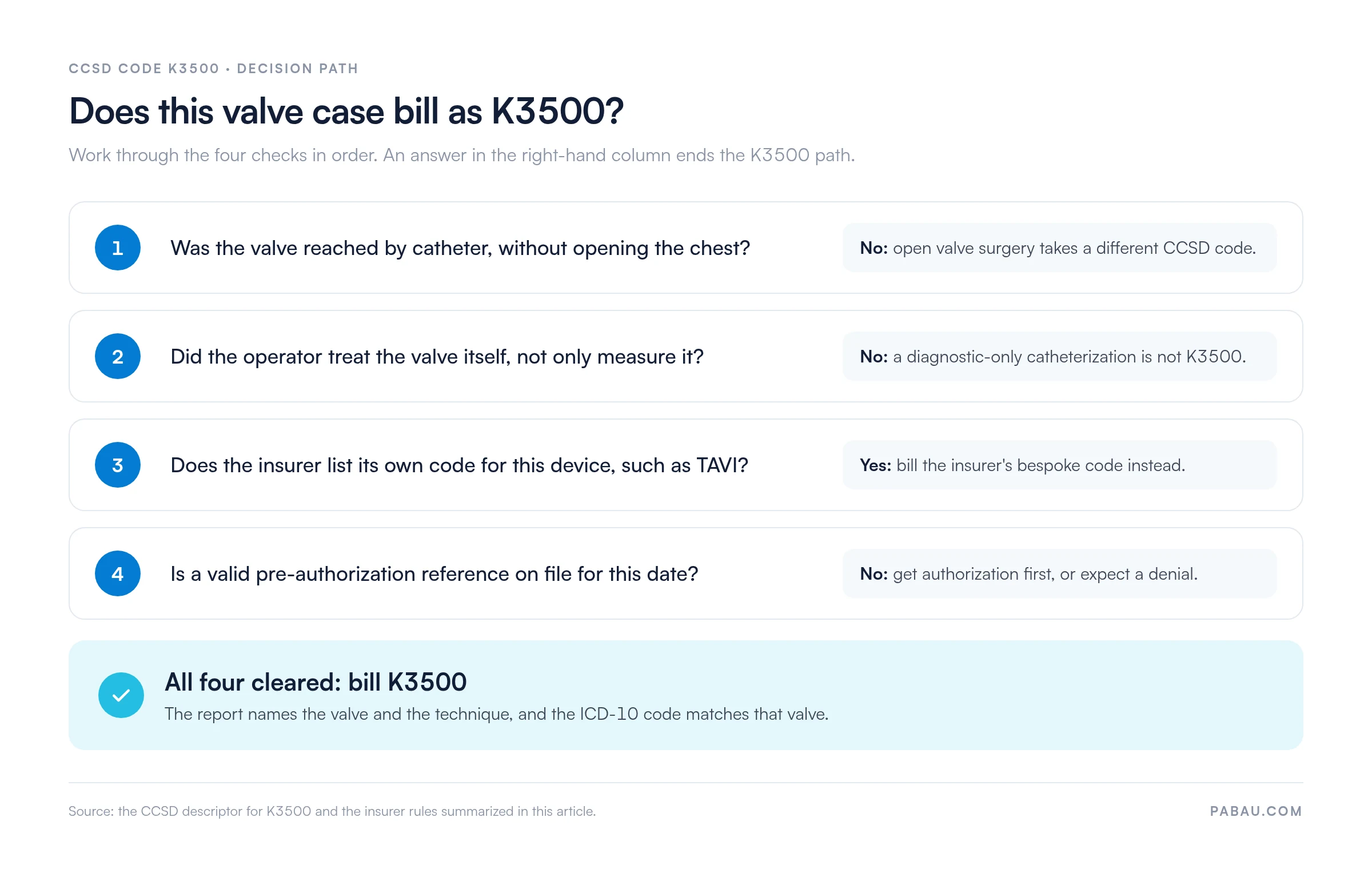
The checks run in the order a coder meets them, from approach to authorization.
Two neighbors in the K-series are often confused with K3500. The table below maps each one and the distinction that separates it.
Unbundling caution: CCSD bundling rules differ from US CPT conventions. A diagnostic catheterization in the same session as a therapeutic valve procedure is absorbed into the therapeutic code. Billing both may trigger a bundling query or denial, so check the current CCSD Technical Guide first.
Every K3500 claim needs an ICD-10 diagnosis code that establishes medical necessity. A mismatch between the procedure and the diagnosis is a leading cause of K3500 denial at UK private medical insurers. The table below lists the ICD-10 codes most often submitted with K3500.
The diagnosis code must reflect the valve pathology in the pre-procedure echocardiogram and the consultant’s indication statement. An aortic valvuloplasty claim carrying a mitral stenosis code will be queried, because the mismatch triggers an automated payer review. The I35.0 and I34.0 reference pages explain when each of those diagnoses applies.
Match the ICD-10 code on the claim to the valve named in the operative report and the pre-authorization request. A three-way match between authorization, report, and claim is the fastest route to a clean K3500 payment.
The major UK private medical insurers treat transcatheter valve procedures as high-cost work that needs pre-authorization before the procedure. A K3500 claim without a valid authorization reference is the most preventable cause of denial. The overview below reflects general payer practice, and criteria change with policy updates, so confirm them with each insurer.
Pabau’s private practice claims management tracks authorization status and reference numbers against each episode. That lowers the risk of an authorization expiring before the claim goes out.
NICE interventional procedures guidance on TAVI and percutaneous mitral valve repair is the evidence framework payers use to judge medical necessity. A consultant letter that cites the relevant guidance strengthens the pre-authorization request. Our Bupa CCSD billing guide covers submission workflows for the UK’s largest private medical insurer.
K3500 denials follow a small set of patterns, and most come from process slips rather than clinical documentation.
Run through this checklist before submitting any K3500 claim, since each item maps to a known denial trigger. Pabau’s digital procedure forms can capture these fields at the point of care, so the billing team has them when the claim goes out.
K3500 sits in a wider group of CCSD codes for cardiac catheterization and valve work, all listed in our CCSD code library. The table below covers the neighbors and add-ons that come up most. For descriptor text and bundling rules, use the current CCSD Technical Guide (October 2025) and each payer’s schedule.
In many cardiology practices, the authorization reference lives in an email, the operative report in the hospital system, and the claim in a billing spreadsheet. A K3500 claim gets assembled from all three, often days after the case. That is where expired authorizations and valve-site mismatches slip through.
Pabau records the authorization reference and its window against the patient’s episode. Its procedure forms capture the valve, the technique, and the therapeutic step in structured fields. The claim then draws on those same fields, so the code, diagnosis, and reference agree before submission.
Your billing team spends less time chasing consultants for missing details, and fewer K3500 claims come back queried.

Pabau keeps pre-authorization references, procedure notes, and CCSD claims on one patient record. Bupa, AXA Health, Aviva, and Vitality claims go out with the details each insurer checks.

K3500 is rarely denied because the procedure was wrong. Denials come from paperwork that fails to prove what happened, or proves it to the wrong insurer. Before your next valve case, settle two questions at referral. Does this payer have its own TAVI or mitral code, and is the authorization window long enough?
The trade-off is a few minutes of checking up front against weeks of resubmission later. Book a demo to see how Pabau carries the authorization from referral to a paid K3500 claim.

Need a full reference for Bupa CCSD billing? Bupa CCSD codes guide covers code lookup, submission workflows, and pre-authorization for the UK’s largest private insurer.
Checking what Bupa pays for a procedure? Bupa procedure codes and fee schedule lists codes alongside the fees attached to them.
Billing an open pulmonary valve procedure? CCSD code K2800 covers pulmonary valve replacement.
Submitting claims on paper? The medical insurance claim form template gives you a ready layout for the details insurers check.
CCSD code K3500 covers therapeutic transluminal operation(s) on a valve of the heart. These are catheter-based procedures that treat a valve pathology, beyond diagnosing it. Balloon valvuloplasty of the aortic, mitral, or pulmonary valve is covered. So are transcatheter valve implantation and repair, where the payer has no bespoke code for the device.
TAVI may be billed under K3500 when the payer has no bespoke TAVI code, because the descriptor covers transcatheter aortic valve implantation. Some UK private medical insurers have issued dedicated TAVI codes, though. Check the payer’s current schedule before submitting K3500 for TAVI.
K3500 covers therapeutic transluminal operation(s) on valve of heart and sits in the Heart – Cardiac Surgery chapter of the CCSD schedule. K3501 sits in a different CCSD chapter (Heart – Cardiology). Confirm its descriptor in the current schedule before use, and never swap one code for the other on a claim.
Yes, Bupa requires pre-authorization for all elective cardiac interventional procedures, including those billed under K3500. Support the request with an echocardiogram report, a multidisciplinary team decision, and the consultant’s clinical letter. Emergency cases may use Bupa’s retrospective pathway, with notice inside the timeframe in the current provider guide.
Generally, no. Under standard CCSD bundling, a diagnostic catheterization in the same session as a therapeutic valve procedure is part of K3500. Billing both creates an unbundling risk and will likely trigger a payer query. Bill the diagnostic code separately only for an independent procedure in a distinct, separately documented session.
The most common reason is a missing or expired pre-authorization reference. Next come operative reports that never confirm a therapeutic intervention, and ICD-10 codes that name a different valve than the report. Unbundling also causes denials, when a diagnostic catheterization code is billed with K3500 for the same session.




