HCPCS code G0206: Diagnostic mammography, unilateral
HCPCS code G0206: Definition and code status HCPCS code G0206 was the Level II c...

Last Updated: Oct 21, 2026
K3210 is the CCSD code for closed mitral valvotomy, an operation that splits a narrowed mitral valve on the beating heart. The surgeon passes a dilator through the heart wall, with no cardiopulmonary bypass. UK private medical insurers pay the specialist's fee against this code.
K3210 sits in Chapter 8 (Thorax and intra-thoracic organs) of the CCSD schedule, under cardiac surgery, in the Complex band. An open valvotomy done under direct vision on bypass bills under K3100 (Open valvotomy) instead.
Let Pabau's smart automation suggest the right codes, reduce claim denials, and keep your practice compliant—effortlessly.
Automate repetitive tasks and focus on what matters most—your patients.
Reduce coding errors and ensure compliance with the latest regulations.
Clean claims, fewer denials, and faster reimbursements.
Powerful insights and reporting to help your practice thrive.
HIPAA compliant SOC 2 certified GDPR-compliant Trusted by 4,000+ clinics worldwide

CCSD code K3210 bills closed mitral valvotomy, done on the beating heart without cardiopulmonary bypass. An open valvotomy bills under a different code, K3100 (Open valvotomy).
The operative note must confirm the closed technique, surgical approach, dilator used and absence of bypass. Without them, expect a query or denial.
Bupa, AXA Health and VitalityHealth all require prior authorisation for elective cardiac surgery, including K3210. Check each insurer’s provider portal before you submit.
Pabau, the practice management platform we build, helps UK private practices attach operative documentation, track authorisation status and submit CCSD claims in one workflow.
CCSD Code K3210 is the procedure code for closed mitral valvotomy in the CCSD schedule. UK private insurers use this schedule to bill and reimburse specialist procedures. The official descriptor is: Closed mitral valvotomy.
The code sits in Chapter 8 of the CCSD schedule (Thorax and intra-thoracic organs), among the heart valve codes in the cardiac surgery section. Its defining word is “closed”: the surgeon works on the beating heart without instituting cardiopulmonary bypass.
That word separates K3210 from K3100, the open valvotomy code listed directly before it. It also drives most documentation and coding decisions.
Key attributes of CCSD Code K3210 at a glance:
A closed mitral valvotomy is a cardiac operation that mechanically separates fused mitral valve leaflets to relieve mitral stenosis. The heart keeps beating, and the patient is never connected to a cardiopulmonary bypass circuit.
The technique was developed before open-heart surgery became routine and remains in use in centres where balloon mitral valvuloplasty is not suitable or available.
The classical operative sequence proceeds as follows:
The absence of cardiopulmonary bypass throughout all five steps is what makes the procedure “closed” for CCSD coding. If the surgeon converts to an open operation on bypass, K3210 no longer describes what was done. Code the procedure that was completed instead; an open valvotomy bills under K3100.
CCSD Code K3210 applies when a patient has symptomatic rheumatic mitral stenosis and valve anatomy that suits the closed technique. Pre-operative echocardiography is essential both clinically and for documentation purposes.
Patient selection criteria that support K3210 coding:
The operative note must reference the pre-operative echo findings to establish that the correct patient was selected for the closed technique. Claims submitted without this reference lose a key supporting document.
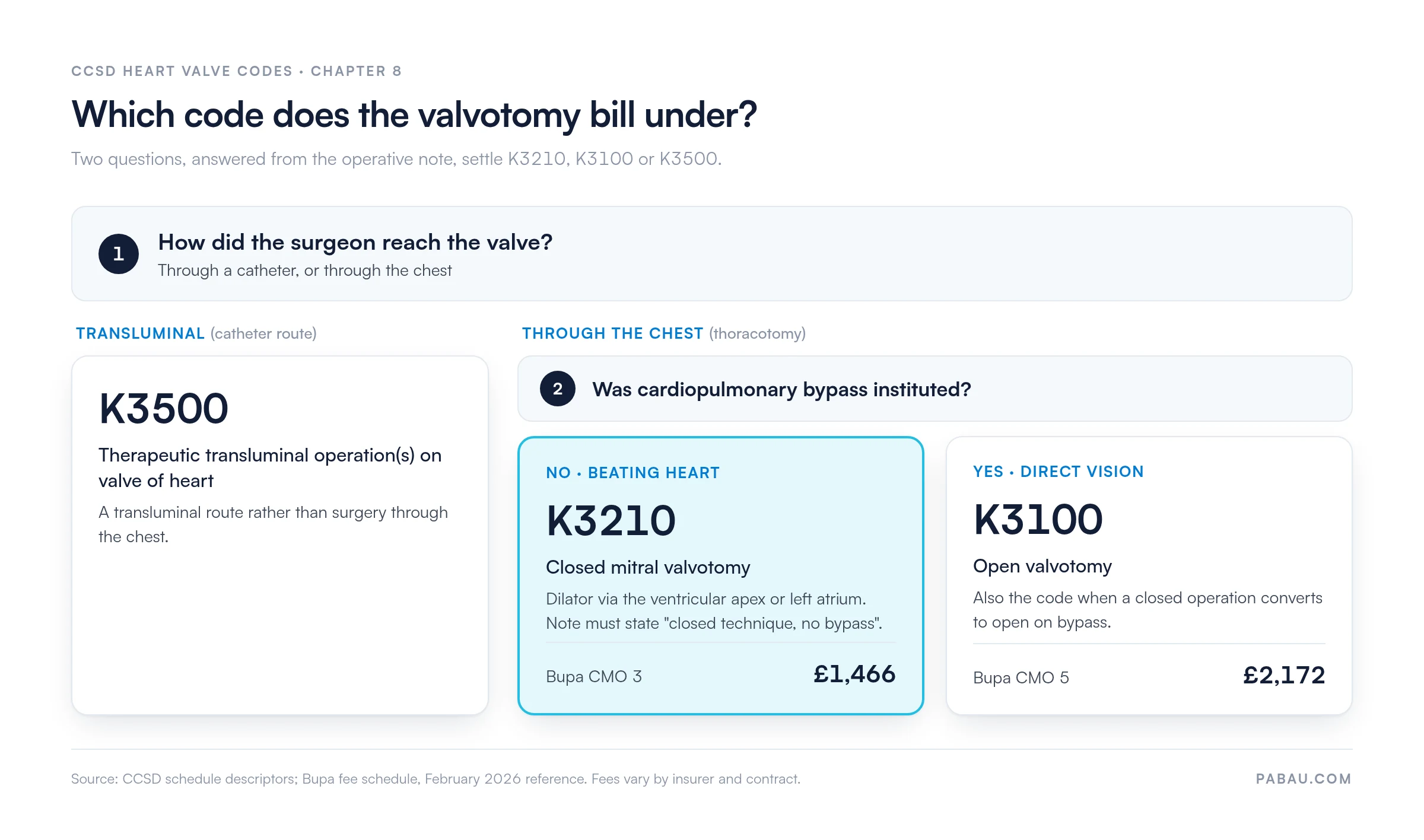
Choosing between CCSD K3210 and K3100 turns on one question: was the valve opened on the beating heart, or under direct vision on bypass? Coders must confirm the answer from the operative note before assigning either code.
The two codes also differ in scope. K3210 names the mitral valve, while the official descriptor for K3100 is simply “Open valvotomy” and names no valve. The same split runs through OPCS-4, where category K31 covers open valvotomy and K32 covers closed valvotomy. The diagram below routes a valve operation to its code from two answers in the operative note.
Coders should check the CCSD schedule edition their practice uses, as the CCSD group updates descriptors periodically. Fees vary by insurer and contract, so treat the Bupa figures above as a reference point rather than a guaranteed payment. Our guide to the Bupa fee schedule lists Bupa’s procedure codes alongside their fees.
K3210 sits among several related heart valve codes in Chapter 8. Knowing them prevents unbundling errors and helps coders pick the most precise descriptor when the operative note describes a different intervention. For codes outside the heart valve group, search our CCSD code library.
Check bundling and co-billing rules against the current CCSD schedule edition. Insurer portals for AXA Health and Bupa publish chapter-specific fee schedules that clarify which codes are mutually exclusive within a session. The anaesthesia code is billed by the anaesthetist on a separate claim, not bundled within K3210.
When a closed mitral valvotomy is converted to an open procedure during surgery, the operative note must record the point of conversion clearly. Code the procedure that was completed: K3210 if the valve was opened without bypass, K3100 if an open valvotomy was done on bypass. Never split one session across both codes.
An operative note that supports CCSD Code K3210 must explicitly confirm the closed technique. Insurers review documentation during audits and query rounds. A vague note that omits key elements is treated the same as a missing note. Good medical billing fundamentals begin with a complete surgical record.
Mandatory elements for a K3210-supporting operative note:
A structured operative note template helps cardiothoracic teams capture each of these required elements consistently. Free-text dictation often leaves out the bypass-status statement, and without it the coder has no basis for choosing between K3210 and K3100.
All three major UK private health insurers reviewed here require prior authorisation for elective cardiac surgery coded under CCSD, including K3210.
Policies change periodically, so practices should always verify current requirements on each insurer’s provider portal before submitting an authorisation request. The Bupa CCSD billing guide on Pabau covers Bupa-specific code submission in more detail.
The cardiologist’s referral letter and the pre-operative echocardiogram report are the two documents that must accompany every prior authorisation request for K3210. Submitting the claim before authorisation is confirmed results in automatic denial across all three insurers listed here.
Most K3210 rejections fall into one of four categories, each with a straightforward corrective action. Sound medical billing compliance practices address all four before the claim is submitted.
If a claim is denied for a documentation reason, request the full denial rationale from the insurer before resubmitting. A generic appeal that does not fix the specific deficiency is likely to be rejected for the same reason.
The CCSD procedure code K3210 must be submitted alongside an appropriate ICD-10 diagnosis code that confirms the clinical indication. UK private insurers use the NHS ICD-10 5th edition (England) classification.
Coders should verify code currency against the version in use at their practice, as terminology and code validity are updated periodically.
Submitting K3210 with a non-stenosis diagnosis, such as a mitral regurgitation-only code, triggers rejection. The procedure relieves stenosis; it does not correct regurgitation. Always cross-reference the diagnosis code against the echo findings documented in the referral.
Print the pre-operative echocardiogram summary on the same document bundle as the claim. Insurers reviewing K3210 authorisation requests compare the echo mitral valve area measurement against the submitted ICD-10 code. A mismatch between echo findings and the diagnosis code is a fast route to query or denial.
A K3210 claim usually draws on four separate records: the echo report, the authorisation reference, the operative note and the invoice. Each hand-off between them is a chance to lose a document or key the wrong code.
Pabau keeps those records on one patient episode. The workflow below shows how a cardiothoracic practice manager would take a K3210 claim from authorisation to payment with Pabau’s private medical billing tools.
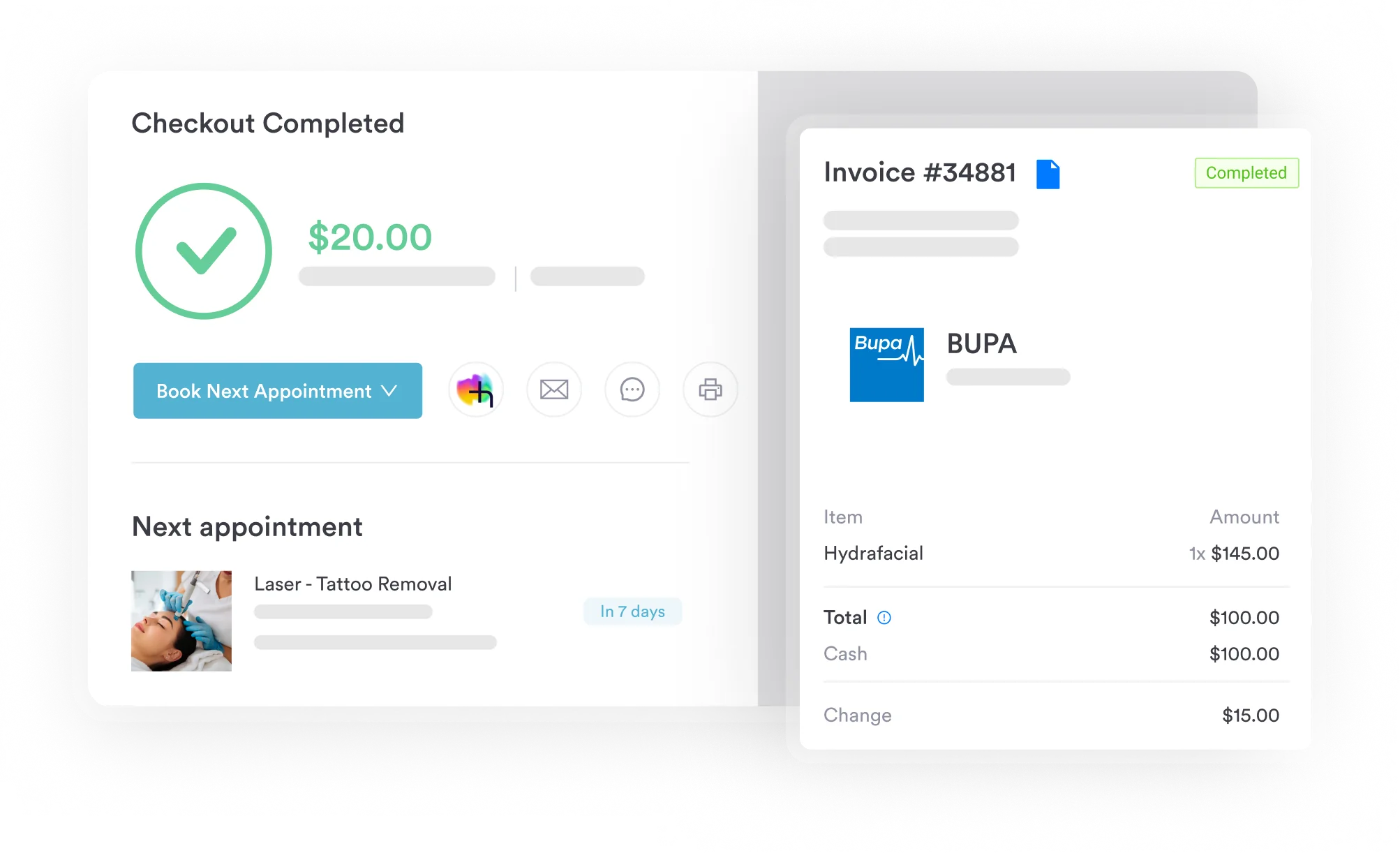
With the operative note, echo report, authorisation record and claim in one system, a claim is far less likely to leave without a required document.

Pabau helps UK private practices track prior authorisation status, attach operative documentation, and submit CCSD codes to insurer portals without switching between systems.

Most K3210 problems start before the claim is built, in an operative note that never says whether bypass was used. Fix that one sentence at source and the choice between K3210 and K3100 stops being a judgement call for the coder.
The rest is discipline: no submission without an authorisation reference, and a diagnosis code that matches the stenosis on the echo. Practices that hold every claim to those checks spend far less time on queries and appeals.
Practices handling cardiothoracic CCSD billing can reduce manual errors by managing operative documentation, authorisation tracking, and claim submission in a single workflow. To see how Pabau supports private billing for UK surgical practices, book a demo.

Looking for a complete private billing workflow? Claims management software shows how Pabau handles CCSD claim submission, denial tracking, and payment reconciliation for UK private practices.
Coding other cardiac surgery in Chapter 8? CCSD code K2310 covers excision of a cardiac tumour, another cardiac surgery code in the same chapter.
CCSD Code K3210 covers closed mitral valvotomy, a cardiac operation that widens a narrowed mitral valve with a mechanical dilator, without cardiopulmonary bypass. UK private insurers such as Bupa, AXA Health and VitalityHealth accept it as part of a complete CCSD claim.
A closed mitral valvotomy is done on the beating heart without bypass, using a dilator passed through the ventricular apex or left atrium. An open valvotomy uses bypass, so the surgeon can open the valve under direct vision. In CCSD, the closed operation bills under K3210 and an open valvotomy under K3100.
Yes. Mitral commissurotomy and mitral valvotomy are clinical synonyms for splitting fused mitral valve commissures. Code selection depends on whether the approach was closed (K3210) or open (K3100), not on which term the surgeon used in the operative note.
The operative note must state that no cardiopulmonary bypass was used, name the surgical approach and the dilator, and reference the pre-operative echocardiogram. The echo report and a cardiologist referral letter should accompany the claim as supporting documents.
Yes. Both Bupa and AXA Health require prior authorisation for elective cardiac surgery, including procedures coded under K3210, and VitalityHealth does the same. Check the current evidence requirements on each insurer’s provider portal before you request authorisation, as policies change periodically.
The most common reasons are a wrong code, missing prior authorisation, a diagnosis that does not match mitral stenosis, and an incomplete operative note. A wrong code usually means K3210 and K3100 were confused because the note never said whether bypass was used.
Yes. The anaesthetist submits the anaesthesia code separately on their own claim, and it is not bundled within K3210. Confirm the applicable anaesthesia code against the relevant insurer’s fee schedule.
K3210’s official descriptor is “Closed mitral valvotomy”, while K3100’s is “Open valvotomy” and names no specific valve. Both sit in Chapter 8 of the CCSD schedule. A single valvotomy is coded once, to the technique the operative note records.