HCPCS Code J1110: Dihydroergotamine mesylate injection billing guide
HCPCS Code J1110: Official descriptor and drug overview HCPCS Code J1110 is the ...

Last Updated: Oct 29, 2026
K5283 is the CCSD code for a complex Cox lesion set maze operation. This heart surgery treats atrial fibrillation by creating a planned pattern of scar lines in the atria, which block the irregular electrical signals.
K5283 sits in Chapter 8 (Thorax and intra-thoracic organs) of the CCSD schedule, in the Heart - Cardiac Surgery section. UK private medical insurers pay the specialist's fee against this code and expect pre-authorisation before an elective operation.
Let Pabau's smart automation suggest the right codes, reduce claim denials, and keep your practice compliant—effortlessly.
Automate repetitive tasks and focus on what matters most—your patients.
Reduce coding errors and ensure compliance with the latest regulations.
Clean claims, fewer denials, and faster reimbursements.
Powerful insights and reporting to help your practice thrive.
HIPAA compliant SOC 2 certified GDPR-compliant Trusted by 4,000+ clinics worldwide

CCSD code K5283 is the UK private medical insurance code for a complex Cox lesion set maze operation, a surgical treatment for atrial fibrillation.
The descriptor names the lesion set, not the energy source, so the operative note must show which lesions the surgeon created.
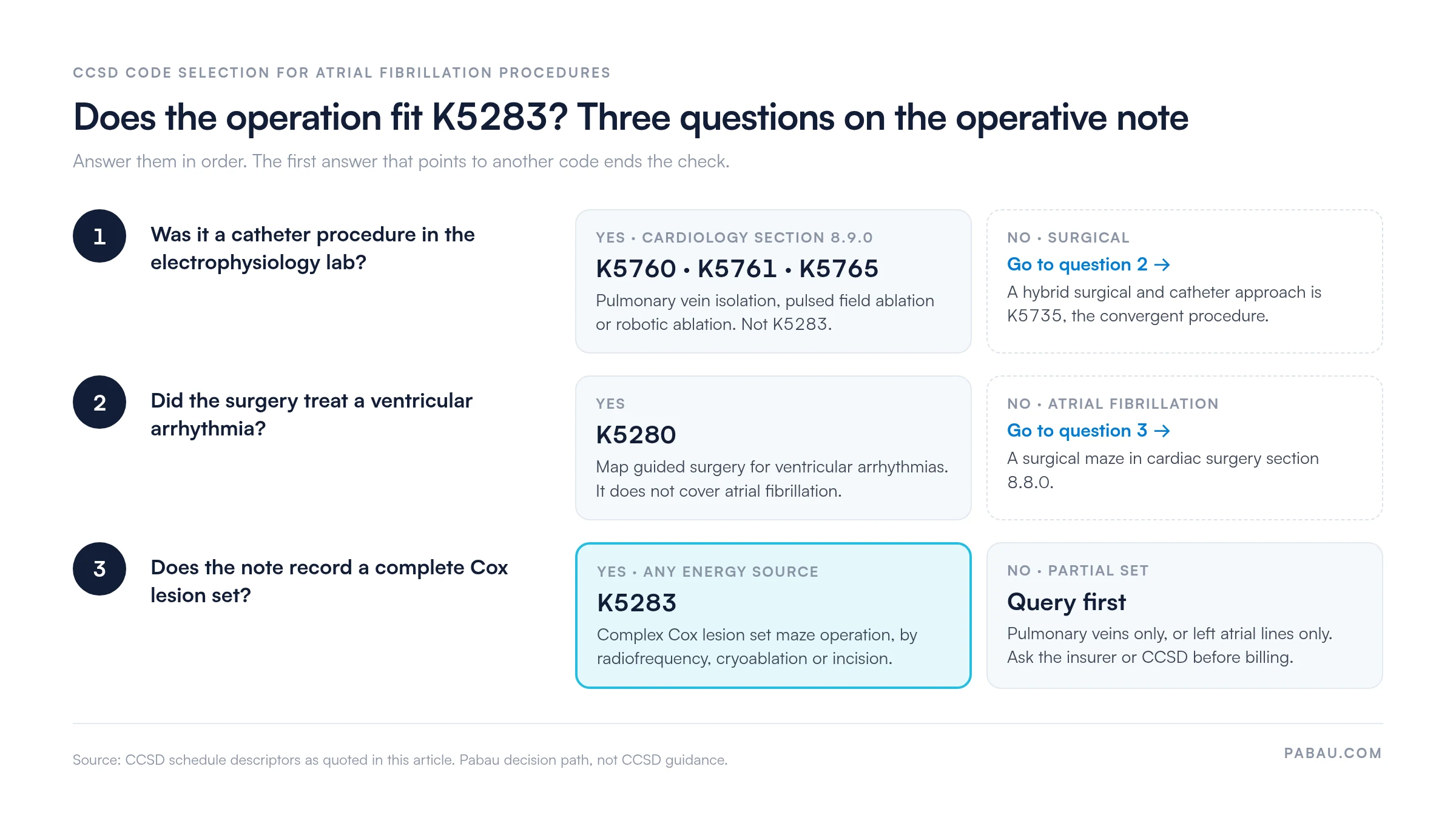
Catheter ablation for atrial fibrillation sits in the cardiology section of the schedule, under codes such as K5760 and K5761.
Insurers such as Bupa, AXA Health, Aviva and Vitality expect elective surgery to be pre-authorised, so record the authorisation number before admission.
Pabau’s claims management software helps UK private practices submit and track claims, so each K5283 claim stays linked to the patient record.
CCSD code K5283 is the procedure code for “Complex Cox lesion set maze operation” in the schedule. The schedule is maintained by the Clinical Coding & Schedule Development (CCSD) Group. UK private medical insurers and private hospitals use this schedule to bill and pay for specialist procedures.
K5283 sits in Chapter 8 (Thorax and intra-thoracic organs), in section 8.8.0 Heart – Cardiac Surgery. That places it with open cardiac operations, not with the catheter ablation codes in section 8.9.0 Heart – Cardiology. Our CCSD code library covers other procedures in the schedule.
The descriptor is short, so read it precisely. It names the operation (a maze) and the extent of the lesions (a complex Cox lesion set). It does not name an energy source or an access route. It also does not say whether the maze is done alone or during another operation.
Cardiothoracic surgeons bill K5283 for their professional fee, and private hospitals use it to build the episode for the admission. Medical secretaries and billing teams in private cardiac practices use it to request pre-authorisation and submit the claim.
The code matters most to practices that treat atrial fibrillation surgically. That usually means teams that already operate on the mitral valve, where atrial fibrillation is a common companion condition.
The Cox maze operation treats atrial fibrillation by creating a planned pattern of scar lines in the atria. The scars block the chaotic electrical circuits that drive the arrhythmia, so the heart’s normal signal can follow a single path again.
Dr James Cox and colleagues introduced the procedure in 1987. Early versions made the lesions with surgical incisions, a technique known as “cut and sew”. The Cox-Maze IV technique replaces most of those incisions with lines made by bipolar radiofrequency clamps and cryoablation probes.
A full Cox lesion set isolates the pulmonary veins and adds connecting lines across the left atrium. The classic biatrial pattern adds lines in the right atrium too. Surgeons usually perform the operation on cardiopulmonary bypass, either on its own or during another procedure such as mitral valve surgery.
K5283 applies when a patient with atrial fibrillation undergoes a surgical maze operation that completes the complex Cox lesion set. The arrhythmia may be paroxysmal, persistent or long-standing persistent. Common scenarios include:
Keep the clinical rationale in the referral letter and the operative note. Insurers review the indication during pre-authorisation, and these notes are the evidence they ask for.
The descriptor names the lesion set, so code selection depends on what the surgeon created, not on the device used. It does not limit the energy source, so a complete Cox lesion set made by radiofrequency, cryoablation or incision fits its wording.
The harder question is a partial lesion set. A surgeon may isolate only the pulmonary veins, or ablate only the left atrium, during valve surgery. The K5283 wording describes a complex Cox lesion set. When the note records a smaller set, check with the insurer or raise a query with CCSD before you submit.
Insurers expect the diagnosis code on the claim to support the procedure. For K5283, that means an atrial fibrillation code from ICD-10.
Check the ICD-10 edition your billing system uses for permanent and long-standing forms. When the maze is done during another operation, add the diagnosis code for that condition as well, such as the mitral valve disease being repaired.
Several CCSD codes sit close to K5283. Each descriptor below is quoted from the schedule, and each one describes a different procedure. The decision path shows which one fits the operation on the note.
When the maze is done during another operation, that operation has its own CCSD code. Check the CCSD coding principles and each insurer’s multiple-procedure rules before you list both codes on one claim. The CCSD entry for K5283 also lists unacceptable combinations, including K5730 and K5765, so check that list before you add a second code.
Before you submit K5283 with a valve or bypass code, ask the insurer how it pays multiple procedures in one episode. Confirm the payable amount during pre-authorisation, so the patient knows about any shortfall before admission.
Pabau’s complete Bupa CCSD reference is our compilation of Bupa’s February 2026 schedule. It places K5283 in the CMO 5 complexity band, with a listed fee of £2,172. Confirm both figures in Bupa’s own code search before you quote them.
Other insurers set their own fees for the same code, and schedules are updated. A quote based on an old fee can leave the patient with an unexpected bill. Our Bupa CCSD codes guide explains how Bupa structures its schedule.
UK private medical insurers generally expect elective surgery to be pre-authorised before admission. A surgical maze is planned surgery, so request authorisation once the surgeon confirms the plan. Have these details ready:
Record the authorisation number against the episode before admission. A claim that arrives without one is likely to be rejected.
The operative note is the evidence behind a K5283 claim. Structured digital forms help surgical teams record each required detail, even under theatre time pressure.
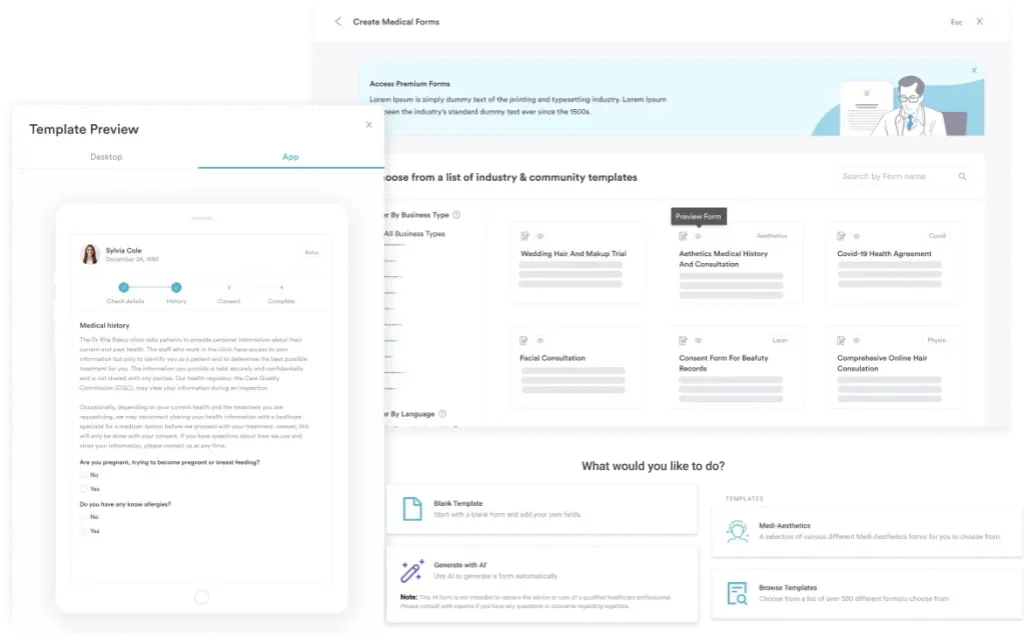
Complete the note before the claim is submitted. If a note is corrected later, date and initial the amendment so the record stays clear.
A K5283 claim is usually queried over its paperwork rather than the operation. Check for these errors before a claim leaves the practice:
A K5283 episode involves an operative note, a pre-authorisation number, at least two codes and follow-up with the insurer. When those sit in separate systems, one missing detail can delay payment.
Pabau, the practice management platform we build for private practices, keeps the patient record, clinical forms and invoices together. Its tools for faster claims management help UK private practices submit and track claims, so your team can see where each K5283 claim stands.
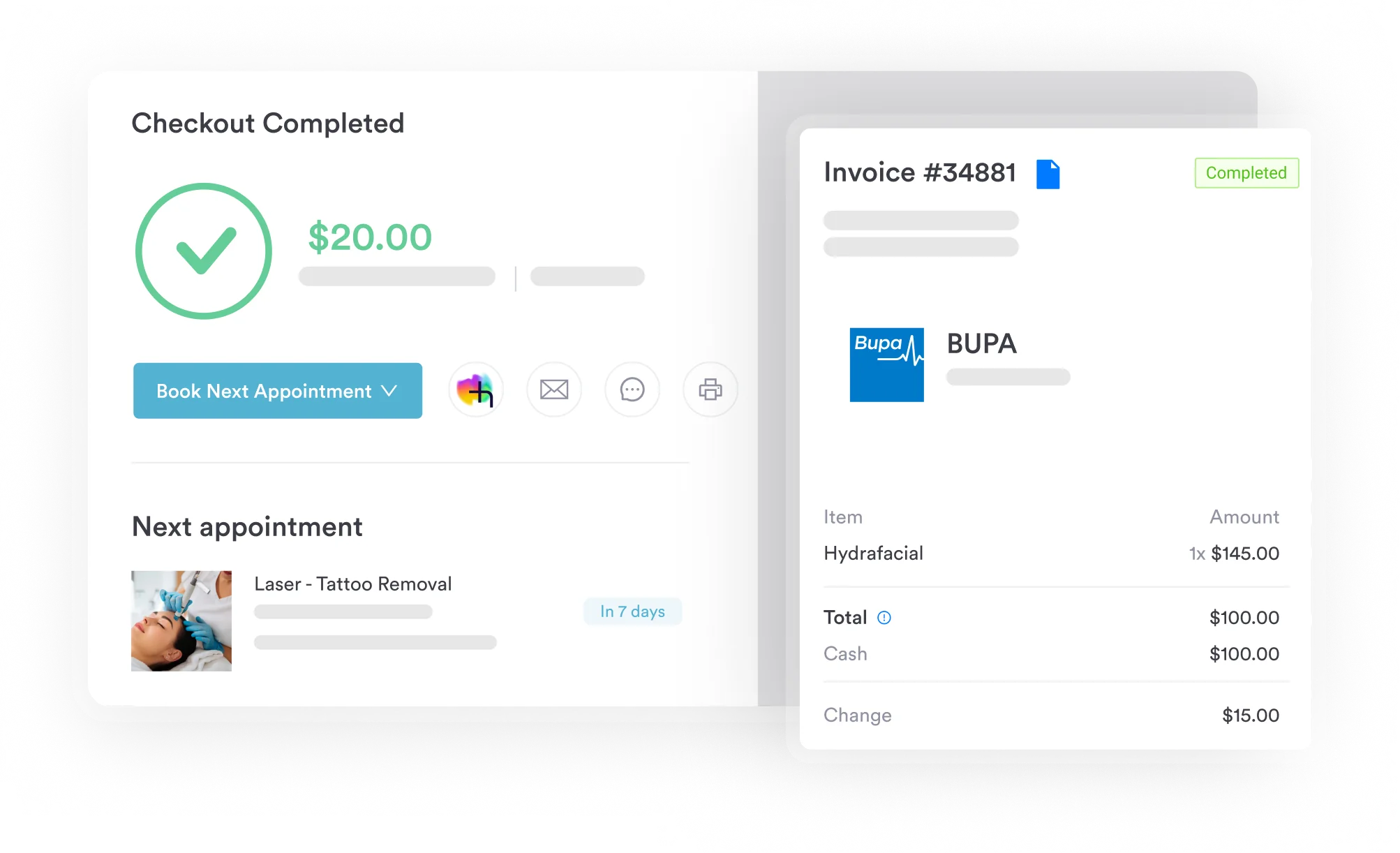
Structured forms capture the lesion set and energy source when the note is written. The claim then goes out with the detail an insurer checks first. If you’re still weighing up systems, our guide to the best UK billing software compares seven platforms.

Pabau’s claims management software helps UK private practices submit and track claims, with clinical forms and patient records in the same system.

Treat the operative note as the deciding document for K5283. If it lists a complete Cox lesion set, the code fits, whatever energy source the surgeon used. If it records a smaller set, raise the query before submission rather than after a rejection.
The fee needs the same care. Confirm the band and payable amount with each insurer at pre-authorisation, so the patient hears about any shortfall before admission. Book a demo to see how Pabau keeps the note, the authorisation number and the claim together for your cardiac practice.

Need guidance on Bupa’s CCSD coding requirements? Bupa CCSD codes guide covers how Bupa structures its private healthcare schedule and what coders need to know.
Want to reduce claim rejections across your private practice? Claims management software from Pabau helps UK private practices submit and track claims.
Choosing billing software for a UK private practice? Best medical billing software in the UK compares seven platforms on insurer claims, pricing and setup.
CCSD code K5283 is the UK private healthcare procedure code for a complex Cox lesion set maze operation. It is used to bill surgical treatment of atrial fibrillation that creates the full Cox pattern of lesions in the atria.
The K5283 descriptor names the lesion set, not the energy source. A complete Cox lesion set fits its wording whichever energy the surgeon used, but the operative note should still state the source.
No. K5283 sits in the cardiac surgery section of the CCSD schedule. Catheter ablation is billed under cardiology codes, such as K5760 for pulmonary vein isolation or K5761 for pulsed field ablation.
No. The CCSD website lists no code K5282. Pabau’s compilation of Bupa’s February 2026 schedule shows only K5280 and K5283 in the K52 range. A surgical maze with a complete Cox lesion set is billed under K5283.
A combined episode carries both codes, because the other operation has its own CCSD code. Check the CCSD coding principles and the insurer’s multiple-procedure rules before you submit the claim.
Bupa, AXA Health, Aviva and Vitality generally expect elective surgery to be pre-authorised before admission. Requirements vary by insurer, so confirm with each one and record the authorisation number before the operation.