HCPCS code P9058: Red blood cells, leukocytes reduced, CMV-negative, irradiated
HCPCS code P9058: Official descriptor and key attributes HCPCS code P9058 report...

Last Updated: Oct 26, 2026
K2612 is the CCSD code for aortic valve replacement using a homograft or stentless porcine valve. A homograft is donor human tissue, and a stentless porcine valve is pig tissue with no metal frame. CCSD lists K2600, K2601 and K2610 as unacceptable combinations, so never bill them alongside K2612.
Let Pabau's smart automation suggest the right codes, reduce claim denials, and keep your practice compliant—effortlessly.
Automate repetitive tasks and focus on what matters most—your patients.
Reduce coding errors and ensure compliance with the latest regulations.
Clean claims, fewer denials, and faster reimbursements.
Powerful insights and reporting to help your practice thrive.
HIPAA compliant SOC 2 certified GDPR-compliant Trusted by 4,000+ clinics worldwide

K2612 is the CCSD code for replacement of the aortic valve with a homograft or stentless porcine valve. It sits beside other aortic valve codes in the K26 block.
CCSD lists K2600, K2601, K2602, K2610, K2613 and K3500 as unacceptable combinations with K2612, so they never go on the same claim.
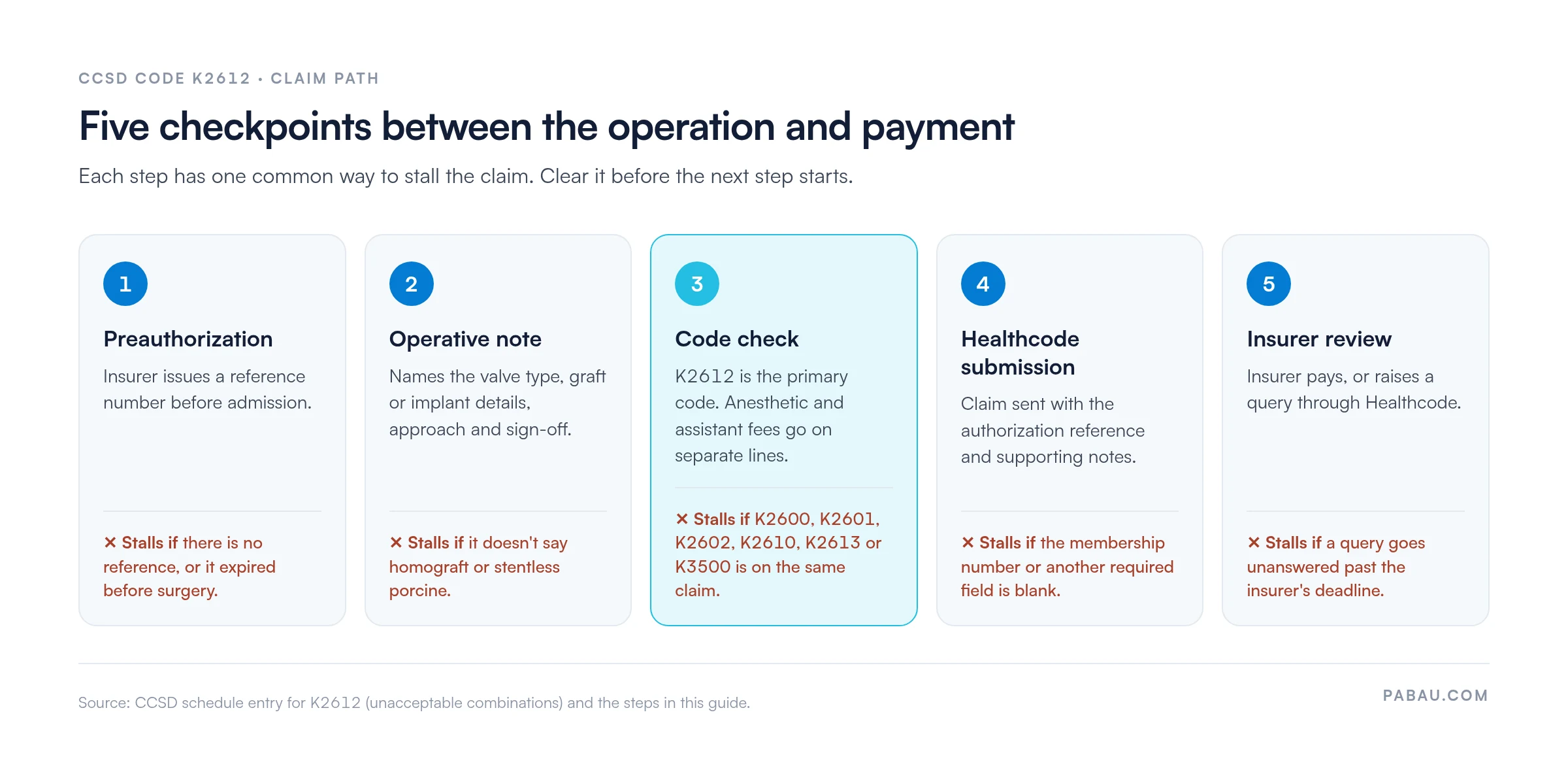
Get preauthorization before admission and put the reference number on the claim.
The operative note should name the valve type and the graft or implant details, so the insurer can match the operation to K2612.
Pabau, the practice management platform we build, sends CCSD-coded claims to Healthcode from the patient record.
CCSD code K2612 is the UK private billing code for replacement of the aortic valve with a homograft or stentless porcine valve. A homograft is a donated human valve. A stentless porcine valve is a pig valve with no rigid frame.
CCSD, the Clinical Coding and Schedule Development group, publishes the CCSD schedule that Bupa, AXA Health, Aviva and Vitality use for billing.
Getting the code right decides whether the surgeon’s fee goes through first time. If a neighboring K26 code goes on the claim instead, expect a query or a rejection. Below, you’ll see what the code includes, how it differs from its neighbors, and how the claim moves to payment.
Every code in the K26 block is an aortic valve procedure, from K2600 to K2613 where published. K2612 is the one to use when the new valve is a homograft or stentless porcine. Descriptors get revised, so check the live entry on the schedule when you code.
Bupa, AXA Health, Aviva, Vitality and WPA all recognize K2612 as a billable surgical procedure. For the wider picture, our guide to Bupa CCSD procedure codes covers how Bupa structures its schedule.
Our CCSD codes library lists every other code we cover.
The K2612 fee pays for the valve replacement itself. Other services on the same admission go on separate lines, often from a different biller.
Typically included in K2612:
Typically billed separately:
One rule matters more than the rest. CCSD lists K2600, K2601, K2602, K2610, K2613 and K3500 as unacceptable combinations with K2612. None of them can be billed with it. Companion lines are only for anesthetic, assistant and other codes that don’t conflict.
Before you add a companion line, check it against the CCSD unacceptable-combination list for K2612 and the insurer’s own unbundling rules. Insurers can decide which combinations they accept, so a line one insurer pays may be queried by another.
All the K26 codes describe aortic valve surgery, so the valve and the technique decide which one applies. Mitral valve work sits elsewhere in the schedule, under codes such as K2540, K2542 and K2560.
The table uses the descriptors as published on the CCSD schedule.
K2611 doesn’t appear on ccsd.org.uk, so it’s left out. K2602 is also on the unacceptable-combination list, so check its live descriptor before you use it.
Quick example: a surgeon replaces a stenotic aortic valve with a stentless porcine valve. That’s K2612. Had the surgeon implanted a sutureless valve, K2601 would apply instead. The two never appear on one claim.
Insurers check the operative note against the code. For K2612, that means the note must show which valve went in. These are the elements to confirm before the claim goes out:
Billing teams should check the note against this list first. If an element is missing, send the note back to the surgeon before the claim goes out.
UK private medical insurers expect preauthorization before planned cardiac valve surgery. Without it, the surgical claim is likely to be declined, whatever the clinical need. The process and the information required vary between Bupa, AXA Health, Aviva, Vitality and WPA.
The request needs a diagnosis as well as the procedure code. Nonrheumatic aortic stenosis is coded I35.0, and nonrheumatic aortic regurgitation is I35.1.
The table shows the general sequence. Confirm current requirements with each insurer before admission.
Processing times differ by insurer, and emergency admissions follow a separate route. Check each insurer’s own guidance, such as Aviva’s fee schedule and provider guidelines, before you book the surgery date.
K2612 claims go to the insurer electronically through Healthcode, the clearinghouse most UK independent hospitals and consultant billing teams use. Here’s the standard post-operative walkthrough.
Each step has one common way to stall the claim, and the flow below shows all five.
Still choosing a billing system? Our comparison of UK medical billing software sets out the options for consultant practices.
Run through these five checks before every K2612 claim. They take a couple of minutes and catch the usual causes of a rejection.
K2612 denials follow a few familiar patterns. Fixing them before submission is quicker than appealing afterward.
All major UK insurers recognize K2612, but their processes differ. The table reflects general published provider guidance. Check with each insurer before submission, because policies change.
Recognition is separate from preauthorization. Even a correctly coded K2612 claim is declined if the insurer doesn’t recognize the operating surgeon, so confirm it before any planned admission.
Billing a valve replacement often means juggling an authorization letter, an operative note and a Healthcode submission across separate systems. When one piece goes missing, the claim stalls.
Pabau keeps those pieces on one patient record. Its claims management software sends CCSD-coded claims to Healthcode straight from that record. Before a claim goes out, it checks that required fields, such as the membership number and authorization code, are complete.
Your billing team then follows claim status in one place, so a query gets answered before it lapses.

Pabau sends CCSD-coded claims to Healthcode from the patient record and checks required fields before submission. Your billing team sees every claim’s status in one place.

K2612 rewards precision. Its descriptor names two valve types, and the operative note has to name one of them. When it does, the code is straightforward. When it doesn’t, the insurer has good reason to query it.
So do the checking in the days before surgery, not after the claim comes back. Confirm the authorization, match the valve to the descriptor, and keep the K26 neighbors off the claim. A few minutes there saves a resubmission later.
Book a demo to see how Pabau sends CCSD-coded claims to Healthcode with the authorization details already in place.

Working with Bupa fees for cardiac surgery? Bupa procedure codes fee schedule explains how Bupa structures fees across CCSD code categories.
Need the wider Bupa schedule? Bupa CCSD codes reference covers the procedure codes Bupa recognizes, with notes on submission.
Coding other aortic surgery? CCSD code L2360 covers repair of an interrupted aortic arch.
Billing another open-heart operation? CCSD code K2310 covers excision of a cardiac tumor.
A homograft is an aortic valve taken from a human donor and preserved for implant. Surgeons often choose one when infection has damaged the aortic root. K2612 covers implanting it in the aortic position.
It’s a pig aortic valve with no rigid frame, sewn directly into the patient’s aortic root. Without a frame, it leaves more room for blood flow than a framed valve of the same size.
Not K2612, which covers homograft and stentless porcine valves only. Look at K2600, the CCSD code for replacement or repair of the aortic valve, and confirm it on the live schedule.
CCSD added K2612 on January 20, 2010. Descriptors can be revised after a code is added, so check the live entry when you code.
The consultant surgeon bills K2612 for the operation. The anesthetist claims their own fee, and the hospital usually bills the valve or graft and the stay. Each sends a separate claim.