HCPCS code G0257: Unscheduled or emergency dialysis billing guide
HCPCS code G0257: Official descriptor and code overview HCPCS code G0257 is defi...

Last Updated: Oct 27, 2026
H3400 is the CCSD code for open excision of lesion of rectum and colon. It covers removing a discrete lesion, such as a polyp or tumor, from the rectum or colon through an open incision.
H3400 sits in CCSD sub-chapter 11.6.0 Rectum/Anus. Transanal, perianal and endoscopic removal have their own codes. UK private medical insurers such as Bupa, AXA Health, Aviva and Vitality use CCSD codes.
Let Pabau's smart automation suggest the right codes, reduce claim denials, and keep your practice compliant—effortlessly.
Automate repetitive tasks and focus on what matters most—your patients.
Reduce coding errors and ensure compliance with the latest regulations.
Clean claims, fewer denials, and faster reimbursements.
Powerful insights and reporting to help your practice thrive.
HIPAA compliant SOC 2 certified GDPR-compliant Trusted by 4,000+ clinics worldwide

CCSD code H3400 covers open excision of a lesion of the rectum and colon. UK private medical insurers such as Bupa and AXA Health use it.
H3400 sits in CCSD sub-chapter 11.6.0 Rectum/Anus, and its descriptor was widened from the rectum alone to the rectum and colon.
Transanal, perianal and endoscopic removal have their own codes, such as H4000, H4130 and H2003, so H3400 is for open surgery.
CCSD’s coding principles for H3400 cover the colectomy, rectal resection and rectal biopsy codes, so check them before claiming any of those alongside it.
Pabau, the practice management platform we build, creates insurer claims from the patient record, sends them through Healthcode and tracks each one.
CCSD code H3400 is the procedure code for open excision of a lesion of the rectum and colon. It covers removing a discrete lesion, such as a polyp or tumor, through an open incision rather than through an endoscope. Like the other CCSD codes UK insurers use, it sits in a numbered sub-chapter, here 11.6.0 Rectum/Anus.
The code comes from the Clinical Coding & Schedule Development (CCSD) group, which maintains the schedule UK private insurers use. Bupa, AXA Health, Aviva and Vitality all accept CCSD codes. Its descriptor was later widened from “Open excision of lesion of rectum” to the current wording.
Open excision of a rectal or colon lesion removes a discrete growth from the large bowel through an open incision. The surgeon gets direct access to the lesion and the tissue around it. The operation takes place under general anesthesia in an operating room.
Surgeons choose the open approach when a lesion is too large or awkwardly placed for endoscopic removal. It is also used when an endoscopic attempt has failed. Colorectal surgeons and general surgeons with colorectal experience perform it.
For coding, the approach is the deciding fact. H3400 describes an open operation. Transanal, perianal and endoscopic removal each have their own CCSD codes, covered below. If the operative note records one of those approaches, H3400 is the wrong code.
The ICD-10 diagnosis code on an H3400 claim must match the lesion removed. Pairing the wrong diagnosis, such as a benign polyp code for an excised cancer, is a common reason insurers query colorectal claims.
Confirm the ICD-10 sub-site with the operating surgeon before submission. Insurers check the diagnosis against the procedure, so even a sub-site error within C18.x can hold the claim for review.
Choosing between H3400 and the codes around it comes down to two questions. Did the surgeon remove only the lesion or a section of bowel, and how did they reach it? The diagram takes them in that order, and the table after it lists each code’s descriptor.
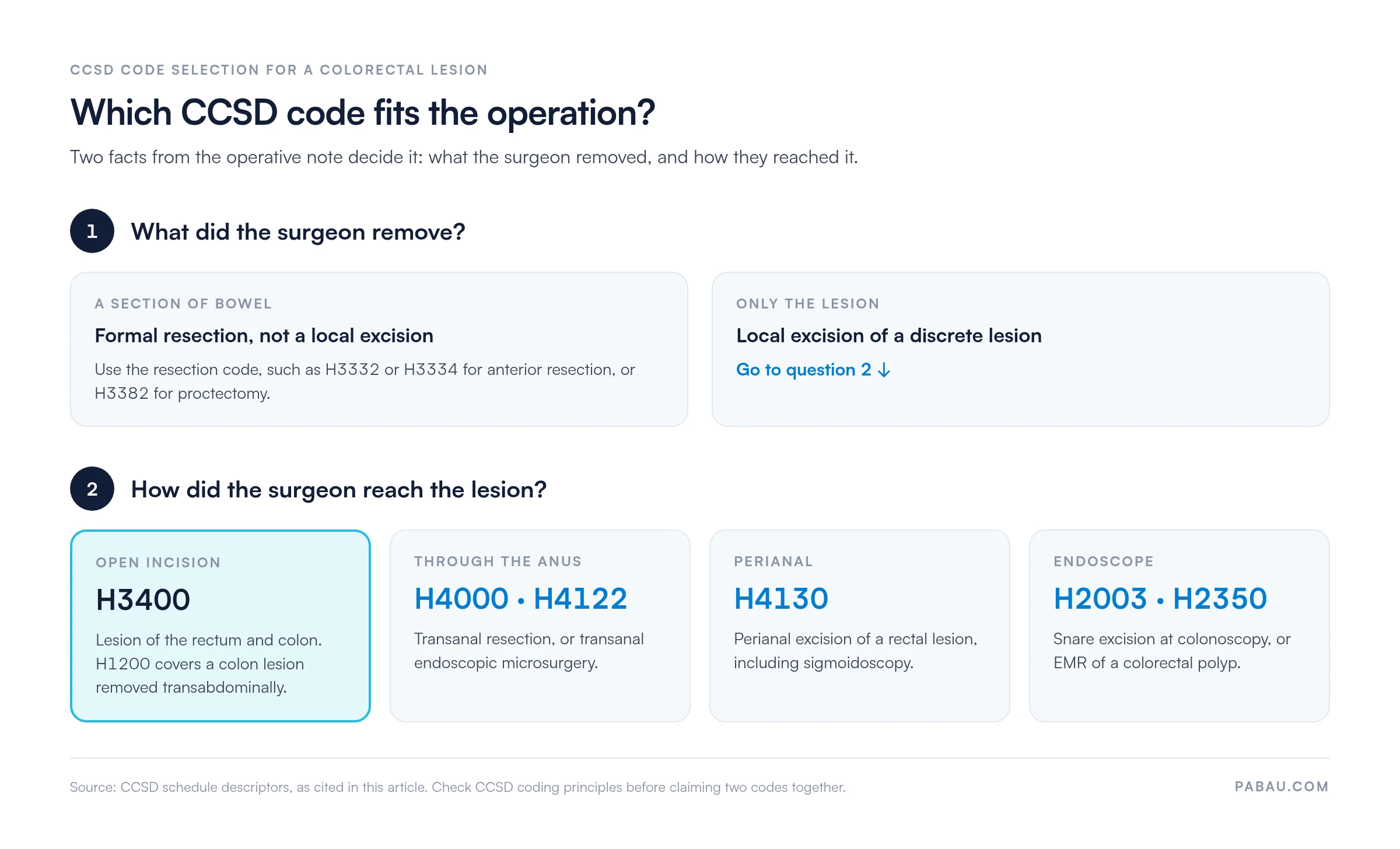
CCSD links H3400, through its coding principles, to H1200, H4000, H4130, H4180 and the colectomy and rectal resection codes. Check those principles in the current CCSD technical guide before you claim any of them with H3400.
UK private medical insurers generally expect the patient to get pre-authorization before planned surgery such as H3400. The authorization number goes on the claim, and it should name the procedure the surgeon performed.
Requirements vary by insurer and by policy, so confirm them before the operation date. If the plan changes, for example from an endoscopic to an open approach, tell the insurer before you claim. An authorization issued for one code does not automatically cover another.
Complete documentation decides whether an H3400 claim is paid or queried. Insurers can ask for clinical records, and thin operative notes are a frequent reason for colorectal claim queries.
Run a checklist before submitting any H3400 claim. Confirm the note says open and records the lesion site and size. Then check histology was sent, the authorization number is on the claim and the ICD-10 code matches the histology.
Submitting CCSD code H3400 correctly means gathering the codes, documents and authorization reference before the claim goes to the insurer. Each check below takes minutes and saves a query later.
Insurers query H3400 claims for a handful of recurring reasons, and practice managers can fix most of them before submission. The table pairs each reason with the step that prevents it.
Each insurer sets its own fee for H3400, and CCSD does not set reimbursement. Check the insurer’s fee schedule, such as the Healix fee schedule, before you quote the patient.
H3400 covers the open excision of a discrete lesion from the rectum or colon. Several similar operations fall outside it and take their own codes.
When you review a colorectal claim, read the operative note for one word: Open, transanal or colonoscopic. The approach in the note must match the CCSD code. Resolve any mismatch before submission, not after a query.
Surgical practices billing H3400 tend to lose time in the same places. Authorization numbers sit in emails, invoices get typed twice and queried claims go unchased.
In Pabau’s billing software, the patient, the insurer details and the invoice sit on one record. Its claims management software builds the claim from those details and sends it through Healthcode. Your team then tracks every claim’s status in one place.
Pabau does not choose the CCSD or ICD-10 codes, so the coding decision stays with the coder. The outcome is fewer claims lost in a spreadsheet and a clear view of which insurer still owes a response.

Pabau builds each claim from the patient, insurer and invoice details already on file. It sends the claim through Healthcode and tracks it until it is settled.

H3400 is a narrow code: Open excision of a lesion of the rectum and colon. Endoscopic, transanal and perianal removal each have their own CCSD code, and so does a formal resection. The operative note is what proves which one applies.
Code from the note, authorize the exact procedure and match the ICD-10 code to the histology. Those three habits remove the most common reasons for an insurer query. To see how Pabau keeps CCSD claims moving through Healthcode, book a demo.

Need a broader view of CCSD procedure codes? Bupa CCSD codes explains how the CCSD schedule is structured and how UK insurers apply it.
Removing a colon lesion through the abdomen? CCSD code H1200 covers transabdominal excision of a colon lesion and how it differs from snare removal.
Removing a rectal lesion without an abdominal incision? CCSD code H4130 covers perianal excision of a rectal lesion, including the sigmoidoscopy.
Want fewer insurer queries on surgical claims? Claims management software shows how Pabau submits and tracks claims through Healthcode.
Removing a section of colon instead? CCSD code H0700 covers right hemicolectomy, one of the formal resections that falls outside H3400.
CCSD code H3400 covers open excision of a lesion of the rectum and colon. The surgeon removes a discrete lesion, such as a polyp or tumor, through an open incision. Endoscopic, transanal and perianal removal use other CCSD codes.
H3400 covers open excision of a lesion of the rectum and colon, in sub-chapter 11.6.0 Rectum/Anus. H1200 covers transabdominal excision of a colon lesion only, in sub-chapter 11.5.0 Large Intestine. CCSD links the two through its coding principles, so check them before claiming both.
UK private medical insurers generally expect pre-authorization before planned surgery such as H3400. Requirements vary by insurer and policy, so confirm them with the patient’s insurer before the operation date. Put the authorization number on the claim.
Billing H3400 needs operative notes that record the open approach, the lesion’s site and size and the excision margins. Add the histopathology report, the matching ICD-10 code and the pre-authorization number.
CCSD’s coding principles for H3400 cover H1200, H4000, H4130, H4180 and the colectomy and rectal resection codes. Check the current CCSD schedule before you claim any of them with H3400 for one operation.
Not for the same lesion in the same episode. A lesion removed at colonoscopy is coded H2003, while open removal is H3400. If a diagnostic colonoscopy came first, in a separate episode, each procedure is claimed on its own with its documentation.