HCPCS Code A4627: Spacer and valved holding chamber
HCPCS Code A4627: official descriptor and code definition HCPCS Code A4627 is th...

Last Updated: Oct 21, 2026
H0510 is the CCSD code for total excision of colon and ileorectal anastomosis. It covers removal of the whole colon, from the caecum to the rectosigmoid junction, with the terminal ileum joined to the preserved rectum.
The code sits in chapter 11 of the CCSD schedule, under section 11.5.0 Large Intestine. The ileorectal anastomosis is part of the code, so it is never billed separately, and insurers expect the operative note to confirm rectal preservation.
Let Pabau's smart automation suggest the right codes, reduce claim denials, and keep your practice compliant—effortlessly.
Automate repetitive tasks and focus on what matters most—your patients.
Reduce coding errors and ensure compliance with the latest regulations.
Clean claims, fewer denials, and faster reimbursements.
Powerful insights and reporting to help your practice thrive.
HIPAA compliant SOC 2 certified GDPR-compliant Trusted by 4,000+ clinics worldwide

CCSD Code H0510 covers total excision of the entire colon with ileorectal anastomosis and a preserved rectum, so it is not a proctocolectomy code.
The ileorectal anastomosis is integral to H0510 and must not be coded separately, because unbundling it is a common denial trigger.
All major UK private insurers require pre-authorisation for H0510, and the operative note must confirm full colon excision and rectal preservation.
Pabau, the practice management platform we build, helps surgical teams manage CCSD claims and keep operative documentation together.
The Clinical Coding and Schedule Development (CCSD) Group defines CCSD Code H0510 as “Total excision of colon and ileorectal anastomosis.” The code sits within the CCSD H-series, which covers intestinal surgical procedures.
Two anatomical facts define its scope. First, the surgeon removes the entire colon. Second, the surgeon preserves the rectum, so the terminal ileum joins directly to the upper rectum via an IRA.
H0510 belongs to the broader H-series alongside segmental colectomy codes such as H1000, plus panproctocolectomy and restorative proctocolectomy codes. Rectal preservation is the distinction that separates it from those neighbours. If the surgeon also resects the rectum, a different code applies. As a result, billers working from an operative report that does not explicitly confirm rectal preservation often reach for the wrong code.
H0510 sits in chapter 11 of the schedule, under section 11.5.0 Large Intestine, and our library of CCSD codes lists its neighbours. The Bupa CCSD codes guide explains how Bupa applies the schedule. The CCSD Group does not set fees, so reimbursement is agreed between the operating surgeon and each insurer.
Total excision of the colon means removing the large bowel from the caecum (including the appendix) through to the rectosigmoid junction, leaving the rectum intact. The surgeon then joins the cut end of the terminal ileum to the top of the preserved rectum. This ileorectal anastomosis restores bowel continuity without an external stoma in most cases.
CCSD H0510 covers both open and laparoscopic total colectomy with IRA. The CCSD schedule does not, as a rule, assign separate codes for surgical approach the way US payer systems use modifiers. Therefore, you bill laparoscopic total colectomy with IRA under H0510 whatever the approach.
However, the surgeon must still document the approach in the operative report. Several private insurers, including Bupa, audit operative notes and expect the surgeon to state the approach explicitly, even when the code itself does not change.
Likewise, robotic-assisted total colectomy with IRA follows the same rule. The robot is an instrument, not a separate procedural category under the current CCSD schedule. Surgeons should document the robotic system and the setup time where the insurer’s audit guidelines ask for it, but the claim code stays H0510.
Surgeons reserve H0510 for cases where the entire colon must come out but the rectum works well enough to accept an anastomosis safely. Five conditions account for most H0510 claims in UK private practice.
UK private insurers process CCSD procedure codes alongside ICD-10 diagnosis codes. The paired diagnosis must clinically support the procedure, or the insurer will query the claim. The table below lists the most commonly used ICD-10 codes across the primary H0510 indications.
These codes reflect the current ICD-10 tabular list used in the UK, but they are not exhaustive. For example, a patient may have co-existing conditions that influenced the surgical decision, such as high-grade dysplasia confirmed on pre-operative colonoscopy alongside UC. In that case, include both ICD-10 codes on the claim to give the insurer a complete clinical picture.
Document the precise ICD-10 code on the pre-authorisation request and mirror it exactly on the claim form. Insurers flag mismatches between the diagnosis submitted at pre-auth and the diagnosis on the invoice as a routine audit trigger for H0510.
The H-series contains several codes that describe variations of large-bowel excision. Selecting the wrong code is a frequent billing error on total colectomy claims. The decision hinges on two questions: was the entire colon removed, and was the rectum preserved?
Billers often confuse H0510 with a proctocolectomy code when the operative note is ambiguous about how much rectum remains. If the surgeon excises the rectum along with the colon, a proctocolectomy code such as H0410 applies. However, if the surgeon preserves the upper rectum and joins it to the ileum, H0510 applies.
Meanwhile, an abdominal revision of an existing restorative proctocolectomy is a separate procedure again, which you bill under H0480. Overall, the operative report’s description of the distal resection margin and anastomotic level decides the code. The path below shows how each answer maps to one.
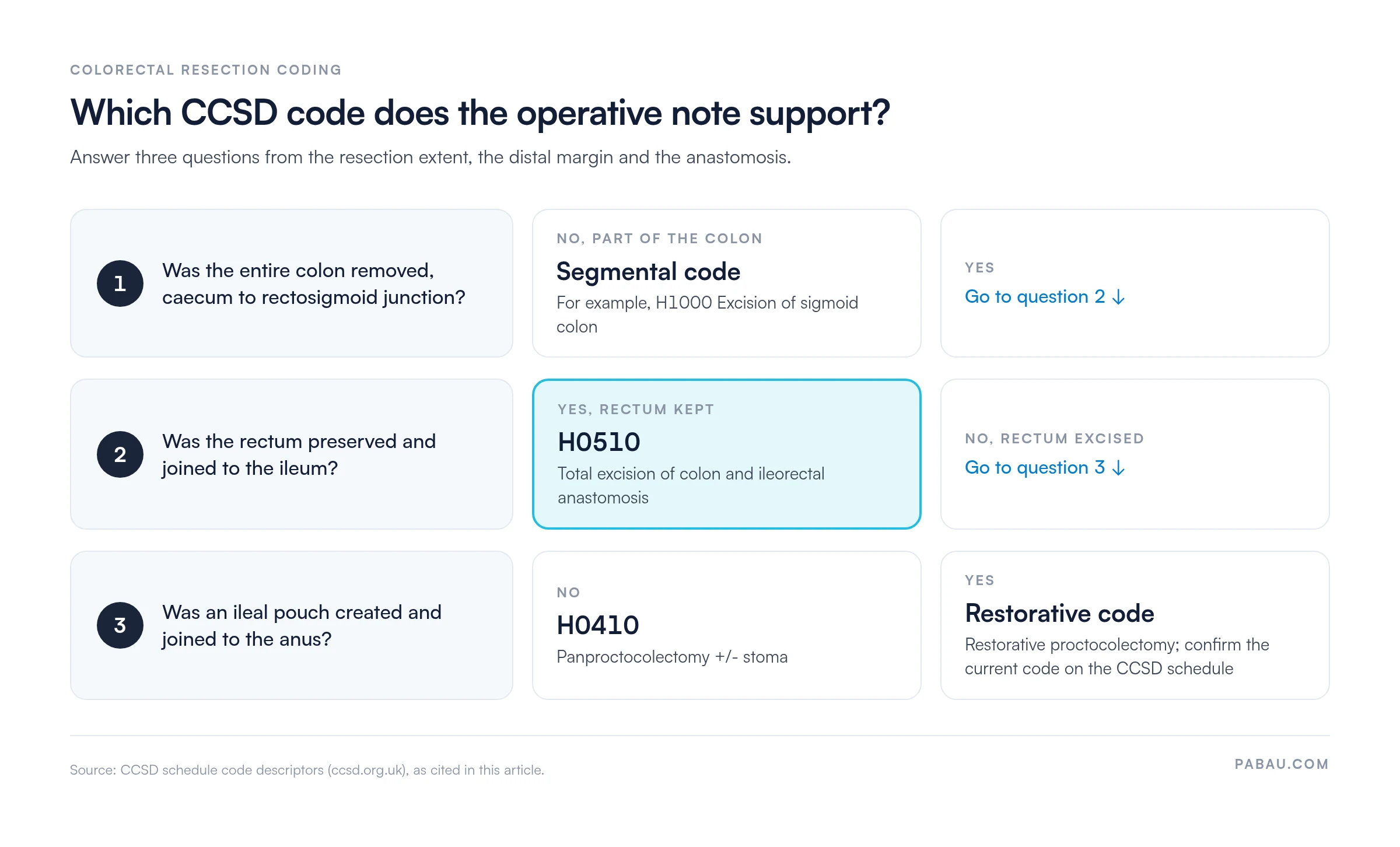
An incomplete operative note is a common reason insurers query or deny an H0510 claim. UK private insurers audit operative records for large colorectal procedures. They request the note if the procedure looks clinically complex or the claim value is high.
To withstand audit, the note must confirm all of the following when you bill CCSD Code H0510.
Surgical teams should build a post-operative documentation checklist that maps directly to these audit criteria. Otherwise, if the first check happens when the insurer asks for the note, your team must chase any missing detail while payment waits.
Every major UK private health insurer treats total colectomy as a major elective inpatient procedure requiring pre-authorisation before surgery. This applies to Bupa, AXA Health, Aviva, Vitality Health, and WPA. Outside an emergency, insurers decline the claim for surgery without pre-authorisation, however well the team codes and documents it.
Insurers usually ask for the following as part of the pre-authorisation submission.
In contrast, for emergency total colectomy, such as acute severe UC failing medical therapy, most insurers allow retrospective notification within 24 to 48 hours of admission. However, the exact window and process vary by policy. Surgeons and practice managers should document the emergency decision-making in the notes and notify the insurer at the earliest opportunity.
Insurers deny H0510 claims for a predictable set of reasons. Fortunately, routine checks before you submit prevent most of them. The table below maps the most common denial triggers to their resolution.
H0510 includes the ileorectal anastomosis, so never bill it as a separate procedure. This is a standard CCSD bundling rule, because the named anastomosis in a procedure descriptor is integral to the code. Thus, coding it separately is improper unbundling and a claim denial trigger across UK private insurers.
However, you may bill some concurrent procedures alongside H0510 when they represent distinct surgical decisions that the surgeon documents separately in the operative note.
Anaesthetists, assistant surgeons, and hospitals invoice their fees and facility charges apart from the operating surgeon’s CCSD claim. H0510 bundling rules do not affect them. Still, billing teams should confirm each insurer’s unbundling guidance, because individual payer policies can differ from the general CCSD rule. The Healix fee schedule publishes explicit bundling guidelines that serve as a useful reference point.
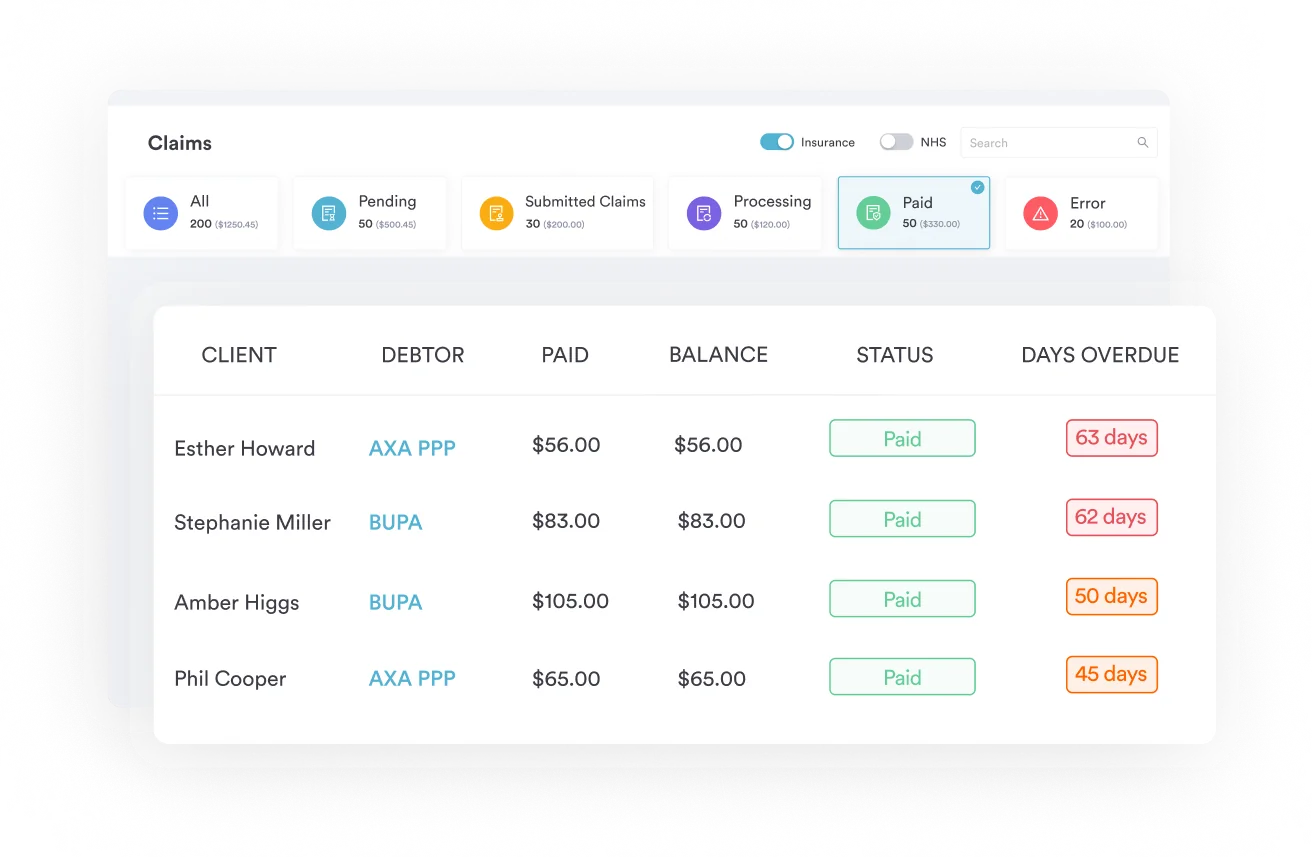
Check the Healix unbundling guidelines before billing any concurrent procedure alongside H0510. Healix publishes its bundling rules publicly. They broadly align with how Bupa and AXA Health assess claims, which makes them a practical reference for pre-submission review.
CCSD does not publish fixed reimbursement amounts in its public documentation. The schedule defines the code and its descriptor, and each private insurer sets the fee with the consultant through recognition agreements. Reimbursement rates for H0510 therefore vary by insurer, by consultant recognition tier, and by any fixed-fee or block contract in place.
As a major inpatient colorectal procedure, H0510 sits at the higher end of the CCSD fee spectrum. UK private insurers usually apply benefit levels based on the procedure’s complexity grade within their schedule.
Surgeons should check their current recognition letter and the insurer’s fee finder before quoting patients. Our guide to the Bupa fee schedule explains how those benefit levels work.
Consultant fees and hospital facility charges are separate invoice streams. The consultant bills for the surgical procedure, while the hospital bills for the facility, theatre time, consumables, and nursing care. A surgical practice, especially one newly moved from the NHS into private work, should set clear invoicing protocols so claims reconcile without double-billing.
Many surgical teams follow an H0510 case across separate places. The referral letter sits in one folder, the operative note in another, and the claim in an insurer portal. When Bupa or AXA Health queries the claim, someone rebuilds the file by hand.
Pabau keeps the patient record, clinical notes, letters and invoices in one place. Its claims management software sends insurer claims through Healthcode and tracks each one from submission to payment.
As a result, your team can defend a claim in minutes. When an insurer asks for the operative note, it is already on the patient record next to the invoice it supports.

Pabau helps private surgical teams manage claims and keep documentation together, so CCSD claims go out clean without manual chasing. See how it works for colorectal and general surgical practices.

An H0510 claim stands or falls on two facts in the operative note. The whole colon came out, and the rectum stayed and was joined to the ileum. Code from the distal margin the surgeon recorded, not from the procedure name on the theatre list.
If the rectum was excised too, switch to a proctocolectomy code before the claim leaves. In addition, on every elective case, confirm pre-authorisation and carry its diagnosis code onto the invoice unchanged.
The trade-off is a few extra minutes per operative note, spent up front. Those minutes replace the insurer queries that hold payment back later. Book a demo to see how Pabau keeps operative notes, letters and CCSD claims together for colorectal practices.

Need a full CCSD code reference for Bupa claims? Bupa CCSD codes and billing guide covers the full CCSD procedure code schedule used by Bupa-recognised providers.
Billing across multiple private insurers? Bupa procedure codes fee schedule explains how Bupa’s fee structure works and how recognised consultants apply benefit levels.
Billing a segmental resection instead? CCSD Code H1000: Excision of sigmoid colon covers the code for removing the sigmoid colon alone.
Revising an existing ileal pouch? CCSD Code H0480: Abdominal revision of restorative proctocolectomy explains how pouch revision surgery is coded.
Coding the diagnostic work-up? CCSD Code H2002: Diagnostic colonoscopy covers the colonoscopy that often precedes a total colectomy referral.
CCSD Code H0510 is the UK private healthcare procedure code for total excision of the colon with ileorectal anastomosis. The surgeon removes the large bowel from the caecum to the rectosigmoid junction, preserves the rectum, and joins the terminal ileum to it. Colorectal surgeons use it when billing UK private insurers such as Bupa, AXA Health, Aviva and Vitality Health.
H0510 preserves the rectum and creates an ileorectal anastomosis, while proctocolectomy codes such as H0410 remove both the colon and the rectum. The deciding test is whether rectal tissue remains after surgery. If the rectum is excised, a proctocolectomy or restorative proctocolectomy code applies instead of H0510.
The ileorectal anastomosis is included within H0510 and must not be coded separately. Billing a separate anastomosis code alongside H0510 is improper unbundling and a common reason for claim denial across UK private insurers.
No. CCSD H0510 covers both open and laparoscopic total colectomy with ileorectal anastomosis. The surgical approach does not change the code. The operative note must still document the approach clearly, as insurers audit this detail even when it does not affect code selection.