CPT Code 62284: Injection procedure for myelography
CPT Code 62284: official descriptor and procedure overview The American Medical ...

Last Updated: Oct 19, 2026
E2320 is the CCSD code for open operation(s) on pharyngeal pouch. It covers surgical repair of a pharyngeal pouch, usually a Zenker diverticulum, through a neck incision. That includes diverticulectomy, diverticulopexy or both, and a cricopharyngeal myotomy at the same sitting is generally bundled in.
The surgical approach decides the code. Transoral and endoscopic repairs, such as Dohlman's procedure, are coded E2480 instead. UK private insurers expect preauthorization against E2320 before surgery.
Let Pabau's smart automation suggest the right codes, reduce claim denials, and keep your practice compliant—effortlessly.
Automate repetitive tasks and focus on what matters most—your patients.
Reduce coding errors and ensure compliance with the latest regulations.
Clean claims, fewer denials, and faster reimbursements.
Powerful insights and reporting to help your practice thrive.
HIPAA compliant SOC 2 certified GDPR-compliant Trusted by 4,000+ clinics worldwide

CCSD code E2320 covers open operations on pharyngeal pouch, performed through a neck incision rather than a transoral approach.
Endoscopic repairs, including Dohlman’s procedure, are coded E2480, so the approach recorded in the operative note decides the code.
A same-sitting cricopharyngeal myotomy is generally bundled into E2320, so record it in the operative note to head off an unbundling query.
ICD-10 K22.5 (acquired esophageal diverticulum) is the diagnosis code most often paired with E2320, so check current NHS coding guidance before submission.
All major UK private insurers require preauthorization for E2320, and a missing or expired approval is a common reason these claims are denied.
CCSD code E2320 carries the official descriptor “Open operation(s) on pharyngeal pouch.” The key word is open. The code applies when the surgeon reaches the pouch through a cervical incision, not through an endoscope or rigid diverticuloscope.
The plural “(s)” means one open sitting can include more than one surgical step, such as diverticulectomy with cricopharyngeal myotomy, under the single code.
The CCSD schedule, maintained by Clinical Coding and Schedule Development, lists E2320 in chapter 5 (ear, nose and throat), under section 5.6, Throat. It is a surgical procedure code, not a diagnostic or investigation code. Our CCSD codes overview explains how the rest of the schedule is organized.
Key facts at a glance:
A pharyngeal pouch is a mucosal herniation through Killian’s dehiscence. That is the triangular weak point between the oblique and transverse fibers of the inferior pharyngeal constrictor muscle.
The most common type is a Zenker diverticulum, a pulsion diverticulum that forms at the back of the pharyngoesophageal junction. It develops when raised pressure inside the pharynx pushes the mucosa through that weak point.
Zenker diverticula make up the large majority of pouches referred for open repair. Lateral (Killian-Jamieson) and mid-pharyngeal pouches exist as rarer variants.
Patients typically present with progressive dysphagia, regurgitation of food (often hours after eating), halitosis and weight loss. Those referred for open repair tend to be older adults with a large pouch. Others have failed endoscopic treatment, or have anatomy that rules out safe transoral access.
This presentation matters for coding. The referral letter and operative note should record a confirmed pharyngeal pouch, not a generic dysphagia code. Without that, the claim faces a medical necessity challenge.
The open operation follows a consistent sequence, and each step should be visible in a compliant operative note. Coders reviewing an E2320 record should recognize these steps.
The operative note must name the approach (open cervical), the technique (diverticulectomy, diverticulopexy or combination) and whether a myotomy was performed. It should also record any intraoperative findings. A note that only says “pharyngeal pouch repair” leaves the insurer guessing at the approach, and that ambiguity is what prompts a code query.
Knowing where E2320’s bundling boundaries sit prevents two errors. Undercoding misses legitimate separate charges, while overcoding claims procedures already built into the primary code.
Myotomy is the element insurers query most on E2320 claims. Because the descriptor reads “operation(s),” most UK private insurers treat a same-sitting myotomy as part of E2320. The position still varies by insurer, so confirm it before submission and record the myotomy explicitly in the operative note.
Pharyngeal pouch claims usually go wrong at code selection, when the operative note is vague about the approach. The table sets E2320 beside its endoscopic counterpart and its nearest numeric neighbor.
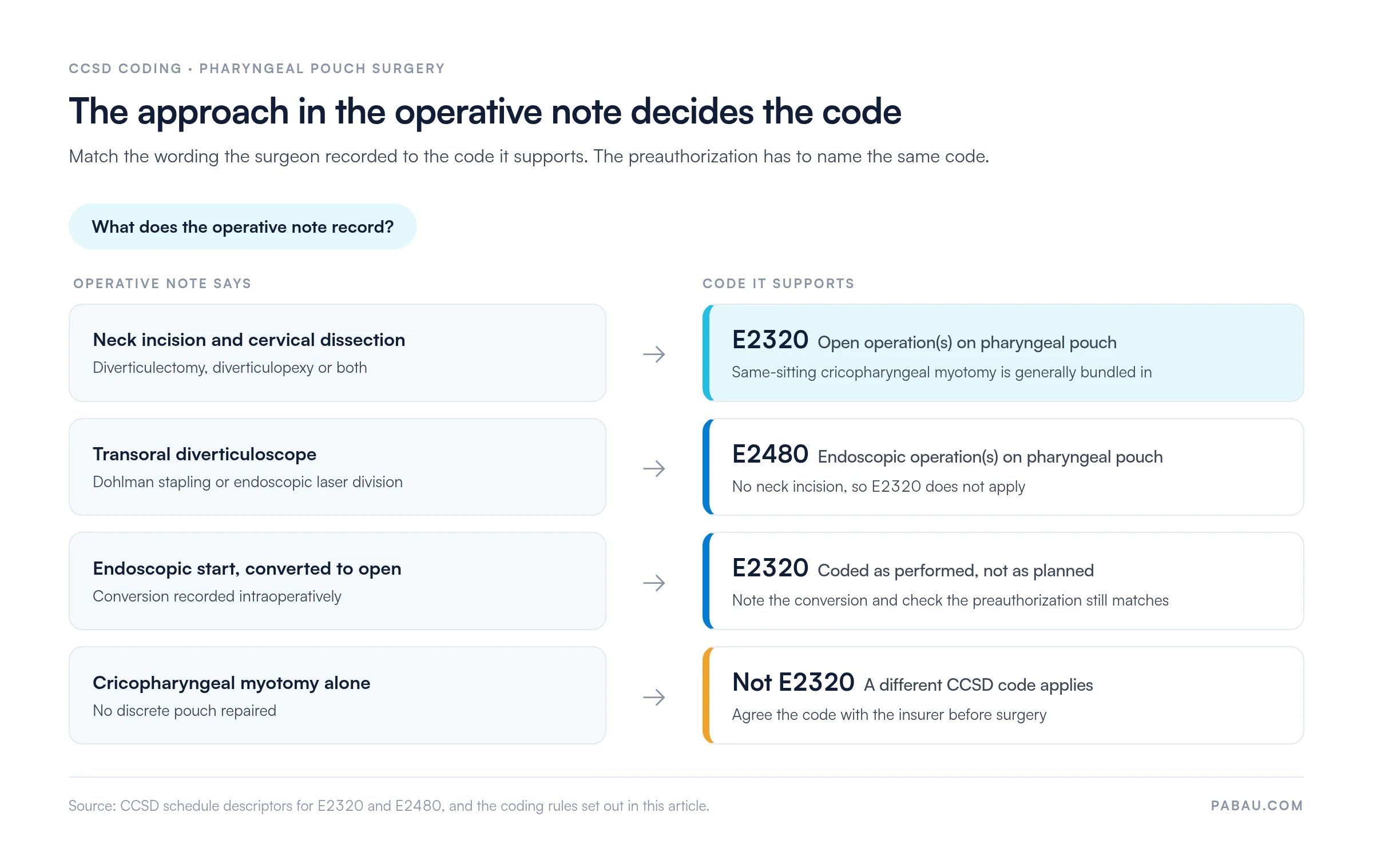
The approach recorded in the operative note decides between E2320 and E2480. A note describing a transoral diverticuloscope, Dohlman stapling or endoscopic laser division supports E2480. A note describing a neck incision and cervical dissection supports E2320.
If the surgeon converts from a planned endoscopic approach to an open one, code the procedure as performed, not as planned. Record the conversion in the claim documentation and check that the preauthorization still matches. The decision path below maps each operative-note wording to the code it supports.
Every E2320 claim needs an ICD-10 diagnosis code that supports the medical necessity of open surgery. That code should match the type of pouch documented in the clinical record and preoperative imaging.
A claim with only a symptom code, such as R13 for dysphagia, as the primary diagnosis will typically trigger a medical necessity review or denial. Reference the barium swallow or endoscopy report that confirms the pouch in both the preauthorization request and the claim.
Check ICD-10 codes against the current NHS Classifications Browser before submission, as descriptors and mapping rules change periodically.
A complete E2320 claim rests on documentation from three points in the patient journey: preoperative investigation, the operative record and the postoperative note. A missing element at any of these points can trigger an insurer audit. Billing teams new to private ENT surgery often underestimate how detailed this documentation needs to be.
Preoperative documentation must include:
The operative note must record:
Postoperative documentation should include a discharge summary confirming the procedure performed, the diagnosis and the follow-up plan. Histology results, once available, should be linked to the patient record. Structured operative note templates with required fields reduce the risk of any of these elements being left out.
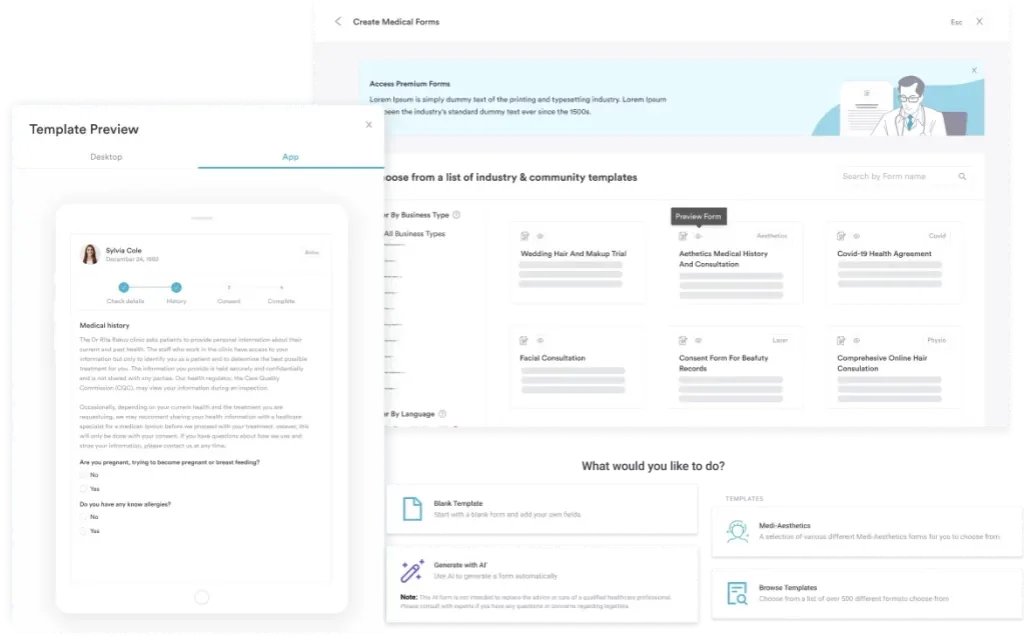
Build a standard operative note template for pharyngeal pouch repair with a mandatory field for surgical approach (open vs endoscopic). When surgeons complete that field as part of routine documentation, the approach question is settled before the claim goes out.
Every major UK private health insurer requires preauthorization before an open pharyngeal pouch repair, and the approval must name the correct CCSD code. A claim submitted under E2320 when the approval covers a different code, such as the endoscopic E2480, will be denied.
Clinical appropriateness does not change that outcome. The Bupa CCSD code guide explains how Bupa structures its procedure code approvals.
Insurers update preauthorization requirements and evidence thresholds when they revise their provider manuals, typically once a year. Treat the table as a starting point and confirm current requirements with each insurer’s provider team before booking the procedure. An approval for a different code, or for the patient’s previous episode, does not transfer to E2320.
Insurers scrutinize the same few points on E2320 claims, so denial patterns are predictable. Most denials fall into one of five categories, and each has a clear fix.
Good claims management software tracks denial reasons by code, so patterns show up across your E2320 submissions. When the same reason appears on more than two claims, look for a documentation or process fault rather than a one-off error.
Most UK private insurer denials can be appealed within 30 to 90 days of the denial date, depending on the insurer’s provider terms. A structured E2320 appeal should include:
If the first appeal fails and the clinical grounds are strong, most insurers offer a second-level independent review. Guidance from ENT UK (British Association of Otorhinolaryngology – Head and Neck Surgery) on pharyngeal pouch management can support a clinical necessity argument. It helps most when the insurer questions whether the open approach was appropriate.
Cricopharyngeal myotomy performed at the same sitting as an open pouch repair is generally bundled into E2320, not billed separately. UK private insurers read the descriptor’s plural “operation(s)” as covering the myotomy as part of the complete open procedure.
Bupa, AXA Health and Aviva, the largest-volume payers for ENT surgery, take this position consistently. Their provider manuals can still change with each schedule year, so check them before you bill.
Two scenarios justify a separate billing discussion with the insurer before surgery:
When in doubt, ask the insurer’s provider line for a written ruling on bundling before the procedure. That correspondence joins the preauthorization file and protects against an unbundling denial after submission.
Document cricopharyngeal myotomy in the operative note even when you plan to bundle it into E2320. If a payer later requests records, the explicit mention shows the open operation was complete and clinically appropriate. That supports the E2320 fee level.
The denials above share a pattern. The operative note skips the approach, the preauthorization reference never reaches the claim, or details get rekeyed between a records system and a billing tool.
Pabau, the practice management platform we build, keeps the operative note, the insurer details and the invoice on the same patient record. When you send a claim to Healthcode, Pabau pre-fills it from that record. Validation checks run first, and the Send button stays disabled until details like the membership number and authorization code are in place.
Every claim then sits in one dashboard with a live status, from pending to paid. Your billing team can see which E2320 claims have stalled and follow up while the appeal window is still open.

Pabau checks authorization codes before each claim goes to Healthcode, so your E2320 claims leave complete and your team can track them to payment.

The surgery behind E2320 is well defined, so payment problems usually start in the paperwork. Trouble begins when the operative note, the preauthorization and the claim describe different procedures.
Before your next pouch repair, add a required approach field to the operative note template. Then agree the myotomy position with each insurer in writing. Both are one-time jobs, and they protect every E2320 claim that follows.
Preauthorization is the check you repeat for every patient, because approvals do not transfer between codes or episodes. Confirm the code on the approval matches the operative note before the invoice goes out. Book a demo to see how Pabau catches a missing authorization code before your E2320 claim reaches the insurer.

Billing a pharyngeal myotomy as its own procedure? CCSD code E2300 covers pharyngeal myotomy and how to code it alongside a Zenker diverticulum repair.
Managing swallowing safety after pouch surgery? Pabau’s dysphagia care plan template sets out nursing assessments, aspiration precautions, and IDDSI diet levels for patients who struggle to swallow.
Treating the swallowing problem with dilatation instead? CCSD code 0632G covers endoscopic dilatation of the esophagus, including documentation and insurer requirements.
Checking how Bupa pays across your other procedures? Pabau’s Bupa procedure codes and fee schedule guide collects the insurer’s codes and benefit maximums in one place.
CCSD code E2320 covers open operations on pharyngeal pouch, meaning repair through a neck incision rather than a transoral endoscopic approach. It includes diverticulectomy, diverticulopexy or both. It generally also covers cricopharyngeal myotomy performed at the same sitting.
E2320 applies only to open pharyngeal pouch operations through a cervical incision. Dohlman’s endoscopic stapling and other transoral approaches use a separate CCSD code, E2480, in the E24 series. The approach in the operative note decides the code: a neck incision means E2320, and a transoral diverticuloscope means E2480.
Major UK private insurers, including Bupa and AXA Health, generally treat a same-sitting cricopharyngeal myotomy as bundled into E2320. Confirm the position with each insurer before submission, as schedule-year updates can change it. Document the myotomy in the operative note whether or not it is billed separately.
Yes. All major UK private health insurers require preauthorization for E2320 before the procedure. Bupa, AXA Health, Aviva and Vitality ask for a specialist referral, imaging that confirms the pouch, and the proposed CCSD code. Cigna and smaller insurers vary by policy, and a claim without a valid preauthorization reference is denied on administrative grounds.
The five most common reasons are a wrong approach coded, a missing or expired preauthorization, and a diagnosis code mismatch. The other two are an absent or incomplete operative note, and an unbundling query over a separately billed cricopharyngeal myotomy.
K22.5 (acquired esophageal diverticulum) is the ICD-10 code most often paired with E2320 for a Zenker diverticulum. Q39.6 applies when the record documents a congenital pouch, which is rare in adults. A symptom code such as R13 (dysphagia) can appear only as a secondary code, never as the primary diagnosis.
A complete E2320 claim needs the preauthorization reference citing E2320, plus an operative note confirming the open cervical approach, the technique and any myotomy. Add the preoperative imaging report confirming the pouch and the postoperative discharge summary. Include histology results when a diverticulectomy was performed.