

CPT Code 30801: Superficial turbinate ablation billing guide
CPT Code 30801: Official descriptor and procedure overview The American Medical ...

Last Updated: Nov 27, 2026
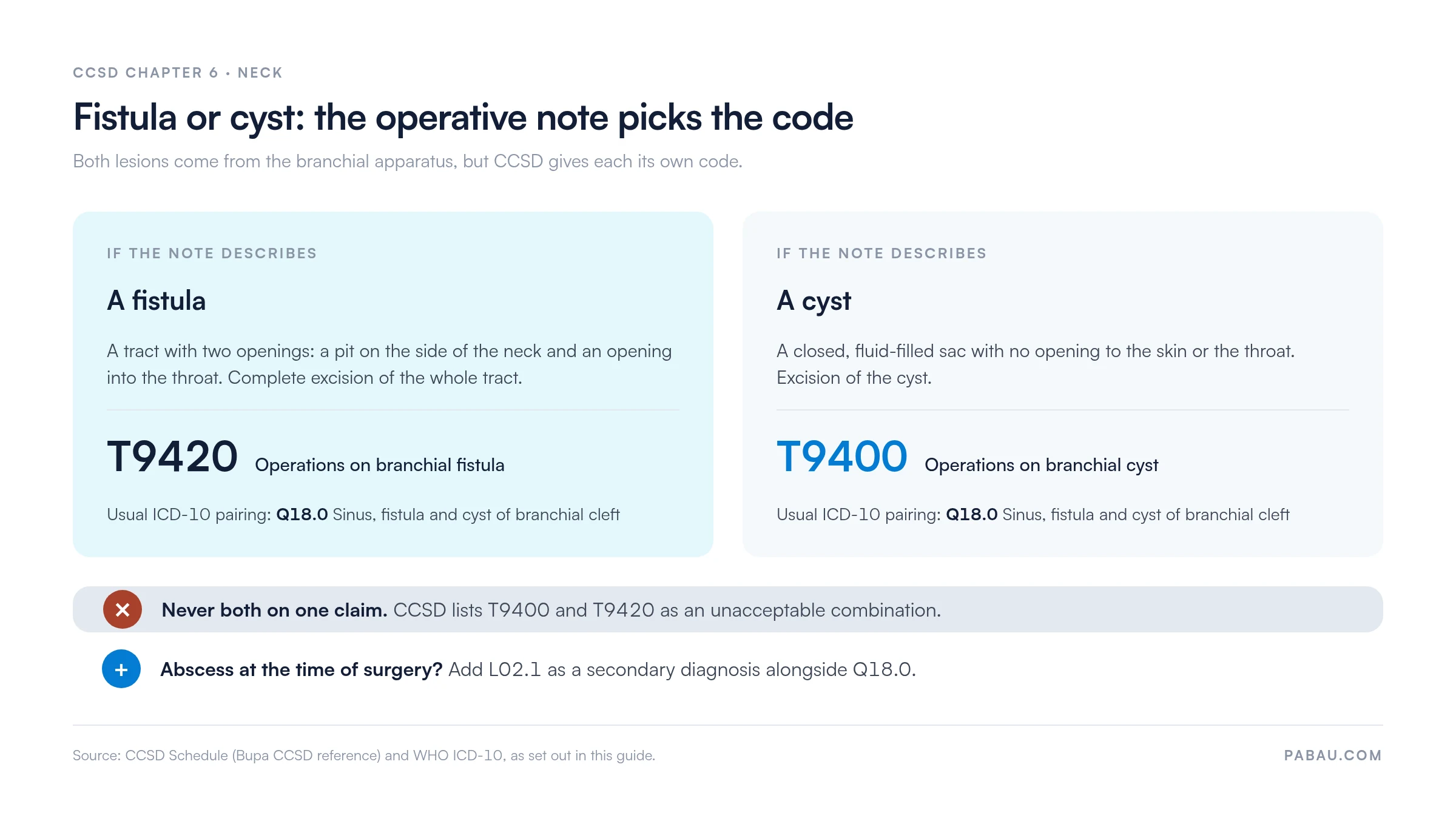
T9420 is the CCSD code for operations on branchial fistula. It covers complete excision of a congenital tract that runs from a pit on the side of the neck to an opening in the throat.
T9420 sits in chapter 6 of the CCSD Schedule, in the neck section. A branchial cyst takes T9400 instead, and CCSD lists the two codes as an unacceptable combination. Q18.0 is the usual ICD-10 pairing.
Let Pabau's smart automation suggest the right codes, reduce claim denials, and keep your practice compliant—effortlessly.
Automate repetitive tasks and focus on what matters most—your patients.
Reduce coding errors and ensure compliance with the latest regulations.
Clean claims, fewer denials, and faster reimbursements.
Powerful insights and reporting to help your practice thrive.
HIPAA compliant SOC 2 certified GDPR-compliant Trusted by 4,000+ clinics worldwide

CCSD Code T9420 covers complete surgical excision of a branchial fistula tract, not incision, drainage or branchial cyst removal.
Branchial cyst excision is T9400, and CCSD lists T9400 and T9420 as an unacceptable combination, so the two are not billed together.
Pair T9420 with ICD-10 code Q18.0 (sinus, fistula and cyst of branchial cleft), because a mismatched diagnosis can trigger a query or denial.
Most major private insurers require pre-authorisation for T9420, and the authorisation reference must appear on the invoice submitted via Healthcode.
Pabau, a practice management platform for UK private practices, keeps the operative note, pre-authorisation and Healthcode invoice for a T9420 case on one record.
CCSD Code T9420 is the procedure code for operations on branchial fistula in the CCSD Schedule, the coding framework for UK private healthcare billing. The CCSD Group’s schedule site describes the schedule as the standard procedure and diagnostic test codes for the UK private healthcare sector. ENT surgeons and paediatric head and neck surgeons use T9420 to claim for complete excision of a branchial fistula tract. The excision runs from the skin opening to the tract’s deepest point.
T9420 sits in chapter 6 of the schedule (face, mouth, salivary and thyroid), in the neck section. Its one close sibling there is T9400, operations on branchial cyst. CCSD lists T9400 as an unacceptable combination with T9420, so the two codes are not billed together.
The code applies to any branchial cleft of origin: first, second (the most common), third, or fourth. Still, what matters for coding purposes is the nature of the lesion.
A fistula has two openings. By contrast, a sinus has one opening and no internal connection, and a cyst is a closed cavity. So only a complete fistulectomy qualifies for T9420. Incision and drainage, partial excision, or simple wound care are not billable under this code.
A branchial fistula is a congenital tract remnant that runs between an internal pharyngeal opening and an external pit on the lateral neck. It arises from incomplete obliteration of the branchial apparatus during embryonic development. The second branchial cleft accounts for the majority of cases. Its tract usually runs between the tonsillar fossa and the anterior border of the sternocleidomastoid muscle.
Surgeons operate when the fistula causes recurrent infection, discharge, or abscess formation. Because the tract communicates with the pharynx, spontaneous resolution is unlikely, and conservative management prolongs the cycle of infection.
Complete surgical excision under general anaesthesia is the definitive treatment. In contrast, incomplete excision carries a significant risk of recurrence, which is why the operative note must confirm the entire tract was removed.
Surgeons perform branchial fistulectomy under general anaesthesia. When the tract is long or complex, a pre-operative sinogram or fistulogram maps its full course. That map then guides the surgical approach. The standard technique proceeds as follows:
Theatre time varies with tract complexity, usually 45 to 90 minutes. Because the operation needs general anaesthesia, a separate anaesthetic CCSD code applies alongside T9420.
The boundaries of T9420 decide what goes on the invoice, so the table below shows what the code covers and what must be coded separately or not billed at all.
T9400, operations on branchial cyst, is the one close sibling of T9420 in the neck section of the CCSD Schedule. Confirm the clinical diagnosis before you pick a code, because the lesion type decides it. Insurers often query a T9420 claim after a mix-up between the two.
Read the operative note for the number of openings before you code, because that one detail settles the choice. The decision runs as follows.
However, other head and neck procedures sit elsewhere in the schedule, and the CCSD code library covers them code by code.
Every T9420 invoice you send to a private insurer must carry a diagnosis code alongside the procedure code. The correct primary diagnosis for branchial cleft fistula is Q18.0 (Sinus, fistula and cyst of branchial cleft). It covers congenital lateral neck anomalies arising from branchial apparatus remnants. Also, confirm the edition of ICD-10 your payer uses, because minor revision updates occasionally affect sub-code availability.
Always confirm the ICD-10 code set version accepted by the specific payer before submission. Bupa and AXA Health may reference different annual revisions. When in doubt, include the full clinical description from the operative note in the diagnosis field rather than relying on the code number alone.
Insurers query or deny a claim for CCSD Code T9420 without complete supporting documentation. Private insurers require the operative note to confirm complete excision, not simply that the surgeon performed a neck exploration. So every T9420 submission needs the following documentation, attached or on hand.
Pre-authorisation requirements for branchial fistula surgery vary across private insurers. The table below reflects general payer policy for elective surgery. Verify current requirements with each insurer before scheduling, because pre-auth rules change between policy years. The Bupa code search portal and the Aviva fee schedule publish current procedural requirements for enrolled providers.
Claim denials for CCSD Code T9420 follow common patterns. Fortunately, you can prevent most of them with accurate code selection and complete documentation before submission.
Run a pre-submission check before every T9420 invoice. Confirm the fistula code rather than the T9400 cyst code, the Q18.0 diagnosis, and the pre-auth reference. Then check that the operative note confirms complete fistulectomy and that anaesthetic time units match the theatre record. A five-minute check prevents a six-week denial cycle.
CCSD Code T9420 covers only the surgical component of branchial fistula excision. As a result, you need additional codes for the anaesthetic and any extra procedures. You bill the anaesthetic on a time-unit basis using the relevant CCSD anaesthetic code, and you calculate units from the official CCSD technical guide rules.
Payer-specific bundling rules apply. Some insurers bundle wound closure into the primary procedure code; others allow it to be billed separately. So check the relevant payer’s schedule before including extra codes.
Healthcode is the standard electronic billing platform for UK private practice CCSD claims. Most major insurers, including Bupa and AXA Health, receive invoices online through Healthcode rather than by post or email. Practices that raise invoices in a billing system linked to Healthcode thus avoid keying each claim twice.
Bupa also adds its own invoicing rules on top of the steps above. The Bupa CCSD billing guide breaks down those requirements for Bupa-specific submissions.
A T9420 claim depends on three documents: the surgeon’s operative note, the anaesthetic record, and the insurer’s pre-authorisation reference. When they live in separate systems, an invoice can go out before anyone checks that the note confirms complete excision.
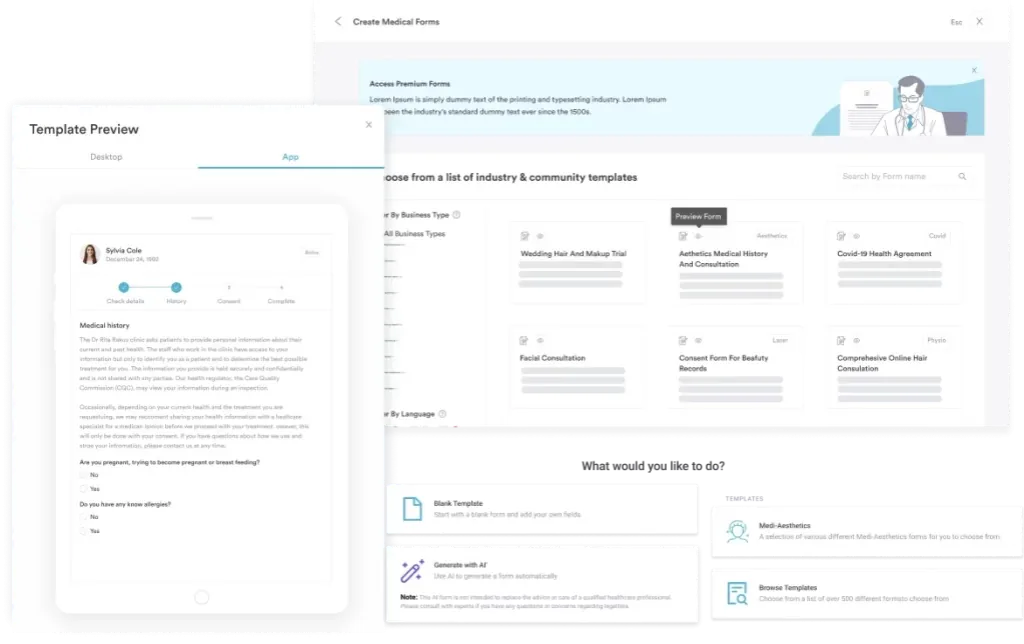
Pabau, a practice management platform for UK private practices, keeps all three on the patient record. Digital forms and note templates prompt the surgeon for the details a payer checks. Those include ligation of the internal end and the cleft of origin.
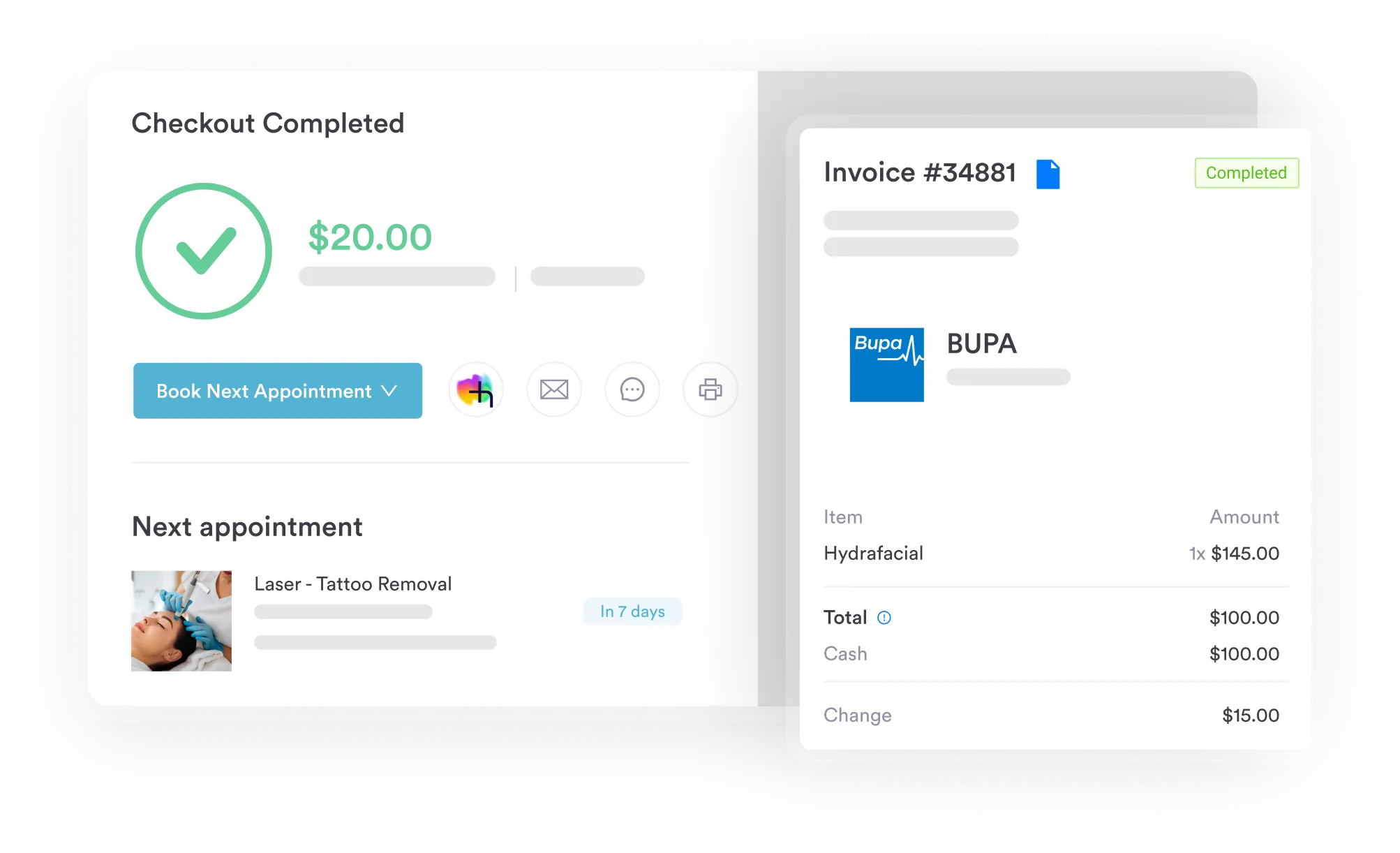
Pabau’s claims software for surgeons then sends the invoice through Healthcode with the procedure, anaesthetic and diagnosis codes already attached. The outstanding balance stays visible against T9420 until the insurer pays.

Pabau supports UK private practices with structured invoicing, digital documentation, and billing workflows designed around CCSD codes. See how it works for ENT and head and neck surgical teams.

Code T9420 only when the operative note describes a fistula and confirms the whole tract came out. A closed cyst is T9400, and the two codes never share a claim.
In short, the checks that protect the claim all happen before submission. Q18.0 goes on the invoice, the pre-authorisation reference is in place, and the anaesthetic record matches theatre time. Build those checks into the invoice workflow once, and each branchial fistula case after that goes out complete.
Book a demo to see how Pabau carries a T9420 case from the operative note to a paid Healthcode invoice.

Need a full Bupa billing reference? Bupa CCSD codes guide covers Bupa’s invoicing rules, fee schedule structure, and submission requirements for private practice.
Looking to streamline surgical claim workflows? Claims management software from Pabau supports structured CCSD invoicing, pre-auth tracking, and Healthcode integration.
Billing other ENT surgery? CCSD Code D0342 covers bony meatoplasty, with the documentation and combination rules for an ear canal procedure.
CCSD Code T9420 covers complete surgical excision of a branchial fistula tract. That includes dissection from the external skin opening to the internal pharyngeal end, ligation, and removal of the full tract. It does not cover branchial cyst excision, which is T9400, or incision and drainage and simple wound care.
A branchial fistula has two openings, an external pit on the neck and an internal connection to the pharynx. A branchial cyst is a closed, fluid-filled sac with no opening. T9420 applies only to the fistula, and branchial cyst excision is coded T9400. CCSD lists the two codes as an unacceptable combination, so never bill both for one operation.
Yes, branchial fistula surgery is an elective surgical procedure and both Bupa and AXA Health generally require pre-authorisation before the operation. The authorisation reference number must appear on the invoice submitted via Healthcode. Verify current requirements directly with each insurer, as pre-auth rules are updated periodically.
Yes. CCSD Code T9420 applies to branchial fistula excision regardless of which cleft is involved: first, second, third, or fourth branchial cleft origin. The second branchial cleft is by far the most commonly operated on, but the code applies across all cleft origins.




