CPT code 51797: Intra-abdominal voiding pressure add-on
What CPT code 51797 covers CPT code 51797 is the add-on code for intra-abdominal...

Last Updated: Oct 19, 2026
E1920 is the CCSD code for partial pharyngectomy, the removal of part of the pharyngeal wall while the rest of the pharynx is preserved. UK private insurers use it to pay surgeons for open or transoral resections of the oropharynx and hypopharynx, mostly for squamous cell carcinoma.
Total pharyngectomy is billed as E1910, and a robotic-assisted partial resection as E1921. When the larynx is removed in the same sitting, a laryngopharyngectomy code applies instead.
Let Pabau's smart automation suggest the right codes, reduce claim denials, and keep your practice compliant—effortlessly.
Automate repetitive tasks and focus on what matters most—your patients.
Reduce coding errors and ensure compliance with the latest regulations.
Clean claims, fewer denials, and faster reimbursements.
Powerful insights and reporting to help your practice thrive.
HIPAA compliant SOC 2 certified GDPR-compliant Trusted by 4,000+ clinics worldwide

CCSD Code E1920 covers partial pharyngeal resection only. Total pharyngectomy is E1910, and laryngopharyngectomy has its own code.
The operative note must state the pharyngeal sub-site, the extent of resection and the margin status, or the claim risks a downgrade or denial.
Most UK private insurers require pre-authorisation before an elective E1920 procedure. Retrospective notification is reserved for emergencies.
Robotic-assisted partial resection, such as transoral robotic surgery, is billed as E1921 rather than E1920.
Pabau, the practice management platform we build, links the CCSD code, operative note and insurer claim in one patient record.
CCSD Code E1920 is the billable procedure code for partial pharyngectomy in the CCSD schedule. UK private health insurers use that code set for surgical billing. The code applies when a surgeon removes a portion of the pharyngeal mucosa and underlying tissue, leaving the rest of the pharynx intact. Total removal of the pharynx takes E1910, while combined pharyngeal and laryngeal resection has its own CCSD code.
The pharynx has three regions. The nasopharynx sits behind the nasal cavity. The oropharynx runs from the soft palate to the epiglottis and includes the tonsils and base of tongue. The hypopharynx runs from the epiglottis to the oesophageal inlet. It includes the piriform fossae and the back wall of the pharynx.
E1920 most often applies to oropharyngeal and hypopharyngeal resections. However, nasopharyngectomy as its own procedure usually has a separate code. Check the current CCSD schedule edition when nasopharyngeal anatomy is involved.
Surgeons perform partial pharyngectomy almost only for cancer. Squamous cell carcinoma of the oropharynx or hypopharynx makes up most cases. Benign lesions rarely need pharyngeal excision, but they can also use this code. NICE guidance on head and neck cancer (NG36) recommends surgery as a main or follow-up treatment for tumours that can be removed. As a result, E1920 is one of the key codes in the CCSD ENT chapter.
The surgeon reaches the tumour through the mouth, the neck, or both, depending on its site and size. Next, they cut out the affected part of the pharynx with clear margins. The size of the defect then decides how they rebuild it:
Reconstruction carries a separate CCSD code, so E1920 does not include it. Coders must check the operative note for reconstruction and, if the surgeon did it, add the right code. Likewise, neck dissection in the same sitting has its own code, which the bundling section below covers.
The table below maps each pharyngeal sub-site to its E1920 applicability. It shows whether the operative anatomy fits the code or needs a different one.
The CCSD schedule groups pharyngeal resections in a short family of E-codes. Knowing what each neighbouring code covers is the best way to avoid miscoding. The table below lists the neighbours most often confused with E1920, and our CCSD codes hub covers the wider schedule. Check exact descriptors against the current schedule edition before submission.
The most common miscoding error is applying E1920 when the operative note describes laryngopharyngectomy. If the surgeon removed any of the larynx in the same sitting, the procedure is a laryngopharyngectomy. It takes the separate CCSD laryngopharyngectomy code, not E1920, so check that code in the current schedule. The test is whether the specimen includes laryngeal cartilage or mucosa. If it does, E1920 does not apply.
CCSD also lists two codes that you cannot bill with E1920. They are E1910, total pharyngectomy, and E2400, a therapeutic endoscopic operation on the pharynx. Instead, bill robotic-assisted partial resection, such as transoral robotic surgery, as E1921. The decision flow below applies these rules in the order a coder should check them.
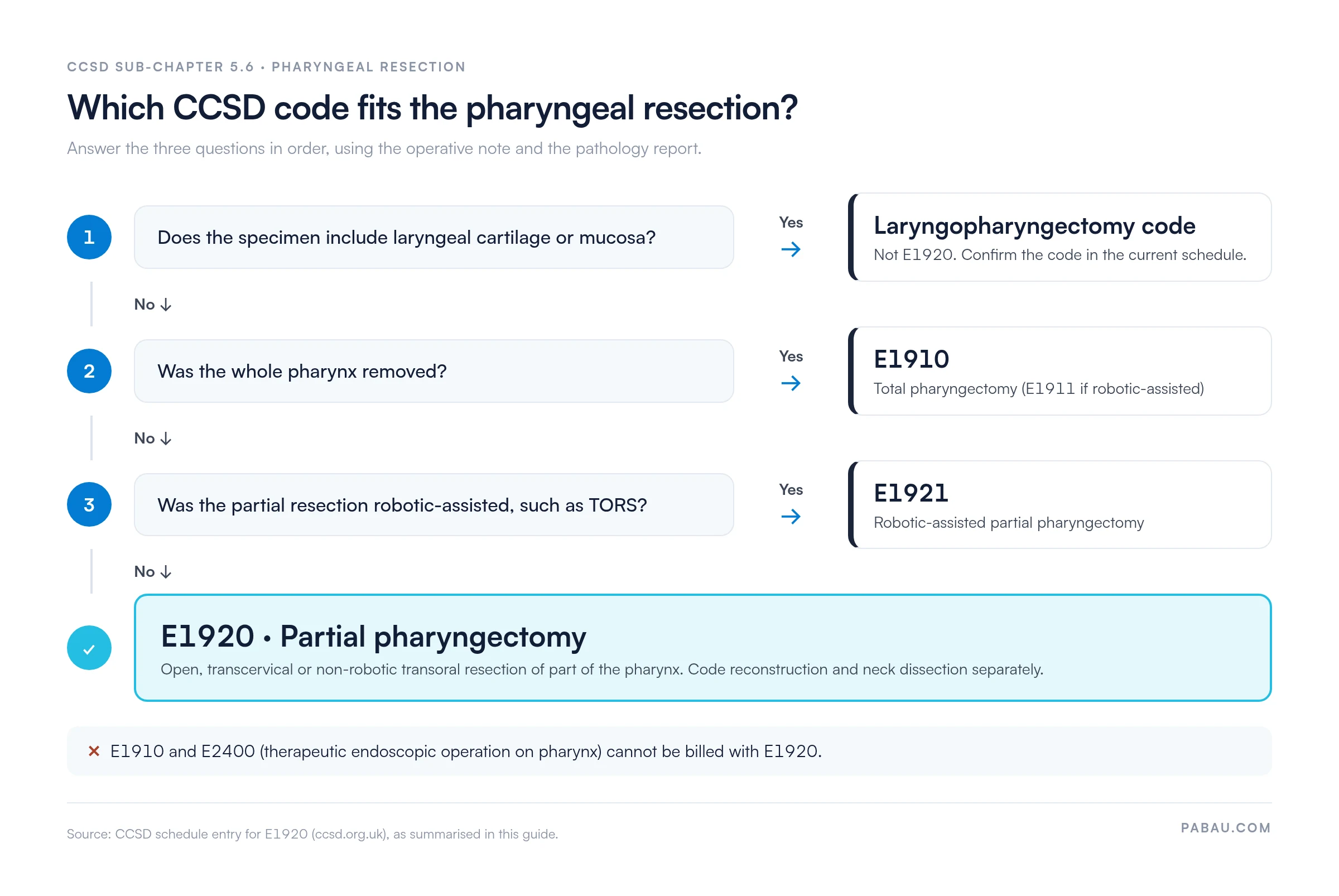
UK private insurers expect the operative note to support the exact procedure billed. A vague note stating “pharyngeal resection performed” is not enough for E1920, so it will trigger a request for records or a denial. The operative note and supporting records must cover all of the following:
Thorough records also help you comply with UK GDPR, which governs how long you keep surgical records and how you share them with insurers.
Partial pharyngectomy is a major elective procedure, so most UK private insurers treat it as a pre-authorised case. The insurer must approve the procedure before it happens. Otherwise, the claim risks refusal on paperwork grounds, whatever the clinical need. Refer to the Bupa CCSD code guidance for Bupa-specific authorisation workflows.
The table below summarises typical pre-authorisation requirements by insurer. Thresholds and portal names change from time to time, so confirm with the insurer’s current provider documentation before submission.
Emergency pharyngectomy for cancer that blocks the airway may qualify for notification after surgery. In those cases, tell the insurer promptly, explain the emergency, and attach the operative note. The notice window differs by insurer, so confirm it in each provider guide. Late notification does not guarantee payment, because the policy wording decides.
Once you have pre-authorisation, a clean E1920 claim follows these steps. Software for cleaner claims keeps the operative note, authorisation reference and diagnosis code in one linked record. That way, you are less likely to miss a required element at submission.
Surgeons rarely perform partial pharyngectomy alone. Therefore, you can properly co-bill the following CCSD codes with E1920 when the operative note documents the matching procedure:
Flag reconstruction and neck dissection decisions in the pre-authorisation request, not just at the claim submission stage. Insurers that approved E1920 alone may dispute additional co-billed codes if they were not included in the original authorisation. Listing all planned codes upfront prevents a second authorisation cycle after surgery.
E1920 claims fail for a familiar set of reasons. The table below maps each common denial reason to a fix. As a result, practice managers and coders can correct rejections directly instead of sending blind appeals.
An insurer can still pay a denied E1920 claim on appeal. Follow these steps to build the case:
Tracking claim status, denial dates and appeal deadlines in one place keeps each appeal inside the insurer’s filing window. After all, a late appeal forfeits the right to challenge the decision.
CCSD Code E1920 claims require a supporting UK ICD-10 diagnosis code. Use the most specific code from the pathology report. All codes below come from UK ICD-10 (5th edition, used in England). Do not use US ICD-10-CM codes, because they differ in detail and structure.
Verify codes using the NHS Classifications Browser, which provides the current UK ICD-10 5th edition in full. That way, you know the code is active and matches the site in the pathology report.
The scenarios below apply the coding decisions above to typical E1920 cases.
Scenario 1: Straightforward partial oropharyngectomy, no reconstruction. A 58-year-old with T2N0 squamous cell carcinoma of the left tonsillar fossa has a non-robotic transoral resection of the left oropharyngeal wall with primary closure. The operative note confirms partial resection, the left tonsillar fossa sub-site, clear margins and no reconstruction. Codes: E1920 (primary), anaesthetic code (concurrent), ICD-10 C09.0 (malignant neoplasm of tonsillar fossa). Had the resection been robotic-assisted, the primary code would be E1921 instead. The practice obtained pre-authorisation and sent the claim with the operative note attached.
Scenario 2: Partial pharyngectomy with free flap reconstruction. A 64-year-old with T3 hypopharyngeal carcinoma of the left piriform fossa has a left partial hypopharyngectomy followed by radial forearm free flap reconstruction. The same surgeon performs both parts in a single sitting. Codes: E1920 (pharyngeal resection), reconstruction CCSD code (free flap), anaesthetic code, ICD-10 C12. Both codes must appear in the pre-authorisation. If you leave reconstruction out of the original request, the insurer usually starts a second review. Logging the authorisation reference against each code line prevents the same omission at submission.
Scenario 3: Partial pharyngectomy with concurrent neck dissection. A 61-year-old with T2N1 oropharyngeal carcinoma has a transoral partial oropharyngectomy and a selective neck dissection in the same sitting for nodal disease. The operative note documents both parts separately. Codes: E1920 (pharyngeal resection), selective neck dissection CCSD code, anaesthetic code, ICD-10 C10.9. The practice includes both procedure codes in the pre-auth and the claim. Submitting only E1920 and expecting it to cover neck dissection is a bundling error. It leads to underpayment, because neck dissection is a separately paid CCSD procedure.
On many private head and neck lists, the operative note, the authorisation reference and the claim form live in three different places. Each hand-off is a chance to drop a co-billed code or a reference number.
Pabau, the practice management platform we build, keeps them in one patient record. The CCSD codes, the pre-authorisation reference and the operative note sit together, so your team builds the claim from the record rather than retyping it. After that, UK insurer claims go out electronically through Healthcode.
As a result, insurers return fewer claims for a missing reference, and you can see which E1920 cases still await payment or an appeal decision.

Pabau manages CCSD coding, documentation, pre-authorisation tracking and insurer claims for private head and neck practices in one workflow. Each submission goes out complete.

E1920 rewards the practice that settles the code before surgery rather than after it. Read the operative plan against the three questions in the decision flow. Then put every planned code, including reconstruction and neck dissection, into the pre-authorisation request.
The trade-off is a few minutes of checking at booking against weeks of rework after a denial. When the larynx, the whole pharynx or a robot is involved, E1920 is the wrong code, and catching that early costs less than any appeal.
Book a demo to see how Pabau keeps CCSD codes, authorisations and operative notes in one record for head and neck billing.

Need a structured approach to Bupa CCSD submissions? Bupa CCSD code guidance covers Bupa-specific code lookup, fee schedules, and submission requirements for UK private practice.
Looking for a full CCSD billing overview? Bupa procedure codes fee schedule maps CCSD codes to current fee levels across surgical specialties.
Coding a total rather than partial resection? CCSD code E1910 covers billing for total pharyngectomy under the CCSD schedule.
Billing open surgery on a pharyngeal pouch? CCSD code E2320 explains the code for open pharyngeal pouch surgery, another throat procedure in the same sub-chapter.
CCSD Code E1920 covers partial pharyngectomy, the surgical removal of a portion of the pharynx. UK private health insurers use it to pay head and neck surgeons for oropharyngeal and hypopharyngeal resection. It does not cover total pharyngectomy (E1910), laryngopharyngectomy, or nasopharyngectomy as a distinct procedure.
E1920 applies when part of the pharynx is removed and the remainder is preserved. Total pharyngectomy, which involves complete removal of the pharynx, uses a separate CCSD code, E1910. The operative note must state that the resection was partial, or E1920 does not apply.
Missing pre-authorisation is a leading cause, along with an operative note that omits the pharyngeal sub-site or extent of resection. Other common reasons are a total pharyngectomy or laryngopharyngectomy code in place of E1920, and an ICD-10 diagnosis mismatch. Bundling errors also cause denials when nobody coded reconstruction or neck dissection separately.
Yes. Neck dissection and pharyngeal reconstruction each carry their own separate CCSD codes and are co-billable with E1920 when the operative note documents them. Include both in the original pre-authorisation request to avoid a second review after surgery.
The most common ICD-10 codes paired with E1920 are C10 for the oropharynx, C12 for the piriform sinus and C13 for the hypopharynx. Tonsil tumours take C09, such as C09.0 for the tonsillar fossa, and base of tongue tumours take C01. Use the most specific sub-code available from the pathology report. Always use UK ICD-10 5th edition rather than US ICD-10-CM.