HCPCS code V2630: Anterior chamber intraocular lens
HCPCS code V2630: official descriptor and code definition HCPCS code V2630 is th...

Last Updated: Oct 15, 2026
E2330 is the CCSD code for removal of lesion of para-pharyngeal space. UK private medical insurers use it to pay for open excision of a mass in that space. The approach may be transcervical, transparotid or combined. Robotic-assisted removal is coded E2331 instead.
The code sits in Chapter 5 (Ear, nose and throat), in the Throat section. Pleomorphic adenoma of the deep parotid lobe, paraganglioma and schwannoma are the usual pathologies, and most insurers require pre-authorisation before surgery.
Let Pabau's smart automation suggest the right codes, reduce claim denials, and keep your practice compliant—effortlessly.
Automate repetitive tasks and focus on what matters most—your patients.
Reduce coding errors and ensure compliance with the latest regulations.
Clean claims, fewer denials, and faster reimbursements.
Powerful insights and reporting to help your practice thrive.
HIPAA compliant SOC 2 certified GDPR-compliant Trusted by 4,000+ clinics worldwide

CCSD Code E2330 covers open removal of a lesion in the parapharyngeal space, not a standalone parotidectomy or neck dissection. Bill robotic-assisted removal under E2331.
Pleomorphic adenoma of the deep parotid lobe and paragangliomas are the pathologies most commonly requiring E2330, and each maps to a distinct ICD-10 code.
AXA Health, Bupa, WPA, and most other major UK insurers usually require pre-authorisation before you submit an E2330 claim.
Claims management in Pabau, our practice management platform, checks membership numbers and authorisation codes before a claim goes to Healthcode, then tracks it to payment.
The Clinical Coding and Schedule Development (CCSD) Group defines CCSD Code E2330 as the removal of a lesion of the parapharyngeal space. The code sits in Chapter 5 (Ear, nose and throat) of the CCSD schedule, within the Throat section. Consultants use it in UK private medical practice, where CCSD codes govern payment from private medical insurers (PMI).
Our library of CCSD code guides covers the neighbouring throat and salivary gland codes in the same format.
The official descriptor is precise in its anatomical scope. E2330 applies when the primary surgical objective is excision of a mass located within the parapharyngeal space itself. It does not encompass a standalone total or superficial parotidectomy performed entirely within the parotid gland. Likewise, it does not cover a neck dissection where the parapharyngeal space is not the operative target.
The code matters to ENT surgeons and head and neck surgeons billing private insurer episode fees. In addition, billing staff and theatre coordinators need to know it. Insurers usually require pre-authorisation, and the claim needs operative documentation that distinguishes E2330 from adjacent codes.
The parapharyngeal space is an inverted pyramid-shaped fascial compartment running from the skull base to the hyoid bone. It lies lateral to the pharyngeal constrictors and medial to the mandible and parotid gland. Its contents explain why parapharyngeal surgery carries distinctive risk and justifies a dedicated CCSD code.
The pre-styloid compartment contains primarily fat and the deep parotid lobe. The post-styloid compartment contains the carotid sheath structures and cranial nerves. This division shapes both the surgical approach and the likely pathology. As a result, the operative note must record both to support the E2330 claim.
E2330 covers open surgical excision whose primary target is a lesion lying within the parapharyngeal space, by a transcervical, transparotid or combined approach. Robotic-assisted removal of the same lesion has its own CCSD code, E2331. The two most common cases are pleomorphic adenoma arising from the deep lobe of the parotid and paragangliomas. Schwannomas, minor salivary gland tumours and vascular malformations can also fall within the code’s scope.
Parapharyngeal procedures are fairly low-volume but high-value episodes for a private ENT practice. Therefore, getting the code right from the outset avoids delayed payments and insurer audits.
The code does not cover the following when performed in isolation:
The operative note must capture the approach used for parapharyngeal space surgery. Moreover, that detail matters for patient safety records and for defending the E2330 claim against insurer review.
Surgeons use the transcervical (cervical incision) approach for most post-styloid lesions and for pre-styloid lesions that do not extend far into the parotid gland. The incision runs along the anterior border of the sternocleidomastoid or in a skin crease below the mandible. Dissection proceeds through the neck, the surgeon divides the stylomandibular ligament, and the lesion comes out from below. Facial nerve monitoring is not usually needed by this route, but surgeons may monitor cranial nerves X and XII for post-styloid tumours.
Surgeons prefer the transparotid approach when a pre-styloid lesion starts in or touches the deep lobe of the parotid. They make a standard parotidectomy incision, identify and preserve the facial nerve, and mobilise the deep lobe to expose the parapharyngeal component. Continuous intraoperative facial nerve monitoring is strongly recommended with this approach, and the operative note must record it where used.
Large lesions may require a combined transcervical-transparotid approach to achieve safe margins. The operative note must state which approach or combination was used and which structures were encountered and preserved. It must also record the extent of the parapharyngeal dissection. Consequently, this detail separates E2330 from a parotidectomy code and gives the clinical reason for the higher fee.
Accurate notes are the most important factor in getting an E2330 claim paid. The operative note must show that the primary target was a lesion within the parapharyngeal space. It must also show that the approach and dissection matched that complexity.
The histopathology report, when received, serves as backup evidence for the claim. Some insurers request it during audit or appeal, so store it alongside the operative note and link it to the episode in your practice management system.
Every E2330 claim requires a supporting ICD-10 diagnosis code. The table below maps the most common parapharyngeal pathologies to their ICD-10 codes. Using an incorrect or generic code is a common denial trigger.
Incorrect ICD-10 pairing can trigger insurer audit or denial. Therefore, always have a qualified clinical coder review the diagnosis code selection, particularly for malignant pathologies where site and cell type decide the code.
Code choice gets harder when the lesion also involves the parotid gland, or when a neck dissection is performed at the same time. The Bupa CCSD code guide provides a useful insurer-specific reference alongside the formal CCSD schedule.
The code numbers and descriptors above follow the CCSD schedule as listed in Bupa’s 2026 code list. The parotid and neck dissection codes sit in Chapter 6 (Face, mouth, salivary and thyroid), outside the throat section. Check them against the current schedule before submitting, because CCSD bulletins update descriptors through the year.
If the lesion stays inside the parotid, the claim moves to a parotid code such as F4400 or F4430. The decision path below shows how the lesion’s site and the surgical technique settle the code.
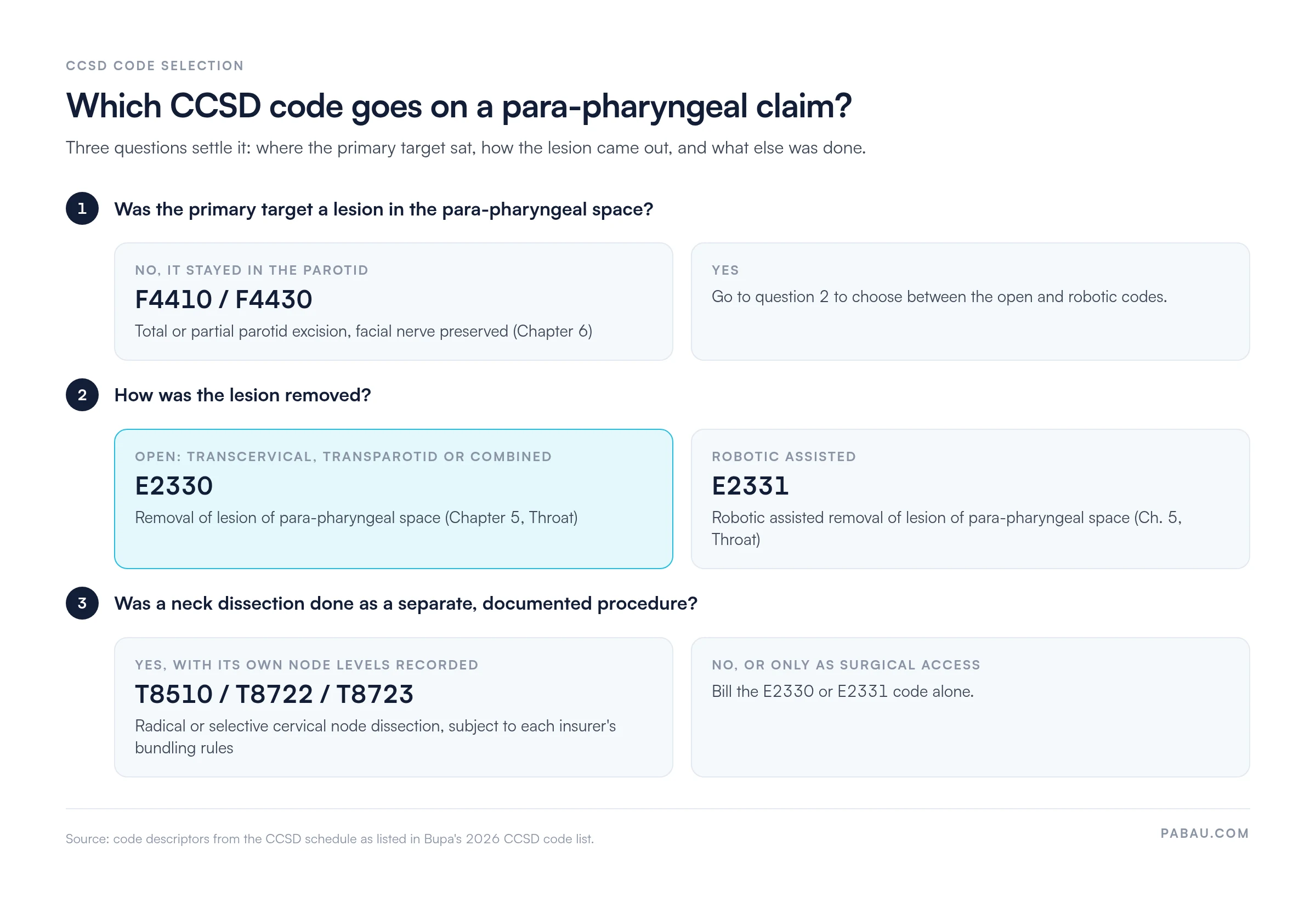
Dual coding is sometimes allowed, but it depends on each insurer’s bundling policy and the CCSD technical guide rules. In general:
Because dual-coding rules depend on each insurer’s policy and can change yearly, treat this as guidance only. Verify current rules with each insurer’s provider relations team before you submit codes together.
Most major UK private medical insurers require pre-authorisation for parapharyngeal space surgery before the procedure takes place. Consequently, submitting a claim without prior authorisation is the most direct route to a denial that you cannot later appeal on clinical grounds.
Pre-authorisation policies change regularly. Therefore, verify current requirements with each insurer’s provider relations team or via their online portal before booking the patient. Private practice claims management software that will not send a claim until staff record the authorisation code stops claims going out before approval.
The CCSD Group does not set fees, so there is no single fixed fee for E2330. Each major UK private medical insurer sets its own fee, either from its own schedule or through agreements with each consultant. The table below shows how each insurer sets and publishes its fees. Payment then depends on the consultant’s recognition terms with each insurer.
Surgeons should confirm their own recognition terms for E2330 with each insurer before operating. This matters because the headline schedule rate and a negotiated rate can differ.
Request a fee confirmation in writing from each insurer before performing an E2330 procedure for a new patient. Verbal quotations from insurer helplines are not binding, and fee disputes are far harder to resolve after the claim has been submitted.
ENT billing staff managing private practice accounts should treat denial prevention as part of the workflow rather than a task after submission. The following are the most frequent triggers for E2330 rejections, based on general UK private billing patterns. However, no insurer-published denial rate data exists in the public domain for this specific code.
A well-constructed appeal can overturn a denial where the clinical documentation supports the code. Follow these steps in sequence.
File the authorisation reference, operative note and insurer letters against the patient record as they arrive. The appeal pack is then ready when a denial lands.
Without a claims system, an E2330 claim relies on someone remembering the authorisation reference and the patient’s membership number. When either is missing, the insurer rejects the claim and the payment wait starts again.
In Pabau, claims to private medical insurers go to Healthcode straight from the invoice, with patient, treatment and insurer details pre-filled. Validation checks confirm membership numbers and authorisation codes before the claim can be sent.
Insurer-specific price lists raise each claim against the right fee schedule. Each claim then moves through pending, submitted, processing and paid on one dashboard, so a stalled payment shows up before the submission window closes.
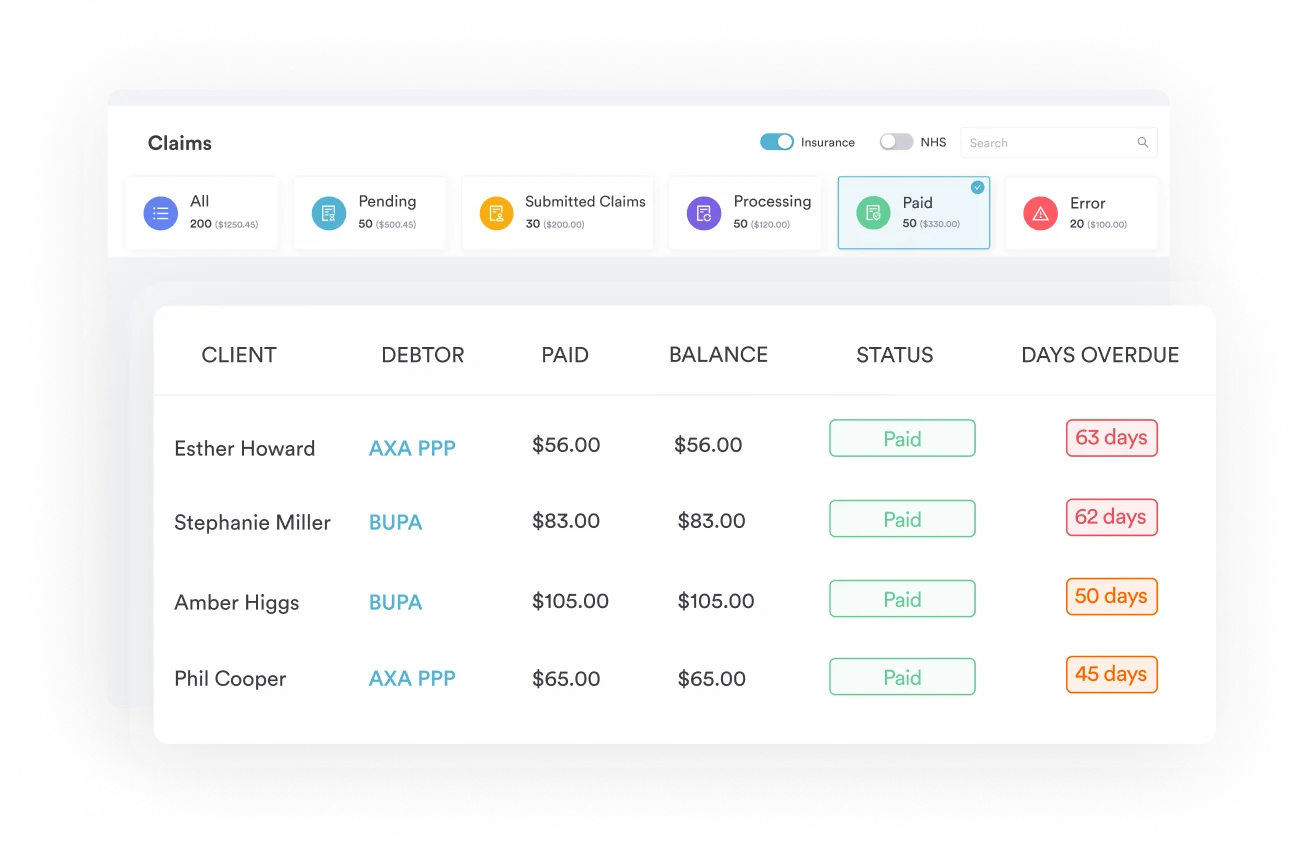

Pabau sends private insurer claims to Healthcode with patient and insurer details pre-filled. Validation checks confirm membership numbers and authorisation codes first, so fewer E2330 claims bounce back.

E2330 claims are won or lost before the patient reaches theatre. An operative note that names the parapharyngeal space as the primary target and states the approach holds up under audit. A pre-authorisation reference on file leaves the insurer no procedural reason to reject the claim.
Scope is the trade-off worth remembering. E2330 pays for open removal of a parapharyngeal lesion, so a robotic case belongs under E2331 and a parotid-only case under a parotid code. If the approach changes in theatre, check that the authorised code still applies before the claim goes in.
Pabau checks membership numbers and authorisation codes before a claim reaches Healthcode, then tracks it to payment. Book a demo to see how it stops E2330 claims stalling at the insurer.

Need a broader guide to CCSD codes for UK private practice? Bupa CCSD codes guide covers the full CCSD schedule in the context of Bupa recognition and fee submission.
Managing Bupa procedure fee schedules across your ENT practice? Bupa procedure codes fee schedule provides a structured reference for Bupa-recognised CCSD fees and submission rules.
Coding a lesion that stayed inside the parotid? CCSD code F4430 covers partial parotidectomy with facial nerve preservation, including documentation and claim rules.
Need the general parotid excision code? CCSD code F4400 explains when a parotid gland excision falls outside F4410 and F4430.
CCSD Code E2330 covers surgical removal of a lesion from the parapharyngeal space. That fascial compartment lies lateral to the pharynx and contains the internal carotid artery, cranial nerves IX-XII and the deep parotid lobe. It applies when the parapharyngeal space is the primary surgical target and the lesion is removed by an open approach. Robotic-assisted removal is coded E2331.
The operative note must confirm the parapharyngeal space as the primary anatomical target and name the surgical approach. It should also record nerve monitoring and preservation status, and confirm specimens sent for histopathology. The supporting ICD-10 diagnosis code must match the pathology described in the note.
AXA Health, Bupa, WPA, Aviva Health, and Cigna UK all require pre-authorisation for major ENT surgical procedures including parapharyngeal space surgery. Pre-authorisation must be obtained before the procedure is performed. A claim submitted without it is usually denied, with limited appeal options.
The most common denial triggers are missing pre-authorisation and an operative note that does not confirm the parapharyngeal space as the primary target. Mismatched ICD-10 codes, unbundling errors and late submission follow. Each of these is avoidable with a pre-submission documentation checklist and an insurer-specific pre-authorisation workflow.