CPT code 93503: Swan-Ganz catheter billing and modifiers
CPT code 93503: Official descriptor and procedure overview In the AMA CPT code s...

Last Updated: Oct 23, 2026
B3017 is the CCSD code for reconstruction of breast using fat transfer, including delayed reconstruction. The surgeon harvests the patient's own fat and injects it to rebuild the breast, in an operation separate from the mastectomy.
Timing decides the code. A mastectomy and fat transfer reconstruction in one operation is B3016, and fat transfer that revises an existing reconstruction is B3018. The sections below cover that choice, the operative note insurers expect, and how to bill each staged session.
Let Pabau's smart automation suggest the right codes, reduce claim denials, and keep your practice compliant—effortlessly.
Automate repetitive tasks and focus on what matters most—your patients.
Reduce coding errors and ensure compliance with the latest regulations.
Clean claims, fewer denials, and faster reimbursements.
Powerful insights and reporting to help your practice thrive.
HIPAA compliant SOC 2 certified GDPR-compliant Trusted by 4,000+ clinics worldwide

CCSD code B3017 covers breast reconstruction using fat transfer as its own operation, including delayed reconstruction after an earlier mastectomy.
When the mastectomy and the fat transfer reconstruction happen in one operation, bill the combined code B3016, not B3017 plus a mastectomy code.
Bupa, AXA Health, and other UK private insurers expect prior authorization before surgery and again before every further session.
The operative note must record the donor site, the volume transferred per breast, and the reconstructive intent to avoid cosmetic-exclusion denials.
B3018 is the revision partner to B3017: it covers fat transfer that refines a reconstruction already in place, not implant reconstruction.
CCSD code B3017 is the procedure code whose official descriptor reads: Reconstruction of breast using fat transfer (including delayed reconstruction). It comes from the schedule maintained by the Clinical Coding and Schedule Development (CCSD) group. UK private insurers use that schedule to process surgical claims.
B3017 sits in Chapter 7 (Breast), under Reconstruction, alongside the neighboring codes in our CCSD code index. It covers a fat transfer reconstruction carried out as an operation of its own, separate from the mastectomy. That includes delayed cases, where the reconstruction takes place weeks or years after the original surgery.
The parenthetical “including delayed reconstruction” confirms that time since mastectomy doesn’t change the code. The operation itself does. When the surgeon removes the breast and reconstructs it with fat under the same anesthetic, CCSD has a separate combined code, B3016.
Fat transfer breast reconstruction harvests the patient’s own adipose tissue from a donor site. The fat is processed and injected into the breast to restore volume and contour. The procedure breaks into three intraoperative phases, each of which must appear in the operative note for B3017 to be defensible.
Most reconstructive lipofilling cases need more than one session. Reaching the target volume commonly takes two to four procedures, staged over six to twelve months.
B3017 describes the first fat transfer reconstruction. Later sessions on a breast that has already been reconstructed usually fall under B3018 or B3020. The pathway below shows how two questions settle the code for each session, so you can fix it before you request authorization.
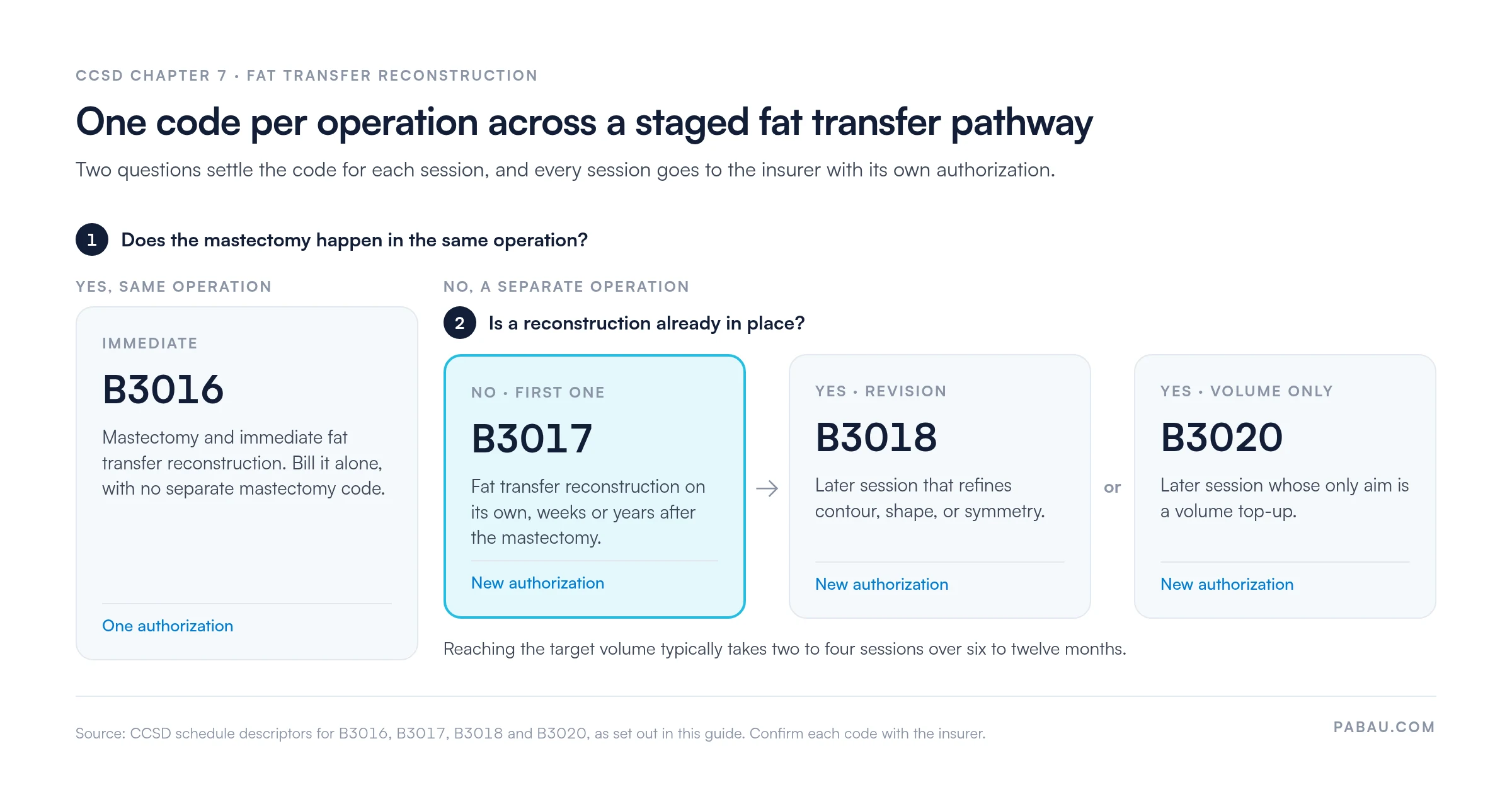
Timing is the first check on any fat transfer claim, because it decides which code applies. CCSD doesn’t ask you to add a mastectomy code to B3017 when both happen in one operation. It gives that scenario a combined code of its own.
Billing B3017 with a separate mastectomy code for one operation unbundles a scenario B3016 already covers. Insurers match the claim against the code they authorized, so that pairing invites a query or a rejection.
The implant codes follow the same pattern. B3012 and B3013 cover mastectomy with immediate reconstruction using an expandable or fixed prosthesis. B3014 and B3015 cover reconstruction with those prostheses as a separate operation, including delayed cases.
For delayed reconstruction, the time elapsed since the mastectomy doesn’t affect eligibility for B3017. What matters is the narrative. The operative note and referral letter must link the reconstruction to the original diagnosis. The reviewer should read it as restoration after treatment, not aesthetic enhancement.
B3017 and B3018 both use fat transfer, so technique doesn’t separate them. The difference is what already exists. B3017 builds a reconstruction. B3018, “Revision reconstruction of breast using fat transfer”, refines one that is already in place. Where the breast was first reconstructed with a pedicled TRAM flap under B2984, later lipofilling falls outside that code and bills separately.
Comparing fat transfer with implant reconstruction is a different question. Delayed or stand-alone implant reconstruction uses B3014 for an expandable prosthesis and B3015 for a fixed one. If fat transfer supplements an implant in the same operation, ask the insurer to confirm the code combination before surgery.
Chapter 7 splits breast reconstruction by technique and by timing. Knowing the adjacent codes prevents mis-coding and shows when a companion code is legitimate.
Descriptors change when the CCSD group issues updates. Confirm each code on Bupa’s code search or the insurer’s own schedule before you bill.
Donor site liposuction is a separate question. The B3020 descriptor states that it includes extraction and transfer, which suggests the schedule treats harvest as part of fat transfer. Don’t add a separate liposuction code to B3017 unless the insurer confirms in writing that it accepts one.
The operative note is the single most important document in a B3017 submission. Payers reviewing claims for fat transfer reconstruction check for specific elements before approving payment. A missing element from the list below often triggers a query or a denial.
ICD-10 codes on a B3017 claim must establish medical necessity. The following are commonly used supporting diagnoses. Insurer acceptance lists differ, so verify them against each insurer’s policy.
For reconstruction after breast cancer, Z85.3 gives B3017 its strongest support. Diagnosis codes alone do not guarantee coverage, though. The operative note narrative must reinforce why the listed diagnosis makes fat transfer medically necessary for this specific patient. Standalone codes without supporting clinical language are a common trigger for cosmetic exclusion review.
UK private medical insurance policies exclude cosmetic procedures. The critical question for any B3017 claim is whether the insurer’s reviewer reads the fat transfer as reconstructive (covered) or aesthetic (excluded). Documentation language determines the outcome.
Both Bupa’s procedure code framework and AXA Health’s Specialist Forms portal ask for the clinical indication behind the procedure. Frame the referral letter and operative note around restoration after disease treatment, not enhancement of appearance. The following language conventions strengthen a B3017 claim.
Where a patient also has an aesthetic goal (symmetry correction on the contralateral breast, for instance), that element may fall under a separate code. Mixing reconstructive and cosmetic indications within a single B3017 claim is the fastest route to a blanket cosmetic-exclusion denial of the entire submission.
Major UK private insurers expect prior authorization for breast reconstruction before admission. A claim without an authorization reference is usually rejected, whatever its clinical merit. Requirements vary by insurer and change over time, so confirm them directly before the procedure date.
Request the code that matches the operation. If the mastectomy and fat transfer happen together, the authorization should name B3016, not B3017.
For staged fat transfer, each session needs its own authorization. Approval for the first session doesn’t extend to later ones. Each request should confirm the code for that session and explain why the target volume hasn’t been reached yet.
Fat transfer claims attract close cosmetic-exclusion review, because the same technique is also used for aesthetic surgery. The following are common denial triggers, with the preventive action for each.
When a claim is denied on cosmetic-exclusion grounds, the appeal must include the original operative note and referral letter. Add any oncology correspondence that confirms the therapeutic context of the mastectomy.
Build a B3017 pre-submission checklist for each insurer you regularly bill. List the authorization portal link, the fields the insurer checks, and the ICD-10 codes it accepts. Add one line that confirms B3016, B3017, or B3018 for the case. Filling it in takes minutes, while chasing a denial can take weeks.
A fat transfer reconstruction often spreads one patient’s billing across several operations and authorizations. In many practices, the operative note sits in one system, the authorization in an inbox, and the claim in the Healthcode portal. Each copy between them is a chance to key the wrong code.
Pabau, the practice management system we build for private practices, keeps the operative note, consent, authorization reference, and procedure code on the same patient record. Its claims software for surgeons pre-fills the claim from that record and checks required fields before it goes through Healthcode.
As a result, each session’s claim builds from its own data. When an insurer queries a claim, the operative note and referral letter for the appeal are already on file.

Pabau links authorization references, operative notes, and procedure codes to each patient record. Your billing team builds accurate CCSD claims for every fat transfer session and sends them through Healthcode.

B3017 is a narrow code with a wide audit surface. Most coding errors with it come down to one decision: which operation is this? A same-operation mastectomy and reconstruction is B3016, and a revision is B3018. B3017 belongs to the fat transfer reconstruction that stands on its own.
Settle that question at authorization, before the operating room is booked, and ask it again for every later session. Then make the operative note, the referral letter, and the claim tell the same story. A fat transfer claim built that way rarely stalls at cosmetic-exclusion review.
Pabau holds the note, the authorization, and the claim on one record, which suits staged reconstruction like this. Book a demo to see how it handles a multi-session fat transfer claim.

Need the full Bupa CCSD code schedule? Bupa CCSD codes covers how Bupa recognizes and reimburses procedures across all chapters.
Checking fees before you quote? Bupa procedure codes fee schedule shows how to confirm Bupa’s rates before a claim goes out.
CCSD code B3017 covers reconstruction of breast using autologous fat transfer as an operation of its own, including delayed reconstruction after an earlier mastectomy. The surgeon harvests the patient’s own fat, processes it, and injects it into the breast. A mastectomy with fat transfer reconstruction in the same operation is billed as B3016 instead.
No. When the mastectomy and the fat transfer reconstruction happen in one operation, CCSD provides the combined code B3016. Billing B3017 alongside a separate mastectomy code would unbundle a scenario B3016 already covers. B3017 applies when the reconstruction is a separate operation, however long after the mastectomy it takes place.
Both codes use fat transfer. B3017 covers the reconstruction itself, while B3018 covers revision reconstruction of a breast that has already been reconstructed, usually to improve contour or symmetry. Neither is an implant code. Implant reconstruction as a separate operation uses B3014 for an expandable prosthesis or B3015 for a fixed one.
Bupa, like other major UK private insurers, expects prior authorization for breast reconstruction before admission. The surgeon or practice submits the clinical indication, oncology history, and proposed CCSD code before the procedure date. Insurer policies change, so confirm current requirements directly with Bupa before any submission.
B3017 describes the fat transfer reconstruction itself. Later sessions on a breast that has already been reconstructed usually fall under B3018 for a revision or B3020 for a stand-alone volume top-up. Each session needs its own authorization, so confirm the code for every session with the insurer before surgery.
Common denial reasons are a missing authorization reference and a cosmetic exclusion caused by weak reconstructive language. Others include an undocumented fat volume or donor site, and a repeat session without new authorization. Billing B3017 with a mastectomy code, where B3016 applies, also causes rejections.