CPT Code 69610: Tympanic membrane patch repair (myringoplasty)
CPT code 69610: official descriptor and procedure overview CPT code 69610 descri...

Last Updated: Oct 19, 2026
CCSD code B3018 covers revision reconstruction of breast using fat transfer. The surgeon injects the patient's own fat into a breast that has already been reconstructed, usually to improve contour or symmetry.
The code only applies once a reconstruction is in place. A first fat reconstruction is B3017, and a stand-alone volume top-up is B3020. Choose the wrong neighbor and the claim won't match what the insurer authorized. The sections below cover that choice, the operative note insurers expect, and how to bill each staged session.
Let Pabau's smart automation suggest the right codes, reduce claim denials, and keep your practice compliant—effortlessly.
Automate repetitive tasks and focus on what matters most—your patients.
Reduce coding errors and ensure compliance with the latest regulations.
Clean claims, fewer denials, and faster reimbursements.
Powerful insights and reporting to help your practice thrive.
HIPAA compliant SOC 2 certified GDPR-compliant Trusted by 4,000+ clinics worldwide

CCSD code B3018 covers revision reconstruction of the breast using fat transfer, performed on a breast that is already reconstructed.
B3016 and B3017 bill a first reconstruction with fat, while B3014 and B3015 cover expander and fixed implant reconstruction.
B3020 covers fat transfer for volume adjustment as a sole procedure, so agree B3018 or B3020 with the insurer at authorization.
The operative note must link the revision to the earlier reconstruction and record the donor site, volume and laterality.
Fat transfer often needs more than one session, and each session usually needs its own authorization and claim.
CCSD code B3018 is the UK private insurance procedure code for revision reconstruction of breast using fat transfer.
In plain terms, the surgeon harvests the patient’s own fat and injects it into a breast that has already been reconstructed. The aim is to improve shape, contour or symmetry once the first reconstruction has settled.
The code sits in Chapter 7, Breast, of the schedule maintained by the Clinical Coding and Schedule Development (CCSD) Group.
Bupa, AXA Health, Aviva, Vitality and WPA all work from that schedule. Even so, each insurer sets its own fee and complexity band for B3018, so check its schedule before you quote the patient.
Fat grafting happens in three steps. First, the surgeon harvests fat by liposuction, often from the abdomen, flanks or thighs. Next, the fat is processed to separate it from fluid and oil. Finally, small amounts are injected into the breast in thin layers.
Some of the grafted fat is usually reabsorbed over the following months. For that reason, many patients need a second or third session. It also explains why B3018 claims tend to arrive in a series rather than alone.
Chapter 7 splits breast reconstruction by technique and by timing. The fat transfer codes sit right beside the implant codes, and that is where many wrong-code claims start.
Use the table below to check the method and the stage before you assign B3018. Flap codes such as B2913 sit in the same family, so rule them out before you settle on a fat transfer code.
Treat the table as a guide rather than the final word. Descriptors change when the CCSD Group issues updates, so confirm each code on Bupa’s code search or the wider CCSD codes guide before billing.
Choose B3018 when the operation revises the reconstruction itself. B3020 fits a stand-alone volume top-up after mastectomy and reconstruction. Because the two descriptors sit so close together, the surgeon’s stated purpose carries the decision.
Three questions usually settle it.
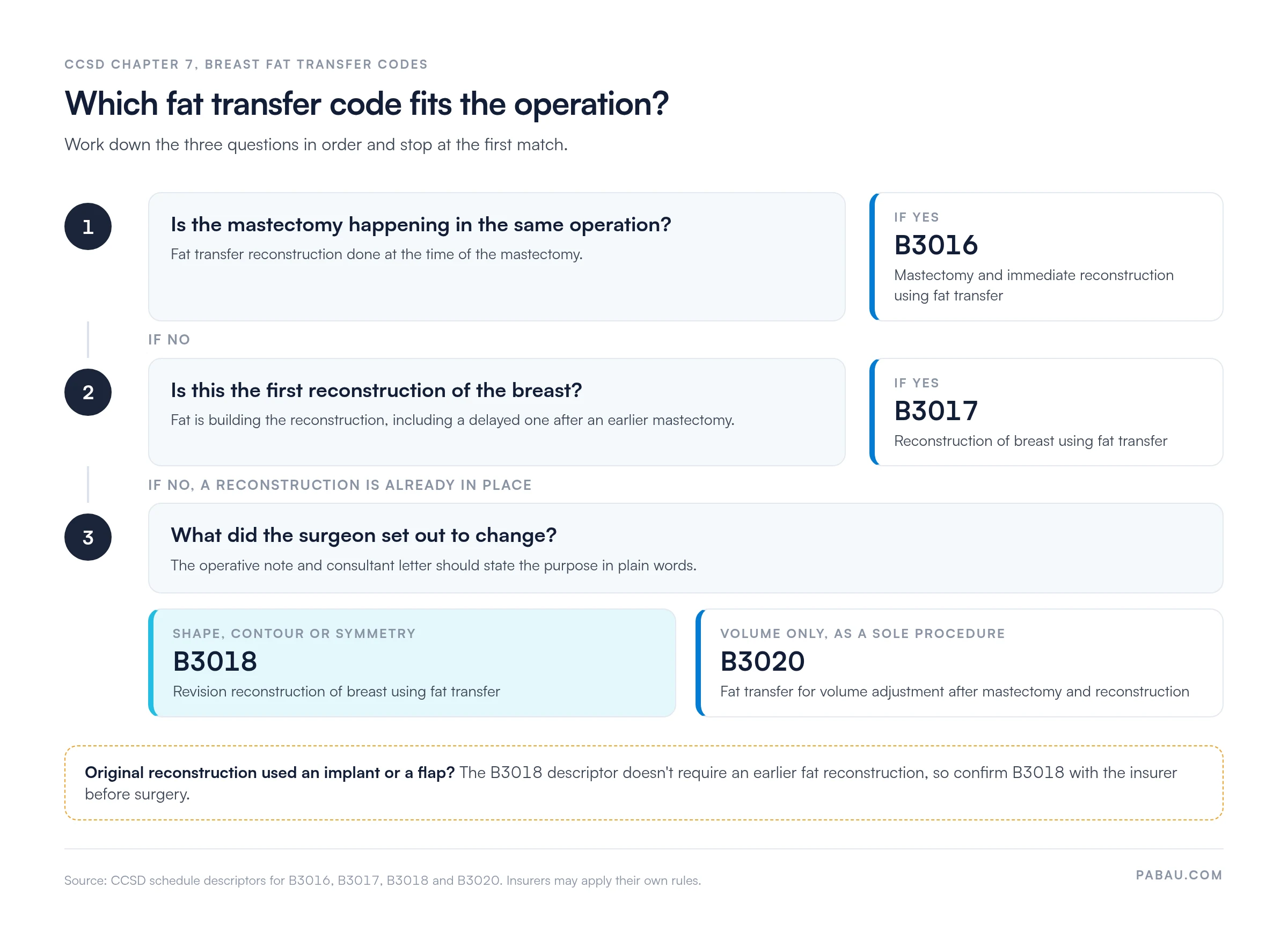
What did the surgeon set out to change? Correcting shape, contour or asymmetry in a reconstructed breast points to B3018. Adding volume as the only aim points to B3020.
Is this the first time fat has been used? A first fat transfer reconstruction after an earlier mastectomy is B3017, not B3018. A fat transfer reconstruction during the mastectomy itself is B3016.
What was the original reconstruction? The B3018 descriptor does not say the first reconstruction must have used fat. If the original was implant-based, such as a B3015 reconstruction, or flap-based, ask the insurer to confirm B3018 before surgery.
If the implant went in at the mastectomy itself, the original operation was CCSD code B2700. A pedicled TRAM flap reconstruction, by contrast, sits under B2984.
Put together, the three questions send each fat transfer case to one of four codes, as the decision path below shows.
Here is how that plays out. A patient had a DIEP reconstruction two years ago and now has a visible dip in the upper part of the breast. The surgeon plans fat grafting to smooth it. That corrects the existing reconstruction, so the request would normally go in as B3018.
Whichever code you land on, put it on the authorization request. Insurers compare the claim with the code they authorized. A mismatch triggers a query, even when the surgery itself was covered.
Insurers read the operative note to confirm that a revision took place. A note that only says “lipofilling to breast” gives them no reason to accept B3018 over a neighboring code. Build these details into your note template:
Alongside the note, most insurers want the authorization reference, a consultant letter setting out the clinical reason, and signed consent. Some also ask for clinical photographs. Keep all of it on the patient record before the claim goes out, so a query never turns into a hunt through email.
The diagnosis code should explain why the revision is needed. Z42.1, follow-up care involving plastic surgery of breast, is common here. Where the reconstruction followed breast cancer, a history code such as Z85.3 often sits alongside it. Check each insurer’s accepted list before you submit.
One revision often becomes two or three sessions, spaced months apart. Each session is normally a separate episode. It gets its own authorization, its own operative note and its own claim.
Two problems trip practices up here. First, an authorization may cover one session only, even when the treatment plan mentions more. Second, a later session can fall outside the authorization window if the surgery date slips.
Cover also depends on how the insurer views the work. Most private medical insurance policies exclude cosmetic surgery, and repeat fat grafting can look cosmetic on paper. For that reason, the consultant letter should tie each session back to the original reconstruction and its clinical reason.
Work on the other breast to improve symmetry is a separate matter. Mastopexy after reconstruction has its own codes, B3130 for one side and B3132 for both. It needs its own authorization, too.
A B3018 claim passes through six stages. Most failures trace back to the first two, long before anyone writes the invoice.
B3018 denials cluster around the same few errors. The table pairs each one with the fix that gets the claim moving again.
Run through these checks before the invoice leaves the practice. Each takes seconds and removes a common reason for a query.
Staged fat transfer spreads one patient’s billing across several operations and several authorizations. In many practices, those details live in a clinical system, a spreadsheet and the Healthcode portal. Every copy between them is another chance to key the wrong reference or code.
Pabau keeps the operative note, consent, authorization reference and procedure code on the same patient record. Its claims management software pre-fills the claim from that record. It also checks required fields, such as the authorization code, before you send it through Healthcode.
As a result, each session’s claim builds from its own data. Billing staff can see which sessions are paid, pending or queried without opening another system.
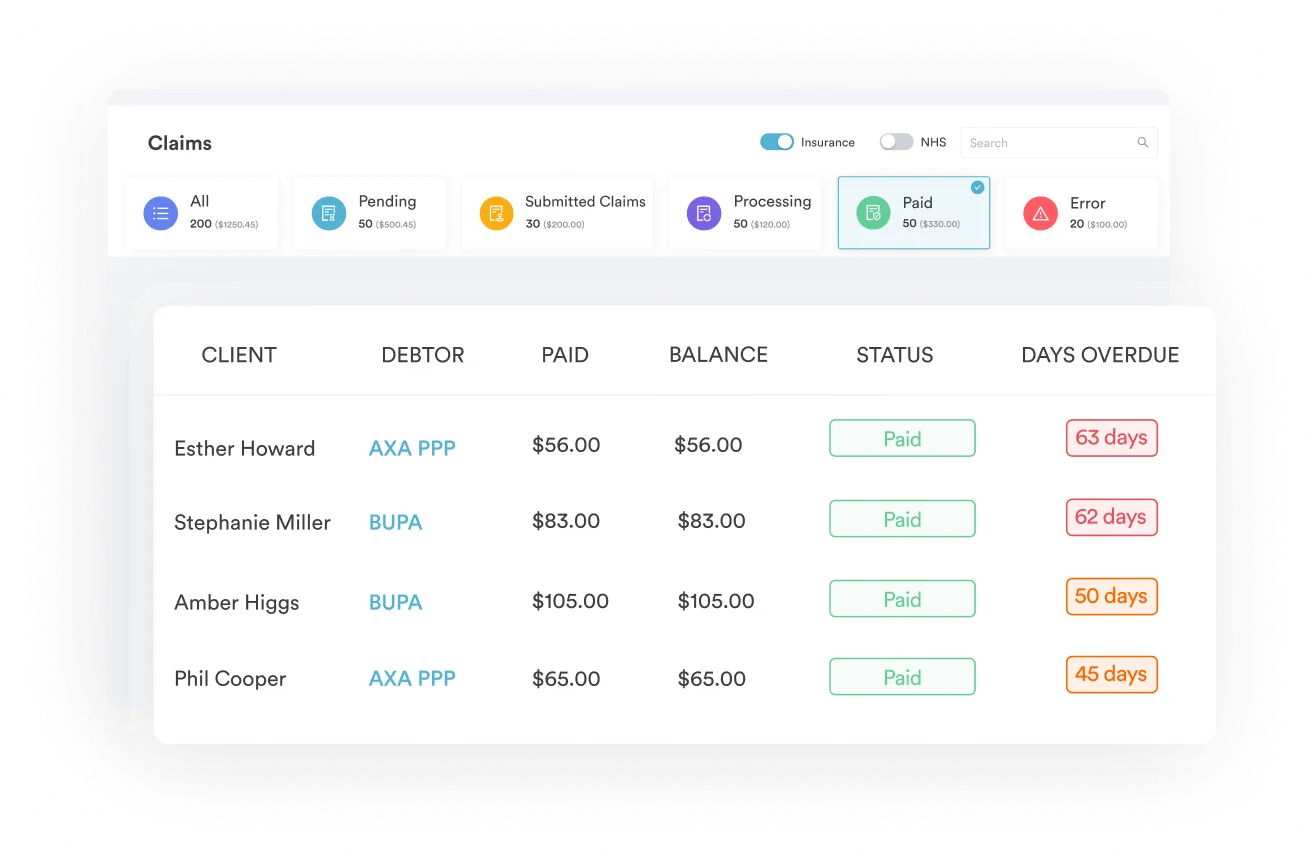

Pabau links authorization references, consent and procedure codes to each patient record. Your billing team prepares accurate CCSD claims for every fat transfer session and sends them through Healthcode.

B3018 rewards the practice that settles the code early. Decide between B3017, B3018 and B3020 when you request authorization, and make sure the surgeon’s note says what was revised. After that, treat each session as its own claim, with its own reference and date.
Get those steps right and most queries never happen. Skip them, and a straightforward revision can sit unpaid for weeks while notes and letters are chased.
Pabau holds the note, the authorization and the claim on one record, which suits staged procedures like this. Book a demo to see how it handles a multi-session fat transfer claim.

Billing an implant reconstruction instead? CCSD code B3015 covers reconstruction of breast using a fixed prosthesis, immediate or delayed.
Planning a two-stage implant reconstruction? CCSD code B3014 explains how expander-based breast reconstruction is coded and authorized.
Need the wider schedule? Pabau’s CCSD codes guide explains how the schedule works across UK private insurers.
Submitting to Bupa? Bupa CCSD codes covers Bupa’s code rules and authorization requirements.
Checking fees before you quote? Bupa procedure codes fee schedule shows how to confirm Bupa’s rates before a claim goes out.
Not usually, provided the notes link it to the original reconstruction. Most policies exclude cosmetic surgery, so a revision with no stated clinical reason can be declined. A consultant letter explaining what the session corrects keeps it within reconstructive cover.
Usually, but insurers differ on the format. Some want one claim line per side, while others accept a single line covering both. Confirm the format at authorization, and make sure laterality matches the operative note.
It depends on the policy. Some insurers cover a private revision after NHS treatment, while others apply pre-existing condition exclusions. Ask the insurer before booking, and include the NHS operation details in the authorization request.
Generally not. Insurers treat the fat harvest as part of the fat transfer procedure, so adding a liposuction code invites an unbundling query. Bill it separately only if the insurer agrees in writing.
No. CCSD codes are what UK private insurers use to pay consultants and hospitals. OPCS-4 codes classify procedures in hospital records. A hospital may record both, but the insurer claim needs the CCSD code.