CPT Code 69610: Tympanic membrane patch repair (myringoplasty)
CPT code 69610: official descriptor and procedure overview CPT code 69610 descri...

Last Updated: Oct 19, 2026
B3014 is the CCSD code for reconstruction of breast using expandable prosthesis, including delayed reconstruction. Surgeons use it when a tissue expander or adjustable implant rebuilds the breast in an operation that doesn't include the mastectomy. UK private insurers such as Bupa and AXA Health pay the surgeon's fee against it.
The key detail is timing. If the mastectomy happens in the same operation, the correct code is B3012, and a fixed implant points to B3015. The wrong choice gets the claim rejected or paid at the wrong fee. Below, you'll find what the fee includes, how prior authorization works, and where claims tend to fail.
Let Pabau's smart automation suggest the right codes, reduce claim denials, and keep your practice compliant—effortlessly.
Automate repetitive tasks and focus on what matters most—your patients.
Reduce coding errors and ensure compliance with the latest regulations.
Clean claims, fewer denials, and faster reimbursements.
Powerful insights and reporting to help your practice thrive.
HIPAA compliant SOC 2 certified GDPR-compliant Trusted by 4,000+ clinics worldwide

CCSD code B3014 covers breast reconstruction using an expandable prosthesis, including delayed reconstruction, when no mastectomy takes place in the same operation.
A mastectomy with immediate expander reconstruction is billed as B3012, and a fixed prosthesis points to B3015 instead.
Bupa, AXA Health, Vitality, and Aviva expect prior authorization before admission, and retrospective requests are routinely declined.
The implant, anesthetic fee, and theater charges are billed separately and never folded into the surgeon’s B3014 fee.
The operation note has to show reconstructive intent and the expandable prosthesis used, because insurers match the note against the code.
CCSD code B3014 is the procedure code for reconstruction of breast using expandable prosthesis, including delayed reconstruction. The consultant surgeon bills it when a tissue expander or adjustable implant rebuilds the breast in an operation without the mastectomy.
The code comes from the schedule maintained by the Clinical Coding and Schedule Development (CCSD) group. UK private insurers, including Bupa, AXA Health, Vitality, Aviva, and WPA, use it to process surgical claims. B3014 sits in Chapter 7 (Breast), under Reconstruction, in the Major complexity band.
Several neighbors in the CCSD codes library read almost the same. So check the full descriptor before you pick one.
Insurers match the code and its descriptor against the operation note, so quote the descriptor exactly instead of paraphrasing it.
CCSD also updates the schedule from time to time. Before you submit, confirm the current wording in the CCSD Technical Guide (updated October 2025).
B3014 pays the consultant surgeon for the reconstruction itself. The costs around it are billed separately. Knowing where that line falls prevents both underbilling and accidental overbilling.
Included within B3014:
Billed separately from B3014:
Misstating what B3014 includes is a common audit trigger. If an insurer’s fee schedule treats the code as a global surgical package, get that confirmed in writing before you submit. Surgeons used to NHS bundled tariffs are often caught out by this unbundled structure.
Choosing between neighboring breast codes is the most frequent cause of miscoding on these claims.
Two questions settle most cases. Was the mastectomy done in the same operation? And was the prosthesis expandable or fixed?
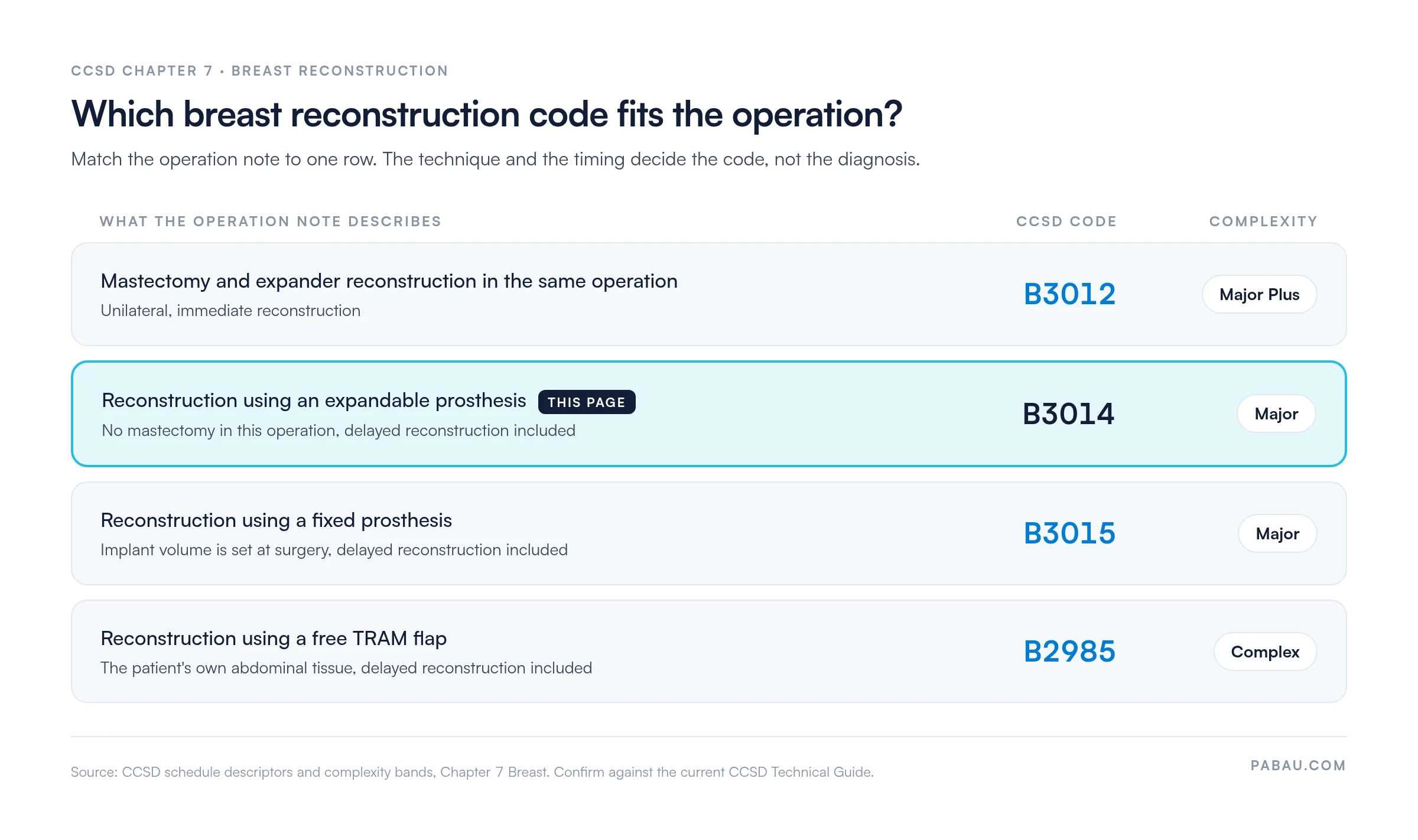
Two mistakes come up again and again. The first is billing B3015 when the operation note records an expander, or the reverse. The second is billing B3014 when the mastectomy happened in the same sitting, which belongs under B3012. Either error means the claim is rejected or paid at the wrong fee.
The technique used to rebuild the breast moves the claim elsewhere too. When a latissimus dorsi flap supports the implant, the episode is billed under B2913. When the surgeon rebuilds the breast with the patient’s own fat rather than a prosthesis, the code is B3017.
When the surgeon moves abdominal tissue on its own intact blood supply, the pedicled TRAM is billed under CCSD code B2984. The free TRAM version sits under B2985, in the Complex band.
When the note is unclear, call the insurer’s provider helpline before you submit, not after a denial. Bupa’s code search tool, linked in the insurer table below, also shows whether a fee has been set for each code.
Before billing B3014, check the insurer’s provider portal to confirm the fee has been set. Also confirm the code is active for the current schedule year. CCSD codes can be updated or retired in the annual schedule review without prior notice to practices.
Every major UK private insurer expects prior authorization for surgical breast reconstruction before the patient is admitted.
Retrospective authorization is almost never granted for elective surgery. As a result, a B3014 claim without a valid authorization reference is one of the fastest routes to rejection.
Surgeons moving from the NHS into private work often underestimate this step. In the NHS, clinical need drives admission. In private practice, the insurer’s authorization reference drives payment.
Record the authorization number in the patient record as soon as it arrives. That way it’s ready at submission, even when weeks pass between surgery and billing.
Insurers can request clinical records to validate any claim, and high-value reconstructive procedures draw more of those requests. A documentation routine set up before the operation saves hours of chasing afterward.
Before you submit, check that the patient file holds these five documents:
Word the indication clearly, too. If the note reads like cosmetic surgery, Bupa and AXA Health may decline the claim as outside the policy.
Keeping all five documents in one patient record, linked to the claim, is the most reliable way to answer an evidence request quickly.
Most UK private insurer claims go through Healthcode’s ePractice platform, which connects consultant practices to Bupa, AXA Health, Vitality, and other major payers. Claims prepared while the episode is still fresh tend to go out with fewer errors.
Denial patterns on breast reconstruction claims are consistent across insurers. Most trace back to authorization, code selection, or documentation, rather than disputes about clinical need.
Knowing the patterns in advance costs far less than chasing appeals:
If a claim is denied, ask for the insurer’s written reason code before you appeal. Appeals that don’t address the specific reason rarely succeed.
Set a billing diary reminder for 30 days after every B3014 submission. If no payment or query letter has arrived by then, call the insurer’s provider helpline. Confirm they received the claim and are processing it. Chasing early stops claims from aging beyond the appeal window.
Breast reconstruction is almost always a multi-party claim. The consultant surgeon bills B3014, while the anesthetist bills their own CCSD fee. The hospital then bills theater and recovery time. Each party submits a separate claim against the same authorization number.
Each party bills only its own element. The surgeon doesn’t bill the anesthetic fee, and the hospital doesn’t bill the operative fee. Insurers cross-check all three claims against the one authorization number and query any overlap, and duplicate billing can trigger a fraud investigation.
In many surgical practices, the authorization number lives in an email and the consent form in a scanned PDF. The claim itself sits in a separate billing portal. Each handoff is another chance to mistype a membership number or lose the reference.
Practice management software like Pabau keeps those pieces in one patient record. Its claims management software pre-fills the claim from that record. It also checks required fields, such as membership and authorization numbers, before you can send.
For UK insurers, claims go straight to Healthcode, so you can track their status without leaving the system. The payoff is fewer rejections for missing details and faster answers when an insurer asks for evidence.
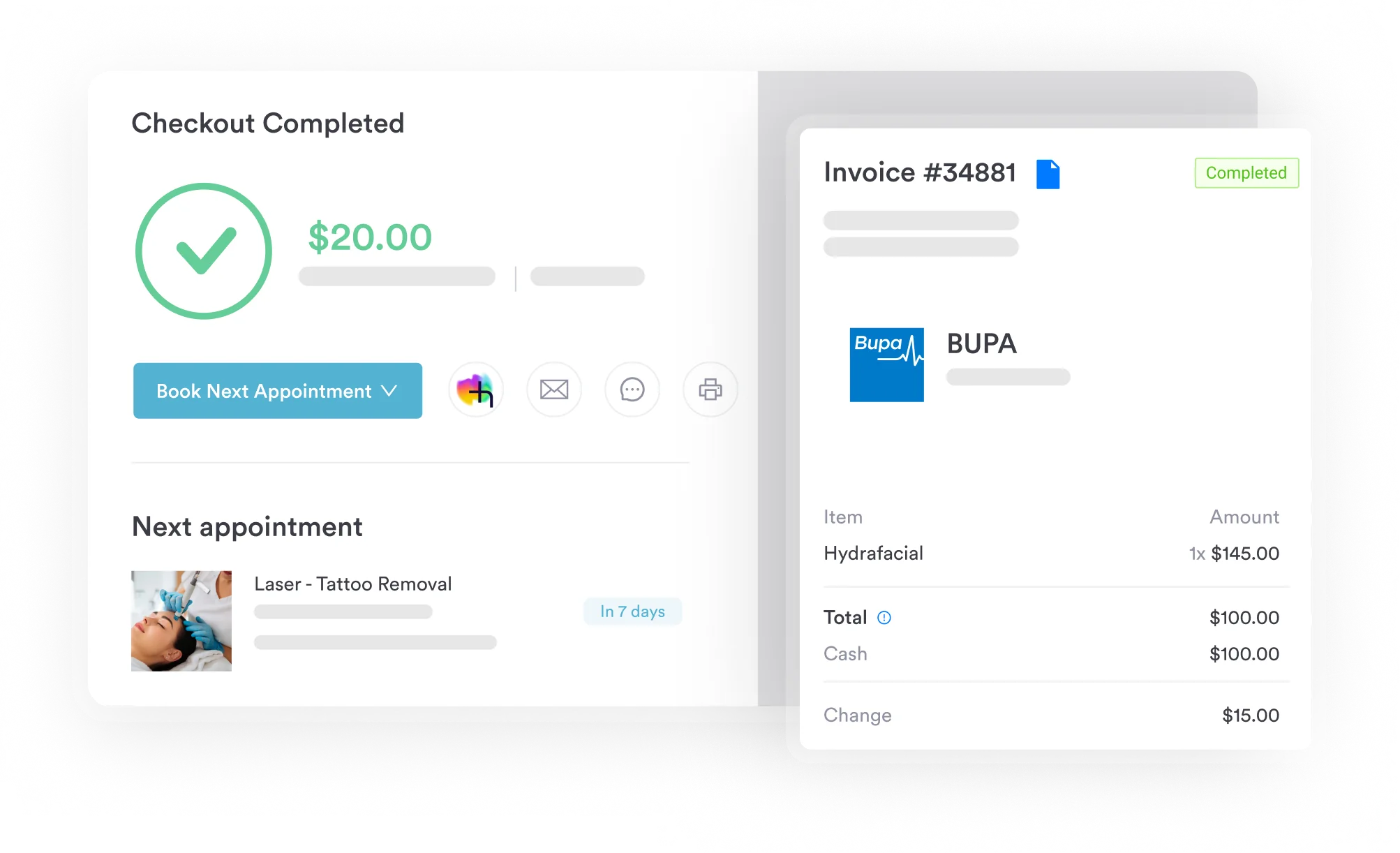

Pabau keeps consent forms, authorization numbers, and CCSD claims in one patient record. Your team can submit complete claims to Healthcode without chasing paperwork across systems.

B3014 is a narrow code. It pays for expander-based reconstruction on its own, so the first check is always whether the mastectomy happened in the same operation. Confirm that, make sure the operation note names the expander, and most coding queries never arise.
After that, the work is about sequence. Secure authorization before admission and keep the implant, anesthetic, and facility fees off the surgeon’s claim. Then submit well inside the insurer’s window.
If your team still assembles claims from emails and spreadsheets, a single patient record removes most of that risk. Book a demo to see how Pabau carries a reconstruction case from signed consent to a submitted Healthcode claim.

Coding a fixed implant instead? CCSD code B3015 covers reconstruction using a fixed prosthesis, the code most often confused with B3014.
Was the mastectomy in the same operation? CCSD code B3012 explains billing for mastectomy with immediate expander reconstruction.
Using a flap rather than an implant? CCSD code B2985 walks through free TRAM flap reconstruction and its Complex band.
Need a complete Bupa CCSD code reference? Bupa CCSD code schedule covers the codes Bupa recognizes, with guidance on submission.
Checking fees across Bupa codes? Bupa procedure fee schedule gives a structured reference for fees across Bupa-recognized CCSD codes.
An expandable prosthesis is a tissue expander or implant whose volume can be increased after surgery. The surgeon fills it with saline over several outpatient visits, which gradually stretches the skin. Some devices are later swapped for a permanent implant, while adjustable implants can stay in place.
Yes. B3014 applies whether the reconstruction happens soon after a mastectomy or months or years later. What matters is that the mastectomy isn’t part of the same operation. That combination is billed as B3012 instead.
Often, yes, but the policy wording decides. Cover depends on the reason for surgery and on any exclusions in the patient’s plan. Check the patient’s benefits during pre-authorization, and flag any limits before the surgery date is confirmed.
CCSD places each procedure in a complexity band, such as Intermediate, Major, or Complex. Insurers and hospitals use the band as a guide when benchmarking fees and facility charges. B3014 sits in the Major band, the same as B3015, while B3012 is Major Plus.