HCPCS code E0280: Bed cradle Medicare billing guide
HCPCS code E0280 describes the cradle frame, not the bed HCPCS code E0280 is the...

Last Updated: Oct 15, 2026
B3015 is the CCSD code for reconstruction of breast using fixed prosthesis, including delayed reconstruction. It covers insertion of a permanent, non-expandable silicone implant in a single operative stage. The same code applies whether the implant goes in at the time of mastectomy or months later.
B3015 sits in Chapter 7, Breast, of the CCSD schedule and pays the surgeon's fee only. The prosthesis itself is agreed and billed separately with the insurer.
Let Pabau's smart automation suggest the right codes, reduce claim denials, and keep your practice compliant—effortlessly.
Automate repetitive tasks and focus on what matters most—your patients.
Reduce coding errors and ensure compliance with the latest regulations.
Clean claims, fewer denials, and faster reimbursements.
Powerful insights and reporting to help your practice thrive.
HIPAA compliant SOC 2 certified GDPR-compliant Trusted by 4,000+ clinics worldwide

CCSD code B3015 covers breast reconstruction with a fixed, non-expandable prosthesis, whether immediate or delayed.
The phrase ‘including delayed reconstruction’ in the descriptor means one code covers both timing scenarios.
Pre-authorization from Bupa, AXA Health, and Vitality is required before the procedure in almost every case.
The prosthesis device cost is not bundled into B3015 and must be agreed separately with the insurer.
Pabau supports CCSD code lookup and claim preparation before submission to Healthcode.
CCSD code B3015 is defined by the Clinical Coding and Schedule Development (CCSD) Group as: Reconstruction of breast using fixed prosthesis (including delayed reconstruction). It sits in Chapter 7, Breast, of the CCSD fee schedule. That schedule is the coding standard used across all major UK private medical insurance (PMI) providers, including Bupa, AXA Health, Vitality Health, WPA, and Aviva.
The key clinical qualifier in this descriptor is “fixed prosthesis.” This distinguishes B3015 from codes covering tissue expanders or multi-stage implant exchange procedures. A fixed prosthesis is a permanent, non-expandable silicone implant inserted in a single operative stage. Once placed, it is not inflated or exchanged as part of the reconstruction pathway coded here.
The parenthetical “(including delayed reconstruction)” confirms that B3015 applies in both timings. It covers the implant inserted at the time of mastectomy and the one inserted later as a staged procedure. Coders do not need a separate code for the delayed scenario. Timing changes the documentation and billing context, but the procedure code itself remains B3015.
Breast reconstruction using a fixed prosthesis creates a breast mound with a permanent silicone implant. The implant sits beneath the pectoralis major muscle or in a pre-pectoral plane. The procedure is performed by a consultant plastic or oncoplastic surgeon in a hospital setting. Billing teams reviewing these claims need to recognize the surgical scope in the operative note before they code it.
The main clinical scenarios covered by B3015 are:
The NICE guideline NG101 on breast reconstruction following breast cancer treatment is referenced by insurers when they assess medical necessity. It supports both immediate and delayed implant-based reconstruction where that is clinically appropriate.
Both immediate and delayed scenarios use CCSD code B3015 for the reconstructive procedure itself. What changes between them is the billing context. That means the companion codes on the claim, the ICD-10 diagnosis codes, the authorization episode, and the documentation the insurer expects.
For delayed cases where the mastectomy was performed on the NHS, confirm the insurer’s position on NHS-to-private pathway continuity. Some PMI providers want written confirmation that the private consultant has reviewed the original diagnosis and treatment pathway before they authorize the reconstruction episode.
CCSD code B3015 rarely appears alone on a claim. The codes below are those most frequently billed on the same invoice or within the same authorized episode. Verify companion code rules against current insurer schedules, as bundling policies vary by PMI provider.
Anesthetic fees on a B3015 case are always submitted separately, on the anesthetist’s own invoice. Surgeons should not include them within their own B3015 claim.
Chapter 7 of the CCSD schedule contains several codes that describe different reconstruction techniques. Selecting the wrong one is the most common coding error on B3015 claims. The differentiator is always the reconstructive method used: fixed implant, tissue expander, autologous flap, or a later volume adjustment. Check the descriptor in the current CCSD code schedule before you assign a code.
The most frequent coding error is billing B3015 when the operative note describes placement of a tissue expander. B3014 is the correct code in that case. Billing a fixed prosthesis code for an expander insertion is caught on clinical review by the insurer’s medical assessors. The result is a denial, or a request for supporting documentation. Always confirm from the operative note that the device inserted is described as fixed or permanent.
The same check applies to the other reconstructive methods. A latissimus dorsi flap with implant placement is coded B2913, not B3015. A breast rebuilt with the patient’s own transferred fat is coded B3017.
A breast rebuilt with a pedicled TRAM flap from the abdomen is coded B2984, not B3015. The flap is based on the rectus muscle, and the primary reconstruction uses no implant.
Check the operative note for the words ‘fixed’, ‘permanent’, or the specific implant brand and size before assigning B3015. If the note describes ‘expander’ or ‘temporary device’, stop: B3014 applies instead. A two-minute documentation check prevents a denial that takes weeks to resolve.
Incomplete documentation is the leading cause of B3015 claim denials. Insurers assess these claims against their internal medical necessity criteria and against the clinical record provided. The operative note is the foundation, and every other document supports it.
The minimum documentation set for a B3015 claim is:
An operative note template with structured fields for implant type, plane of placement, and device identifiers removes most of the ambiguity that triggers insurer queries. Capturing those details at the point of care also cuts the administrative time spent answering requests for clarification after submission.
Authorization is required for B3015 by all major UK PMI providers. Bupa, AXA Health, and Vitality Health all classify breast reconstruction as a major elective surgical procedure. All three require authorization before the procedure takes place. Retrospective requests are rarely approved. The Bupa CCSD codes guide sets out the Bupa-specific code and authorization requirements.
The process differs slightly by insurer, but the clinical evidence set is broadly consistent:
Authorization references have episode windows. Confirm the window length with the insurer at the point of authorization, and make sure the procedure takes place inside it. If the date moves because of patient fitness or scheduling, apply for an extension before the window expires rather than after.
Build authorization tracking into the practice management system so that no B3015 procedure is booked without a valid reference already on file. A booking made ahead of the authorization is the single easiest denial to prevent.
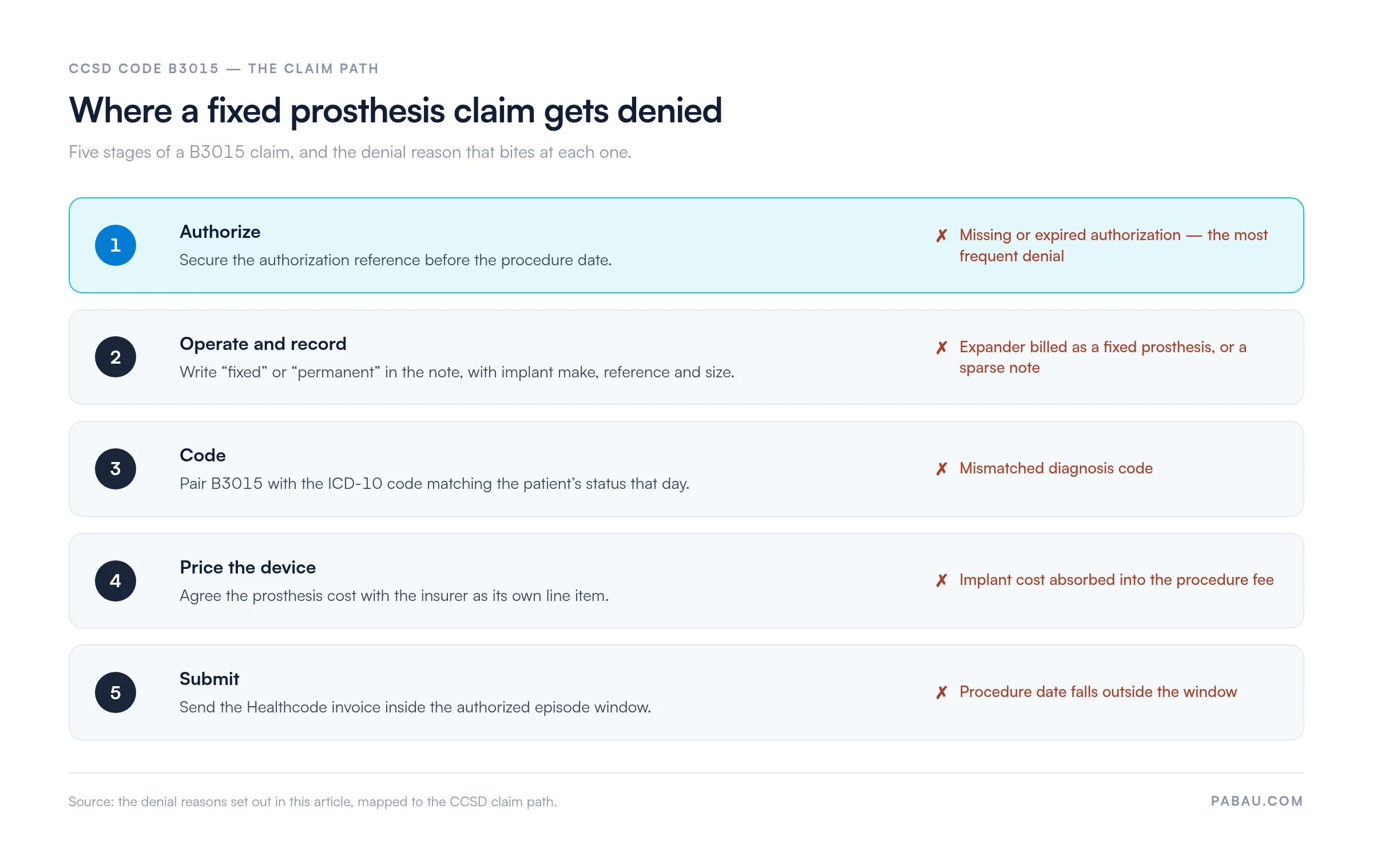
B3015 denials follow predictable patterns, and each one bites at a specific point in the claim’s path. Addressing them in order lets a billing team fix the risk before submission rather than after rejection.
Mapped onto the claim’s path, those six reasons resolve into five checkpoints between authorization and submission:
CCSD code B3015 covers the surgical procedure fee only. The prosthesis device cost is not bundled into it and must be agreed separately with the insurer. This is the most commonly misunderstood part of fixed prosthesis billing, and recovering the implant cost the wrong way is a denial risk.
That split is not unique to breast codes. Insertion of a voice prosthesis is billed under CCSD code E4100, and there too the device is invoiced apart from the surgeon’s fee.
The implant cost recovery process works as follows:
Verify the implant cost recovery pathway with each insurer before the procedure date, not after. Policies change, and what Bupa accepted in a previous episode may need renegotiating under current provider agreements.
Healthcode is the primary electronic invoicing platform for UK private medical billing. Most consultants and private hospitals use it to submit claims to Bupa, AXA Health, Vitality, and other PMI providers. Submitting B3015 through it follows a structured workflow that mirrors the insurer’s authorization requirements.
The standard Healthcode submission steps for B3015 are:
Re-keying the code, the authorization reference, and the diagnosis code by hand is where most submission errors start. Holding the clinical record and the billing workflow in one system removes that step entirely.
Breast reconstruction using a fixed prosthesis takes place in registered private hospital settings in England. The Care Quality Commission regulates those settings under the Health and Social Care Act 2008. Scotland, Wales, and Northern Ireland have separate oversight for private healthcare, so provider obligations differ by nation. None of this changes how B3015 is coded, but it does affect the facility details an insurer expects to see on the authorization record.
Private Healthcare Information Network (PHIN) transparency reporting applies to private hospitals in England, and procedures coded under B3015 may fall within its scope. Consultants and hospitals should confirm their reporting obligations with the hospital’s compliance team. The CCSD technical guide sets out the business rules governing code structure, unbundling, and co-billing across the schedule.
Most UK private billing teams assemble a B3015 claim from three places. The operative note sits in the clinical system, the authorization reference in a spreadsheet, and the invoice in the Healthcode portal. Every detail that decides whether the claim clears has to be copied across by hand.
Practice management software like Pabau keeps those details on one patient record. The operative note, the implant manufacturer and reference number, the authorization reference, and the CCSD code all live together. Billing staff prepare and review the claim there, then send it to Healthcode with nothing re-typed.
That matters most on the fields B3015 claims fail on. Billing teams who want faster claims management get the authorization reference, its expiry date, and the procedure code on one screen. A window that has already closed shows up before the invoice leaves the practice, not six weeks later in a denial letter.

Pabau supports CCSD code lookup, authorization tracking, and claim preparation before submission to Healthcode. See how UK billing teams cut submission errors and speed up payment recovery.

Getting B3015 right comes down to three things. The operative note has to confirm a fixed prosthesis. The authorization reference has to be valid and in window, and the diagnosis code has to match the clinical scenario. When all three line up, the claim clears. When one is missing, the denial is close to certain and the resolution is slow.
Notice how little of that can be fixed at submission. Four of the five checkpoints are already decided by the time the invoice is written. The work that protects a B3015 claim happens in the weeks before it, not in the minutes before you press send.
Pabau gives UK private billing teams one workflow for CCSD code selection, authorization tracking, and claim preparation. Errors surface before the invoice goes out rather than weeks after a denial. Book a demo to see how that works on a breast reconstruction claim.

Need the full Bupa procedure code schedule? Bupa CCSD codes guide covers the code and authorization requirements Bupa applies to UK private practitioners.
Billing a mastectomy and reconstruction on one claim? CCSD code B3012 covers mastectomy with immediate expandable prosthesis reconstruction, unilateral.
Coding an autologous reconstruction instead? CCSD code B2985 covers free TRAM flap reconstruction, where no implant is used.
Working through a rejected invoice? Denial codes in medical billing explains what each rejection code means and how to respond to it.
CCSD code B3015 is the UK private medical insurance procedure code for reconstruction of the breast using a fixed, non-expandable prosthesis. It includes cases where reconstruction is performed as a delayed procedure after a prior mastectomy. It covers the surgeon’s fee for the reconstructive procedure only, so the implant device cost and the anesthetist fee are billed separately.
Both scenarios use B3015 for the reconstruction itself. The differences are in the companion codes and the diagnosis coding. Immediate reconstruction typically uses a C50.x active malignancy code and appears on the same claim as a mastectomy code. Delayed reconstruction uses Z42.1 and is submitted as a standalone episode with its own authorization reference.
No. B3015 covers the surgical procedure fee only. The prosthesis device cost must be agreed and billed separately with the insurer, or invoiced directly to the patient, depending on the funding arrangement. Including the implant cost inside the B3015 procedural fee without a separate insurer agreement is a denial risk.
B3014 covers breast reconstruction using a tissue expander, a temporary inflatable device placed as the first stage of a two-stage reconstruction. B3015 covers insertion of a fixed permanent implant in a single stage. If the operative note describes an expander, B3014 applies. If it describes a fixed or permanent implant, B3015 applies. Confusing the two is the most common coding error in this procedure group.
The most frequent reasons are a missing or expired authorization reference and the wrong code selected. Others are an incomplete operative note lacking implant type and device identifiers, a mismatched ICD-10 diagnosis code, and billing outside the authorized episode window. Each one can be addressed through a pre-submission checklist before the claim is dispatched to Healthcode.
Yes. Authorization is required before the procedure takes place with all major UK PMI providers, including Bupa, AXA Health, and Vitality Health. Retrospective authorization requests are rarely approved. Confirm the requirements and the episode window length directly with each insurer before booking, as policies change.